Every now and then you see a piece of advertising genius. I know it’s not completely new, but I love the style and sentiment in this ad for Twinings Tea (I am clearly feeling soppy after a long day!):

Every now and then you see a piece of advertising genius. I know it’s not completely new, but I love the style and sentiment in this ad for Twinings Tea (I am clearly feeling soppy after a long day!):
You may or may not be familiar with the amusingly odd website Will It Blend? Basically, the website’s title says it all.
You may also remember that I have previously blogged about my irrational dislike of all things Apple. Such a cathartic moment, then, to discover that the folks at Will It Blend? have decided to apply themselves to the iPhone.
Enjoy!
Vodpod videos no longer available.
Small birds bounce back
31 March 2011
Over 600,000 people took part in this year’s RSPB Big Garden Birdwatch, a record breaking number watching their garden birds.
And their counts revealed that some of the smaller birds that decreased in numbers last year, bounced back this year.
Sightings of goldcrests, the UK’s smallest birds, doubled, long tailed tits increased by a third and coal tits increased by a quarter.
The long, harsh winter of 2009/2010 hit birds like long-tailed tits, goldcrests and coal tits with all three species dropping significantly in last years’ Big Garden Birdwatch.
Although smaller birds can be particularly badly affected by harsh winters, a good breeding season can help reverse declines, and these new results suggest that may have been the case in 2010.
Thousands of people were also lucky enough to see waxwings.
The striking birds flood to the UK from Scandinavia every few winters and this year saw an influx, known as a ‘waxwing winter.’
Waxwings are bold birds that are comfortable feeding around our towns and cities, and over 7,000 were counted in this year’s survey, in almost 1,000 gardens.
Big Garden Birdwatch Co-ordinator Sarah Kelly says: ‘It’s fantastic that so many people stepped up for nature by taking part. We were really interested to see how the small birds fared, after such a disastrous last year. It appears that many may have had a decent breeding season and have been able to bounce back a little.
‘But we mustn’t be complacent –another hard winter could see numbers back down so it’s important everyone continues to feed their garden birds.’
RSPB Scientist Mark Eaton says: ‘We knew this was going to be a bumper year for waxwings as we’d had so many reports from all over the UK.
‘But the Big Garden Birdwatch is the first indicator of exactly how many were seen in gardens, and we’re pleased that so many people got to enjoy sightings of these beautiful birds.
‘They’d only come into gardens if the right food was available to them. They feed on berries so it shows that lots of people are planting the right things for wildlife and reaping the rewards.’
609,177 people counted 10.2 million birds
A total of 609,177 people counted over 10.2 million birds. Over 70 species were recorded in 300,780 gardens across the UK over the weekend 29-30 January.
Starlings and blackbirds have swapped positions on this year’s leader board, with starlings now at number two and blackbirds at number 3.
Starling sightings have increased by a quarter since last year, but their numbers are still down from when Big Garden Birdwatch began in 1979.
The house sparrow retained its top spot for the eight year running with an average of four seen per garden, and has increased by 10 per cent.
Numbers of blue tits increased by 22 per cent and great tit numbers were up by 12 per cent.
Almost 90,000 school children and teachers took part in the schools version of the survey, ‘Big Schools’ Birdwatch.’ The UK-wide survey of wildlife in schools, which celebrated its 10th birthday this year, introduces thousands of children to the wildlife visiting their school environment.
Nearly 3,000 classes from more than 2,000 schools were involved, which was also a record-breaking number for the survey. 87% of schools taking part reported seeing blackbirds, with an average of five being seen at each school, making it the most common visitor to school grounds.
From the RSPB.
Last night I stumbled across one of the most inspirational and best-presented documentaries I’ve seen in years. Typically it was on in the middle of the night and a brief summary (a history of statistics presented by a Swedish professor) might make you think it was one from the early canon of Open University spectaculars.
However, Professor Hans Rosling is one of the most exciting and engaging presenters I’ve seen on television in a long time. After a long day in the office, his quirky, amusing and insightful jaunt through the past, present and possible future of statistics was gripping. If you missed it, you can look at The Joy of Statistics on BBC iPlayer.
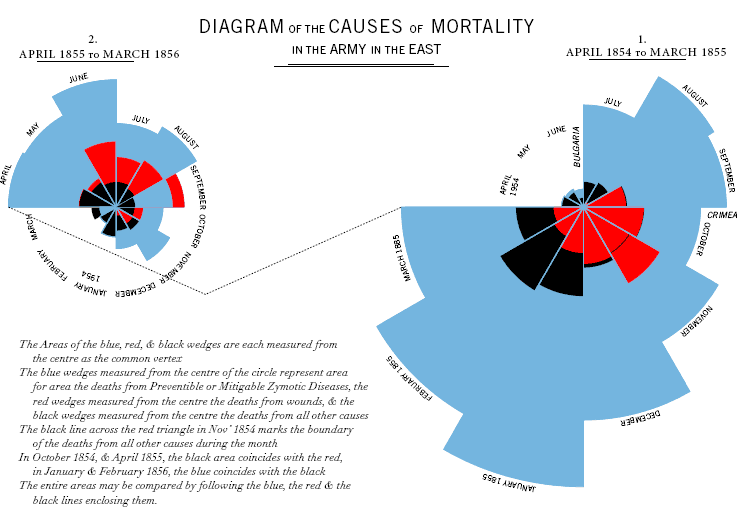
One of the most engaging aspects was his demonstration of how the stories of numbers are often best told through visual depiction.
For instance, I had no idea that Florence Nightingale was a statistician. It was her meticulous record-keeping translated into startling pictures that drove the changes in nursing that she instituted:
Over a hundred years later, people like David Mccandless make their living finding ways to translate complex information into more readily understandable pictorial form. On his Information Is Beautiful blog he finds different and exciting visualisations of statistical data. The Billion-pound-o-gram is his way of making those mad, large numbers more comprehensible:

Perhaps the most spectacular use of animation was Professor Rosling’s depiction of the progress of countries in terms of their life expectancy and their income. His enthusiasm, love and knowledge are a real joy to behold. To really see a story told in numbers, watch this little snippet below:
Vodpod videos no longer available.
I have an eclectic musical taste that roams the genres and I can find myself listening to anything from Finzi and Mozart, to Counting Crows, The Jayhawks, Guns N’Roses, Linkin Park and Sick Puppies, all via the Pet Shop Boys, “Ibiza dance” and Lady Ga Ga. Not forgetting of course Led Zeppelin, U2, Nightwish, The Village People etc etc…
Nothing gets to me though quite like John Denver and there is one album in particular that defines him for me: Poems, Prayers and Promises.
It was his fourth album and every song is an acoustic musical masterpiece (except “The Box”, Kendrew Lascelles’s stunning anti-war poem, read with genuine agony by Denver on the last track of side two). His beautiful tenor soars and swoops, occasionally tinged with a spine-tingling melancholy, and the lyrics are homely, humbling and thought-provoking without being trite.
Perhaps it is because it is the first non-classical record I heard Mum and Dad play that it means so much to me. Perhaps it is because it conjures safe memories of lying on the carpet in pools of dappled sunlight, thinking that days like that could never end. Perhaps it is because it has been the soundtrack to many a long car journey to Cornwall. Or perhaps it is because its calm simplicity lets me find my centre, even in the hardest times.
John Denver died in 1997. What a beautiful legacy to leave.
From “Poems, Prayers and Promises”
The days they pass so quickly now
Nights are seldom long
And time around me whispers when it’s cold
The changes somehow frighten me
Still I have to smile
It turns me on to think of growing old
For though my life’s been good to me
There’s still so much to do
So many things my mind has never known
I’d like to raise a family
I’d like to sail away
And dance across the mountains on the moon
I have to say it now
It’s been a good life all in all
It’s really fine
To have the chance to hang around
And lie there by the fire
And watch the evening tire
While all my friends and my old lady
Sit and watch the sun go down
And talk of poems and prayers and promises
And things that we believe in
How sweet it is to love someone
How right it is to care
How long it’s been since yesterday
What about tomorrow
What about our dreams
And all the memories we share
Vodpod videos no longer available.
Lego was always a favourite toy.
Spaceships, towns, castles… But I never got quite as creative as the Russian who has mixed Lego with the online game Team Fortress 2 and stop-motion animation to create an ultra-violent tribute to one of gaming’s most popular online shooters.
As a gamer, a film enthusiast and a Lego lover of old, this is great. Complete with menacing Russian narration.
Vodpod videos no longer available.
My future brother-in-law, Mr Bagnall, reminded me of one television programme that must be one of my all-time favourite childhood memories. Who could have thought that a five minute short animation of the simplest kind could create such a comforting sense of timelessness?
When so many of today’s children’s programmes are such a disruptive mess of loud music, rudeness, primary colours and inane bouncing around, the undramatic stories of The Merioneth and Llantisilly Rail Traction Company Limited, that recognise children are capable of being entertained in far quieter, more thoughtful ways, seem almost revolutionary.
Please give a big hand for Ivor the Engine.
Vodpod videos no longer available.
 In 1992, the United Nations designated March 22nd as the World Day for Water in Resolution 193 of the Forty-seventh Session of the General Assembly.
The World Day for Water was first proposed in Agenda 21 for the 1992 Rio Summit, the meeting that hugely raised awareness of the role of local government and local communities in tackling global environmental and climate issues.
Since 1993 the day has been observed consistently, drawing attention to the plight of the estimated one billion people plus who each year have to rely on dangerous sources of water to survive.
Having travelled a little in India and Africa, turning on a tap and being able to drink a handful of clean, cold water is still something for which I am profoundly grateful. Whilst it is easy to take it for granted, when I think about it I can’t begin to imagine what it would be like not to have it.
A year or so ago we had a small taste of what it was like to lose our mains supply for just a few hours. The sense of worry as you wonder when you might be able to wash clothes or make drinks again is out of all proportion to the scale of a relatively small inconvenience. It does, however, cause you to pause and consider how it would be to have to walk miles a day to a potentially polluted stream and draw water you’d be uncomfortable watering the garden with.
The IRC International Water and Sanitation Centre reports the stark analysis of the World Health Organization:
Each year more than 1 billion of our fellow human beings have little choice but to resort to using potentially harmful sources of water. This perpetuates a silent humanitarian crisis that kills some 3900 children every day and thwarts progress towards achieving the Millennium Development Goals (MDGs). The consequences of our collective failure to tackle this problem are the dimmed prospects for the billions of people locked in a cycle of poverty and disease.
The root of this underlying catastrophe lies in these plain, grim facts: 4 of every 10 people in the world do not have access to even a simple pit latrine and nearly 2 in 10 have no source of safe drinking-water.
Thankfully, the appalling situation is not something that the UN/WHO are prepared to see continue:
To help end this appalling state of affairs, the MDGs include a specific target (number 10) to cut in half, by 2015 the proportion of people without sustainable access to safe drinking-water and basic sanitation. In addition, the UN Millennium Project Task Force on Water and Sanitation recently recognized that integrated development and management of water resources are crucial to the success or failure of all the MDGs, as water is central to the livelihood systems of the poor.
Among the more innovative ideas for drawing water to the surface, one particularly caught my attention, marrying the desperate need for fresh water to a completely different and endless resource: the playful, optimistic energy of children.
Water for People provides a very clear explanation of how these amazing inventions work:
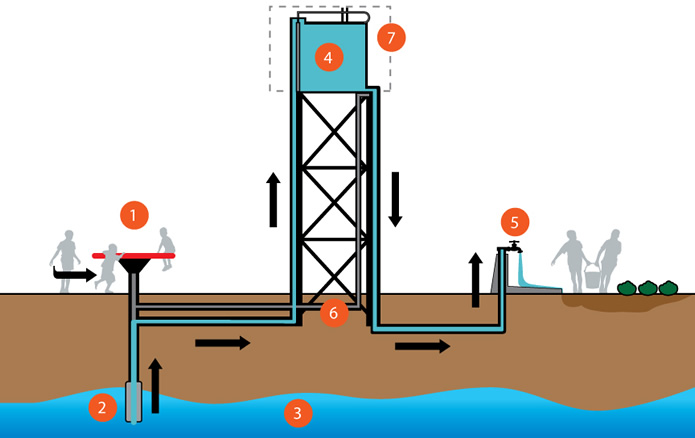
Innovations such as this, which show the application of creative, lateral thinking, create a real hope that the challenge of providing clean water can be met. Days such as the World Day for Water play a crucial part in alerting all of us to the need to act sooner – not later.
The video below, again from Water for People, is quite uplifting.
Vodpod videos no longer available.
Finally, by way of a footnote, I clearly should have written this yesterday – but being tired after a long day I didn’t. So my apologies for lateness (something I seem to do far too often).
There’ll be plenty of people of my generation (mainly men with nerdy secrets I suspect) who, notwithstanding the CGI wonders of Michael Bay’s special effects-fest, have a special fondness for the animated series of Transformers and the tinny beep of “Tranformers Robots in Disguise” over the dark thunderings of Linkin Park’s “New Divide” (I imagine my younger brother Seth is among them!).
Very amusing then to open Metro this morning and to see a story about Drew Beummier, a contestant on American Idol, who has discovered that “chicks find it sexy” when he wears his home-made Transformer suit.
Apart from wondering if Em thinks I’ve missed a trick somewhere along the line, I do wonder if this is taking fond childhood memories a step too far?
Anyway, he’s hoping to have the suits on sale in the UK soon…
Each morning the C2C trains trundle into London, beginning their journey in Shoeburyness, the end of the line that lies in close proximity to the secrecy-shrouded MOD facilities of the tidal island of Foulness. One hour and ten minutes later they arrive in Fenchurch Street, the oft-forgotten commuter terminal for East Essex that hides between the contradiction of gleaming office blocks and ramshackle reminders of older, darker London such as the East India Arms.
These trains pass through the seaside excitements of Southend, on past the old-now-fashionable fishing town of Leigh and then through the connurbation of Pitsea, which, with the closure of the Motorboat Museum, has almost lost its struggle to retain a sense of its own maritime connections. From Pitsea the journey enters the sprawl of Basildon, the brash young upstart neighbour of both Pitsea and Laindon, both of which were the principal local urban centres prior to the Whitehall social laboratory experiment which was the New Towns Act 1946.
Between Laindon and the sleepiness of West Horndon lies my favourite part of my daily commute: the Bulphan Fen.
Yes, I love the bleak industrial landscape of the detours via the loop line, forced on weary travellers by endless engineering works: the vast and towering complexes of Dagenham; the faded, crumbling decay of Tilbury’s dockside menace; and the empty mystery of Purfleet and its invisible military history. Yes, I love, too, the changing landscape of East London, where clean, proud new build sits between the higgledy-piggledy tangle of scrap-yards, brick-arch businesses and the shells of now-forgotten commercial giants of Britain’s imperial past.
However, for me, nothing touches the vast, rural emptiness of the Bulphan Fen for its capacity to reassure, by reminding me I have truly left the loud metropolitan chaos of the city behind me. Perhaps it is because it is the stretch I have travelled for more years than any other, the daily schoolboy journey to Upminster a daily and extravagant adventure that took me far from the country comfort of Langdon Hills. Whatever the reason, nothing gives me the calm reassurance of the prospect of home as much as this small stretch of a rural England that is quickly vanishing.
In Summer, the setting sun casts long, warm shadows that stretch from field to field, heralding barbecue-weekends, the easy company of family sharing a glass or two under the reaches of the old vine and the wistful strains of Finzi or Vaughn-Williams teasing our souls with the melancholia of English poems and promises.
In Autumn, tendrils of mist snake between the trees and hang low in the fields. They lend the landscape an ethereal shroud worthy of Tolkein that disguises agricultural purpose and hides the pylon sentinels in their silent vigil over this corner of South Essex.
In Winter, icy frosts glitter on earth as hard as iron. These last two years such frosts foretold the blizzards which saw our landscape reborn white and pristine, the dangers of broken road and path buried by snows that harbour their own cruelties and hazards.
And in today’s Spring morning, green fields sparkled with dew under cloudless blue skies and commuters burred quietly with refreshing wonder about the sunshine, its bold appearance vanquishing the greyness of February’s dying season.
I love the Bulphan Fen – and its enduring promise of home.
 Fragments and Reflections