Regardless of the truth of the bullying allegations surrounding Brown and Number 10, they appear to be creating an even less savoury picture of goings on with our friends in the international community.
Apple Daily runs an online news channel called Next Media that, instead of using actors, animates its newscasts in order to make them more exciting. Launching simultaneously on 26 November 2009 in Taiwan and Hong Kong, it quickly courted controversy with parents complaining about explicit, erotic and violent content. If you are interested, Media, the marketing and communications newspaper for Asia-Pacific carries an interesting article on the rows surrounding Apple Daily on its website.
In any event, the sales-boosting bullying furore around Rawnsley’s new book, The End of the Party, has clearly attracted attention in the Asia-Pacific region and has made its way into the most extraordinary news bulletin I’ve yet seen on the matter:
It is difficult to know quite what to make of the provocative way in which Next Media presents current affairs. Suffice to say that their coverage of the bizarre legal dispute in Colarado over who owns the head of Mary Robbins (the Robbins family or Arizona’s Alcor Life Extension Foundation) suggests they like to sensationalise sensational stories.
At dinner last night, we talked about the way that the experience of war imprints itself on the experiences of individuals and societies differently, according to the war and the immediacy of its domestic impact.
Reflecting on that conversation, it struck me that growing up with the threat of Mutually Assured Destruction hanging over us left its own imprints. Less immediately dramatic, perhaps, than the years of evacuation, rationing and lights out of World War Two, but no less terrifying in its own insidious way, the Cold Waroffered plenty of sleepless nights to this over-active imagination.
I remember panicking when we were told that total annihilation was just four minutes away. Whenever the sirens were tested I found myself wondering if the radar I now know was based at Jodrel Bank had picked up inbound enemy missiles that would destroy my school and my family and the small world of Langdon Hills that I inhabited. I imagined Soviet tanks trundling through my childhood stamping ground of the Fränkische Schweizand rolling across Western Europe, destroying everything in their path.
Television films like Threads and the Day Afterdepicted the horrors of a nuclear Armageddon in chilling detail. I remember lying awake for nights, terrified of what would happen.
I also remember taking the bus to Romford to see Rocky IV in 1985 and being reassured that we would always beat the bad guys. How could we not be? Our plucky little hero was avenging his friend’s death and completed his training montage in the frozen Russian countryside with just a few logs at his disposal.
Drago on the other hand, his giant of an opponent, was wired up to the most sophisticated computers and pumped full of steroids – yet our man still triumphed and, in doing so, won the admiration of the Russian President.
Gloriously awful nonsense, but now, looking back, the parameters seem so much safer. In much the way that my father’s grandparents reflected on the unique camaraderie of the Second World War, the sense of social obligation and national community, I catch myself thinking back fondly to the geo-strategic certainty of a time when two superpowers leaned in on each other. The USA and the USSR were the hammer-beam roof of our geo-politics, creaking and immobile under the weight of their respective nuclear edifices.
In this changed world of terrorist cells, underground bombers, dirty bombs and cyber-warfare, such certainty seems oddly nostalgic. For me, that surreal stalemate of infinite nuclear escalation has woven itself into the fabric of memory, mischievously tangling itself with normative childhood archetypes of safety, and I find myself prompted to rueful reflection by the architecture of redundant physical structures or the clumsily amateurish animation of public information broadcasts.
They each harbour the childhood ghosts of lingering summers spent wondering on the end of the world.
The Nuclear Bunker at Kelvedon Hatch is a local example of such a building. I find a certain poignancy in the way that this extraordinary structure, disguised beneath a simple cottage and chillingly significant in its original purpose, has been reduced to such a level that it can now be hired out for parties. If you click the picture below you might see what I mean in the gallery that I have pulled together on Flickr.
In a similar way, the series of Protect and Survive public information films retain their ability to shock, despite their amateurishness. I still wonder if hiding under some doors and suitcases would ensure my survival in the event of a nuclear strike.
But perhaps the greatest reminder that this period in our history is dead and gone is the strange news that Latvia recently sold Skrunda, an entire Soviet-era town, now completely deserted. Click on the photo below and you will be transported to an eerie gallery on Flickr that paints a haunting picture of decaying urban sprawl – its architecture, posters and purpose abandoned to the past.
Here the ghosts of my childhood nightmares can still play amongst the radar stations and the tower blocks and the crumbling, brick-strewn classrooms.
I am definitely not the first person to have blogged about the wince-inducing news that the American military have developed robots that can power themselves by eating organic material. However, I’ve not read much that speculates on what interesting things could happen if you marry this robot technology with several other recent developments in the field of computing – like “adaptive behaviour” for instance. (I use “interesting” in that very British way: gross understatement, superficial calm and underlying blind panic all at once.)
DARPA has been responsible for lots of sci-fi military technology.
They sponsored the development of the MQ1-Predator. This is the un-manned drone missile platform that costs $4.5 million a pop and that enterprising Iraqis hacked using a €30 piece of software called SkyGrabber – PayPal accepted. (If you are not quite sure yet what you’d do with your very own MQ1-Predator there is a trial version here).
I first became aware of EATR in a report by Stephen Sackur on Radio 4, excerpted from a report he prepared for the BBC World Service. (If you’ve time, have a listen. It is chilling.)
In it, the scientist behind the technology explains rather lamely that its diet would be restricted to a vegetarian one as eating human corpses would be against the Geneva Conventions.
Really?! I am glad they are straight about that!
Considered in isolation, I can fully accept that the problem we are dealing with here is one to do with the ethics of the individuals charged with programming these robots. There is only a problem with the Geneva Conventions if someone set the parameters for their diet too widely. (I am not entirely convinced on this point. I am diabetic – and I know something about the vagaries of diet control.)
Chaos Theory and “adaptive behaviour”
All well and good.
However, a few weeks ago, I was among those who marvelled at Professor Jim Al-Khalili’s programme “The Secret Life of Chaos”, a scientific tour de force which sought to outline the role played by chaos theory in producing the order we see about us every day. Whether or not you accept his assertion that the simple yet unpredictable rules of chaos which underpin evolutionary theory are the sole reason for our existence (rules best depicted by the infinitely variable intricacies of the Mandelbrot set) his analysis of process and the role of mathematics in revolutionising our understanding of biological processes was simply brilliant. (As it happens, I disagree with his assertion that this understanding takes science beyond philosophy and religion – for even if you argue this understanding to be true, there is still no scientific explanation for the existence of this behaviour-dictating rule-set in the first place. Btw you should really watch the Mandelbrot set zoom sequence above. It is incredible.).
One fascinating part of that programme was a demonstration of evolutionary behaviour in successive generations of computer avatars. Games software has often been at the cutting edge of computer technology. The increasingly complex coding necessary to create more life-like games enjoys a symbiotic relationship with computer hardware manufacturers producing faster and more powerful computer chips.
The software development company Natural Motion grew out of work at Oxford University, commercialising research into human and animal movement. Co-founder Torsten Reil, described as an “animating neural biologist”, worked on creating simulations of nervous systems based on genetic algorithms. He and his team set out to teach stick figures to walk using virtual neural networks analogous to that bit of the nervous system in the spine, something described in computer terms as “adaptive behaviour”. (It’s important to distinguish between this “learning” process (complex) and simply programming a computer avatar to walk (simple). This was the former, effectively the computer-generated avatar teaching itself how to walk).
Reil’s team started with lots of neural networks. By their very nature, those in this first generation were going to behave in a random manner. However, a genetic algorithm selected those examples that showed some promise, for example the avatar managing a small step rather than falling over, and then included that behaviour in the next generation of avatars. In twenty generations, the avatars had taught themselves to walk in a straight line. If you are interested, there is the most phenomenal video available at Technology, Entertainment, Design: Ideas Worth Spreading, in which Reil gives an inspirational and fascinating presentation to a live studio audience:
Natural Motion’s white paper on “Dynamic Motion Synthesis”, published in March 2005, sums up the power of adaptive behaviour technology:
This technology is now an integral part of computer game design in some of the world’s largest studios. Natural Motion’s endorphin technology is used by firms like Sony and Electronic Arts, whilst its morpheme software is used by Codemasters and Eidos, amongst others.
What if?
The moment I heard Sackur’s piece on Radio 4, I found myself asking the “What if?” question.
What if some bunch of loons, with a multi-billon dollar budget, thought that there might be some merit in at least experimenting with a synthesis of EATR and adaptive behaviour technology? Could those be the sort of loons that spend millions on bot-bees and robo-rats? The very same techno-brilliant weapons nerds you might find digging into the deep pockets of DARPA?
Throw the robo-rat technology into the mix and suddenly the prospect of a corpse-eating robot, that adapts itself to its fighting environment and, from time to time, turns captured soldiers into DARPA’s version of the “Borg” (or even EATR’s version of the “Borg” – the ones it doesn’t eat, anyway), and suddenly it all looks even more alarming.
Is it really too fanciful to conceive of robots that are imprinted with an evolutionary artificial intelligence and that then calculate it is in their best survival interests to over-ride the protocols relating to the Geneva Conventions, eat the corpses of dead soldiers to remain fuelled and re-deploy captured enemy combatants by remote control to bolster their offensive capabilities? After Abu Ghraib, Guantanamo Bay, Project MK-ULTRA and Binyam Mohamed, reliance on the programming ethics of human beings seems a rather flimsy defence. It seems even flimsier in a context of unconventional warfare, billion-dollar research budgets and ever-diminishing physical resources.
Tech-heads and Terminators
James Cameron’s Terminator franchise depicts a world in which an artificially intelligent computer, Skynet, takes over the world, with computer-controlled robots deployed to destroy humanity. The long trailer for Terminator 2: Judgement Day gives you a pretty good idea of what it is all about. Not even Cameron had Arnie eating the corpses of fallen fighters for fuel. (Incidentally, for all you conspiracists out there, Skynet does indeed exist as a family of military satellites providing strategic communications to the UK Armed Forces and its NATO allies on coalition operations).
We may laugh about these things, but as we do, teams of DARPA boffins are beavering away in the classified bowels of the U.S. Department of Defense. If EATR, robo-rats and mind-control target acquisition are declassified, we can only wonder at what is going on behind DARPA’s firmly closed doors – and suddenly Cameron’s Skynet is looking distinctly ZX-81 compared to what could be coming down the military technology track…
And now for something (not) completely different…
In the meantime, rest assured that it’s not just the DARPA boffins that risk losing the techno-weaponry plot. Deep in the badlands of Texas, the gun nuts of Mil-Spec Monkey™ have discovered a need for flash-lights that double as submachine guns.
I kid you not.
Watch… And snigger. Or groan. And be glad you don’t live in Texas.
Since Kamal was illegally imprisoned by the Syrian regime in Adra Prison, in 2005, numerous of our democratically elected representatives have raised his plight in our national and international parliaments. I have trawled through the websites of the UK Parliament and the European Parliament to consolidate the various representations in one place. I have also linked again to the petition running on the Number 10 website.
Some of you may wonder why I bother.
To some, Kamal is just one more unfortunate political progressive caught on the wrong side of an unreconstructed Middle Eastern dictator.
Not to me.
I bother because he is an artist, a philosopher, a radical and a Liberal.
Most of all, though, I bother because he is my friend.
I don’t suppose I am alone in not paying much attention to what our representatives say in the European Parliament.
It is a mistake not to. Trawling through the archives I found the text of a debate from September last year in which the cases of Muhannad Al-Hassani, Kamal Al-Labwani and Anwar Al-Bunni are all referenced.
Take a moment to read it and realise that there is a point to what these people do – and we should be supporting them in their efforts.
Workshop with Delaine Le Bas – Saturday 13 February 2010, 12-5pm
Witch Hunt installation at Aspex Gallery, Portsmouth: Tara Darby and Delaine Le Bas
Witch Hunt installation at Aspex Gallery, Portsmouth: Tara Darby and Delaine Le Bas
Delaine Le Bas is part of the UK Romany community. In her works she explores many of the experiences of intolerance, misrepresentation, transitional displacement and homelessness that the community continues to experience. She uses multi media creating installations that include performance and music. Le Bas’ work was included in Paradise Lost, The First Roma Pavilion, Venice Biennale 2007; Refusing Exclusion, Prague Biennale 3, Prague 2007; Living Together, Museo De Arte Contemporeanea De Vigo, Spain, 2009 (curated by Emma Dexter and Xabier Arakistain). Her most recent exhibition was Foreigners Everywhere, with Claire Fontaine, Karl Holmqvist and Damian Le Bas at Dvir Gallery, Tel Aviv. She is included in Sixty: Innovators Shaping Our Creative Future by Thames & Hudson. Delaine Le Bas is represented by Galleria Sonia Rosso, Turin and Galerie Giti Nourbakhsch, Berlin.
Delaine is inviting people to join her for a workshop to create a piece for the gallery window cabinets, exploring the themes of Eva Sajovic’s “Be-Longing: Traveller’s Stories, Traveller’s Lives”: BELONGING, IDENTITY, MIGRATION, COMMUNITY, DIASPORA.
Delaine is asking participants to bring objects and images related to these ideas to contribute to the installation that will be created at the workshop.
The Role of Photography and Media in Challenging Stereotypes and Prejudice when Representing Gypsy, Traveller and Roma Communities – Wednesday 17 February 2010,7-9pm
This seminar will be chaired by leading Gypsy Journalist Jake Bowers.
After growing up on the road as one of 17 children, increasingly hostile public attitudes and the impending arrival of the first of his three children pushed him into a more settled life. He now runs the Gypsy Media Company, providing education about Gypsies and Travellers through media, and presents Rokker Radio, a BBC programme for the travelling community.
With the Chilcott Inquiry proving a much more exacting process than many of us imagined it might, curiosity provoked me to buy a copy of The Strange Death of David Kelly by Norman Baker MP. Norman Baker stepped down from the Lib Dem front bench after the 2005 election, despite the offer to continue as Environment spokesman, so that he could spend time investigating the circumstances surrounding the sudden death of the United Nations’ pre-eminent expert on weapons inspections.
My curiosity was also piqued by the news that emerged earlier this year that Lord Hutton had requested a gagging order of 70 years on documents relating to Dr Kelly’s death, including the post-mortem reports and photographs. His inquiry was widely condemned at the time as a white-wash. I remember seeing the size of the report, watching MPs responding to its conclusions as presented by Tony Blair to the House of Commons, and wondering how on earth they could make any sense of something so vast, with so much evidence, in the sort amount of time available to them to prepare for a government statement. Speaking to the BBC on 26 January 2010 about the gagging order, Norman Baker was typically forthright:
Think back seven years, to the frantic stories over the validity of the “dodgy dossier”, or to the earlier dossier with its claims that Iraq could deploy weapons of mass destruction in just 45 minutes. Think back to the surreal reports that Dr David Kelly had been found dead, just two days after he carefully and professionally gave evidence to the International Affairs Select Committee.
It seems like a lifetime away.
Seven years later, out of the Helleresque maelstrom of torturous logic twists that characterised so much of the political conversation at the time, it is easy to sweep this under the carpet of history and wait for it to quietly disappear. Commentators and analysts help push the subject to the margins, keen to avoid attracting career-hindering labels. A knowing journalistic smile places those who ask difficult questions in the company of loony conspiracists and authors of badly-formatted underground websites, moments before the jingling traffic report is read and the story is forgotten. Despite even Baroness Scotland writing to Sir John Chilcott to request that the inquiry include the death of David Kelly, a quick search of the transcript of evidence given by Tony Blair to the Chilcott Inquiry reveals David Kelly’s name doesn’t occur once.
As Norman Baker reminds us, we like to think that unpleasant things like political murder don’t occur in Britain.
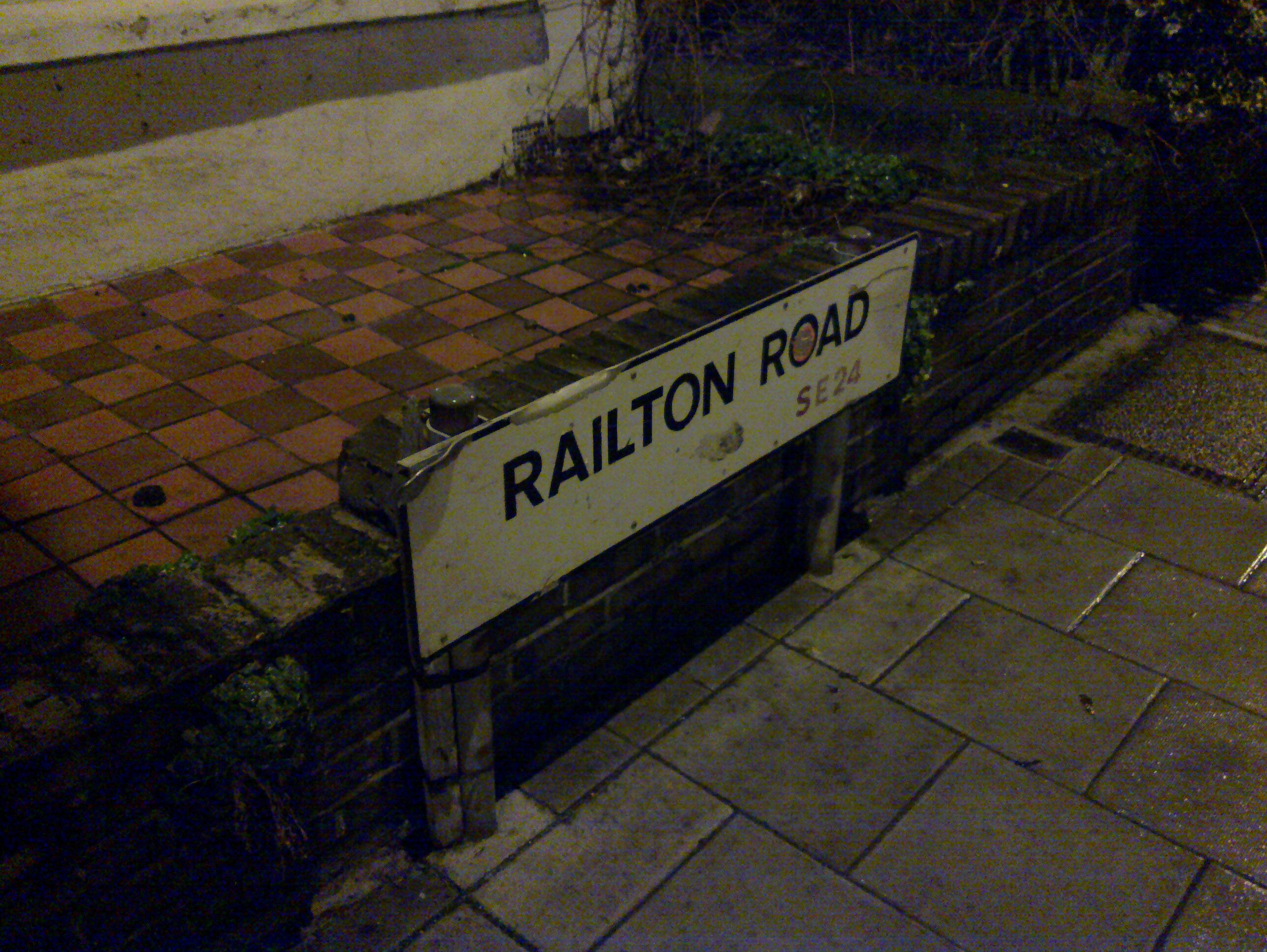
Wednesday evening, after work, I took a taxi to 198 Railton Road, home to 198 Contemporary Arts and Learning. A few days earlier I had received an invitation to the preview of its new exhibition of photographs by Eva Sajovic, the Slovenian artist I have blogged about previously.
To call 198 a gallery is to do it a disservice. Rather, it describes itself in the following way:
“198 is a pre-eminent cultural space in Brixton, which explores the rich diversity of artistic practices informed by globalisation and emerging cultural identities.”
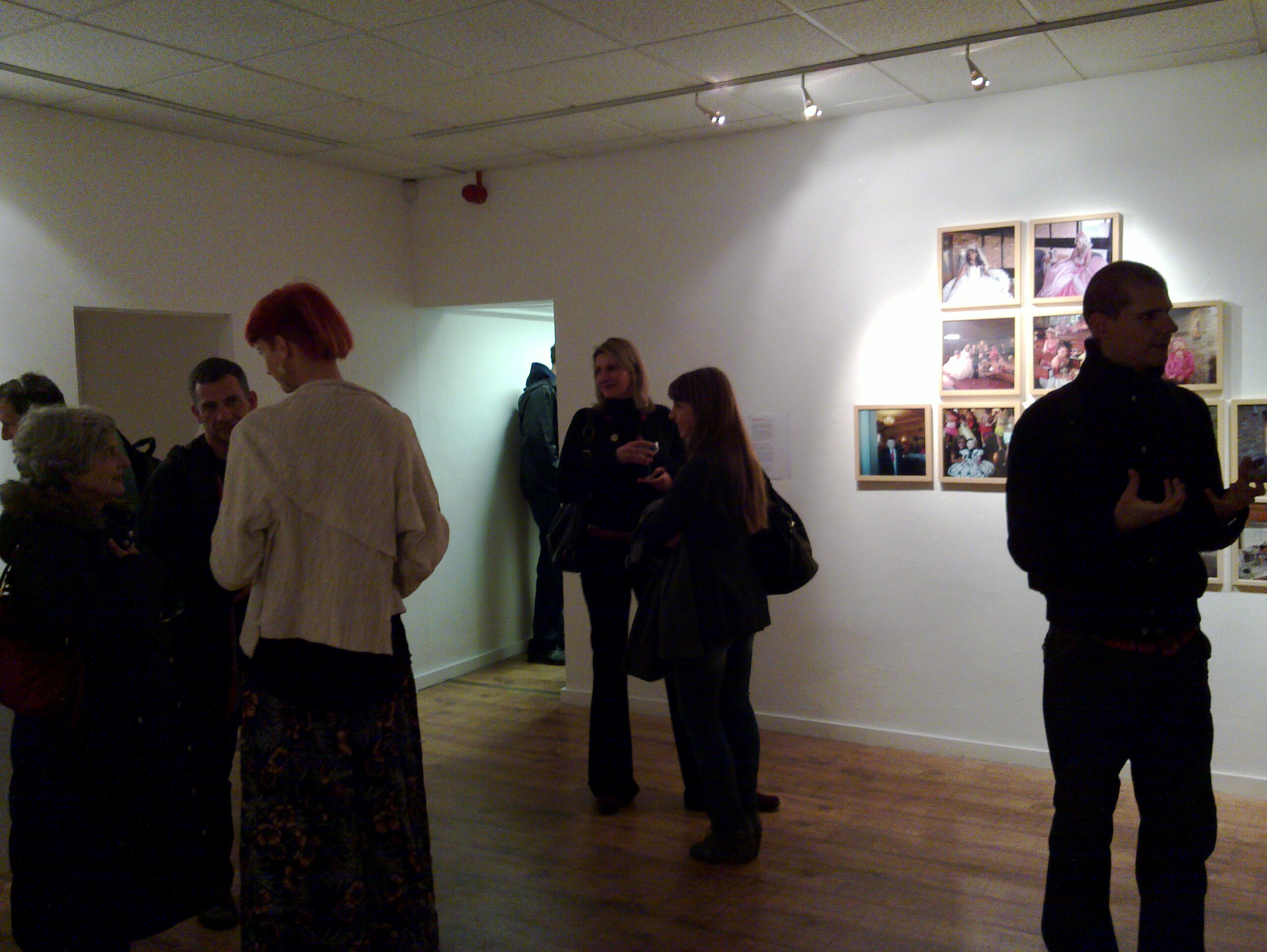
Sajovic’s exhibition, focused as it is on the experiences of Gypsies, Roma and Travellers in the United Kingdom, Italy and Slovenia, could not find a more appropriate home. The minimalist, white-washed lines of the 198 are the perfect contrast with Sajovic’s vibrant pictures that capture the raw and sometimes confused emotions that arise at the intersection of diverse migratory cultures and the settled community. Perhaps most humbling is the sheer force of will required by Gypsies, Roma and Travellers to maintain their traditions and social structures in the face of overwhelming hostility, mistrust and misrepresentation. As Sajovic’s pictures, and their accompanying stories remind us, the persecution of difference is as great today as ever it was – the UK, Italy and Slovenia representative of European societies where society appears to deem it acceptable to discriminate against travelling communities in a way that it would not contemplate with those from other minorities.
Eva Sajovic's “Be-Longing” at the 198
For me, talking to two Travellers living in Southwark, the greatest irony is that the value that drives them to maintain their traditions above any other is the same as that of their fiercest conservative critics: family. It is the belief in inter-generational support, of the transmission of knowledge and tradition from one generation to another, that creates the tremendous familial bonds in travelling communities. How sad it is that as the settled community laments the loss of that ideal, the communities that are the object of so much of its hatred earn that ire as a consequence of living out that same ideal. Sajovic spoke movingly of the warmth and generosity with which she was received upon gaining the trust of the communities she worked with. For me it all gives Matthew 7 a very modern context:
“Do not judge others, and you will not be judged. For you will be treated as you treat others. The standard you use in judging is the standard by which you will be judged. And why worry about a speck in your friend’s eye when you have a log in your own? How can you think of saying to your friend, ‘Let me help you get rid of that speck in your eye,’ when you can’t see past the log in your own eye? Hypocrite! First get rid of the log in your own eye; then you will see well enough to deal with the speck in your friend’s eye.”
Matthew 7, 1-5, New Living Translation
An exhibition of photographers of travelling communities may not be the first thing that comes to mind when thinking how to spend a couple of hours of an evening. However, this initiative represents another small but very important step in helping to foster understanding between settled and travelling traditions that are steeped in a mutual suspicion that is centuries-old. Be adventurous and give it a go – and see something special from an exciting new talent.
Winston Churchill made an elaborate but astute observation regarding Russia in a radio broadcast in October 1939:
“I cannot forecast to you the action of Russia. It is a riddle, wrapped in a mystery, inside an enigma; but perhaps there is a key. That key is Russian national interest.”
Step forward seventy years and it’s not too great a leap of the imagination to make the same observation of Syria – though you might argue that the Syrian national interest bears a close correlation to the interests of Bashar al-Assad.
If you are interested in the politics of the Middle East, I urge you to read it.
Syria’s diplomatic bravura is understandable in terms of the politics of local alliances and attempting to forge a distinct and US-independent stabilising force in the region, along Islamic lines.
It is also entirely in keeping with the egoistical nature of Bashar’s regime. Hitherto, Damascus has been regarded by many as Ba’athist in name rather than principle. However, Syria’s posturing and tightened grip on matters of internal security (in obvious violation of its civil and political rights obligations in international law) has provided Syria, as the only regional power run by the Ba’ath Party, with a beacon status with which to lead a foreign policy that is based on revitalised Ba’athist ideals of pan-Arab nationalism.
In my view, domestic suppression is part of the code of that diplomatic flexing, demonstrating in its publicly loud prevarication over the EU-Syria Mediterranean Agreement that it will not see its economic interests subordinated to Western ideals of civil society. The careful switch of language regarding the US that Mozes identifies, from enemy to adversary, shows Bashar understanding that the West are desperate to engage Syria but that, at the same time, by maintaining a measure of distance he can enhance his credibility as the emerging leader of the region.
This, to my mind, can only have worrying consequences for those like Kamal al-Labwani who advocate peaceful and democratic reform of Syria’s politics. He and others would appear to be exemplars of Bashar’s policy of resistance. If Bashar’s goal is consolidation of his regional status, he will be in no hurry to release those detained for democratic politics redolent of the West (and Israel), except maybe on an exceptional basis to titillate those European politicians determined to spot reformist intentions in the Syrian regime whatever the regional political weather (and cost to their own diplomatic credibility). If this is the case, maintaining the international spotlight on their plight is even more important.
The fact that the EU are so ready to embrace the EU-Syria Mediterranean Agreement suggest that Bashar’s ploy of deft belligerence is working and the diplomatic pressures that those of us concerned about the fate of Kamal al-Labwani, Anwar al-Bunni, Hatham al-Maleh and Ma’an Aqil wish to see exerted will not emerge. The UK, like its EU partners, is in danger of being suckered.
It was more made more striking by its ordinariness: a standard-issue Council desk with a signing book and cheap pen placed neatly in the middle and little yellow booklets strewn about. The foyer of the BasCentre bustled, but the space around the table was poignantly empty. Sitting at the desk, words failed me and I was unsure what to write. Everything seemed trite – a sentiment that couldn’t reflect the sheer horror of the Holocaust, sanitised as it is through the combined filters of years and internet technology and information overload.
Yesterday was Holocaust Memorial Day. Visiting the site I discovered that I was the 34,127th person to light a virtual candle and become part of the Legacy of Hope. Each year, Holocaust Memorial Day (known this year as “HMD2010”) identifies and develops a particular theme:
It is too easy in this age of instant tragedy, when an earthquake or tsunami can be broadcast into our living room, to forget the sheer brutality we are capable of inflicting on each other as human beings. I saw the legacy of that insane cruelty in my recent work in Sierra Leone. According to the UNDP, Sierra Leone is the third poorest country in the world. I saw single, double, triple and quadruple amputees attempting to rebuild and live their lives alongside those who had perpetrated their agonies upon them in a vicious civil war.
The Holocaust is the ultimate manifestation of that evil that drives man to brutalise man.
To be honest, I struggle to get my head around the figures involved. Auschwitz-Birkenau was the largest Nazi killing camp, murdering approximately 1,100,000 men, women and children. In total, 6,000,000 Jews were murdered (almost two out of every three Jews in Europe), alongside 200,000 Roma and Sinti (Gypsies) and almost 250,000 mentally or physically disabled people. Tens of thousands of gay men and women, Jehovah’s Witnesses, intellectuals and political opponents were also murdered. They are the sort of stratospheric figures that become meaningless – and in that meaninglessness lies incredible danger.
Holocaust Memorial Day reminds us that genocide is not a thing of the past:
Genocide is with us today. It is another inconvenient truth that, in its hopeless enormity and our helpless inadequacy, we push uncomfortably from our minds.
In Nuremberg, in Bavaria, the city closest to the village where I spent my first few years growing up, part of the monstrous unfinished remains of the Nazi Party’s Congress Hall (Kongresskalle) has been transformed into a museum of brutal truth: the The Documentation Center Nazi Party Rallying Grounds(Dokumentationszentrum Reichsparteitagsgelände). I have visited it three times and it has never failed to move me to tears. It tells the story of the rise of Adolph Hitler and the Third Reich, the Holocaust, liberation and the Nuremberg trials. It does not flinch in admitting the culpability of the German nation in the Holocaust. It is a harrowing experience – but one that begins to make a dent in the inconceivability of such horror. Importantly, the centre serves as a reminder of the hatred and evil that was spawned in ordinary men and women on that very site.
It demonstrates, in terrifyingly precise detail, the truth in that phrase coined by Hannah Arendt: “The banality of evil”. (Her premise was, essentially, that it is ordinary people -not monsters – who are responsible for the greatest acts of evil in history. They accept what they are told by the state and so participate in even extreme acts because it is normal to do so.)
“First they came…” may be a poem that has become mired in controversy over its origins. However, whether they are the words of the Lutheran pastor Martin Niemöller or not, they contain a simple and uncomfortable truth about our preparedness to speak out in circumstances of right and wrong that we should all reflect upon. Read them again and think about them – not with the eyes of knowing, ironic commentators who might claim these words are the refuge of the lazy and clichéd, but as if you’re seeing them for the first time:
“First they came for the communists, and I did not speak out—because I was not a communist;
Then they came for the trade unionists, and I did not speak out—because I was not a trade unionist;
Then they came for the Jews, and I did not speak out—because I was not a Jew;
Then they came for me—and there was no one left to speak out.”








 Fragments and Reflections