Time For Change – IKEA’s gnome attack

So I realise even before I make this post that I am, in my own small way, contributing to the viral marketing success of this latest advertising campaign from IKEA. So, let me say up front, that whilst I like their tubes of fish paste and their crackers, I’m not a fan of the store. Too big and the whole one-way thing is a bit annoying!

That doesn’t stop me appreciating a good ad when I see one and the latest offering from IKEA is a hoot.  With the current success of The Walking Dead on the telly and The Evil Dead in the cinema, an invasion theme is a pretty canny one. This mischievous take, though, sees an army of gnomes attempting to resist a couple’s determination to transform their garden. Hats off to Mother, London and their creative team.

For anyone wondering about the soundtrack, it’s Mötley Crüe’s Time for Change, performed by The Palace Of Budapest Philharmonic Orchestra and The Heritage Singers.

Brilliant.

Next to nothing – the feather art of Isa Barbier

Colossal has examples of French artist Isa Barbier’s incredible installations of feathers, suspended on virtually invisible lines. The ingenuity of many people defies imagining and these works of art are mysterious, ghostly and beautiful.

This slideshow requires JavaScript.

This slideshow requires JavaScript.

Stupid & Dangerous – but extraordinary, too

A slo-mo highlights reel from the Danish TV show Dumt & Farligt (“Stupid & Dangerous”) has been posted online. A series of madly hypnotic stunts, usually involving some form of explosive energy, there is something beautifully hypnotic about the results. Shot at 2500 FPS, you get to witness aspects of motion that you would never ordinarily see.

The pencil photographs of Kelvin Okafor

If you’ve not yet come across them, the drawings of Kelvin Okafor are something else. They are pencil illusions, stunning graphite recreations by eye from photographs, each taking between 80 and 100 hours to complete.

The talent of some people is simply extraordinary.

This slideshow requires JavaScript.

Beauty from brokenness: more street art from OakoAk

Street artists have a unique eye for taking things that most of us walk past, or regard as ugly or broken, and making them into something very different. Funny, surreal, thought-provoking and sometimes just beautiful, there is a tremendous variety of street art out there around the world.

It can provoke passionate discussion, with some dismissing it as merely an excuse for graffiti. Somehow, though, I think it is more than that, saying something about the urban areas in which we live, and giving value back to things that have lost their value and (sometimes purpose) through decay, damage and vandalism.

One of my favourites is OakoAk, described on his own website as a “French artist who likes to play with urban elements”. His work is simpler than some, often eschewing perspective illusions and instead going for the comic,  occasionally tugging a heart-string.

Here’s a selection of some of his most recent, courtesy of Bored Panda:

This slideshow requires JavaScript.

Coming soon… A history of noise

Noise.

It fills our lives. It is something that is so constant that I doubt any of us really experience true silence except perhaps on a few occasions in our lives. There is the daily burr that forms a soundtrack to our lives that we barely pay attention to any more. There are the phones chirruping away, cars passing, doors closing, papers shuffling, colleagues talking at the water cooler, footsteps in the corridor. The list is endless.

In more peaceful places there is still noise: the wind in the trees, birds singing, the sea on the shore, the rustle of grass as we walk. Even now, in this house, with no music playing, the windows double-glazed and with the heating currently off, I can hear the whirr of the computer’s fan and my fingers clicking on the keyboard (and what a joy it is to be typing on a real keyboard, not a laptop or a Blackberry). At other times there might be the creak of pipes or the sound of the house settling after the day or a distant siren howling through the town.

Interestingly, pretty much the world’s quietest place isn’t in the middle of nowhere at all. It is at Orfield Laboratories, in their anechoic chamber:

anechoic chamberAnechoic means echo free and this chamber is designed to completely absorb sound waves and create an experimental space in which there can be absolute silence. Somehow or other I suspect that I would end up being driven mad by the sound of the blood rushing in my ears!

Anyway, browsing Facebook, the feed of an old friend with whom I wish I kept in better touch flashed up a link to a blog: Noise – A human history. Starting Monday 18 March, this 30-part series will explore the role of sound in the past 100,000 years of human history As it says on the blog:

“Recorded on location around the world, it will take us from the shamanistic trance-music of our cave-dwelling ancestors, the babel of ancient Rome, the massacre of noisy cats in pre-revolutionary Paris, and the sonic assaults of trench warfare, right through to our struggle to find calm in the cacophony of a modern metropolis. This is not about sound in the abstract: it is about sound as a matter of life and death, pain and pleasure, feeling and intellect. People, and their past behaviours, are at the heart of it.”

Sound has always fascinated me – how we become attuned to some sounds and not to others, how music can bend our emotions, how people communicate, how we hear the world when we actually stop to listen. Something tells me that this series will be quite special.

Check it out – and those of you who enjoy quality radio, listen out for it.

Dick Turpin: Horrible Histories rock the highwayman

A few days ago I couldn’t help post up the Horrible Histories take on Vikings and their great soft rock ballad. This time it’s Dick Turpin who gets the rock history treatment – and did you know he was caught out by his handwriting? Nor did I!

Three amazing artists

Some people are just amazingly talented. Here are examples of the work of three artists that took my breath away. They each use our environment in very different ways.

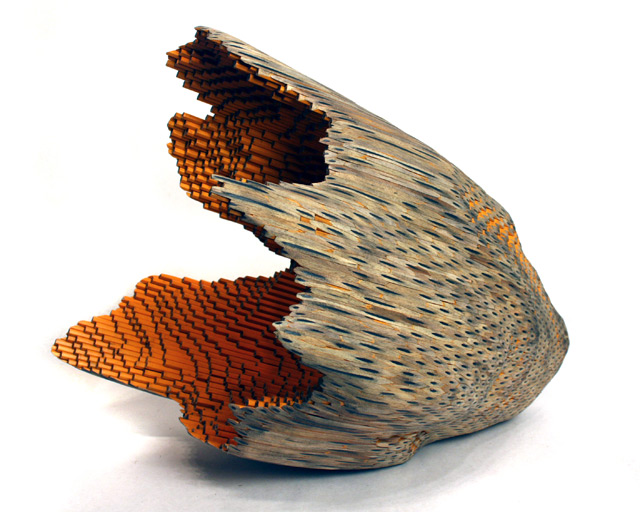
Jessica Drenk was born and grew up in Montana, developing a tremendous affinity for the natural world around her, background that has had a very deep influence on her art.  As reported by arts blog This Is Colossal:

Drenk’s most recent sculptures are a series called Implements, each of which begins with a mass of standard No. 2 pencils that have been tightly glued together. Using an electric sander she then molds the piece into a form that seems more likely to have originated in a dark cave or deep within the ocean than from a school desk. Of her work she says:

“By transforming familiar objects into nature-inspired forms and patterns, I examine how we classify the world around us. Manufactured goods appear as natural objects, something functional becomes something decorative, a simple material is made complex, and the commonplace becomes unique. In changing books into fossilized remnants of our culture, or in arranging elegantly sliced PVC pipes to suggest ripple and wave patterns, I create a connection between the man-made and the natural.”

drenk-3Haroshi is a self-taught artist from Japan. This skull, made from recycled skateboard decks, is just awesome.

haroshi-1Finally, Vadim Zaritsky is a former army office turned artist and entymologist – and uses the wings of dead butterflies, found either beside the road or thrown out from collections. In his own words on Oddity Central:

“Butterfly collectors know that some wings are considered – collectors call it trash,” Zaritsky says. “If the wings are damaged, if they have partially faded, specialists would usually put them aside. It’s a shame to throw them away but you cannot use them either. In time, the bits may become infested with pests and you have to throw everything away anyway.”

Vadim-Zaritsky-butterfly-wings-550x406

The natural world art of Svetlana Ivanchenko

The pictures below blew me away. Blogger Spooky, on the site Oddity Central, gives a brief biography:

Svetlana Ivanchenko is a talented Ukrainian artist who uses overlooked natural materials like sand, seashells, quartz, tree roots and tree bark to create wonderful mosaics that look almost painted by hand.

Born and raised in Yalta, on the shores of the Black Sea, Ivanchenko was always fascinated by the abundance of natural materials that surrounded her. She studied at the Crimean Art School, under the supervision of renowned artist Sergei Bokaeva, and later graduated from the Glukhivskiy Pedagogical Institute. The artist currently based in the city of Dnepropetrovsk uses a variety of sand, shells, quartz and tree parts to create amazing works of art inspired by her place of birth and the warmth of the female body. It’s hard to believe, but every little piece of material used to create the artworks is placed by hand, and no coloring other than that of the composing elements is used.

As Pinar from My Modern Metropolis notes, Svetlana “merges the various textures and colors brilliantly, making it difficult to imagine the frames being made of anything else.” Her natural masterpieces have been exhibited in international galleries, and many of them reside in the private collections of connaisseurs in Russia, Ukraine, Germany, Estonia and the Dominican Republic.

Enjoy them.

This slideshow requires JavaScript.

When gaming and amateur film-making cross over

I’ve long been a gamer, ever since I first laid my sticky mitts on a ZX81 and dived into Mazogs:

My favourite games these days are MMOs, usually fantasy-based, like EQ and EQ2. I have also had a sneaking fondness for FPS games, like Unreal Tournament. The game I am playing most at the moment is Battlefield 3. Up to 32 players on each side, from across the world, play as either US or Russian forces in various forms of battle on various maps, small and large. My liking for this sort of thing is probably a throwback to watching films like Where Eagles Dare as a kid, though there is also a real and peculiar sense of camaraderie when four of you are locked down in the same squad, all communicating by Team Speak, buildings blowing up around you and ammo running low. It is also remarkably cathartic after a frustrating day.

We are so used to seeing computer graphics in films these days, like the magnificent CGI tiger in Life Of Pi, that we can barely distinguish them from the real thing. Conversely, the graphics in many modern games, like BF3, are so realistic, and the models so controllable, that artistic sorts around the world are creating films using exclusively in-game footage.

This effort from Fierce Eagles, a team of gamers in Pakistan, and ultra-violent as it is being based on BF3, is quite something else.

Take a look at Mazogs above.

And then check out the video below to see how scarily gaming technology has advanced in the thirty years since Mazogs was published by Bug Byte in 1982. (Warning: there is a lot of shooting and killing.)

Where will full-immersion 3D, more powerful processors and even higher definitions take us in the next thirty years?