Over on basildonFOCUS, my colleagues and I have launched a survey regarding the forthcoming discussion at Council on Borough status (Wed 24 February 2010). If you live in Basildon and want your views to be heard, please take a few moments to click the relevant buttons.
lib dems
The politics of connection: basildonFOCUS #libdems #basildon
My politics, my family’s politics and my party’s politics are about empowering people to take control of their own lives, in communities that we hope can be vibrant and and nurture diversity, ambition and a sense of collective responsibility towards a sustainable future. It can all start to sound very grand. The reality is, though, that taking control starts with very simple and mundane things that politicians – even local ones – start to overlook as their grand designs grow.
Joining the dots between people, the lives they live, their surroundings and the politicians who run the local council is what basildonFOCUS is about. Inspired by Rochford’s onlineFOCUS (imitation is the sincerest form of flattery, so the cliché goes!), basildonFOCUS is our latest attempt to make it easier for people to raise issues that, if tackled, would make a real change to their immediate area. At the same time, it is our way of trying to keep those who voted for us informed.
The web is often cited as the solution to people’s information needs. It is not. It is part of it. For those who don’t have access, it is irrelevant. For those who have access but little experience or understanding, some supposedly helpful sites are so bloated and confusing that they are more hindrance than help.
Our intention is to keep basildonFOCUS clean-looking, informative and easy to use.
And for those who are interested, click on the excerpt of the preamble to the Liberal Democrat’s constitution to get a sense for the instinctive and inclusive beliefs that underpin the party’s philosophy.
Your comments are welcome.
Geoff Williams’s campaign as Lib Dem candidate for South Basildon and East Thurrock #libdem #basildon
For those interested in following Geoff Williams’s campaign to be the Member of Parliament for South Basildon and East Thurrock, you can keep up-to-date in a couple of new ways.
If, like me, you are on Twitter, you can follow his Tweets on twitter.com/geoff4mp – just add him to your Twitter feed.
For those who are on Facebook (I made my first foray recently – more on that later), you can follow his campaign by becoming a fan on www.facebook.com/geoff4mp – feel free to post comments, ask questions and generally get to know what he’s about.
Local champion Geoff Williams selected to fight South Basildon and East Thurrock for the Lib Dems #basildon
Local activist and campaigner Geoff Williams has been selected to fight the seat of South Basildon and East Thurrock for the Liberal Democrats at the next General Election.
Geoff, who has been a local champion, successful campaigner and district councillor for many years, spoke to supporters this evening in the Allpress Hall at Dry Street Memorial Church. He made clear that this was a crucial election for Nick Clegg and the Liberal Democrats, the party’s gut instinct for fairness giving local people in South Basildon and East Thurrock a chance for real change at the election.
In response to questions, he said he was keen to get the Liberal Democrat message out across the towns and villages that comprise the new seat, pointing out that places such as Bulphan, Fobbing and Horndon-on-the-Hill are often overlooked by politicians.
More in the days to come…
In the meantime, congratulations Dad!
Nuclear cheerleaders: Essex Tories embrace Brown’s Bradwell nuclear agenda – and decide residents’ views don’t matter #toryfail #green #nonewnuclear
“The Members of Essex County Council are very concerned that the Government is only undertaking a very limited public consultation on Bradwell being a suitable site for a replacement Nuclear Power Station. Members call upon the Government to widen this consultation across Essex so that all our residents have the opportunity to make their voices heard on this very important issue.”
This was the motion put forward by Essex Liberal Democrats at the meeting of Essex County Council on 15th December.
It looks pretty measured doesn’t it? It doesn’t indulge in party-political posturing. It doesn’t even pompously declare that “Liberal Democrats are very concerned” but uses the neutral “Members of Essex County Council are very concerned”. It doesn’t require the spending of large sums of taxpayers’ money or force the County Council to do something (heaven forfend!). It simply requests that the Government – the Labour Government – extend its very narrow consultation on a potential new nuclear power station at Bradwell to the rest of Essex (the existing Bradwell nuclear power station was decommissioned on 28 March 2002). The motion doesn’t put pro-nuclear supporters in a difficult position by offering an opinion as to whether nuclear power is a good thing or a bad thing. Rather, it simply makes the point that on an issue this big the whole of Essex should be consulted.
As motions go, particularly those designed to attract support from across the political spectrum, it’s pretty darn good. So more on the motion in just a moment.
First, it’s worth taking a moment to examine quite how appalling the consultation referred to is. Or rather – was. I think. To be honest, it isn’t so clear. On 9 December, the Department of Energy & Climate Change (DECC) issued a press release entitled “What does new nuclear mean for Essex?” It boasts:
“Residents of Essex are this weekend being asked to have their say on proposals to a build a new nuclear power station in the area……The announcement on new nuclear sites was made as part of a planning overhaul for big energy projects and ten potential new sites for nuclear energy were named in the draft Nuclear National Policy Statement. These sites are Bradwell, Braystones, Hartlepool, Heysham, Hinkley Point, Kirksanton, Oldbury, Sellafield, Sizewell and Wylfa. Bradwell was nominated by EDF, who are currently seeking to sell the site to a credible nuclear operator.
Following the nomination of the sites the Department of Energy and Climate Change is conducting a 15 week consultation to hear people’s views about the proposals.
The new Infrastructure Planning Commission will use the National Policy Statement when considering planning applications for new nuclear power stations. This consultation is an opportunity for local people to influence what the IPC should take into account when considering whether to grant consent or not.”
It looks promising. There is a fifteen week consultation. There is an opportunity for local people to influence what should be taken into account when considering whether to grant consent or not. In fact, the press release begins by saying “Residents of Essex are this weekend being asked to have their say on proposals to a build a new nuclear power station in the area”.
- On Wednesday 9 December DECC issues its press release including consultation details.
- On Thursday 10 December there is an exhibition in West Mersea.
- On Friday 11 December there is an exhibition in Maldon.
- On Saturday 12 December there is an exhibition in Bradwell-on-Sea.
- And there were two “two public discussion events” – but no details were provided in the release. (They clearly weren’t intended for non-locals who I assume – hope – were at least leafleted.)
And… Er… That’s it.
Residents of Essex, eh?
Even though DECC describe the site in their press release as “near Chelmsford” there isn’t a consultation in Chelmsford. Despite it being a fifteen week consultation, Essex gets five highly localised events in the three days immediately after the press release going out. I may be atypical of your average Essex resident, but even despite my political interests, I don’t keep tend to keep track of Government department press releases day by day.
Good luck to those of you who do and managed to get there.
According to the website of West Mersea Council, West Mersea has a population of 6,925 people. According to the website of Maldon District Council, Maldon has a population of approximately 60,700. The website of Bradwell Parish Council doesn’t provide any information on population – but Wikipedia lists the population as 877. According to the website of Essex County Council, the population of Essex is 1,396,400 (excluding Thurrock and Southend-on-Sea – though in the event of disaster, I am not convinced fallout is as discriminating as the Boundary Commission).
Of course the residents of those places should be consulted. However the Labour Government (DECC) and the Infrastructure Planning Commission think that consulting 0.05% (I am rounding up here) of the population of Essex is somehow giving residents of Essex the chance to have their say. As for the time given over to consultation, the DECC press release highlights a paltry three specified days in a fifteen week consultation.
It is nothing short of outrageous – a complete scandal in a 21st century liberal democracy.
And you would think that the Conservative Party, a national party of opposition, that controls the County Council, would want to stick up for the right of local people to be heard, regardless of its own policies on nuclear power.
Back to the motion…
Did the Conservatives support the Liberal Democrat motion?
Not a chance. The Tories voted against. They opposed the extension of the consultation to the rest of Essex and, by doing so, have effectively said our views don’t matter.
Essex County Council doesn’t record how people vote as a matter of course. Why should they – after all, you are not interested in what your elected representatives are doing, are you? Therefore, finding out which way your local representatives voted looks like being a case of emailing them directly.
You can find your way to the contact details for Essex County Councillors here. For those readers in Basildon, the following Conservative councillors may well have voted to prevent you having more information:
- David Abrahall – Pitsea: Cllr.David.Abrahall@essex.gov.uk
- John Dornan – Laindon Park and Freyerns: Cllr.John.Dornan@essex.gov.uk
- Anthony Hedley – Billericay and Burstead: Cllr.Anthony.Hedley@essex.gov.uk
- Sandra Hillier – Pitsea: Cllr.Sandra.Hillier@essex.gov.uk
- Don Morris – Wickford Crouch: Cllr.Don.Morris@essex.gov.uk
- Iris Pummell – Wickford Crouch: Cllr.Iris.Pummell@essex.gov.uk UPDATE: Iris Pummell was unable to attend and so consequently did not vote
- Terri Sargent – Laindon Park and Fryerns: Cllr.Terri.Sargent@essex.gov.uk
- John Schofield – Westley Heights: Cllr.John.Schofield@essex.gov.uk
- Kay Twitchen – Billericay and Burstead: Cllr.Kay.Twitchen@essex.gov.uk
I have emailed each of them to ask if they were there on 15 December and, if they were, how they voted. If they opposed the motion, I have asked why they don’t believe the Government should consult the people in Basildon that they are elected to represent.
You might want to do the same.
I would be interested to know the reasons people vote as they do – so please add a comment to this blog piece!
Kamal Labwani and the West’s appalling indifference #eu #syria #labwani
Last October, I wrote to over a hundred senior officials and politicians, many of whom are based in Brussels. I wanted to draw attention to Syria’s continual violation of human rights and flagrant disregard for the UN’s International Covenant on Civil and Political Rights as the European Union was intending to sign an Association Agreement with Syria. I wrote very directly about the situation of Kamal al-Labwani.
You can read my text here:
The only person who could be bothered to respond was Liz Lynne, the Liberal Democrat MEP, who wrote back to me on the 6th November to say she was taking my concerns up with Benita Ferrero-Waldner, European Commissioner for External Relations and European Neighbourhood Policy (if it wasn’t a distraction I would ask who the hell the rest of the elected politicians I wrote to think they are, disregarding correspondence as they enjoy the salaries and expenses I am part-paying for). You can read that email in full below:
Yesterday, and demonstrating impressive commitment, I received a further email from Liz Lynne to which she attached a letter from Baroness Catherine Ashton, the new High Representative of the European Union for Foreign Affairs and Security Policy. Read it – and be angry:
If you clicked the link to Ashton’s official page above you will have seen it is headed up with the following quote:
“I am looking forward to working closely with colleagues in the Council, the Commission, the European Parliament and the Member States to strengthen Europe’s foreign policy. We will do this with determination and with full respect for the values that the European Union stands for, above all peace and prosperity, freedom and democracy, the rule of law and the universality and indivisibility of human rights.”
What pointless drivel from a pointless politician.
The total press comment on her official site consists of two statements of congratulations following appointments and a statement of shock following the Lakki Marwat bombing.
No action.
No condemnation.
No statements of stiff resolve.
Instead, her words are the grey, empty platitudes we fear from out-of-touch politicians – politicians we still hope might be moved to action by the personalisation of the problems they otherwise put behind them at the end of the day. If this is what being “the best person for the job” means, as Baroness Ashton claims she is, then the words in her email are a damning indictment of the impotency of this newly-created position. Ashton points out in that report that EU leaders were “comfortable” with her appointment. I am sure they were: Ashton is clearly not someone for rocking the boat, but rather is happy to continue a policy of engagement that talks tough on human rights and political freedom, but achieves nothing: maintain the status quo of holding our collective noses as we conduct business as usual.
I am glad she is at least “worried”. I am also worried.
This was Kamal in Basildon in 2005, standing proudly by his artwork with Chris Hyde and his great friend and supporter Maureen Thomas:
- Kamal, Chris Hyde (L) and Maureen Thomas (R)
This was Kamal in 2006, peering from a prison cell:
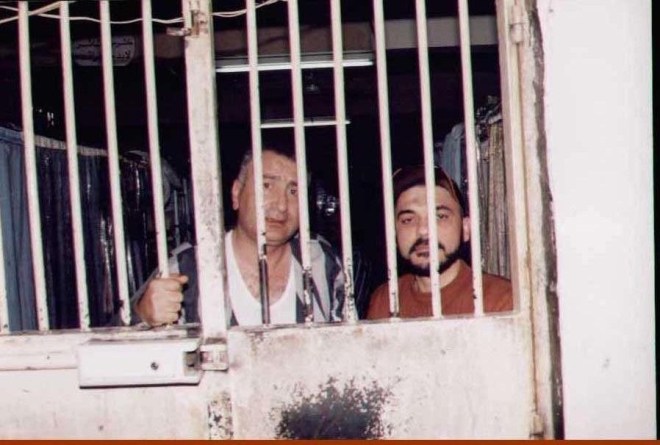
I am worried.
I am shocked.
I am bloody furious that my friend, who shares our values of freedom of expression, freedom of thought and peaceful dissent, languishes in a Syrian hell-hole whilst supposedly powerful politicians like Baroness Cathy Ashton appear to think that his incarceration is incidental to a “comprehensive political dialogue and longer term relationship that can build trust and ensure progress on human rights issues.”
What possesses these people to write such coded cant? She doesn’t even mention the fact that once signed, the agreement can be suspended if human rights violations are evidenced. Too embarrassing perhaps as people might question why it was being signed in the first place?
Look at those two pictures.
Think about them and what they represent.
Think of the gentle family man, the artist, the doctor, who is imprisoned because he wants his family, friends, colleagues and countrymen to enjoy the chance to talk freely, to believe and think what they want, to worship as they choose (or not) and to associate socially and politically without interference from state-sponsored goons.
If you are involved in politics, whichever party or none, ask yourself why you got involved – and if you could write the words of Baroness Ashton? (And don’t give me patronising rubbish about “a complex situation”, “difficult discussions” and “diplomatic sensitivities” – you know I’ve heard them all.)
And if those pictures anger you, if the complacency of politicians and officials who are charged with representing our values as a country abroad frustrates you, if you abhor the political double-speak that expresses concern whilst the ink dries, then click one of the links below and take action:
Familiarise yourself with Kamal, his experiences and his beautiful, moving paintings
Write to Gordon Brown, our Prime Minister
If you are a UK national, sign the petition r.e. Kamal and the EU Trade Association Agreement
If you are on Twitter, Tweet the link to the petiton by cut and pasting the following: http://bit.ly/TZ4R7
Thank you Liz Lynne for being interested – and for acting.
And shame on the rest of you, Liberals and non-Liberals alike, for your indifference.
You know who you are.
Show us why we should continue to even consider you worth our confidence.
PAVIS, Basildon Council and The Institute of Fundraising – cheque it out #cheques #fundraising #poverty
Jane Lutton’s comment to my previous article on cheques has prompted me to write another little piece.
Jane works for PAVIS Foundation for Visually Impaired People, a small registered charity set up in 1998 that provides a tremendous range of services for those with sight difficulties. Jane’s concern is that it is this sort of charity – and I think that there must be hundreds around the United Kingdom – that will be disadvantaged by the removal of cheques, as proposed by the Payments Council [see this summary note for a reminder of the plans]. If PAVIS cannot identify the resources to invest in direct debit facilities to manage donations, then I presume that, if it can no longer raise the necessary funds, then this is a charity whose very existence could be determined by the usability and cost-effectiveness of any cheque replacement.
It is the threat to vulnerable individuals that concerns me most.
For instance, the Conservative administration at Basildon Council has decided that it is no longer cost-effective to provide housing benefit by cheque and so has announced it is to withdraw that option. The Cabinet member with responsibilities for resources, Cllr Phil Turner, claims it costs £10 to process each cheque, making it too expensive. In a further telling comment, he explains that it is more convenient for the claimant. It is refreshing to see that for all of Cameron’s Conservatives’ pretence at reinvention and identification with modern Britain, its members remain as patronisingly paternal in their treatment of those less fortunate than themselves. They, it would seem, are not entitled to decide what is the most convenient way for them to be paid.
For those who are might be defined as vulnerable, the threat is two-fold.
Firstly, the interplay between the continuing “electronification” of financial services will lead to a particular form of financial exclusion amongst those unwilling or unable to adapt to new technologies. If you think this is a small number of people, Lavinia Mitton’s 2008 study for the Joseph Rowntree Foundation, entitled Financial Inclusion in the UK: Review of Policy and Practice, will shock you with its reporting of a 2003 review in Scotland that showed that a third of disabled people in Scotland did not even have a current account with a cheque book. (There are two other superb studies on the JRT website, both ten years old, that look at financial exclusion: Understanding and combating ‘financial exclusion’ and Family finances in the electronic economy. Both highlight some of the issues that are coming to light in the current debate around cheques.) Andrew Harrop, for Age Concern, was similarly concerned:
“Many older people rely on cheques as their main form of payment and will be very worried about how they will manage if they are withdrawn.
“Our fear is that setting a date will give the green light to banks and retailers to withdraw cheques even earlier than 2018‚ as some already have. It is vital that before cheques are phased out‚ the Payments Council ensures there is a practical‚ safe‚ paper-based alternative in place which serves the needs of this group.
“Chip and pin is problematic for many older and housebound people and we know 6.4 million over 65’s have never used the internet. Without cheques‚ we are very concerned people will be forced to keep large amounts of cash in their home‚ leaving them vulnerable to theft and financial abuse.
“We are being asked to take on trust that the banking industry will create an alternative people can use‚ but new forms of payment can take a long time to develop and no action has been taken to date.”
Secondly, as Jane’s example shows, there is a very real threat to the plethora of voluntary support services that provide assistance to the vulnerable.
By way of representative organisations, Jane mentions the Institute of Fundraising. In its own words:
“The Institute of Fundraising is the professional membership body for UK fundraising. Its mission is to support fundraisers, through leadership, representation, standards-setting and education, and it champions and promotes fundraising as a career choice.”
Sadly, in their list of top stories in fundraising, the issue of cheques doesn’t feature. This is a significant omission as, whilst it is unlikely that this decision can be reversed, development of a suitable alternative needs to be championed by an organisation that can represent the broad range of interests in fundraising – not just the corporate donors. If you are interested in raising this issue, even to establish their opinion, you can contact the Institute of Fundraising here.
Finally, the Lib Dems have started a group on their new social networking site ACT, which is dedicated to saving the cheque. You don’t have to be a party member to join ACT and the group is called Save The Cheque Campaign.
**
By way of a small distraction, Cllr Turner’s eagerness to refuse to pay by cheque is not matched by his readiness to refuse payment. Enter “cheque” into the Basildon Council Website search facility and you produce 41 results (including the press release linked above). If you require reports from planning services, you are instructed to pay by cheque. If you are disabled and eligible for aid, you are instructed to pay the builder by cheque. If you want to get a season ticket you are to fill in a form – and pay by cheque. Paying fines? Cheque is an option. Rebate on your council tax? Basildon can pay this by cheque. I do not know if Cllr Turner is planning to cancel all these facilities shortly or if these cheques are somehow cheaper to process. If I were less generous, I might think that he is starting with desperate people who will go through whatever Council hoops are forced on them in order to keep a roof over their heads (the comments on the Echo story linked in the main piece suggest that housing benefit claimants are not particularly popular and therefore an easy target for a Council wanting to save some money). Thoughts would of course be appreciated, together with suggestions for questions that should be asked.


