“Progression” and “The Woodsman”: A Tale of Two Sculptures (Or: Basildon’s Tories and Public Art)

"Progression" - Michael Condron

“Progression” – Michael Condron

It is sobering to realise how quickly things fade from the memory.

The controversy surrounding “The Woodsman” and an emailed comment from a friend in Basildon Choral Society has reminded me of the fate of “Progression”, the sculpture created by another exciting Essex artist. Ten years ago, Rochford-born sculptor Michael Condron was commissioned by the Council to create a piece of work to celebrate Basildon’s journey into the new Millennium. The general nature of Condron’s work  is summarised well on the website of Chelmsford Borough Council:

“Michael Condron is a sculptor whose principal aim is to make artwork that belongs to its place. A common theme running throughout his work is a sense of fun and discovery. His sculptures can be interactive, responding to the viewer’s presence with sound, movement, light and even bubbles!”

From even that brief description it is clear that his creations are intended to be touched not just looked at. His installations are almost performance pieces, challenging young and old to explore their physicality as well as admire their lines and designs. That this was intended for “Progression” is borne out by the detailed design information that is available on Condron’s website:

“The sculpture will require little maintenance beyond routine inspection, being robust enough to withstand vandalism, people climbing, etc. Any dirt/graffiti can easily be cleaned by Basildon District Council’s normal maintenance contractors. As the sculptures are set at ground level, the surrounding grass will need to be cut with care. A nylon cord strimmer should be used close to the sculpture to prevent damage.”

Interestingly, the issue of health and safety, the reason so often cited for its removal, was addressed throughout:

“The Artist liaised with Basildon District Council to ensure that any Health and Safety concerns over the design were addressed, including edges, projecting parts, trip and slip hazards.”

The biggest controversy surrounding “Progression” centred on its cost. The Conservative opposition said that spending £25,000 of public money on public art was a waste of money. Instead, Cllr Tony Ball said that the money should be spent on Wickford Citizen’s Advice Bureau and Billericay Citizen’s Advice Bureau who, at the time, faced a cash funding crisis.

Thankfully, they are both still there doing a very important job.

“Progression” is not.

In the story linked above, Cllr Ball makes the following comment:

“We are not against the art – but the cash should be from private sponsorship.”

Personally, I disagree. I believe that public art fulfils an important purpose, in the same way other facilities do. Public art makes the places we live in less severe, breaking up their harsh anonymous lines. It helps create a unique sense of identity.

Other places have been far more welcoming of publicly-commissioned art installed in public spaces. Sticking with Condron, in Woking, his “Martian” has been hailed by visitors as a masterpiece and draws on the local heritage of H. G. Wells. In Slough, he worked with Beechwood School to mark its relocation, creating “Moving On” from pieces of steel cut according to outline drawings of pupils’ feet.

Elsewhere in Essex, his “Timeline” was the result of a commission from the Essex Records Office. The Colchester and Tendering Hospital Arts Project commissioned him to create “Tube Figures”, a series of sculpted figures installed around their hospital sites.  Even the County Council commissioned Condron – after “Progression” was installed.

Elsewhere, the importance of public art is recognised in law. In New York, that bastion of socialism, there is a 1% rule:

“In 1982, the Percent for Art law was initiated by Mayor Edward I. Koch and passed by the Council of the City of New York requiring that one percent of the budget for eligible City-funded construction projects be spent on artwork for City facilities.”

In Norway, which also has statutory funding requirements in respect of public buildings, the government has a professional body for public art (KORO) with a clear statement of purpose:

“Art expresses human creativity and originality. Through art, reality is adapted in order to convey new experiences, new understandings and new insights. Producing art for public spaces is a way of expressing a democratic idea that upholds the right of every person to experience art.”

In the course of my professional work I have had reason to visit Norway and have held discussions with senior public figures regarding the role of public art in promoting health and well-being. I had the good fortune to be shown around a new hospital being built, in which each room was carefully decorated and the communal spaces were filled with beautiful works of public art. The feeling of peaceful recuperation was palpable. (There was even a piano, regularly tuned and maintained, for patients, visitors or staff to play.)

In its own small way, “The Woodsman” did just that. It broke up the harsh lines of the commercial space around it and reminded us of softer, greener and older places – and reminded us that we each have the right to experience art. Experience is an important word, too. It is not about ‘liking’, though many of us loved “The Woodsman”. ‘Dislike’ is important in creating a discussion, getting us engaged in the debate about how our environment should look.

Where is that discussion in Basildon?

Ten years’ on from “Progression”, public art produced in Basildon, for Basildon, by a Basildon artist, is now rotting in an anonymous yard.

£38 million can be spent furthering the sporting interests of the district, but the Council is not even prepared to spend the few thousand necessary to restore “The Woodsman” to the space it was made for (and made in).

And whilst “The Woodsman” lies open to the elements, but closed to the public, what of Condron’s “Progression”? This piece, a work that was designed to “withstand climbing, swinging, vandalism or the elements”, is also in Wat Tyler Country Park, fenced off from the public like some museum piece.

This tale of two sculptures is also the story of the diminution of Wat Tyler Country Park. Wat Tyler has its own identity, its own story to tell of struggles ancient and modern.  It shouldn’t become the repository of Basildon District Council’s public art – where you have to make a visit to see it and admire it from afar.

The more I think about it, the more Friday’s symbolic funeral wreath, which could have been mocked for its mawkishness and sentimentality, captures a vital idea – the sad passing away of public art in Basildon.

I would challenge those who are “not against the art” to say otherwise.

For those who are interested in Condron’s work, I have pulled together a gallery on Flickr from publicly available pictures. It is predominantly made up of shots of his three-piece “War of the Worlds” installation in Woking – you can find examples of his other work on the links above.

If you want to find out more about public art in general, Wikipedia has a very good entry which should serve as a useful starting point. Public art online is a leading UK website which covers information from across the country as well as internationally. Artquest has a very interesting section entitled Government Policies and the Arts which looks at the statutory framework regarding public art in different countries. It also contains a free library of legal information for artists on its Artlaw subsite. There is also a directory of public art which contains news of new installations as well as a growing collection of public art from around the globe.

Add to FacebookAdd to DiggAdd to Del.icio.usAdd to StumbleuponAdd to RedditAdd to BlinklistAdd to TwitterAdd to TechnoratiAdd to Yahoo BuzzAdd to Newsvine

The beautifully different faces of South Essex

Looking over Ellie’s art, and writing about the decision of the Council to remove “The Woodsman”, reminded me how beautiful this part of Essex is – in very different ways. Ellie’s art, as she explains in her words in my post below, is heavily influenced by the landscape of her childhood. We grew up nestled in a rural area that was an idyll for children raised on Enid Blyton. Dry Street in Langdon Hills is isolated from the New Town in terms of development and social culture (you might find my very early post on the new town interesting). However, we often took trips to the Estuary coastline, to Coal House Fort, from where we could see the effects of industrialisation very clearly.

With that in mind, I decided to create two galleries on my Flickr page to show off the very different beautiful aspects of the area we live in (both of which are linked in earlier posts but are easy to miss).

The first is of Langdon Hills and is a stunning display of the natural beauty that is available to us in Basildon. The second is of the industrialised Thames Estuary and presents a very different, but equally beautiful view of the same area. Both galleries show pictures of the landscapes to be found in the constituency of South Basildon and East Thurrock.

Some of the scenes are barely a mile apart. Enjoy – and marvel at this diverse and beautiful place.

It is something to celebrate.
Add to FacebookAdd to DiggAdd to Del.icio.usAdd to StumbleuponAdd to RedditAdd to BlinklistAdd to TwitterAdd to TechnoratiAdd to Yahoo BuzzAdd to Newsvine

Geoff Williams’s campaign as Lib Dem candidate for South Basildon and East Thurrock #libdem #basildon

For those interested in following Geoff Williams’s campaign to be the Member of Parliament for South Basildon and East Thurrock, you can keep up-to-date in a couple of new ways.

If, like me, you are on Twitter, you can follow his Tweets on twitter.com/geoff4mp – just add him to your Twitter feed.

For those who are on Facebook (I made my first foray recently – more on that later), you can follow his campaign by becoming a fan on www.facebook.com/geoff4mp – feel free to post comments, ask questions and generally get to know what he’s about.

Add to FacebookAdd to DiggAdd to Del.icio.usAdd to StumbleuponAdd to RedditAdd to BlinklistAdd to TwitterAdd to TechnoratiAdd to Yahoo BuzzAdd to Newsvine

Nuclear cheerleaders: Essex Tories embrace Brown’s Bradwell nuclear agenda – and decide residents’ views don’t matter #toryfail #green #nonewnuclear

“The Members of Essex County Council are very concerned that the Government is only undertaking a very limited public consultation on Bradwell being a suitable site for a replacement Nuclear Power Station. Members call upon the Government to widen this consultation across Essex so that all our residents have the opportunity to make their voices heard on this very important issue.”

This was the motion put forward by Essex Liberal Democrats at the meeting of Essex County Council on 15th December.

It looks pretty measured doesn’t it? It doesn’t indulge in party-political posturing. It doesn’t even pompously declare that “Liberal Democrats are very concerned” but uses the neutral “Members of Essex County Council are very concerned”. It doesn’t require the spending of large sums of taxpayers’ money or force the County Council to do something (heaven forfend!). It simply requests that the Government – the Labour Government – extend its very narrow consultation on a potential new nuclear power station at Bradwell to the rest of Essex (the existing Bradwell nuclear power station was decommissioned on 28 March 2002). The motion doesn’t put pro-nuclear supporters in a difficult position by offering an opinion as to whether nuclear power is a good thing or a bad thing. Rather, it simply makes the point that on an issue this big the whole of Essex should be consulted.

As motions go, particularly those designed to attract support from across the political spectrum, it’s pretty darn good. So more on the motion in just a moment.

First, it’s worth taking a moment to examine quite how appalling the consultation referred to is. Or rather – was. I think. To be honest, it isn’t so clear. On 9 December, the Department of Energy & Climate Change (DECC) issued a press release entitled “What does new nuclear mean for Essex?” It boasts:

“Residents of Essex are this weekend being asked to have their say on proposals to a build a new nuclear power station in the area……The announcement on new nuclear sites was made as part of a planning overhaul for big energy projects and ten potential new sites for nuclear energy were named in the draft Nuclear National Policy Statement. These sites are Bradwell, Braystones, Hartlepool, Heysham, Hinkley Point, Kirksanton, Oldbury, Sellafield, Sizewell and Wylfa. Bradwell was nominated by EDF, who are currently seeking to sell the site to a credible nuclear operator.

Following the nomination of the sites the Department of Energy and Climate Change is conducting a 15 week consultation to hear people’s views about the proposals.

The new Infrastructure Planning Commission will use the National Policy Statement when considering planning applications for new nuclear power stations. This consultation is an opportunity for local people to influence what the IPC should take into account when considering whether to grant consent or not.”

It looks promising. There is a fifteen week consultation. There is an opportunity for local people to influence what should be taken into account when considering whether to grant consent or not. In fact, the press release begins by saying “Residents of Essex are this weekend being asked to have their say on proposals to a build a new nuclear power station in the area”.

  • On Wednesday 9 December DECC issues its press release including consultation details.
  • On Thursday 10 December there is an exhibition in West Mersea.
  • On Friday 11 December there is an exhibition in Maldon.
  • On Saturday 12 December there is an exhibition in Bradwell-on-Sea.
  • And there were two “two public discussion events” – but no details were provided in the release. (They clearly weren’t intended for non-locals who I assume – hope – were at least leafleted.)

And… Er… That’s it.

Residents of Essex, eh?

Even though DECC describe the site in their press release as “near Chelmsford” there isn’t a consultation in Chelmsford. Despite it being a fifteen week consultation, Essex gets five highly localised events in the three days immediately after the press release going out. I may be atypical of your average Essex resident, but even despite my political interests, I don’t keep tend to keep track of Government department press releases day by day.

Good luck to those of you who do and managed to get there.

According to the website of West Mersea Council, West Mersea has a population of 6,925 people. According to the website of Maldon District CouncilMaldon has a population of approximately 60,700. The website of Bradwell Parish Council doesn’t provide any information on population – but Wikipedia lists the population as 877. According to the website of Essex County Council, the population of Essex is 1,396,400 (excluding Thurrock and Southend-on-Sea – though in the event of disaster, I am not convinced fallout is as discriminating as the Boundary Commission).

Of course the residents of those places should be consulted. However the Labour Government (DECC) and the Infrastructure Planning Commission think that consulting 0.05% (I am rounding up here) of the population of Essex is somehow giving residents of Essex the chance to have their say. As for the time given over to consultation, the DECC press release highlights a paltry three specified days in a fifteen week consultation.

It is nothing short of outrageous – a complete scandal in a 21st century liberal democracy.

And you would think that the Conservative Party, a national party of opposition, that controls the County Council, would want to stick up for the right of local people to be heard, regardless of its own policies on nuclear power.

Back to the motion…

Did the Conservatives support the Liberal Democrat motion?

Not a chance. The Tories voted against. They opposed the extension of the consultation to the rest of Essex and, by doing so, have effectively said our views don’t matter.

Essex County Council doesn’t record how people vote as a matter of course. Why should they – after all, you are not interested in what your elected representatives are doing, are you? Therefore, finding out which way your local representatives voted looks like being a case of emailing them directly.

You can find your way to the contact details for Essex County Councillors here. For those readers in Basildon, the following Conservative councillors may well have voted to prevent you having more information:

I have emailed each of them to ask if they were there on 15 December and, if they were, how they voted. If they opposed the motion, I have asked why they don’t believe the Government should consult the people in Basildon that they are elected to represent.

You might want to do the same.

I would be interested to know the reasons people vote as they do – so please add a comment to this blog piece!

Add to FacebookAdd to DiggAdd to Del.icio.usAdd to StumbleuponAdd to RedditAdd to BlinklistAdd to TwitterAdd to TechnoratiAdd to Yahoo BuzzAdd to Newsvine

Arrogance and disregard for the taxpayer: Hanningfield’s latest wheeze as Essex freezes #toryfail #snow

The sheer arrogance of Lord Hanningfield is unbelievable.

The leader of Essex County Council clearly thinks he is running his own version of Essex Bank, rather than leading an elected local authority. The latest venture from the Bank of Essex – surely the greatest testament to personal ego of any initiative in local government in recent years – is to offer a £100,000 overdraft facility to eligible businesses.

Excuse me?

Admitting you are no longer capable of running public services and handing them wholesale to IBM is one thing, but doing so as you extend the commercial operations of a bank that only exists because of your elected mandate is something entirely different. At no point do I recall my local successful candidate at the County Council Election, Cllr John Schofield, informing voters that he intended to be a party to such speculation with public funds: public funds provided by hard-working Council Tax payers.

According to the Frequently Asked Questions on the Banking on Essex website, all profits from the venture will be used to cover potential losses and protect taxpayers’ funds.

Where has Lord Hanningfield been for the last eighteen months?

Banks with a hundred-year tradition of providing commercial services haven’t been able to get this right in the current economic climate. How on earth can taxpayers have any confidence that self-aggrandising politicians will succeed where self-aggrandising bankers failed? More importantly, how can politicians, with little or no experience at running a bank, guarantee that the profits will cover the losses? I am not sure that assuring voters that you are working in partnership with a large banking organisation gives much confidence these days…

I suppose you could have a little more confidence if some care was taken with the presentation. However, that is clearly no concern for this commercial operation. Here is how the guarantee appears in the Banking on Essex FAQs (Frequently Asked Questions) at the time of writing:

“Will the initiative put tax payers’ money at risk?
The County Council is using all additional income earned to cover potential loses [sic] and protect tax payers’ funds.”

The italics are mine.

Essex is the Education Authority.

Essex is also attempting to generate a sense of commercial confidence.

The example above demonstrates why politicians should put their determination to write themselves into history to one side and stick to what they were elected to do: represent the interests of the people who put them in office.

Here is a reminder for Conservative councillors  John Schofield and Lord Hanningfield of matters that should be the priority for Essex County Council over the next few weeks:

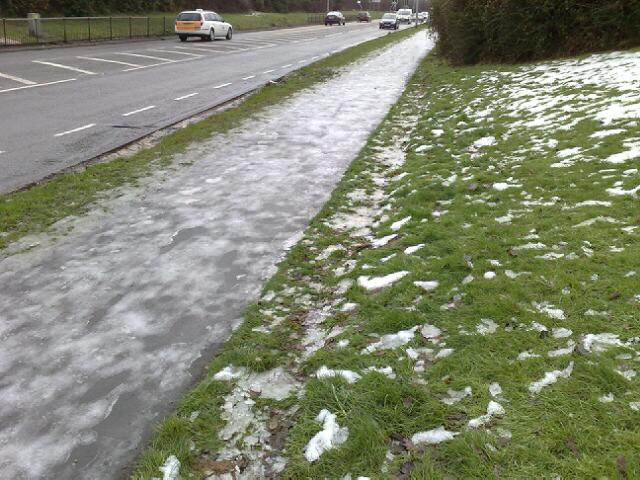
Path to hospital at junction of Nethermayne and the Knares, 24 December 2009

Path to hospital, 24 December 2009

These two pictures were taken of the main footpath to the principal site of Basildon and Thurrock University Hospitals on Christmas Eve 2009 – exactly one week after the heavy snow falls that caused chaos in South Essex. It was still iced over even when the snow on surrounding banks had melted and the roads had been gritted.

In the NHS Foundation Trust’s own words:

[We] primarily serve the almost 400,000 population of Basildon and Thurrock in South West Essex, plus some residents of the neighbouring districts of Brentwood (for whom we are the main provider of cardiology services) and Castle Point.

With a annual budget of £250 million, the Trust treats 63,000 inpatients and day cases, provides 270,000 outpatients consultations and attends to more than 90,000 Accident and Emergency (A&E) patients.

And pictured just above is the path people had to walk to reach that hospital, should they not be fortunate enough to drive a car.

I met an elderly constituent of mine as I walked to town that Thursday. He was incandescent. He is usually a charming conversationalist, but that day he had only three words for me as he gestured unsteadily with his walking stick at the ice: “It is wicked”.

The Basildon Recorder was forced by Essex County Council to issue an apology when it ran a story criticising the county for inadequate salt supplies. Apparently, there is no shortage:

“The county council would like to assure residents that Essex County Council continues to be fully prepared for icy winter conditions with more than sufficient supplies of gritting salt for the bad weather.”

So if there was no shortage, I can only assume that Essex County Council simply doesn’t care about pedestrian access to the major health facility in the south of the county. Surely, if there was salt, and it gave a stuff, Essex would have taken the time to grit this major pedestrian route? Winter 2008/2009 saw the highest excess winter mortality rates for ten years. It is hard to believe that figure will be lower for 2009/2010 if this Winter is harsher. Respiratory illnesses are just one set of conditions that are exacerbated by conditions in the winter months. (If you are really interested, there is a superb paper on the website of of the Centre for Public Health at the Liverpool John Moores University entitled Weather forecasting as a Public Health Tool). People need to be able to get to hospital – and that includes by foot.

This is the Met Office weather warning for the East of England, for Tuesday 5th January, issued on Monday 4th January:

“There is a moderate risk of severe weather affecting east and southeast England.

Outbreaks of sleet and snow will become heavier during Tuesday afternoon and evening, with an increasing risk of disruption to transport networks.

Issued at: 1124 Mon 4 Jan”

Sky News is warning Heavy Snow Set to Bring More Travel Chaos.

The question I have is: will Essex County Council heed the warnings and make an effort to ensure that key footpaths are snow and ice free this time around?

To finish, three simple things:

Stop throwing the taxes of hard-working local people at self-indulgent, speculative schemes.

Stop criticising the press for reflecting local concerns.

Start delivering a basic level of service: grit our roads and footpaths, especially where they provide access to major facilities such as hospitals.

Add to FacebookAdd to DiggAdd to Del.icio.usAdd to StumbleuponAdd to RedditAdd to BlinklistAdd to TwitterAdd to TechnoratiAdd to Yahoo BuzzAdd to Newsvine

Tories and IT procurement: headline-grabbing opportunism

Francis Maude has made the bold statement that the Tories will ban IT projects that cost over £100m. It looks good in the headlines. He said:

“Labour’s IT procurement process has been marked by a catalogue of failures, late deliveries and cost overruns.

“We need a freeze on signing up to yet more failed projects.”

You can read the full story in the Telegraph by following this link.

A week is clearly a long time in Tory politics.

On December 22  I blogged about the £5bn proposal by Lord Hanningfield‘s Tory administration in Essex to hand over the running of services it is unable to provide effectively itself to IBM. You can remind yourself of the story here.

Contrast the Tories’ willingness to talk tough on cash limits on  IT projects at the centre (probably quite sensible knowing how badly some of them have failed), with their example in local government in Essex. Unlike other local authorities, Essex are off-loading services that they clearly believe they are no longer capable of delivering. It strikes me as a comprehensive admission of political failure to deliver. If Maude’s boast is to have any credibility, the sheer untested lunacy of Hanningfield’s project demands robust intervention from Cameron et al.

Just as irresponsible spending on projects in Whitehall needs clamping down on, so local authorities, including Tory Essex, should not receive carte blanche to experiment with innovative IT projects at vast public expense.

Headline-grabbing opportunism is one thing. Dealing with your own IT cowboys is something entirely different.

Add to FacebookAdd to DiggAdd to Del.icio.usAdd to StumbleuponAdd to RedditAdd to BlinklistAdd to TwitterAdd to TechnoratiAdd to Yahoo BuzzAdd to Newsvine

Tory-run Essex County Council becomes Cameron’s sandbox

IBM takes on services in Essex as part of £5bn privatisation deal

It is one of those headlines that makes you wonder where on earth it will lead. I’ve spent the past hour wondering if my immediate Tweet in response was over the top and a misinterpretation of what is going on:

Essex Tories begin revolutionary dismantling of public services – with Cameron’s full support

It wasn’t.

This is a deal that has the potential to fundamentally alter the nature of local government in England. A Cameron win in 2010 could see a revolution in the provision of local services that strangles political differentiation, subjugates community priorities to an ideology of technocratic efficiency – and all whilst reassuring voters that these changes are merely efficient and (of course) apolitical.

Superficially, the attraction is obvious.

Politicians are held in contempt on a national and local level. (Ironically, Lord Hanningfield bridges the gap between the national expenses scandal and the crisis in local service provision in extraordinary fashion, with reports that detectives have sent files to the Crown Prosecution Service alleging fraud, just at the point that Essex County Council, which he leads, is condemned for its appalling record on children’s services.) What better way to score a political victory than to tacitly acknowledge that distrust by placing the delivery of services in the hands of a non-political and widely-respected industry leader such as IBM?

IBM has considerable experience of public service delivery in Canada, as the Times article linked in the headline shows. There is an impressively detailed exposition of its objectives and relationship with Canadian public services in IBM’s paper Service Canada – A New Paradigm in Public Service Delivery. Even a cursory reading demonstrates that IBM’s engagement in Canada is very, very different to what is being reported has been agreed with Hanningfield. Prioritising 21st Century public service delivery in a mountainous, multi-lingual country, that is the second largest in the world, yet the ninth least densely populated, is rather different from the Essex experience (Langdon Hills may boast “one of the most astonishing prospects to be beheld“, but. let’s face it, we’re not exactly talking the Rockies here). Yet even with these laudable objectives, the project has attracted criticism on a variety of levels, for its effect on women, its impact on health care and even concerns for national security. (A google search consisting of “public services” “wholesale privatization” and “canada” is revealing.)

I have no ideological objection to the delivery of public services through the private sector. I believe that the well-considered and appropriate out-sourcing of services and the importation of industry best practice have led to genuine improvements in service. The key to its success is the accountability that comes from having contracts that are carefully scrutinised, regularly reviewed and competitively tendered for.

At the same time, I am very conscious that public services are exactly that: services provided to the public by authorities that should be transparent, prepared for detailed scrutiny and, ultimately, held to account. There is a balance to be struck and the job of local politicians is to strike that balance, serving the needs of those they represent as best they can. Those in opposition draw attention to deficiencies in current services and offer an alternative programme for local priorities.

Ultimately, the people who pay for and use those services decide who they want in charge.

Hanningfield’s wheeling and dealing should send a chill through anyone who still places a value on choice, transparency, accountability, competition and social justice. Companies like IBM don’t invest in technological infrastructure to run services for a couple of years. They expect to be the partner of choice for many. The contract we are told is for eight – well beyond the date of the next County Council elections. And as many will have noticed,  it is measurably harder to extract detailed information from private sector partners, council officers nervously explaining that such information is restricted due to the need to observe commercial confidentiality (actually it isn’t, a lot of the time, but that’s another story).

Couple the Essex example with Tory-run Barnet’s attempts to experiment with ‘no-frills’ local government services – two-tier services that lead to extra charges or rebates depending on how much you need them – and everyone involved in the political conversation of the country should take note:

The Cameron revolution is under way before a single vote has been cast and it shows every sign so far of being as ideological, divisive and destructive as Thatcher’s.

We in Essex and Barnet may be living in Cameron’s sandbox today, but the results of these experiments could inform the local services of everyone tomorrow – for years and year to come.

Add to FacebookAdd to DiggAdd to Del.icio.usAdd to StumbleuponAdd to RedditAdd to BlinklistAdd to TwitterAdd to TechnoratiAdd to Yahoo BuzzAdd to Newsvine