Basildon Arts Forum launched… and Old Man Stan on the fate of “The Woodsman” #woodsman #toryfail

Exciting news from Basildon’s artistic community.

The first “Basildon Arts Forum” is to be held at St Martin’s Church Hall, Basildon Town Centre on Monday 1st March at 7pm. Anyone interested in seeing a thriving artistic community in Basildon is welcome. As spaces have to be limited for health and safety reasons please drop an email to Liz Grant if you are intending to come: lizzy_grant@btopenworld.com.

Also, in the best traditions of anti-establishment art, the irreverent Old Man Stan has decided to share his views on the fate of “The Woodsman”. He really is the most incredible creation, sort of like Alf Garnett crossed with Statler and Waldorf and “Grandad Trotter”. I hope that those it lampoons remember that satire in Britain has a handsome pedigree – and take it in the spirit of Fousgasse and Hogarth.

Or at least Spitting Image.

Add to FacebookAdd to DiggAdd to Del.icio.usAdd to StumbleuponAdd to RedditAdd to BlinklistAdd to TwitterAdd to TechnoratiAdd to Yahoo BuzzAdd to Newsvine

“The Woodsman”: Chance for Council to decide? #woodsman

Those who are interested in “The Woodsman” may wish to know that at the next Council meeting (18 February 2010 at 6pm) I will be moving the following motion for discussion:

“The Council welcomes the demonstration of public support for reinstating The Woodsman in St Martin’s Square, recognises the talent and generosity of Dave Chapple in giving The Woodsman to the people of Basildon, and commits to its restoration and reinstatement in St Martin’s Square at the earliest practical opportunity.”

It is the last item on the meeting’s agenda – and the agenda is a very long one as it will also deal with setting the level of Council Tax (there is therefore a danger that it might not be reached).

The Council meets in the St George’s Suite and it is a meeting open to the public (public question time is the first item on the agenda – questions have to be submitted in writing three days before (the deadline is usually regarded as 10am on Monday).

Add to FacebookAdd to DiggAdd to Del.icio.usAdd to StumbleuponAdd to RedditAdd to BlinklistAdd to TwitterAdd to TechnoratiAdd to Yahoo BuzzAdd to Newsvine

And yet more pointless municipal vandalism…

Sometimes a picture says all that can be said. For some reason, Conservative-controlled Basildon Council has decided to rip out the relatively recently constructed features that distinguish St Martin’s Square. When the bid to the Government for money for new lighting was discussed, this wasn’t. (Nor were the design and placement of the lights, but that’s another story.)

When Em’s family visited for the first time they commented on how pleasant and unusual that part of St Martin’s Square looked. How sad that this is the last picture I took of it.

Demolishing St Martin's Square

Demolishing St Martin's Square

I can’t help feeling that these Conservative councillors care less and less about the area and more and more about building some lasting concrete (!) legacy. Exactly the criticism they made of previous Labour councillors. Is it any wonder that people give up in despair?

Rooting around on the Council’s website I found the notice to tender for the contract. Strangely, there is no information in the appropriate section to say who got the contract. To that end, concerned residents might wish to be aware that the tender has just closed for further works to Compass Square (I believe Compass Square is the area immediately in front of the Bascentre). I wonder if the Council will say who has secured that?

Add to FacebookAdd to DiggAdd to Del.icio.usAdd to StumbleuponAdd to RedditAdd to BlinklistAdd to TwitterAdd to TechnoratiAdd to Yahoo BuzzAdd to Newsvine

“Progression”: ‘extraordinary attitudes’ that did for “The Woodsman”? #woodsman

Following my post on “Progression” and “The Woodsman” I made contact with the artist Michael Condron, the sculptor commissioned by Basildon Council to make “Progression”. I thought it courteous to draw his attention to the fact I was blogging about his work. His response – which he is happy for me to share – is an extraordinary and depressing indictment of the lack of courtesy and general ignorance of Basildon Council (and by extension its Conservative administration) in its dealings with artists and issues of public art:

“The attitude Basildon DC has shown towards it’s public art is pretty extraordinary, and fortunately not the kind of behaviour I’ve come across elsewhere.

The relocation of my Progression sculpture was not something I was consulted on.  Whilst I’m not entirely happy with the new situation, it is better than the artwork rotting in a storage yard somewhere.

You mentioned NYC’s percent for art programme in the blog, and I wonder if you’re aware that Essex County Council also has a percent for art policy.  Many commissions have been funded by developers through “section 106” planning requirements, including my recent Life Cycle installation at Hanningfield reservoir.

Generally speaking public art is vibrant in Essex!”

What is particularly depressing is that, whilst Basildon’s Conservatives neglect and rip out our public art, the record of Essex County Council, another Conservative administration, is a national leader when it comes to supporting public art. As Condron notes, Essex does indeed operate a percent policy for art. Art in the Open singles out Essex as its case study for best practice in “embedding public art within Council-led capital projects”. The page on commissioning guidance states:

“Essex County Council (ECC) has been commissioning art in the public realm as part of its Capital Development Programme and Essex Design Initiative for many years.  It was the first County Council to develop and adopt the principle of a public art policy in the late 1980s.  In 2002 it adopted a Percent for Art policy and, more recently, has developed a central budgeting process to create a new fund, the Public Art Common Fund, that draws money directly from ECC’s capital programmes budget, enabling the public arts team to plan longer term.  This has lead to the development of a three-year programme of more substantial commissions under the banner of ‘Genius Loci’ (‘Spirit of Place’).  These commissions are predominantly permanent but also include some temporary work to help highlight and pave the way for the permanent.”

What’s more, Essex demonstrates that it truly understands the purpose of public art:

“ECC seeks to commission art in the public realm to:

  • Improve the aesthetics of the built environment
  • Enhance a sense of community and place
  • Foster community pride and ownership
  • Celebrate artistic achievement
  • Reflect a ‘spirit of place’”

To demonstrate how serious Essex is about supporting public art, Art in the Open explains how the County Council organises the staff that support public art:

“ECC believes in an embedded and informed approach to commissioning art in the public realm.  It runs workshops and organises study trips to support internal development and understanding; the public art team sits within the built environment department, ensuring a close working relationship across planning and development teams; a Public Art Strategy Group, chaired by a cabinet member and including officers from across the council, helps keep an informed overview; occasionally, external organisations are brought in to provide additional commissioning support.”

And the big question in local government is always the money:

“Funding streams:

  • Percent for Art: up to 1 per cent of almost all capital builds across the council. This has been consolidated for 2007-2010 as the Public Art Common Fund where 0.74 per cent, £2.14 million, has been designate for Genius Loci. The continuation of the Common Fund beyond 2010 is subject to approval by the Council and is depended on a successful bid from the Public Art Team.
  • Money can also be brought in through section 106 (however, this mechanism is dependent on the policy of the local planning authority not the County Council).”

To be honest, it is a pretty extraordinary commitment from a local authority and I applaud Essex’s seriousness in making public art accessible and relevant – not shoved away in corners as museum pieces to be visited.

So why is it, with such a leading example so politically and geographically close to home, that Basildon’s Conservative Party acts like a Neanderthal collective when it comes to  public art? I can’t answer that. However, I can only think that the “pretty extraordinary” attitude identified by Condron was a principal contributing factor to the appalling ruin of “The Woodsman”.

Add to FacebookAdd to DiggAdd to Del.icio.usAdd to StumbleuponAdd to RedditAdd to BlinklistAdd to TwitterAdd to TechnoratiAdd to Yahoo BuzzAdd to Newsvine

Cultural vandals: Basildon’s Tories tear up the national motorboat collection as the Motorboat Museum is closed #toryfail #basildon

In yet another display of cultural vandalism, Basildon’s Tories have torn up the national motorboat collection, following their closure of the nation’s Motorboat Museum so it can be converted into a “green” centre. To give you an idea of the collection’s significance, here is an excerpt from the note on the website about it:

“The Motorboat Museum has been Britain’s leading authority on sporting and leisure motorboats since its creation in 1986.

Many record breakers and rare examples of boats, inboard and outboard motors are housed in the Museum. There is also an extensive collection of historic replica models and memorabilia.

The comprehensive library holds books, magazines and plans dating back to the 1890s. The library is open for use by researchers by appointment only. Enquiries can also be made through the post.”

The museum’s website says the following:

“We’re sorry to announce that the Motorboat Museum is closing down as of 4th December 2009.

Due to large scale refurbishment of the building housing the Motorboat Museum, it is necessary to close the Motorboat Museum and repatriate the collection.”

Back in November, The Echo ran a story on with the headline £1m green centre to open on site of boat museum. In that article, there is a reference to the Council’s postition:

“It would see half of the existing motorboat museum transformed into the new green museum by Spring 2011.

The other half will go out to lease, but could still remain as a venue for powerboat enthusiasts if an interested party comes forward to take over the running from Basildon Council.

Although planning is still in the early stages, it could also house historical artefacts and other items of interest.”

The article concludes:

“The council stressed all options were still open regarding the remainder of the motorboat museum, which is now only visited by about 10 per cent of visitors to the park annually.”

On the 12th November, Cabinet met and agreed to take further funding from the Department for Communities and Local Government under its Parklands Initiative. (I sit on Cabinet but, detained at work, missed the first items on the agenda, including this one. You can see from the voting record at the back of the minutes.) The report to Cabinet states:

“The second phase of funding will develop part of the Motorboat Museum to create a new community facility that provides education on the environment and the reduction of carbon.”

As this was an extensive redevelopment, you would expect it to close to the public for some time – and for the collection to be temporarily relocated.

So to recap…

On 9 November The Echo runs a story saying it could close.

On 12 November Cabinet meets and paves the way for the museum’s closure to permit the works at Wat Tyler.

On 4 December or before, the  Motorboat Museum posts a story on its website saying that as of 4 December the Motorboat Museum is to be closed and its collection repatriated.

Look again at that press comment. It is written in the clever spin-speak you come to expect of politicians and bureaucrats who want you to reach their conclusion: “now only visited by about 10 per cent of visitors to the park annually”. It is the language of minimisation, when you want to make something less significant.

But remember what Councillor Horgan said of “The Woodsman” and Wat Tyler Park? It bears repeating:

“The woodsman is a well loved piece of public art, and we believe that a new home at Wat Tyler Country Park is more suitable and appropriate, where he will be appreciated by the hundreds of thousands of people that visit the park each year.”

Note the figure: hundreds of thousands. Ten percent of hundreds of thousands means that the Motorboat Museum was being visited by tens of thousands of people annually. A rather more impressive figure than we are led to believe by the figure of ten percent. Indeed, the Cabinet report of 12 November is very specific about Wat Tyler’s projected visitors: numbers are projected to increase to 450,000 in two years. That means that the Council are acknowledging that the museum would receive 45,000 visitors a year in the next two years.

I don’t think 45,000 visitors is an insignificant number for a museum that I doubt has been widely promoted in recent years. (If you have time, the Cabinet report is worth a read – it is riddled with contradictions which it has been suggested to me is the product of repeated redrafting and editing.)

The Motorboat Museum is a registered museum with the Museums, Libraries and Archives Council. As such, upon closure, certain protocols have to be followed to ensure that the collection is properly dispersed (I am not certain, but I presume that this is so that items in the collection can be traced). I have seen correspondence which reassures me that those protocols are being followed. However, the fact remains that the collection as was is no longer intact and a sizeable number of the boats have already been relocated.

Personally, I don’t believe the Council has invested any serious effort in maintaining the integrity of the collection. I have nothing against taking funding from Government for a new green education centre. However, if the Council were bothered enough, they could have sought to preserve this nationally significant collection. I think that when the meeting was held on 12 November, the decision had already been taken privately by administration councillors that they were no longer interested in the Motorboat Museum. They wanted to be rid of it – and the “hassle” of looking after its collection. If I am wrong, and I hope I am, then we will see plans coming forward to preserve and display the remaining boats. After all, all options are still open. Or were.

For once, Basildon was able to lay claim to providing a home to a nationally significant collection (if you Google “”motorboat museum” basildon” you get over 8,000 hits). The Motorboat Museum was a landmark institution – and I don’t recall Basildon Council Tax payers being consulted as to whether Basildon should continue to provide that home.

Irrespective of local people’s views, the fact is Basildon no longer is.

Once again, the Tories have demonstrated their complete contempt for our local and national heritage – and taken us all for suckers.

Add to FacebookAdd to DiggAdd to Del.icio.usAdd to StumbleuponAdd to RedditAdd to BlinklistAdd to TwitterAdd to TechnoratiAdd to Yahoo BuzzAdd to Newsvine

“The Woodsman”: When being free is still not cheap enough #basildon #woodsman

I’ve spent some time reflecting on Cllr Tony Ball’s statement that he made regarding “Progression” (see my earlier post “Progression” and “The Woodsman”: A Tale of Two Sculptures):

“We are not against the art – but the cash should be from private sponsorship.”

I realised I didn’t know anything regarding the financial provenance of “The Woodsman” and whether or not Basildon Council had commissioned it, assisted with transportation costs, paid for its installation etc. I decided to email Vin Harrop, heritage director of Our Basildon, and ask that question. His response was fascinating:

“Dave Chapple on behalf of the then Basildon Arts and Design Initiative (BADI)  gifted the finished work to the people of Basildon.  It took him 5 months to complete, working for nothing from June 1995. He was 63 years old at the time and wanted to work on that scale before he got too old. Dave spent three days a week and never missed a day, each day he was surrounded by scores of people inquisitive to know what he was doing, if he had cut down the tree and how much it was costing. Dave always replied “not one penny”.  People were visiting Dave on a regular basis offering gifts in particular food, so you can see he built up quite a rapport with all those using St Martin’s Square. This is why we use the term ‘People’s Artist’, for he was a man of the people (born in Vange) who created his art for the people of Basildon.

Basildon Council gave permission to install scaffolding in front of the Basildon Centre and covered the hire of a lorry to transport the fallen tree from Langdon Hills, and Dave’s public liability- about £300 in total. The scaffolding was provided as part of a sponsorship deal- other funds were sought but they (BADI) were unsuccessful.”

So here we have it. Unlike “Progression”, which was paid for from public funds, “The Woodsman” cost nothing except the £300 for transport and liability insurance. I have since been told that BADI may have actually raised that £300 also.

It would seem that even when a work is sponsored from private funds, the Conservative administration is not interested in maintaining “the art”. I don’t know if that makes Cllr Ball “against the art” – it does, however, leave a bad taste in the mouth to see the landmark carving of a local artist mouldering on its side in Wat Tyler (I understand it now has a tarpaulin over it).

“Hardcore Carvers” are a group of independent artists and entertainers who specialise in making large wooden carvings (often with chainsaws). They treat their external oak sculptures yearly with teak oil.

B&Q’s cheapest teak oil is currently £5.16 a litre.

The Sporting Village is costing £38 million.

It makes you think about the balance of priorities.

Add to FacebookAdd to DiggAdd to Del.icio.usAdd to StumbleuponAdd to RedditAdd to BlinklistAdd to TwitterAdd to TechnoratiAdd to Yahoo BuzzAdd to Newsvine

So… Should Basildon be a Borough?

Over on basildonFOCUS, my colleagues and I have launched a survey regarding the forthcoming discussion at Council on Borough status (Wed 24 February 2010). If you live in Basildon and want your views to be heard, please take a few moments to click the relevant buttons.

Add to FacebookAdd to DiggAdd to Del.icio.usAdd to StumbleuponAdd to RedditAdd to BlinklistAdd to TwitterAdd to TechnoratiAdd to Yahoo BuzzAdd to Newsvine

New petition to restore and reinstate The Woodsman in St Martin’s Square #woodsman #basildon

For those who have been following the story of “The Woodsman” there is now a petition running on ipetitions to show support for its restoration and reinstatement in St Martin’s Square, Basildon. Signing it only takes a few moments. There is also a drop-down question box on whether or not you live in Basildon or are simply concerned about “The Woodsman”/public art.

Sign the petition on “The Woodsman” now!

Add to FacebookAdd to DiggAdd to Del.icio.usAdd to StumbleuponAdd to RedditAdd to BlinklistAdd to TwitterAdd to TechnoratiAdd to Yahoo BuzzAdd to Newsvine

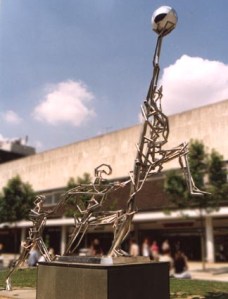
“Progression” and “The Woodsman”: A Tale of Two Sculptures (Or: Basildon’s Tories and Public Art)

"Progression" - Michael Condron

“Progression” – Michael Condron

It is sobering to realise how quickly things fade from the memory.

The controversy surrounding “The Woodsman” and an emailed comment from a friend in Basildon Choral Society has reminded me of the fate of “Progression”, the sculpture created by another exciting Essex artist. Ten years ago, Rochford-born sculptor Michael Condron was commissioned by the Council to create a piece of work to celebrate Basildon’s journey into the new Millennium. The general nature of Condron’s work  is summarised well on the website of Chelmsford Borough Council:

“Michael Condron is a sculptor whose principal aim is to make artwork that belongs to its place. A common theme running throughout his work is a sense of fun and discovery. His sculptures can be interactive, responding to the viewer’s presence with sound, movement, light and even bubbles!”

From even that brief description it is clear that his creations are intended to be touched not just looked at. His installations are almost performance pieces, challenging young and old to explore their physicality as well as admire their lines and designs. That this was intended for “Progression” is borne out by the detailed design information that is available on Condron’s website:

“The sculpture will require little maintenance beyond routine inspection, being robust enough to withstand vandalism, people climbing, etc. Any dirt/graffiti can easily be cleaned by Basildon District Council’s normal maintenance contractors. As the sculptures are set at ground level, the surrounding grass will need to be cut with care. A nylon cord strimmer should be used close to the sculpture to prevent damage.”

Interestingly, the issue of health and safety, the reason so often cited for its removal, was addressed throughout:

“The Artist liaised with Basildon District Council to ensure that any Health and Safety concerns over the design were addressed, including edges, projecting parts, trip and slip hazards.”

The biggest controversy surrounding “Progression” centred on its cost. The Conservative opposition said that spending £25,000 of public money on public art was a waste of money. Instead, Cllr Tony Ball said that the money should be spent on Wickford Citizen’s Advice Bureau and Billericay Citizen’s Advice Bureau who, at the time, faced a cash funding crisis.

Thankfully, they are both still there doing a very important job.

“Progression” is not.

In the story linked above, Cllr Ball makes the following comment:

“We are not against the art – but the cash should be from private sponsorship.”

Personally, I disagree. I believe that public art fulfils an important purpose, in the same way other facilities do. Public art makes the places we live in less severe, breaking up their harsh anonymous lines. It helps create a unique sense of identity.

Other places have been far more welcoming of publicly-commissioned art installed in public spaces. Sticking with Condron, in Woking, his “Martian” has been hailed by visitors as a masterpiece and draws on the local heritage of H. G. Wells. In Slough, he worked with Beechwood School to mark its relocation, creating “Moving On” from pieces of steel cut according to outline drawings of pupils’ feet.

Elsewhere in Essex, his “Timeline” was the result of a commission from the Essex Records Office. The Colchester and Tendering Hospital Arts Project commissioned him to create “Tube Figures”, a series of sculpted figures installed around their hospital sites.  Even the County Council commissioned Condron – after “Progression” was installed.

Elsewhere, the importance of public art is recognised in law. In New York, that bastion of socialism, there is a 1% rule:

“In 1982, the Percent for Art law was initiated by Mayor Edward I. Koch and passed by the Council of the City of New York requiring that one percent of the budget for eligible City-funded construction projects be spent on artwork for City facilities.”

In Norway, which also has statutory funding requirements in respect of public buildings, the government has a professional body for public art (KORO) with a clear statement of purpose:

“Art expresses human creativity and originality. Through art, reality is adapted in order to convey new experiences, new understandings and new insights. Producing art for public spaces is a way of expressing a democratic idea that upholds the right of every person to experience art.”

In the course of my professional work I have had reason to visit Norway and have held discussions with senior public figures regarding the role of public art in promoting health and well-being. I had the good fortune to be shown around a new hospital being built, in which each room was carefully decorated and the communal spaces were filled with beautiful works of public art. The feeling of peaceful recuperation was palpable. (There was even a piano, regularly tuned and maintained, for patients, visitors or staff to play.)

In its own small way, “The Woodsman” did just that. It broke up the harsh lines of the commercial space around it and reminded us of softer, greener and older places – and reminded us that we each have the right to experience art. Experience is an important word, too. It is not about ‘liking’, though many of us loved “The Woodsman”. ‘Dislike’ is important in creating a discussion, getting us engaged in the debate about how our environment should look.

Where is that discussion in Basildon?

Ten years’ on from “Progression”, public art produced in Basildon, for Basildon, by a Basildon artist, is now rotting in an anonymous yard.

£38 million can be spent furthering the sporting interests of the district, but the Council is not even prepared to spend the few thousand necessary to restore “The Woodsman” to the space it was made for (and made in).

And whilst “The Woodsman” lies open to the elements, but closed to the public, what of Condron’s “Progression”? This piece, a work that was designed to “withstand climbing, swinging, vandalism or the elements”, is also in Wat Tyler Country Park, fenced off from the public like some museum piece.

This tale of two sculptures is also the story of the diminution of Wat Tyler Country Park. Wat Tyler has its own identity, its own story to tell of struggles ancient and modern.  It shouldn’t become the repository of Basildon District Council’s public art – where you have to make a visit to see it and admire it from afar.

The more I think about it, the more Friday’s symbolic funeral wreath, which could have been mocked for its mawkishness and sentimentality, captures a vital idea – the sad passing away of public art in Basildon.

I would challenge those who are “not against the art” to say otherwise.

For those who are interested in Condron’s work, I have pulled together a gallery on Flickr from publicly available pictures. It is predominantly made up of shots of his three-piece “War of the Worlds” installation in Woking – you can find examples of his other work on the links above.

If you want to find out more about public art in general, Wikipedia has a very good entry which should serve as a useful starting point. Public art online is a leading UK website which covers information from across the country as well as internationally. Artquest has a very interesting section entitled Government Policies and the Arts which looks at the statutory framework regarding public art in different countries. It also contains a free library of legal information for artists on its Artlaw subsite. There is also a directory of public art which contains news of new installations as well as a growing collection of public art from around the globe.

Add to FacebookAdd to DiggAdd to Del.icio.usAdd to StumbleuponAdd to RedditAdd to BlinklistAdd to TwitterAdd to TechnoratiAdd to Yahoo BuzzAdd to Newsvine

The Woodsman Facebook Group: the significance of public art

There is now a Facebook Group Save The Woodsman that has been set up by members of Basildon’s artistic community. If you are a Facebook user, please take the opportunity to have a look. Attitudes to public art – and the conduct of local authorities – is not just a local issue. The precedents set by councils in different local areas helps shape and define national policy and guidance. Public art makes a valuable contribution to the health and well-being of our communities.

Your support for The Woodsman will help send a message to local government about the communities we all live in.

Add to FacebookAdd to DiggAdd to Del.icio.usAdd to StumbleuponAdd to RedditAdd to BlinklistAdd to TwitterAdd to TechnoratiAdd to Yahoo BuzzAdd to Newsvine