Last night I stumbled across one of the most inspirational and best-presented documentaries I’ve seen in years. Typically it was on in the middle of the night and a brief summary (a history of statistics presented by a Swedish professor) might make you think it was one from the early canon of Open University spectaculars.
However, Professor Hans Rosling is one of the most exciting and engaging presenters I’ve seen on television in a long time. After a long day in the office, his quirky, amusing and insightful jaunt through the past, present and possible future of statistics was gripping. If you missed it, you can look at The Joy of Statistics on BBC iPlayer.
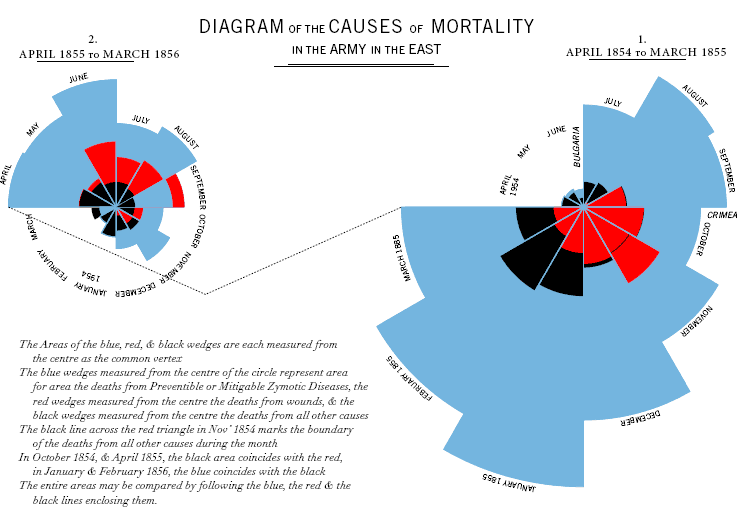
One of the most engaging aspects was his demonstration of how the stories of numbers are often best told through visual depiction.
For instance, I had no idea that Florence Nightingale was a statistician. It was her meticulous record-keeping translated into startling pictures that drove the changes in nursing that she instituted:
Over a hundred years later, people like David Mccandless make their living finding ways to translate complex information into more readily understandable pictorial form. On his Information Is Beautiful blog he finds different and exciting visualisations of statistical data. The Billion-pound-o-gram is his way of making those mad, large numbers more comprehensible:
Perhaps the most spectacular use of animation was Professor Rosling’s depiction of the progress of countries in terms of their life expectancy and their income. His enthusiasm, love and knowledge are a real joy to behold. To really see a story told in numbers, watch this little snippet below:
My future brother-in-law, Mr Bagnall, reminded me of one television programme that must be one of my all-time favourite childhood memories. Who could have thought that a five minute short animation of the simplest kind could create such a comforting sense of timelessness?
When so many of today’s children’s programmes are such a disruptive mess of loud music, rudeness, primary colours and inane bouncing around, the undramatic stories of The Merioneth and Llantisilly Rail Traction Company Limited, that recognise children are capable of being entertained in far quieter, more thoughtful ways, seem almost revolutionary.
There’ll be plenty of people of my generation (mainly men with nerdy secrets I suspect) who, notwithstanding the CGI wonders of Michael Bay’s special effects-fest, have a special fondness for the animated series of Transformers and the tinny beep of “Tranformers Robots in Disguise” over the dark thunderings of Linkin Park’s “New Divide” (I imagine my younger brother Seth is among them!).
Very amusing then to open Metro this morning and to see a story about Drew Beummier, a contestant on American Idol, who has discovered that “chicks find it sexy” when he wears his home-made Transformer suit.
Apart from wondering if Em thinks I’ve missed a trick somewhere along the line, I do wonder if this is taking fond childhood memories a step too far?
Anyway, he’s hoping to have the suits on sale in the UK soon…
You could be forgiven for thinking that part of the appeal of “Never say ‘No’ to Panda” is the peculiar novelty of seeing pretend animals acting in unexpectedly violent ways. However, I was shocked to discover possible antecedents in the early work of Jim Henson and an era of “muppet ultraviolence” that hitherto had passed me by.
In 1957, Henson was contacted by Washington DC-based Wilkins Coffee. They asked him to produce a series of 10 second adverts for local tv stations. Between 1957 and 1961 he made – according to the Muppet Wiki – 179 ads, in which Kermit-forerunner Wilkins, the Wilkins Coffee-lover, attacks Wontkins, the Wilkins Coffee-hater, in varyingly violent ways.
The question I have is… Whatever happened to Wilkins Coffee?
Surprisingly, there’s very little information out there, even in the vast cyber-wilderness of the Internet. According to a poster on Michael Procopio’s blog Food for the Thoughtless:
Wilkins sold the roasting plant to The Great Atlantic & Pacific Tea Companyin 1970 and continued to distribute Wilkins Coffee from Landover, Maryland.Halco, a public company, purchased Wilkins in 1974 and the division was calledHalco/Wilkins Food Service. Wilkins was once again separated and sold in 1982.
There the trail seems to go cold and there are few if any references to what happened to Wilkins Coffee. A second poster on the same site reports that the name was bought by Royal Cup Coffeebut notes that there are no products sold with that branding.
Frustratingly, there appears to be very little information available about Wilkins Coffee before its murderous muppet adventures. The only thing I could find is a tantalising early reference in this list of radio programmeswhich details a 15 minute transmission on WRC (National Broadcasting Co.) at 6.30pm EST on Friday 3rd October 1930 by the Wilkins Coffee Orchestra.
I wonder how big a phenomena that was? I wonder how proud the members of this now-forgotten ensemble must have felt to hear themselves broadcast over the airwaves?
There must have been countless numbers of similar artistic ventures sponsored by companies that are now barely footnotes in our global industrial history. Wilkins Coffee, boasting advertising budgets that could fund hundreds of television ads, now really only survives in the global consciousness as an interesting chapter in the early history of the lunatic puppets created by Jim Henson.
If you can cope with the undoing of happy childhood memories of Kermit’s nephew Robin singing “Halfway Down The Stairs”, take a look at the clips below.
I am not in any way claiming an original discovery here, not with 6,000,000+ views on You Tube. However, there is something darkly satisfying about the humour in this ad campaign by Egyptian company Advantage Marketing and Advertising/Elephant Cairo, the first Middle Eastern company to win a Cannes Lion Award. Created on behalf of Arab Dairy, “Never say ‘No’ to Panda” took a Silver Lion in 2010, as well as a Gold Award at Epica 2010
This series of adverts for Panda Cheese combines humour, subtle menace and explosive violence in a manner not normally associated with pandas. Images of the silent panda-suited star, juxtaposed with the cheerful twang of Buddy Holly’s True Love Ways, creates a sense of the surreal more redolent of Donnie Darko than your average cheese advert.
Dairy Lea it is not!
More than anything, though, it catches that moment in every day when there is nothing else to do but unleash your inner panda…
1990 and Twin Peaks had been the subject of fevered classroom conversation for weeks. There had been teasers and trailers. Deliciously, it was airing on BBC2. Mark and I were in our final year of sixth form, enjoying a friendship that had been long in the making: a knowledge of each other in primary school refined by the ruin of other friendships in secondary school and a discovery of shared interests in gaming and cards and quirky television.
Twin Peaks, the product of the warped creative genius of David Lynch and Mark Frost, was unlike anything else that had been on television. It was the 1990s and it was the first decade I felt I could truly own, really aware of the music and film and television informing the media culture we were growing up in. It was also the last Century of a dying Millennium and somehow the dark weirdness of Twin Peaks seemed utterly appropriate. And from the slow motion opening credits, accompanied by Angelo Badalamenti’s haunting score, I knew we were hooked.
The murder of Laura Palmer – and the seductive overtures of Sherilyn Fenn’s Audrey Horne – would overshadow our final school days.
That all seems a long time ago now and in the intervening years I forgot the specific qualities that made Twin Peaks uniquely brilliant. More sadly, friendships faded and with them the remembrance of things that made them live so vividly at the time.
Then, several years back I spotted Twin Peaks on DVD.
I couldn’t resist. I wanted to know if it had stood the test of time. And I wasn’t disappointed.
Like the very best wine and the very best whisky it had improved. In an almost Lynchian way, it didn’t feel dated – perhaps because so many of the usual markers that age television of a period (technology, city fashions etc) are absent. Instead it was fresh and provocative. And, once again, Twin Peaks accompanied the transformation of a relationship – this time in a very much better direction.
Having previously watched the whole of Sex and the City back to back with Em, Twin Peaks was always going to be something of a contrast. However, we were immediately immersed in Lynch’s mischievous and murderously dark envisioning, lapping up Agent Cooper’s humorous musings, Audrey Horne’s sensuous teasings and hankering after a mug of “damn fine coffee” and a slice of cherry pie.
Lynch is one of our favourite directors.
Even at his most disturbing, there is something shockingly honest about his camera and what it sees. Wild at Heart is one of the films that sticks most in my memory, my Midnight Cowboy or The Graduate, seeing it for the first time after I moved away from home to begin my studies in Hull. Nicolas Cage and Laura Dern give two career-defining performances in this twisted celluloid nightmare that somehow veers just the right side of kitsch, ricocheting through the violent badlands of an America that is only equalled by that of Quentin Tarantino and Oliver Stone in its capacity for brutality. IMDb has a long list of film trivia that is testament to the influences on Lynch and which he recognises in Twin Peaks through wry asides and visual tributes.
Em loved it.
And we both shared the same enormous frustration at learning that the release of Series Two had been held up by legal wranglings. I was particularly keen to get hold of it as I had – have – seen every episode except the very last. Mark never spoiled it for me and I don’t know to this day how the series resolved.
On several consecutive August excursions to Cornwall we asked the guy in Moods and Visions, in Falmouth’s George’s Arcade, if it had been released. We always left empty-handed, wondering if we would ever get to sit down with Coop again.
Then, quite by chance, walking past Basildon’s HMV just last week, I saw it.
Series Two.
Tonight we went back to Twin Peaks and picked up where we left off. It is gloriously bonkers and I am glad to be back home.
Buy it. Watch it.
Enjoy it for the uniquely brilliant piece of extended television theatre it is.
And just in case you are reading, Mark, here’s another little reminder of 1990…
I’ve just spent a very happy hour and a bit slumped on a sofa in front of a roaring fire, Em on one side, a mug of tea on the other – and “Nuts in May” by Mike Leigh on the television. As with all his films, it is a perfect study of the quirks and imperfections of human nature – and the little obsessions that drive us all. If you can laugh at yourself, and you’ve not seen it, try and get hold of a copy. Better still, if you like character-driven cinema, that examines the way we complicate even the simplest things with our hang-ups, routines and prejudices, get hold of a copy of “Mike Leigh: The BBC Collection”, which contains all his surviving films, plays and shorts for the BBC:




 Fragments and Reflections