Kino rage: the death of cinema etiquette (or… Be quiet!)

What is it about cinema? I’ve always loved it and we are spoiled today with an array of multiplexes. With their smaller studio screens they have even recognised that there is a market for art house and foreign cinema, as well as the latest blockbuster, so even those of a more discerning taste can find something to watch.

However, today’s excursion to Skyfall, a second viewing, mid-week and starting at just about tea time, was an eye-opener as far as the behaviour of other cinemas-goers  went. Perhaps at 40 I am becoming a curmudgeonly old git. On the other hand, perhaps my twat toleration levels are severely depleted. Anyway, herewith some handy thoughts to make communal viewing a more pleasurable experience, inspired by unprecedented levels of cretinous behaviour at today’s screening.

Start time

It used to be that you had to buy a local newspaper to find out what was on at the local cinema. Now, though, with a little initiative, you can find the start time listed online. Ain’t technology great? Knowing when the film begins is Very Handy. It means you don’t have to walk in after the adverts, after the trailers and after the opening sequences. Yes, that goes for all TWELVE of you that did that today. You can actually enjoy the whole film (!) if you turn up on time.

Seats

Cinemas generally allocate seats. You can find your seat reference handily printed on your ticket. Don’t be a twat and pretend that you didn’t know you were sitting in the premium seats when you only paid for standard. It’s only embarrassing for you when you are asked to move.

Fidgeting

Sit still. I realise this is a challenge in our ADHD-addled 21st Century world, but honestly. The length of the film can be found online. If you can’t sit still, don’t bloody ruin it for the rest of us by fidgeting like an arse and making your chair squeak.

Food and drink

It’s a cinema. Not a restaurant. Of course have a snack or sweets. But EAT QUIETLY. And certainly with your mouth shut, unlike the munching fules that insisted on rustling their popcorn today before chomping away with their mouths open, so we could all share in the sonorous delights of their mastication.

The loo

Go before the film. Trust me. It’s the best plan. As above, you can tell how long the film lasts. You know how long you can usually go without going. So go before. And don’t order that bucket-sized Pepsi which is a diabetes bomb waiting to explode. You never know when you are going to rub up against the person who won’t move or stand up to let you out. Plan ahead.

Phones

Does this really need saying? Turn them off! You are not James Bond, even if you think you are. You are not going to be called into action. If you are awaiting an important call, or are concerned about the welfare of someone else, get your priorities right and get out of the cinema. It’s not like you have to wait years for it to come out on DVD. You are NOT more special than the rest of us and you really can survive without a text message for two hours. There was a time when people went their entire lives without sending or receiving texts. No, honestly. It is true.

Talking

Don’t! Again, does this really need saying? The odd whisper? Of course. A gasp of surprise? Definitely. Laughter? If appropriate. Talking? NEVER!

And finally?

Follow these simple rules and enjoy the film. Or else…
70 years since five famous adventurers made their debut

It’s 70 years since Enid Blyton’s Famous  Five made their debut in Five on a Treasure Island. I remember reading those novels voraciously as a youngster, determined that when I was exploring castles, such as Raglan and Bodiam, I would also find gold and be an adventurer.

It wasn’t all harmony, though, probably as they were all family, and Anne and George certainly didn’t hit it off. For my part, as a kid I always thought George was a pretty cool kinda girl. There was no messing about with her. Or rather there was a lot of messing about – in trees, clambering rocks and generally getting into scrapes. Anne always seemed a little bit precious and not like any of the girls I hung around with. We were all in it together, grazing knees, throwing apples at each other and having stick wars.

Anyway, I maintain that Enid Blyton is the reason for my love of reading, my love of a good story and a continuing childish sense of adventure. So in celebration of the Famous Five, here’s Anne meeting George for the first time.

When Anne awoke she couldn’t at first think where she was. She lay in her little bed and looked up at the slanting ceiling, and at the red roses that nodded at the open window – and suddenly remembered all in a rush where she was! “I’m at Kirrin Bay- and it’s the holidays.” she said to herself, and screwed up her legs with joy.

Then she looked across at the other bed. In it lay the figure of another child, curled up under the bed-clothes. Anne could just see the top of a curly head, and that was all. When the figure stirred a little, Anne spoke.

“I say! Are you Georgina?”

The child in the opposite bed sat up and looked across at Anne. She had very short curly hair, almost as short as a boy’s. Her face was burnt a dark-brown with the sun, and her very blue eyes looked as bright as forget-me-nots in her face. But her mouth was rather sulky, and she had a frown like her father’s.

“No,” she said. “I’m not Georgina.”

“Oh!” said Anne, in surprise. “Then who are you?”

“I’m George,” said the girl. “I shall only answer if you call me George. I hate being a girl. I won’t be. I don’t like doing the things that girls do. I like doing the things that boys do. I can climb better than any boy, and swim faster too. I can sail a boat as well as any fisher-boy on this coast. You’re to call me George. Then I’ll speak to you. But I shan’t if you don’t.”

“Oh!” said Anne, thinking that her new cousin was most extraordinary. “All right! I don’t care what I call you. George is a nice name, I think. I don’t much like Georgina. Anyway, you look like a boy.”

“Do I really?” said George, the frown leaving her face for a moment. “Mother was awfully cross with me when I cut my hair short. I had hair all round my neck; it was awful.”

The two girls stared at one another for a moment. “Don’t you simply hate being a girl?” asked George.

“No, of course not,” said Anne. “You see – I do like pretty frocks- and I love my dolls- and you can’t do that if you’re a boy.”

“Pooh! Fancy bothering about pretty frocks,” said George, in a scornful voice. “And dolls! Well, you are a baby, that’s all I can say.”

Anne felt offended. “You’re not very polite,” she said. “You won’t find that my brothers take much notice of you if you act as if you knew everything. They’re real boys, not pretend boys, like you.”

“Well, if they’re going to be nasty to me I shan’t take any notice of them,” said George, jumping out of bed. “I didn’t want any of you to come, anyway. Interfering with my life here! I’m quite happy on my own. Now I’ve got to put up with a silly girl who likes frocks and dolls, and two stupid boy-cousins!”

Iconic ‘taches – inspiration for mid-Movember growers #movember

Movember is the month of moustache-growing madness, raising awareness particularly for prostate cancer and other cancers affecting men. An international movement, in the UK Movember ‘taches can even be found sprouting in the corridors of Westminster.

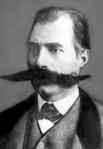
Moustaches may not be the most fashionable look, but there’s no doubting their pedigree. From musicians to scientists to movie stars, from revolutions to civil wars to world wars, there are examples of memorable moustaches throughout history. Writing in the Daily Mail in 2008, Piers Brendon even attributes “the humble moustache” with a key role in the success of the British Empire (How the moustache won an empire).

The 2011 World Beard and Moustache Championships produced some stunning and bizarre examples of upper-lip facial hair, with numerous categories for competitors to enter and strict rules on how they should be grown. Patrick Gorman, overall winner in the moustache category, told the Arizona Daily Star that he wouldn’t be defending his title next year in Las Vegas – so there is hope for the rest of us yet.

For those engaged in Movember 2011, and who might be flagging a little with the bristly scratch of your new growth, here are some iconic ‘taches to keep you motivated.

I might give it a go next year…

This slideshow requires JavaScript.

The stories in numbers

Last night I stumbled across one of the most inspirational and best-presented documentaries I’ve seen in years. Typically it was on in the middle of the night and a brief summary (a history of statistics presented by a Swedish professor) might make you think it was one from the early canon of Open University spectaculars.

However, Professor Hans Rosling is one of the most exciting and engaging presenters I’ve seen on television in a long time. After a long day in the office, his quirky, amusing and insightful jaunt through the past, present and possible future of statistics was gripping. If you missed it, you can look at The Joy of Statistics on BBC iPlayer.

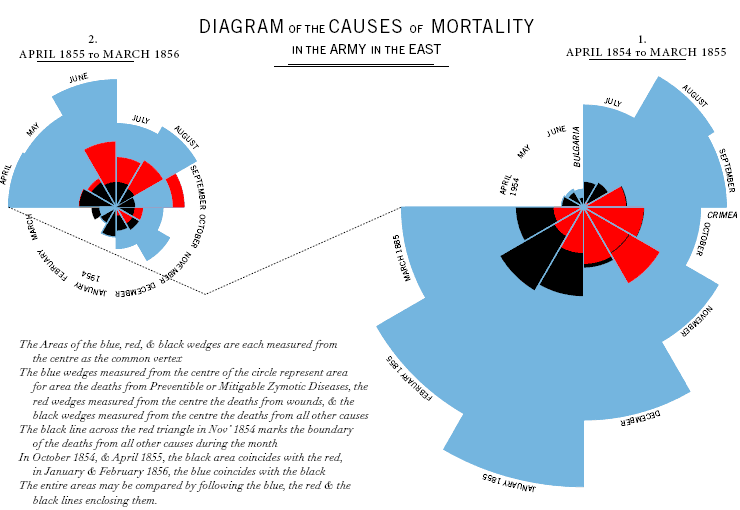
One of the most engaging aspects was his demonstration of how the stories of numbers are often best told through visual depiction.

For instance, I had no idea that Florence Nightingale was a statistician. It was her meticulous record-keeping translated into startling pictures that drove the changes in nursing that she instituted:

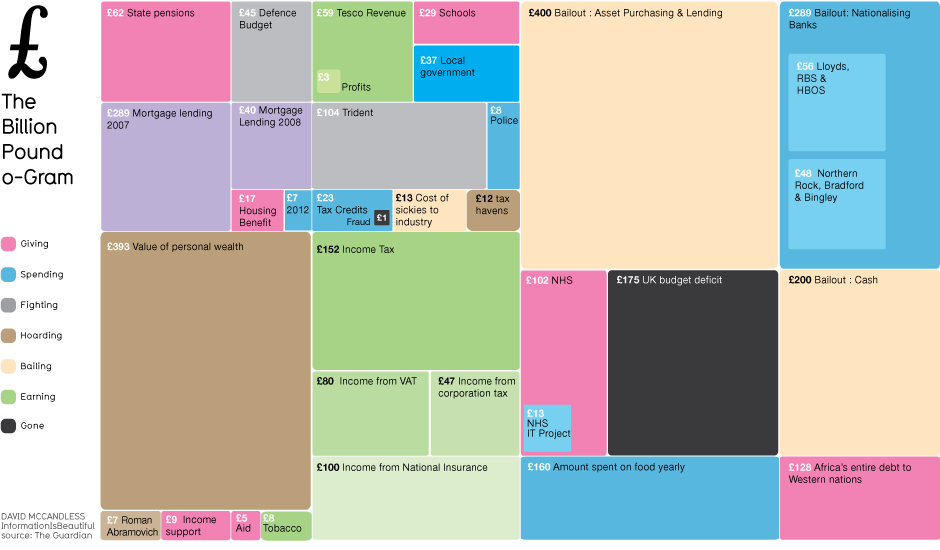
Over a hundred years later, people like David Mccandless make their living finding ways to translate complex information into more readily understandable pictorial form.  On his Information Is Beautiful blog he finds different and exciting visualisations of statistical data. The Billion-pound-o-gram is his way of making those mad, large numbers more comprehensible:

Perhaps the most spectacular use of animation was Professor Rosling’s depiction of the progress of countries in terms of their life expectancy and their income. His enthusiasm, love and knowledge are a real joy to behold. To really see a story told in numbers, watch this little snippet below:

Vodpod videos no longer available.

World Day for Water, the wonder of PlayPumps and apologies for lateness

In 1992, the United Nations designated March 22nd as the World Day for Water in Resolution 193 of the Forty-seventh Session of the General Assembly.
The World Day for Water was first proposed in Agenda 21 for the 1992 Rio Summit, the meeting that hugely raised awareness of the role of local government and local communities in tackling global environmental and climate issues.

Since 1993 the day has been observed consistently, drawing attention to the plight of the estimated one billion people plus who each year have to rely on dangerous sources of water to survive.

Having travelled a little in India and Africa,  turning on a tap and being able to drink a handful of clean, cold water is still something for which I am profoundly grateful. Whilst it is easy to take it for granted, when I think about it I can’t begin to imagine what it would be like not to have it.

A year or so ago we had a small taste of what it was like to lose our mains supply for just a few hours. The sense of worry as you wonder when you might be able to wash clothes or make drinks again is out of all proportion to the scale of a relatively small inconvenience. It does, however, cause you to pause and consider how it would be to have to walk miles a day to a potentially polluted stream and draw water you’d be uncomfortable watering the garden with.

The IRC International Water and Sanitation Centre reports the stark analysis of the World Health Organization:

Each year more than 1 billion of our fellow human beings have little choice but to resort to using potentially harmful sources of water. This perpetuates a silent humanitarian crisis that kills some 3900 children every day and thwarts progress towards achieving the Millennium Development Goals (MDGs). The consequences of our collective failure to tackle this problem are the dimmed prospects for the billions of people locked in a cycle of poverty and disease.

The root of this underlying catastrophe lies in these plain, grim facts: 4 of every 10 people in the world do not have access to even a simple pit latrine and nearly 2 in 10 have no source of safe drinking-water.

Thankfully, the appalling situation is not something that the UN/WHO are prepared to see continue:

To help end this appalling state of affairs, the MDGs include a specific target (number 10) to cut in half, by 2015 the proportion of people without sustainable access to safe drinking-water and basic sanitation. In addition, the UN Millennium Project Task Force on Water and Sanitation recently recognized that integrated development and management of water resources are crucial to the success or failure of all the MDGs, as water is central to the livelihood systems of the poor.

Among the more innovative ideas for drawing water to the surface, one particularly caught my attention, marrying the desperate need for fresh water to a completely different and endless resource: the playful, optimistic energy of children.

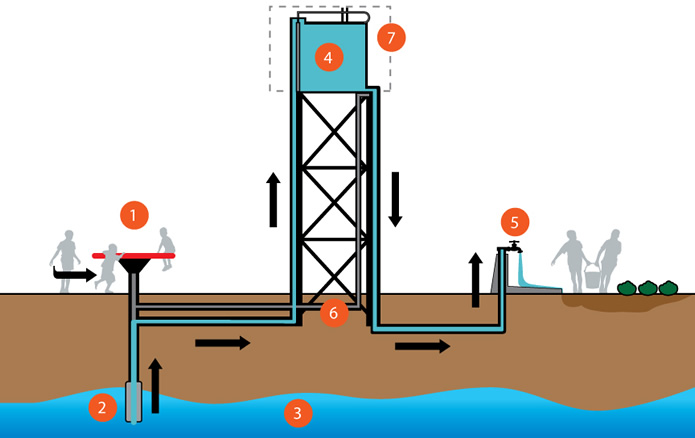
Water for People provides a very clear explanation of how these amazing inventions work:

  • While children have fun spinning on the PlayPump merry-go-round (1), clean water is pumped (2) from underground (3) into a 2,500-liter tank (4), standing seven meters above the ground.
  • A simple tap (5) makes it easy for adults and children to draw water. Excess water is diverted from the storage tank back down into the borehole (6).
  • The water storage tank (7) provides a rare opportunity to advertise in outlaying communities. All four sides of the tank are leased as billboards, with two sides for consumer advertising and the other two sides for health and educational messages. The revenue generated by this unique model pays for pump maintenance.
  • The design of the PlayPump water system makes it highly effective, easy to operate and very economical, keeping costs and maintenance to an absolute minimum.
  • Capable of producing up to 1,400 litres of water per hour at 16 rpm from a depth of 40 meters, it is effective up to a depth of 100 meters.

Innovations such as this, which show the application of creative, lateral thinking, create a real hope that the challenge of providing clean water can be met. Days such as the World Day for Water play a crucial part in alerting all of us to the need to act sooner – not later.

The video below, again from Water for People, is quite uplifting.

Vodpod videos no longer available.

Finally, by way of a footnote, I clearly should have written this yesterday – but being tired after a long day I didn’t. So my apologies for lateness (something I seem to do far too often).

The weekend of the “super moon” in pictures

Sometimes an event defies description. Sometimes only pictures can capture something that touches people in different ways around the world.

Below is a series of pictures taken from different sources showing the drama and beauty of the weekend’s “super moon”.

Credit given wherever information available.

This slideshow requires JavaScript.

Extraordinary free running