Lights Under bushels – my little cousin’s travel writing

So I have always loved my cool cousin and not just because he is called Kit. Which is definitely cool.

It turns out that he likes German – and for his year out he is working at the Hotel Gasthof Stern in Gößweinstein, where he seems to be having a whale of a time. Bernd and Heike run Gasthof Stern with all the love and attention they would expend on their own home. Kit seems to be fitting right in and will be looking to help see them bumped up from a four to five on Tripadvisor.

Anyway, the main reason for writing this post was to give a plug to Kit’s blog. Funny, well-written and well worth checking out, he seems to have been keeping this talent for word-smithing very quiet.

Hope you enjoy his musings.

World Day for Water, the wonder of PlayPumps and apologies for lateness

In 1992, the United Nations designated March 22nd as the World Day for Water in Resolution 193 of the Forty-seventh Session of the General Assembly.

The World Day for Water was first proposed in Agenda 21 for the 1992 Rio Summit, the meeting that hugely raised awareness of the role of local government and local communities in tackling global environmental and climate issues.

Since 1993 the day has been observed consistently, drawing attention to the plight of the estimated one billion people plus who each year have to rely on dangerous sources of water to survive.

Having travelled a little in India and Africa,  turning on a tap and being able to drink a handful of clean, cold water is still something for which I am profoundly grateful. Whilst it is easy to take it for granted, when I think about it I can’t begin to imagine what it would be like not to have it.

A year or so ago we had a small taste of what it was like to lose our mains supply for just a few hours. The sense of worry as you wonder when you might be able to wash clothes or make drinks again is out of all proportion to the scale of a relatively small inconvenience. It does, however, cause you to pause and consider how it would be to have to walk miles a day to a potentially polluted stream and draw water you’d be uncomfortable watering the garden with.

The IRC International Water and Sanitation Centre reports the stark analysis of the World Health Organization:

Each year more than 1 billion of our fellow human beings have little choice but to resort to using potentially harmful sources of water. This perpetuates a silent humanitarian crisis that kills some 3900 children every day and thwarts progress towards achieving the Millennium Development Goals (MDGs). The consequences of our collective failure to tackle this problem are the dimmed prospects for the billions of people locked in a cycle of poverty and disease.

The root of this underlying catastrophe lies in these plain, grim facts: 4 of every 10 people in the world do not have access to even a simple pit latrine and nearly 2 in 10 have no source of safe drinking-water.

Thankfully, the appalling situation is not something that the UN/WHO are prepared to see continue:

To help end this appalling state of affairs, the MDGs include a specific target (number 10) to cut in half, by 2015 the proportion of people without sustainable access to safe drinking-water and basic sanitation. In addition, the UN Millennium Project Task Force on Water and Sanitation recently recognized that integrated development and management of water resources are crucial to the success or failure of all the MDGs, as water is central to the livelihood systems of the poor.

Among the more innovative ideas for drawing water to the surface, one particularly caught my attention, marrying the desperate need for fresh water to a completely different and endless resource: the playful, optimistic energy of children.

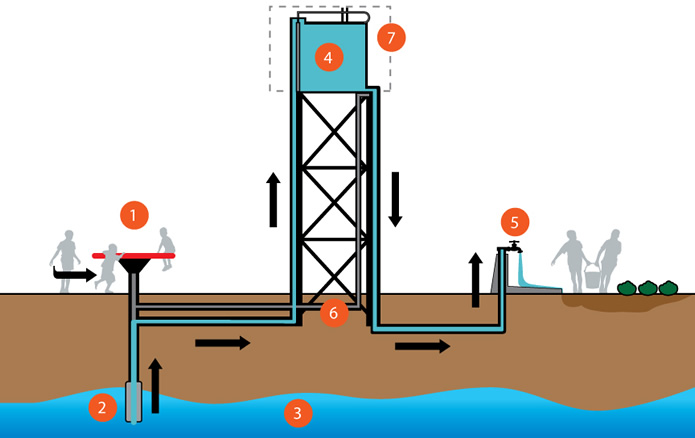
Water for People provides a very clear explanation of how these amazing inventions work:

  • While children have fun spinning on the PlayPump merry-go-round (1), clean water is pumped (2) from underground (3) into a 2,500-liter tank (4), standing seven meters above the ground.
  • A simple tap (5) makes it easy for adults and children to draw water. Excess water is diverted from the storage tank back down into the borehole (6).
  • The water storage tank (7) provides a rare opportunity to advertise in outlaying communities. All four sides of the tank are leased as billboards, with two sides for consumer advertising and the other two sides for health and educational messages. The revenue generated by this unique model pays for pump maintenance.
  • The design of the PlayPump water system makes it highly effective, easy to operate and very economical, keeping costs and maintenance to an absolute minimum.
  • Capable of producing up to 1,400 litres of water per hour at 16 rpm from a depth of 40 meters, it is effective up to a depth of 100 meters.

Innovations such as this, which show the application of creative, lateral thinking, create a real hope that the challenge of providing clean water can be met. Days such as the World Day for Water play a crucial part in alerting all of us to the need to act sooner – not later.

The video below, again from Water for People, is quite uplifting.

Vodpod videos no longer available.

Finally, by way of a footnote, I clearly should have written this yesterday – but being tired after a long day I didn’t. So my apologies for lateness (something I seem to do far too often).

For those that missed it – WikiLeaks returns

Elections are distracting affairs and somewhere along the line I missed the return to the internet of one of the most important resources for freedom of information campaigners of recent years: WikiLeaks.

Having survived the attempts of the US intelligence services to destroy its activities, WikiLeaks suspended itself at the beginning of the year in order to raise funds to ensure its staff could be paid and that a more robust framework for its vast quantities of information could be established.

Wikileaks has become a vital tool of the campaigning trade, especially when attempting to expose the sometimes questionable dealings of multinationals, governments and banks. For instance, WikiLeaks recently reported on the efforts of big pharmaceutical companies to spy on the World Health Organisation.

Take a look – and offer any support you can.

Add to FacebookAdd to DiggAdd to Del.icio.usAdd to StumbleuponAdd to RedditAdd to BlinklistAdd to TwitterAdd to TechnoratiAdd to Yahoo BuzzAdd to Newsvine

Coalition: a moment in history and the reconsiderations of a tribalist #libdems #coalition

The election was little more than two weeks ago, though, in truth, the astonishing developments of recent days make it feel like half a lifetime has passed.

This weekend is the first since before the start of the campaign that I have had a moment to catch breath and reflect on the incredible and exhausting roller-coaster of emotions that has carried me through the last few weeks. I am still struggling to get my head around a moment in history that has taken the party to which I have devoted most of my adult life from being the second party of opposition, fighting against media expectations of annihilation, through the incredible highs of Nick Clegg’s performances in the television debates, to the shock and dismay as we lost seats, and, finally, after careful and determined negotiations, on an extraordinary journey into government. Not at any moment had I envisaged the highs and lows of the last seventeen days, nor the conflict of emotion, loyalty and reason that has tested me and many, many party members.

As regular readers of my blog will know, I have never been backward in offering up frank criticisms of the Conservative Party. At the risk of offending “socialist” colleagues (I use the term advisedly these days), I have long mischievously regarded the Labour Party as merely a hundred-year anachronism that, hugely significant in its impact on the politics of the twentieth century, is merely the upstart younger brother of a progressive Liberal tradition that has a far longer and richer history as a counter-weight to the political and societal inhibitions of Conservatism. With that as my starting point, the idea of a coalition with the Conservative Party was never something I had entertained, instead attaching my instincts in terms of coalition in a balanced parliament situation to the romantic notion of a realignment of the left and a partnership with a Labour Party looking to rediscover its sense of purpose.

I use the term ‘romantic’ quite deliberately. That sense that Labour were the natural partner of the Liberal Democrats paid scant regard to the illiberal and authoritarian reality of thirteen years of Labour government, but owed more to my admiration for the integrity of leaders such as Paddy Ashdown and Menzies Campbell who sought the prize of a realignment of the left in order to usher in a new era of liberal reforms. That emotional detachment from political reality governed many of my initial reactions to the General Election result and the truly baffling parliamentary arithmetic delivered by a cynical, angry public to the political class.

Despite an illegal war (yes, it was illegal), huge incursions by the state into our private lives, the threat to traditional British rights such as trial by jury, repeated failure to deliver on reform of the Lords and our electoral system (even though these were manifesto promises), the running down of our rural communities and the ruin of our agricultural industry, the bankrupting of the nation’s finances, and complicity in the ruin of confidence in our Parliament, Labour somehow still felt a more appropriate partner for government. However, listing these abject failures, just as I did in the pause for thought that was created by Nick Clegg’s commitment to allow the party with the greatest mandate to seek to form a government first, forced me to recognise that the political instincts of the Labour Party, still nominally progressive, are as far from my own and my understanding of my party’s as are those of the Conservative Party. More importantly, from the point of view of attempting to come to terms with the political and economic reality of 2010, the Labour Party is exhausted and broken, uncertain of what it believes or what sort of party it should become.

By contrast, the Conservative Party revealed a confident capacity to subordinate expectation, objectives and tradition to the practical necessity of negotiating with its erstwhile political opponent – qualities that had clearly escaped the observations of many commentators who saw minority government as its only route to power. If I am being completely honest, they are qualities that had escaped me, also, my ready preference to hide behind (well-founded!) tribal prejudices proving that I did not know the party I had been campaigning against as well as I liked to believe.

The outcome, a Coalition Agreement and a Coalition Government which sees Liberal Democrats at every ministerial level, is a genuinely radical attempt to confront the challenges facing the country and, in its composition, demonstrates a commitment from both the Liberal Democrats and the Conservative Party to making this arrangement work.

Knowing how many of my fellow party members share my instinct, I am proud at the way the Liberal Democrats both locally and nationally have responded to the challenge set by the electorate. That there was such considered acclaim for the agreement at the special conference convened to provide an opportunity for members to discuss the Coalition Agreement does not detract from the hard questions the party asked itself. We fully recognise that a new and tough challenge will be to promote ourselves as a party of government, making clear the very real impact that having Liberal Democrats in government will have on people’s lives.

Of course the proof of the pudding will be in its eating at the end of this Parliament and the extent to which the Coalition has delivered on its clear commitments. However, the ambition is tremendous and a high benchmark that has the potential to reconnect the public with politicians and provide a real opportunity to break open the old ways of doing things. The list on which this Coalition is determined to deliver includes things I never seriously believed I would see in the programme of a single government: fixed term parliaments to end the game-playing of sitting prime ministers; an opportunity for the country to decide on voting reform, jemmying the crowbar of preferential voting into our creaking and unrepresentative electoral system; reform of the House of Lords; an ambitious plan to green our economy; a Freedom Bill to roll back the powers of the state; huge investment in the schooling of the country’s poorest pupils; and the raising of the income tax threshold to help those on the lowest incomes.

Most of all, this Parliament provides a uniquely important opportunity for all those supporters of electoral reform: to demonstrate that pluralist politics can work and that the national interest is served by a strong and distinctly Liberal voice in government.

Despite the colourful, passionate and necessary rhetoric of the election, my own emerging understanding of this unprecedented situation is that coalition cannot be founded on our deeply-held prejudices as politicians, but instead has to be grounded in an objective assessment of how best to serve the national interest in all its iterations, however personally troubling the accompanying journey might be. I believe Nick Clegg’s Liberal Democrats and David Cameron’s Conservative Party have made just that assessment, setting aside instinctive and fundamental differences to establish a coincidence of interests to best serve a tired, cynical, yet hopeful public.

I wish them – us –  every success.

And I look forward to pressing the case for Liberal Democrat achievements in Government against robust challenges from both the Conservative Party and the Labour Party in five years’ time.

You can read the Coalition Agreement, approved by the Liberal Democrats and the Conservative Party 11th May 2010, here:

You can read the Coalition’s Programme for Government, published 20th May 2010, here:

Add to FacebookAdd to DiggAdd to Del.icio.usAdd to StumbleuponAdd to RedditAdd to BlinklistAdd to TwitterAdd to TechnoratiAdd to Yahoo BuzzAdd to Newsvine

GRTHM: Remembering the Holocaust against the Roma and Sinti: Exhibition #grthm #roma #sinti

More news from Eva Sajovic, who writes regarding a new exhibition for Gypsy Roma Traveller History Month, this time remembering the Holcaust against the Roma and Sinti in Nazi-occupied Europe.

Hosted at the Mile End Art Pavillion,  the exhibition promises to be a shockingly intimate and comprehensive documentation of the disenfranchisement, persecution and genocide of the Roma and Sinti communities, the photographs and personal testimonies challenging viewers to consider this episode in the context of post-war prejudice and persecution across Europe.

Lead-managed by the Documentation and Cultural Centre of German Sinti and Roma, the official launch being hosted by the German Embassy, the exhibition is intended to raise awareness of the murder of 500,000 people by the National Socialists, a fact which many forget in their consideration of the horrors of the Second World War:

The Arts Pavillion
Mile End
London E3 4QX
Exhibition open 2 – 20 June
Tue-Sat 12-6 pm
Sun 12-4 pm
Closed Mondays

Read more about the exhibition below:

Read more about the Documentation and Cultural Centre of German Sinti and Roma below:

Add to FacebookAdd to DiggAdd to Del.icio.usAdd to StumbleuponAdd to RedditAdd to BlinklistAdd to TwitterAdd to TechnoratiAdd to Yahoo BuzzAdd to Newsvine

A Month To Remember: June 2010 is Gypsy Roma Traveller History Month #grthm #gypsy #roma #traveller

June 2010 will be the third year that Britain has celebrated Gypsy Roma Traveller History Month.

There is a shocking amount of ignorance about the historic and cultural identities of the travelling communities in Britain. Few who are concerned about the impact of travellers on the greenbelt will pause to think about traditions that extend back half a millennium, more rooted in the history of the British isles than many would ever imagine.

As Jake Bowers writes on the GRTHM website:

“Quite simply, ignorance about who we are and where we come from leads to ruined lives.  Gypsy, Roma and Traveller History Month celebrates our culture and history by tackling the negative stereotyping and prejudices that have led to this situation.”

Gypsy, Roma, Traveller, History Month has gained international significance, Gay McDougall, United Nations Independent Expert on Minority issues, issuing a statement welcoming the United Kingdom’s commitment to recognising the contribution of Gypsy, Roma and Traveller communities to British society [see the PDF below].

This year promises to offer the widest range of activities to engage the settled community yet. I hope it crosses your path in places other than this blog. More than anything, I hope we are all big enough to rise to the challenge of considering Gypsy, Roma and Traveller issues with an open mind.

Add to FacebookAdd to DiggAdd to Del.icio.usAdd to StumbleuponAdd to RedditAdd to BlinklistAdd to TwitterAdd to TechnoratiAdd to Yahoo BuzzAdd to Newsvine

Eva Sajovic: Be-Longing: Travellers’ Stories, Travellers’ Lives in Hackney & West Norwood #grthm #gypsy #roam #traveller #sajovic

Eva Sajovic has emailed to say that her phenomenal and moving exhibition about the lives of the travelling community now has two new exciting venues.

If you missed it the first time around, you now have an opportunity to see the work of an extraordinarily talented artist as she brings to life stories that would ordinarily be lost to most of us, even though they are written in the fabric of the community about us.

You can see this exciting exhibition, that tells the story of some of the most persecuted communities in our country, at the following locations:

Exhibition 27th May – 30th June 2010

Central Hackney Library, 1 Reading Lane London, E8 1GQ

Tel: 020 8356 5239

Exhibition 1st – 30th June 2010

West Norwood Library, Norwood High Street, London, SE27 9JX

Tel: 020 7926 8092

Add to FacebookAdd to DiggAdd to Del.icio.usAdd to StumbleuponAdd to RedditAdd to BlinklistAdd to TwitterAdd to TechnoratiAdd to Yahoo BuzzAdd to Newsvine

Essex talent – Michael Condron’s latest public art creations #arts #essex #woodsman

Michael Condron emailed today with details of his latest sculptures.

Interested readers, and particularly those in the Basildon Arts Collective, may recall that at the height of the furore surrounding The Woodsman I blogged on several occasions about Condron’s works of public art, bemoaning the treatment meted out to Progression.

I’ve extracted the photographs from his email and placed them in the gallery below.

Enjoy them, admire them and appreciate a quite extraordinary local talent. And then question why it is that Basildon’s Conservative administration have consistently demonstrated such hostility to public art, including Condron’s own Progression.

This slideshow requires JavaScript.

Add to FacebookAdd to DiggAdd to Del.icio.usAdd to StumbleuponAdd to RedditAdd to BlinklistAdd to TwitterAdd to TechnoratiAdd to Yahoo BuzzAdd to Newsvine

Rage Against The Election: From Lolcats to Lolcleggz… #gonick #libdems #nickclegg

Most of you will be familiar with the ubiquitous Lolcats. Well, I presume the same enterprising group of students that have taken to spending their afternoons defacing Tory posters on the Rage Against The Election photo wall have put together a website devoted to… Lolcleggz.

If you like Nick Clegg and like the Lolcats humour, there are dozens of Nick Clegg pictures for you to chuckle over at lolcleggz.com.

Add to FacebookAdd to DiggAdd to Del.icio.usAdd to StumbleuponAdd to RedditAdd to BlinklistAdd to TwitterAdd to TechnoratiAdd to Yahoo BuzzAdd to Newsvine

Rage Against The Election: the absurdity of our electoral system #gonick #libdems #nickclegg #vote2010

Below is a pictorial representation of the projected share of the vote, based on the latest You Gov polling data for 2nd May (34% Tories [blue], 28% Labour [red], 29% Lib Dems [yellow], 9% others [green]):

Below is a pictorial representation of the number of seats that these percentages would translate into, using the BBC’s seat projector:

That’s 264 Conservative MPs [blue], 267 Labour MPs [red], 90 Liberal Democrat MPs [yellow] and 29 others [green].

Look carefully at those two charts and those two sets of figures.

That’s right.

More British citizens could vote for the Liberal Democrats than for the Labour Party. More British citizens could decide they would rather see Nick Clegg leading the country than Gordon Brown. Yet, when it comes to the translation of votes into seats, the Labour Party could receive almost three times as many seats – all because of the vagaries of our electoral system.

Can you imagine if this were The X-Factor or Britain’s Got Talent?

Would we sit quietly by and accept that we could all cast our votes but the final result could bear no relation to how those votes were cast? Of course not. The switchboards would be jammed. The internet would be crashing. The tabloids would be screaming about fixes and fiddles.

This isn’t The X-Factor. This isn’t Britain’s Got Talent. It’s far more important.

This is the future of our country. Those who are elected will make the laws that determine how we live our lives. Our electoral system fiddles the result.

Isn’t it time we got a little angrier?

Discuss…

Add to FacebookAdd to DiggAdd to Del.icio.usAdd to StumbleuponAdd to RedditAdd to BlinklistAdd to TwitterAdd to TechnoratiAdd to Yahoo BuzzAdd to Newsvine