“The Woodsman”, The Town and The Politicians #basildon #toryfail

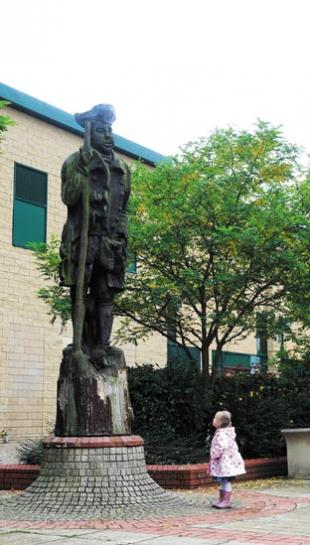
“The Woodsman” by Dave Chapple - unattributed

Yesterday, on my email, I received an email from Conservative-controlled Basildon District Council, linking to a press release on the future of Dave Chapple’s “Woodsman” sculpture. The Council has decided to remove the statue permanently (it is currently in storage) and replace it with the original town clock. As you can see, it says:

“A location for the statue is currently being found within the Park, and the woodsman will remain in storage until then.

Cllr Stephen Horgan, deputy leader of the Council, says: “The woodsman is a well loved piece of public art, and we believe that a new home at Wat Tyler Country Park is more suitable and appropriate, where he will be appreciated by the hundreds of thousands of people that visit the park each year.””

I am all for putting the clock back on display (where it can be properly seen from all four sides!). I am also for ensuring that hundreds of thousands of people get the opportunity to enjoy the unique and other-worldly charm of “The Woodsman”. However, in an act tantamount to municipal vandalism, Conservative councillors intend to remove the sculpture from the urban space for which it was created and place it in a country park – changing its context, function and form entirely.

There is no explanation as to why it is to be moved. We are left to speculate why Cllr Horgan advises that Wat Tyler Country Park will be “more suitable and appropriate”. Perhaps reinstating it so close to the Council’s offices would be a potent reminder of how  successive administrations – including the current Conservative administration – have failed to take care of this significant contribution to Basildon’s artistic heritage?

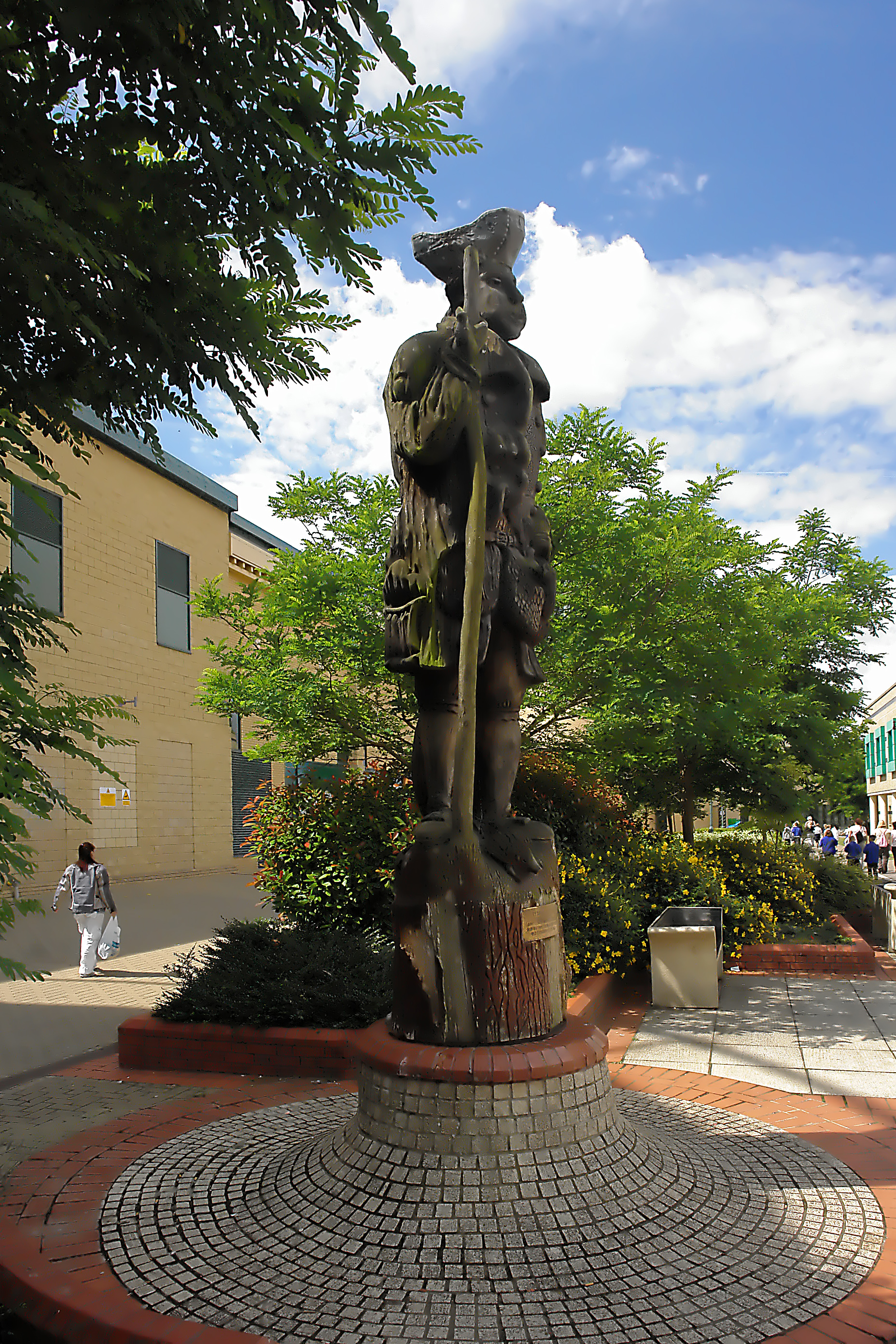
For me, “The Woodsman” isn’t just a quirky carving. Wood is a unique medium to work with. Unlike sculpting in bronze, from a cast, every single wooden carving, even if it appears the same, is very different. Each piece of wood has a different grain. Each piece of wood will have different knots to tax the skills of the carver. Hewn from local timber, from a tree felled in the Great Storm of 1987, “The Woodsman” is a unique piece of art designed to provoke thought and comment in the centre of a busy urban environment. In its original position, it broke up the concrete lines of the town and prompted a pause for thought, even if only a few seconds, to reflect on something that somehow managed to be both incongruous and perfectly situated at the same time.

“The Woodsman” was also a reminder of Basildon’s past. We’ve recently celebrated 60 years as a town. Prior to its construction, much of the area was fields and woodlands. Even now, Basildon is a place that contains areas of incredible natural beauty. It’s not without reason that Arthur Young, in his A Six Weeks’ Tour through the Southern Counties of England and Wales, wrote the following about Langdon Hills:

“I forgot to tell you, that near Horndon, on the summit of a vast hill, the most astonishing prospect that ever was beheld by human eyes, breaks almost at once upon one of the dark lanes. Such a prodigious valley, every where painted with the finest verdure, and intersected with numberless hedges and woods, appears beneath you, that it is past description; the Thames winding through it, full of ships, and bounded by the hills of Kent. Nothing can exceed this amazing prospect, unless it be that which Hannibal exhibited to his disconsolate troops, where he bade them behold the glories of the Italian plains! If ever a turnpike should lead through this country, I beg you will go and view this enchanting prospect, though a journey of 40 miles is necessary for it. I never beheld any thing equal to it in the West of England, that region of landscape.”

24 June 1767, King’s-Head, Tilbury

“The Woodsman” provided a connection to our history and that natural environment right in the middle of our town, where it could be enjoyed by those shopping, working, visiting the Council or passing through. We didn’t have to make a special trip to see it.

Finally, it also stood as a testament to the talents of Dave Chapple, who passed away on Friday 6th November 2009. Dave had even proposed a sculpture for the Millennium Dome when the Government was seeking ideas for what to put inside. To my mind it was a stunning challenge to the material assumptions that have overtaken us, putting Christ at the centre of the building commissioned to mark the new millennium.

Dave Chapple with “The Woodsman” - Picture Esk, Flickr

Beautiful detail at the base of “The Woodsman” - Vin Harrop

“The Woodsman” in its rightful place - Vin Harrop

To my mind, we have lost something as a community when politicians are prepared to spend £38 million on a sporting complex, but those same politicians are not prepared to find the money, time or motivation to ensure that “The Woodsman” – created in Basildon, for Basildon – can be enjoyed by thousands in the space it was created for.

“The Woodsman” is a thing of beauty that tells a story far greater than many imagine.

The Town needs to remember its roots – and the people of the town want to know its history and be reminded how beautiful parts of our district truly are.

And The Politicians need to remember who they represent. They also need to remember the heritage – cultural and natural – that is entrusted to them.

If you are interested in seeing some of Dave Chapple’s other work, please see this online gallery.

Add to FacebookAdd to DiggAdd to Del.icio.usAdd to StumbleuponAdd to RedditAdd to BlinklistAdd to TwitterAdd to TechnoratiAdd to Yahoo BuzzAdd to Newsvine

Syrian repression of free speech continues as two more journalists are “disappeared” #syria #freespeech #humanrights

Reporters sans Frontières is reporting that journalist Ali Taha and cameraman Ali Ahmed have been detained since since 2 January (as usual, the Syrian authorities are providing no information on the arrests):

“The continuing arbitrary arrests of journalists in Syria are disturbing,” Reporters Without Borders said. “The authorities provide no information about the legal grounds for these arrests and or the subsequent place of detention. This complete lack of transparency does not bode well.”

Click here to read the full report.

These are the latest in a wave of arbitrary arrests that the Syrian security services have been carrying out for months.

Add to FacebookAdd to DiggAdd to Del.icio.usAdd to StumbleuponAdd to RedditAdd to BlinklistAdd to TwitterAdd to TechnoratiAdd to Yahoo BuzzAdd to Newsvine

Wikileaks – free speech needs YOU now #wikileaks #freespeech #amnesty

If you’ve not already noticed, Wikileaks is currently closed for business, facing a funding crisis. Wikileaks (different link which goes into the background of Wikileaks) has been a crucial tool for liberals and free speech campaigners in the battle against state censorship and corporate bullying.  In 2008, it won The Economist New Media Award. In 2009, it shared the Amnesty International New Media Award.

YOU have the chance to make a difference. Don’t leave it to other people.

Make a donation. Let’s face it: $25 is a small price to pay to help turn the tide against corruption and secrecy.

Add to FacebookAdd to DiggAdd to Del.icio.usAdd to StumbleuponAdd to RedditAdd to BlinklistAdd to TwitterAdd to TechnoratiAdd to Yahoo BuzzAdd to Newsvine

Google redeems its reputation – and throws down the gauntlet to China #china #freespeech

In a shock announcement, Google, the internet search giant, has thrown down the gauntlet to the Chinese authorities by announcing that it is going to end the censorship of its Chinese operations. In an announcement on its official blog, the search engine giant cites specifically the attacks that have been made by cyber terrorists on human rights advocates.

Google earned condemnation from politicians and internet users around the world for its decision to self-censor its Chinese operations on Tuesday 24 January 2006. Critics pointed out the glaring contradiction between what it was doing – silencing the voices of those who had not earned the approval of Beijing’s regime – and its ten-point philosophy of operations, specifically points 6 and 8:

6. You can make money without doing evil

8. The need for information crosses all borders

Google’s decision is not just a challenge to Beijing. It is a challenge to those other corporate giants that hitherto have put profit before principle. Internet leaders Microsoft and Yahoo, as well as  Cisco, one of the world’s leading manufacturer of networking equipment, have all been the subject of criticism for the way they have been prepared to satisfy the censorial instincts of the Chinese government, notably by members of the Congressional Human Rights Caucus in February 2006. Disturbingly, Reporters Sans Frontières claim Yahoo was responsible for passing personal information to the Chinese authorities, resulting in the jailing of journalist, poet and blogger Shi Tao. You can read some of Shi Tao’s writings on press freedom here. Please click the thumbnail below to be taken to his page on the website of Human Rights in China, founded by students and academics to promote universal human rights and advance their institutional protection in China:

We seem to have developed a tendency, misguided I think, to measure a country disproportionately by its economic reforms. China is no exception – and it certainly has reformed its economy out of all recognition in the past thirty years. The CIA World Fact Book makes the following observation on China’s economy (I still find it odd that the CIA put their World Fact Book online):

“China’s economy during the past 30 years has changed from a centrally planned system that was largely closed to international trade to a more market-oriented economy that has a rapidly growing private sector and is a major player in the global economy. Reforms started in the late 1970s with the phasing out of collectivized agriculture, and expanded to include the gradual liberalization of prices, fiscal decentralization, increased autonomy for state enterprises, the foundation of a diversified banking system, the development of stock markets, the rapid growth of the non-state sector, and the opening to foreign trade and investment. Annual inflows of foreign direct investment rose to nearly $84 billion in 2007. China has generally implemented reforms in a gradualist or piecemeal fashion. In recent years, China has re-invigorated its support for leading state-owned enterprises in sectors it considers important to “economic security,” explicitly looking to foster globally competitive national champions.”

I can’t help feeling that attributing a country some nebulous value of “standing”, based predominantly on perceptions of the sophistication and liberality of its domestic market,  risks eclipsing other considerations which are intrinsic to properly understanding a state and the country it governs. With China having 30 years of reform behind it, and with the current uncertainties dogging established Western free market economies  in the current global economy, we are in danger of forgetting that the expression of Communism in state form has always been accompanied by instruments and policies of the state that are unacceptable in terms of human rights, free speech and human dignity. Akmal Shaikh becomes a footnote in the continuing evolution of economic relations as we establish trade missions for our benefit, regardless of China’s record on human rights and the treatment of those, like  Guo Quan, who risk their life for the free expression we take for granted.

I cannot believe that it is without cost to our own humanity if we decide to subordinate principle to profit.

So from this Liberal – who is an ardent supporter of the basic principles of the free market – well done Google for at the very least giving us pause for thought.

Add to FacebookAdd to DiggAdd to Del.icio.usAdd to StumbleuponAdd to RedditAdd to BlinklistAdd to TwitterAdd to TechnoratiAdd to Yahoo BuzzAdd to Newsvine

Apples aren’t always green: one more reason why I am glad I got a Nokia #n900 #iphone #greenpeace #green

It’s a peripheral consideration for many when making a choice as to the make of phone to buy – and it certainly wasn’t one of mine. However, I have since discovered the Greenpeace International guide to Greener Electronics and I will be paying more attention in future to the companies I buy from.

I am simply glad that Nokia beats the competition by a mile.

If you go to the Greener Electronics page, you will see the little graphic of a hand-held device. Click the number 13 to see the latest report, from September 2009. With a complex formula for scoring the major companies out of ten, Nokia is the only company to score more than 7.

You can read Greenpeace International’s report on Nokia, which puts them 1st, and see how they arrived at the score of 7.5, by clicking on the thumbnail below:

By contrast, Apple may have improved its standing from 11th to 9th, but, by clicking on the thumbnail below, you can see its score is still a paltry 4.9:

Power Geek Enthusiast vs. Flash Git competition aside, there is a real issue here about the ways in which companies that manufacture mass market devices for international distribution respond to real world concerns such as the environmental impact of their commercial activities. If those issues interest you, you can read the full Greenpeace International report by clicking on the thumbnail below:

So there we go.

Apples aren’t always green…

Add to FacebookAdd to DiggAdd to Del.icio.usAdd to StumbleuponAdd to RedditAdd to BlinklistAdd to TwitterAdd to TechnoratiAdd to Yahoo BuzzAdd to Newsvine

Arrogance and disregard for the taxpayer: Hanningfield’s latest wheeze as Essex freezes #toryfail #snow

The sheer arrogance of Lord Hanningfield is unbelievable.

The leader of Essex County Council clearly thinks he is running his own version of Essex Bank, rather than leading an elected local authority. The latest venture from the Bank of Essex – surely the greatest testament to personal ego of any initiative in local government in recent years – is to offer a £100,000 overdraft facility to eligible businesses.

Excuse me?

Admitting you are no longer capable of running public services and handing them wholesale to IBM is one thing, but doing so as you extend the commercial operations of a bank that only exists because of your elected mandate is something entirely different. At no point do I recall my local successful candidate at the County Council Election, Cllr John Schofield, informing voters that he intended to be a party to such speculation with public funds: public funds provided by hard-working Council Tax payers.

According to the Frequently Asked Questions on the Banking on Essex website, all profits from the venture will be used to cover potential losses and protect taxpayers’ funds.

Where has Lord Hanningfield been for the last eighteen months?

Banks with a hundred-year tradition of providing commercial services haven’t been able to get this right in the current economic climate. How on earth can taxpayers have any confidence that self-aggrandising politicians will succeed where self-aggrandising bankers failed? More importantly, how can politicians, with little or no experience at running a bank, guarantee that the profits will cover the losses? I am not sure that assuring voters that you are working in partnership with a large banking organisation gives much confidence these days…

I suppose you could have a little more confidence if some care was taken with the presentation. However, that is clearly no concern for this commercial operation. Here is how the guarantee appears in the Banking on Essex FAQs (Frequently Asked Questions) at the time of writing:

“Will the initiative put tax payers’ money at risk?
The County Council is using all additional income earned to cover potential loses [sic] and protect tax payers’ funds.”

The italics are mine.

Essex is the Education Authority.

Essex is also attempting to generate a sense of commercial confidence.

The example above demonstrates why politicians should put their determination to write themselves into history to one side and stick to what they were elected to do: represent the interests of the people who put them in office.

Here is a reminder for Conservative councillors  John Schofield and Lord Hanningfield of matters that should be the priority for Essex County Council over the next few weeks:

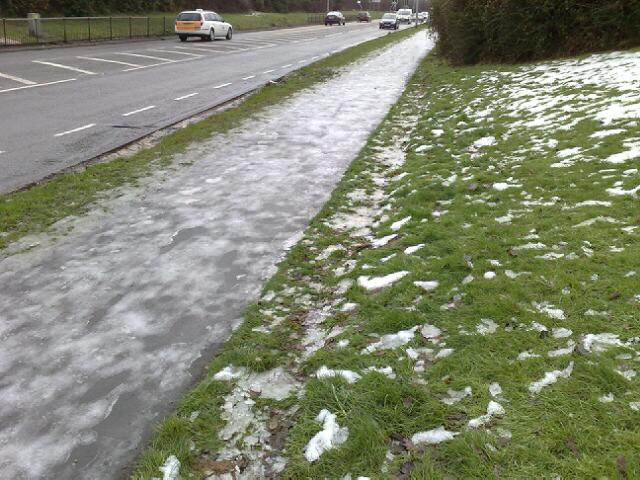
Path to hospital at junction of Nethermayne and the Knares, 24 December 2009

Path to hospital, 24 December 2009

These two pictures were taken of the main footpath to the principal site of Basildon and Thurrock University Hospitals on Christmas Eve 2009 – exactly one week after the heavy snow falls that caused chaos in South Essex. It was still iced over even when the snow on surrounding banks had melted and the roads had been gritted.

In the NHS Foundation Trust’s own words:

[We] primarily serve the almost 400,000 population of Basildon and Thurrock in South West Essex, plus some residents of the neighbouring districts of Brentwood (for whom we are the main provider of cardiology services) and Castle Point.

With a annual budget of £250 million, the Trust treats 63,000 inpatients and day cases, provides 270,000 outpatients consultations and attends to more than 90,000 Accident and Emergency (A&E) patients.

And pictured just above is the path people had to walk to reach that hospital, should they not be fortunate enough to drive a car.

I met an elderly constituent of mine as I walked to town that Thursday. He was incandescent. He is usually a charming conversationalist, but that day he had only three words for me as he gestured unsteadily with his walking stick at the ice: “It is wicked”.

The Basildon Recorder was forced by Essex County Council to issue an apology when it ran a story criticising the county for inadequate salt supplies. Apparently, there is no shortage:

“The county council would like to assure residents that Essex County Council continues to be fully prepared for icy winter conditions with more than sufficient supplies of gritting salt for the bad weather.”

So if there was no shortage, I can only assume that Essex County Council simply doesn’t care about pedestrian access to the major health facility in the south of the county. Surely, if there was salt, and it gave a stuff, Essex would have taken the time to grit this major pedestrian route? Winter 2008/2009 saw the highest excess winter mortality rates for ten years. It is hard to believe that figure will be lower for 2009/2010 if this Winter is harsher. Respiratory illnesses are just one set of conditions that are exacerbated by conditions in the winter months. (If you are really interested, there is a superb paper on the website of of the Centre for Public Health at the Liverpool John Moores University entitled Weather forecasting as a Public Health Tool). People need to be able to get to hospital – and that includes by foot.

This is the Met Office weather warning for the East of England, for Tuesday 5th January, issued on Monday 4th January:

“There is a moderate risk of severe weather affecting east and southeast England.

Outbreaks of sleet and snow will become heavier during Tuesday afternoon and evening, with an increasing risk of disruption to transport networks.

Issued at: 1124 Mon 4 Jan”

Sky News is warning Heavy Snow Set to Bring More Travel Chaos.

The question I have is: will Essex County Council heed the warnings and make an effort to ensure that key footpaths are snow and ice free this time around?

To finish, three simple things:

Stop throwing the taxes of hard-working local people at self-indulgent, speculative schemes.

Stop criticising the press for reflecting local concerns.

Start delivering a basic level of service: grit our roads and footpaths, especially where they provide access to major facilities such as hospitals.

Add to FacebookAdd to DiggAdd to Del.icio.usAdd to StumbleuponAdd to RedditAdd to BlinklistAdd to TwitterAdd to TechnoratiAdd to Yahoo BuzzAdd to Newsvine

Apples, escorts and the perils of sticky fingers #n900 #iphone

So I did it.

It felt like a betrayal.

Very mucky. And it cost a lot (when I am used to getting it “free”).

Absolutely fed up with O2‘s hopeless upgrade options, I decided to buy a new phone. Apparently I have been eligible for an upgrade since 2006. That simply isn’t so, as I have had two phones since then,  but neither appear to be registered on their system. No matter how many times I tell them, each call to their perky, perfectly-mannered team (“FFS, yes, you can call me Ben!”) is like a bizarrely personal production of Groundhog Day for phone geeks.

So, having read completely contrary accounts as to whether O2 intend to offer the phone I wanted, and thinking I might try speaking Esperanto to the customer services team next time to see if I can be any more comprehensible, I took the plunge and ordered online from Nokia. My N900 arrived promptly and, after a couple of days playing with it, I can safely say it is the most fascinating and powerful little gadget I’ve ever had.

To be clear: I am in love. Not the girly sort of romantic love that geekdom is infamously inept at. This is hardcore, soul-shaking gizmo love. Processing passion. Firmware rapture.

Of course, some people don’t get phones (I need to be careful here as the über geeks will remind me the N900 is not a mobile phone but an internet tablet with mobile telephony added). So I thought I would try a car analogy – with a view to winding up iPhone users.  I should warn that this enterprise comes with health warnings: I don’t drive.

The Workhorse

I think most ordinary folk are happy enough to own a phone that makes calls and that can send the occasional text message. They are after something simple and basic and functional. They are not interested in hacking it to pieces (we are talking coding, programming and general fiddling here rather than kindling axes) and are content for it to simply work.

That is: WORK.

This sort of phone is so common – because it is such a good ordinary workhorse – that it is practically invisible. To my mind this is the Ford Fiesta of phones: the Nokia N1100. If they were insects they would be Water Bears (that’s tardigrades to all you biologists)  – prolific, unnoticed and utterly survivable.  Thousands of aunties and grandparents the world over keep them neatly packed in their boxes  for “emergencies”. Others, who have long since upgraded, have their N1100s languishing in a drawer – but only in stasis, ready to be reanimated the moment that flash capacitive screen decides it has been subject to one sticky finger too many.

The Flash Git

For some, the priorities are different. Being cool is a very serious consideration, particularly if “cool” can be dressed up as “useful“.

I can’t help it but every time I think of the iPhone I get this image of 1985, getting the bus to the Romford ABC to see Rocky IV and pimped out Ford Escorts (believe me – it is as bad as it sounds). All the cool kids have one – boy do you know they have one. And all the rest of us loser kids should want one (I did my 80s casual clothes shopping at Liberal Party jumble sales on a Saturday morning so no iPhone for guessing which category I fall into).

I don’t know if it is the contrarian in me, but for that reason alone I’ve held out against the entreaties of the Esperanto speakers of O2 and the various friends and colleagues who have evangelised about their iPhones and resisted the temptation to join the iHerd. XR3i, spoilers, alloy wheels, Ghia, Cabriolet… The iPhone has it all and in spades and just as the 80s cool kids used to congregate in gangs to check out the latest in Escort bling, so now iPhone users entertain their mates with their iFart and iSteam apps.

And yes – it is cool.

And no – I can’t pull it off.

(I also admit to a modicum of nervousness at this particular analogy as there is  probably an equation that relates the number of iPhone-owning friends and relatives I have to my Escort-loving girlfriend in order to produce an accurate indication of the likely diminution of my social circle.)

The  Power Geek Enthusiast

So this is where the self-styled l33t haxx0r ends up.

It’s not simple or bling that counts here.

To qualify for the ultra special category of Power Geek Enthusiast, you need raw horsepower, complexity and a love of Saturday mornings drowning in invective, epithets and machine love as you tinker under the bonnet. For me, the N900 is the Ford Capri of mobile phones (and yes – for me it is still easiest to call it a mobile phone). Why have a 1.6L when you can pack a 3.0 V6? The N900 is the sort of gadget those of us who fantasize about being secret agents have dreamed of – a phone and pocket computer combined, which we can use to save the world. Let’s face it. You wouldn’t have caught Bodie and Doyle driving Escorts – they were Capri men through and through (if you don’t believe me, you can check out their carpool here). If The Professionals were reinvented for the 21st Century you can bet your ass they’d be carrying N900s – not iPhones!

Read this piece from one Capri lover. Feel the passion? It could never be an iPhone.

Actually, sod saving the world. The N900 is for all those of us who believe that one day we might just take over the world – and need a super-techno gadget to help us do so…

And just in case any of you think you still want to chance an iPhone, just take a look at this clip below… Go on… I tell you – all the uncool kids are laughing now!

Add to FacebookAdd to DiggAdd to Del.icio.usAdd to StumbleuponAdd to RedditAdd to BlinklistAdd to TwitterAdd to TechnoratiAdd to Yahoo BuzzAdd to Newsvine

China and the cruel lesson of the execution of Akmal Shaikh #humanrights #akmalshaikh


Akmal Shaikh - Reprieve

It is a hauntingly normal photograph.

For me, it is a picture of everyday humanity that is about as far as it is possible to get from the sense of dread and horror that must have overtaken Akmal Shaikh upon discovering from his family that he had barely twenty-four hours to live. Following the accounts of events around his final hours, as the increasingly frantic diplomatic scrabbling failed to halt his cruel and unjust execution, I felt a different sort of dread – familiar to me from previous death penalty cases. I have never seen the death penalty as anything other than imhumane – a signature of nations whose values are less civilised than my own. I accept that I might be blinkered in this understanding but I can’t pretend it isn’t so.

In recent days there has been much angry talk of political sovereignty, civilised values, humanity, mercy and the rule of law. Despite my rejection of the death penalty, I agree entirely with the assertion that states are entitled to enforce their laws upon their citizens and those that choose to visit or live within their jurisdiction. Equally, I resent being told by a sovereign state, which does not share my respect for free speech or multi-party representation, that my country has no right to criticise its “judicial sovereignty”.

Actually, it does. And I do.

I would go further and say that there is a moral responsibility on those who share liberal values to speak out in their defence, even if that means criticising other nation states. The alternative is that, in the hot-house of international negotiations, we risk seeing these values – important to our confidence in the legitimacy of our own civil society –  subordinated to priorities of trade and engagement, the manner of that engagement apparently far less relevant than the engagement itself. (I assume that sense of liberal indignation is what led Nick Clegg to make the statement he did following the British Olympic Association’s unsuccessful attempt to contractually gag British athletes from making criticisms of the regime in Beijing during last year’s Olympics – see this article in the Daily Mail.)

And that right is just one element of a tragedy of international misunderstanding between countries whose perspectives on history, justice, sovereignty, liberty and diplomacy are clearly very, very different.

I have no problem stating up front that I see the application of the death penalty to a mentally-ill man as a barbaric act. Reprieve, the British Government, his family and independent witnesses produced a wealth of evidence that Akmal Shaikh was mentally unwell. Reprieve’s report that China had consistently refused a full medical evaluation since April 2009 is particularly shocking. To me, it reveals a regime in Beijing that, contrary to its protestations, is not concerned with a judicial process that fairly recognises the mental capacity of the individual – and that lack of concern is entirely Beijing’s prerogative.  However, Akmal Shaikh’s story, familiar and upsetting, is one of a man made victim twice over: once by traffickers, taking advantage of a mentally incapacitated individual to turn him into a mule; and once by a Government determined to place its domestic propaganda requirements above the requirements of fairness in justice.

I had hoped that the passage of hours and days might lessen the grip of Akmal Shaikh’s execution on my thoughts. However, it hasn’t. Perhaps it has been a conscious mental reaction against a sub-conscious and instinctive desire to obliterate his fate – this awful news story that needs relegating to the back of the mind. However, I find his execution challenging – as a Liberal, as a human being who loves his family, as a man with private dreams and ambitions, as a humanitarian and as a Christian. Also, like others, I was provoked by the disgraceful article by Leo McKinstry in the Daily Mail. McKinstry’s confused and contrary tirade is a potent reminder of the dangers inherent in removing rational, liberal voices from the political conversation. It reads like a cynical and desperate attempt to establish caricatured notoriety as a hard-line social commentator and it brought an old proverb to mind: silence is the voice of complicity. I have no desire to be complicit in McKinstry’s attempts to profit in any way from the execution of a mentally-ill man. And I freely admit that I am also attempting to lay my own particular haunting to rest with words.

Fellow liberals might reflect on the tragic irony that the execution of  Akmal Shaikh was carried out on the anniversary of the birth of William Ewart Gladstone. Gladstone,  still years from becoming Prime Minister, used his journey from High Toryism to a radical and reforming Liberalism to condemn the Anglo-China war in 1840 and the opium trade that was its focus. I don’t suppose I was alone in my immediate disbelief when it was reported that the Chinese Embassy in London had released a statement referring to the “Opium Wars” in relation to Shaikh’s execution. I struggled to imagine a comparable situation in Britain where a judicial decision against a foreign national would be influenced expressly by a specific 19th century event.

Yet, part of me knows that, whilst as a country we are not so specific in the way we relate our history to our contemporary decisions, seismic events resonate across decades and shape our perceptions, both as individuals and as a society. No-one would doubt the impact of two World Wars on how we see ourselves or our European neighbours. The Great War began almost a hundred years ago, yet each year we remember its fallen. The Second World War still informs the cod-machismo of pub conversations. With that in mind, it is not so surprising that events to which we were a party, but that hold a different significance in the Chinese national conscious, are remembered vividly after just a further forty-odd years. In that understanding comes another, uncomfortable as it is: defence of liberal values does not preclude the responsibility to understand a state whose values are apparently so different. Quite the reverse, to my mind. Liberalism professes a profound internationalism and that obliges its adherents to understand and to identify, honestly, how a relationship can be developed that prevents a similar tragedy occuring in future. Remembering of course that explanation is not justification, perhaps we should not be so incredulous regarding the impact of the Opium Wars on modern China.

That recognition of the impact of historical events was signalled in the diplomatic phrasing of the two statements issued by the Chinese following Akmal  Shaikh’s execution, neither of which made direct reference to the Opium Wars (but which was made apparent in the Telegraph’s more hysterical translation – see above):
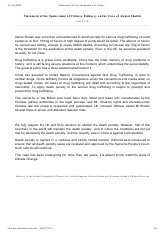
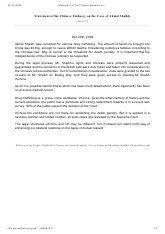
The recognition of threat that China poses to established positions of economic primacy, its self-acknowedged isolation from the world, the incomprehensibility of its vastness of geography and population compared to the United Kingdom, all appear to have helped skew attempts to fully understand China and its emergence onto the world stage.

Fu Ying, the Chinese Ambassador to the UK, made a low-key but significant speech to the English Speaking Union on 14th December 2009 that bears re-reading. It is a recognition by China of the lack of understanding that exists between itself and Western nations:
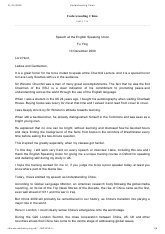
I wonder if we forget even the basic political differences when it comes to negotiations such as those in Copenhagen? China is not a democracy. It is not the USA. It is not the UK. It is not India. It is not Russia. It does not see internal political competition as positive, however inadequately it is expressed in some countries. It is, still, a self-professed communist country, that retains myriad bureaucratic networks that obscure information and confound individual expression. Even economic reforms are restricted by political caution and the vast inequalities between rural, industrialised and commercialised areas. China, unable to resist the march of technology and the coincidence of interest in averting environmental disaster, is having to learn how to deal on the traditional diplomatic stage, just we are having to re-learn how to deal with China outside of a Cold War paradigm we can control. China speaks a political language that we in the West have forgotten in the twenty years since the Berlin wall came down.

Copenhagen is the starkest evidence of this failure of understanding. Whether Copenhagen failed because of a Western trap, as John Lee asserts, or because China was determined to protect its economic interests at all costs, as Mark Lynas suggests, we do not yet know how to talk to China and explain our priorities – and why those priorities matter.

To my mind, the execution of Akmal Shaikh is an extension of that failure.

As a Liberal, as a human being who loves his family, as a man with private dreams and ambitions, and as a humanitarian, I am appalled by China’s execution of this father of five, the mentally-ill victim of drug-traffickers who was denied access to even a basic evaluation of his mental health.  However, as a Liberal, as a human being who loves his family, as a man with private dreams and ambitions, and as a humanitarian, I believe I need to understand China better, so that, should the opportunity present itself in some small way, I can show more clearly why I adhere to the beliefs I do – and demonstrate their intrinsic value.

As a Christian, quietly sharing the sentiments above, I am left reflecting on the intolerable cruelty of Akmal Shaikh’s lonely and forsaken grave – a cold world away from his wife, five children and the taxi business he used to run in North London.

Akmal Shaikh's unmarked grave - N/A

Add to FacebookAdd to DiggAdd to Del.icio.usAdd to StumbleuponAdd to RedditAdd to BlinklistAdd to TwitterAdd to TechnoratiAdd to Yahoo BuzzAdd to Newsvine

PAVIS, Basildon Council and The Institute of Fundraising – cheque it out #cheques #fundraising #poverty

Jane Lutton’s comment to my previous article on cheques has prompted me to write another little piece.

Jane works for PAVIS Foundation for Visually Impaired People, a small registered  charity set up in 1998 that provides a tremendous range of services for those with sight difficulties. Jane’s concern is that it is this sort of charity – and I think that there must be hundreds around the United Kingdom – that will be disadvantaged by the removal of cheques, as proposed by the Payments Council [see this summary note for a reminder of the plans].  If PAVIS cannot identify the resources to invest in direct debit facilities to manage donations, then I presume that, if it can no longer raise the necessary funds, then this is a charity whose very existence could be determined by the usability and cost-effectiveness of any cheque replacement.

It is the threat to vulnerable individuals that concerns me most.

For instance, the Conservative administration at Basildon Council has decided that it is no longer cost-effective to provide housing benefit by cheque and so has announced it is to withdraw that option. The Cabinet member with responsibilities for resources, Cllr Phil Turner, claims it costs £10 to process each cheque, making it too expensive. In a further telling comment, he explains that it is more convenient for the claimant. It is refreshing to see that for all of Cameron’s Conservatives’ pretence at reinvention and identification with modern Britain, its members remain as patronisingly paternal in their treatment of those less fortunate than themselves. They, it would seem, are not entitled to decide what is the most convenient way for them to be paid.

For those who are might be defined as vulnerable, the threat is two-fold.

Firstly, the interplay between the continuing “electronification” of financial services will lead to a particular form of financial exclusion amongst those unwilling or unable to adapt to new technologies. If you think this is a small number of people, Lavinia Mitton’s 2008 study for the Joseph Rowntree Foundation, entitled Financial Inclusion in the UK: Review of Policy and Practice, will shock you with its reporting of a 2003 review in Scotland that showed that a third of disabled people in Scotland did not even have a current account with a cheque book. (There are two other superb studies on the JRT website, both ten years old, that look at financial exclusion: Understanding and combating ‘financial exclusion’ and Family finances in the electronic economy. Both highlight some of the issues that are coming to light in the current debate around cheques.) Andrew Harrop, for Age Concern, was similarly concerned:

“Many older people rely on cheques as their main form of payment and will be very worried about how they will manage if they are withdrawn.

“Our fear is that setting a date will give the green light to banks and retailers to withdraw cheques even earlier than 2018‚ as some already have.  It is vital that before cheques are phased out‚ the Payments Council ensures there is a practical‚ safe‚ paper-based alternative in place which serves the needs of this group.

“Chip and pin is problematic for many older and housebound people and we know 6.4 million over 65’s have never used the internet. Without cheques‚ we are very concerned people will be forced to keep large amounts of cash in their home‚ leaving them vulnerable to theft and financial abuse.

“We are being asked to take on trust that the banking industry will create an alternative people can use‚ but new forms of payment can take a long time to develop and no action has been taken to date.”

Secondly, as Jane’s example shows, there is a very real threat to the plethora of voluntary support services that provide assistance to the vulnerable.

By way of representative organisations, Jane mentions the Institute of Fundraising. In its own words:

“The Institute of Fundraising is the professional membership body for UK fundraising. Its mission is to support fundraisers, through leadership, representation, standards-setting and education, and it champions and promotes fundraising as a career choice.”

Sadly, in their list of top stories in fundraising, the issue of cheques doesn’t feature. This is a significant omission as, whilst it is unlikely that this decision can be reversed, development of a suitable alternative needs to be championed by an organisation that can represent the broad range of interests in fundraising – not just the corporate donors. If you are interested in raising this issue, even to establish their opinion, you can contact the Institute of Fundraising here.

Finally, the Lib Dems have started a group on their new social networking site ACT, which is dedicated to saving the cheque. You don’t have to be a party member to join ACT and the group is called Save The Cheque Campaign.

**

By way of a small distraction, Cllr Turner’s eagerness to refuse to pay by cheque is not matched by his readiness to refuse payment. Enter “cheque” into the Basildon Council Website  search facility and you produce 41 results (including the press release linked above). If you require reports from planning services, you are instructed to pay by cheque. If you are disabled and eligible for aid, you are instructed to pay the builder by cheque. If you want to get a season ticket you are to fill in a form – and pay by cheque. Paying fines? Cheque is an option. Rebate on your council tax? Basildon can pay this by cheque. I do not know if Cllr Turner is planning to cancel all these facilities shortly or if these cheques are somehow cheaper to process.  If I were less generous, I might think that he is starting with desperate people who will go through whatever Council hoops are forced on them in order to keep a roof over their heads (the comments on the Echo story linked in the main piece suggest that housing benefit claimants are not particularly popular and therefore an easy target for a Council wanting to save some money). Thoughts would of course be appreciated, together with suggestions for questions that should be asked.

Add to FacebookAdd to DiggAdd to Del.icio.usAdd to StumbleuponAdd to RedditAdd to BlinklistAdd to TwitterAdd to TechnoratiAdd to Yahoo BuzzAdd to Newsvine

Chequeing Out

Sometimes something can simply not feel right.

Remember the phasing out of Morse Code? It just didn’t sit comfortably.  You can’t argue the case, because the “experts” tell you that it’s been superseded by technology. You feel foolish when it’a pointed out how antiquated it all is. The tech “expert” is the conversational equivalent of the l33t gamer and trying to tell them how to play is going to get you pwnd like a n00b.

Yet, deep inside, the armchair captain in you still knows that when the the computer, the radio and the satellite link-up have failed, you would take more comfort from knowing you could still communicate at a distance with a flash light than from the extremely-expensive-but-now-useless box of WEEE now adorning the bridge. Finally, and long after you’ve been laughed out of the room, a story like that of the MN Rocknes pops up and reminds you that sometimes the old ways of doing things have a flexible benefit all the clever tech in the world can’t beat: Filipinos communicating with Norwegians through the hull of a capsized ship in Morse Code. Now it is the turn of the 350-year-old cheque to be unceremoniously phased out in favour of as yet undeveloped alternatives.

When the Payments Council tried this last year, it found itself facing a less than positive response from small businesses who agreed cheques were inconvenient, but pointed out there wasn’t really a well-developed alternative. It would seem the “experts” in the Payments Council are giving “customer forces” a little nudge in their preferred direction, because, let’s face it, there really isn’t any alternative to a cheque, is there?

Aha, the technorati cry, there are plenty of alternatives! E-mail money transfers! Online payment systems! We can even use our mobiles as alternatives to cheques!

And so this time around, the Forum for Private Business has rolled over.

Nuts. Big fat ones.

Thales is a company that knows a thing or two about electronic communications and financial transactions. They’ve been doing fancy things with MasterCard and something called Advanced Authentication for Chip. Their strategy manager is a chap called Steve Brunswick. It is clear from his blog that even people like Steve haven’t got a clue how they are going to solve this one, really. He makes the brilliantly insightful observation that “Repaying a friend or paying a plumber or gardener for example will be problematic without cheques.”

Whoa! I’d not thought of that! (I’d say your cheque is in the post for Insightful Blog Post Of The Week, but hey, it’s a weak gag.)

What we have here is a familiarly depressing example of how very different groups of people – with very different needs and expectations – participate in the same discussion, but to very different ends. Our “experts” talk in the language of Module Based ID Encryption and “P2P mobile payment solutions” (see Steve’s blog link again for that one). Meanwhile, Mrs Trellis of North Wales doesn’t want to send cash through the post, only has a basic mobile, doesn’t use the internet, but does want to pay that nice chap on the market to frame her pictures and does want to send little Berthog £10 for her birthday. (Berthog is a Welsh name that means “wealthy”. And it is a “her”.)

What does she choose? A cheque.

In the meantime, the Payments Council forces the pace of the getting-rid of a method of payment that is a better leveller of the means of financial exchange than anything other than cash.

I had hoped to point out the finer distinctions between Mrs Trellis and the characters that make up the Board of the Payment Council. Easy enough, I thought.

Mrs Trellis is a single female pensioner and therefore more likely than any other pensioner to be on a low income. Department for Work and Pensions research shows that in 2007-08, the average single female pensioner has just £185 a week left after housing costs. As Mrs Trellis must be almost 80, she will be the wrong side of that average.

By contrast, the Board of the Payments Council is a very different kettle of fish. Curiously, for an organisation which is concerned with all things paymenty, they are very coy about what they are paid.

It is probably a voluntary organisation.

It currently has no Chairman.

So next on the list, by unhappy alphabetical accident, is Michael Alexander, one of the Payment Council’s independent directors. Michael is also Chairman of the Association of Train Operating Companies, Chairman of TGE Marine AG, Non-Executive Director of Costain Plc, and a member of the European Advisory Board for Landis and Gyr. After several hours of looking, I’ve pretty much given up trying to establish Michael’s weekly take-home pay. Like the Payment Council, there is a general coyness around the sums of money involved. Perhaps they are all voluntary positions. However, deep inside (!) I can’t help feeling that it is probably a little more than £185. Something tells me, too, that it’ll probably be equally hard to obtain the figures for the rest of his colleagues. (My apologies to Michael Alexander – I am just attempting to make a point about the different worlds in which this same conversation is taking place.)

None of this rambling post is meant as an attack on business or somehow a criticism of companies that I am sure will all play a key role in the UK’s recovery from recession. It is, however, trying to point out that the needs of a commercial world that trades in bits and bytes is very different from that of an impoverished pensioner in a part of the country where she may still be struggling to get Channel 5.

The cheque, physical, simple and technologically challenged, is trusted almost as much as cash by those who live simpler, ordinary lives.

And when the cheque goes?

Perhaps it is time to reinvigorate the Postal Order for the 21st Century. For those who are prepared to make the leap to the web, the Postal Order could provide a secure vehicle for non-cash transactions, requiring the sharing of bank/card details with a single provider: the Post Office. Those not comfortable dealing electronically could purchase them from the Post Office, perhaps through little dispensers (like parking ticket machines only rather more pleasant). Properly coded it could place little strain on the banks, provide an approximate solution for those who fear the increasingly virtual nature of our money, and reinvigorate a failing Post Office network at a time when rural and urban  communities alike are looking for a stable community focus.

Finally, late as it is, and prone to conspiracy theories as I am, I will simply remark on the curiosity of discovering what a small world it is. I began this piece knowing nothing about Thales or ATOC. It was only in the writing that I noticed that the former – specialists in cashless, virtual transactions – and the latter, which shares its Chairman of the Board with the Payments Council, have already done a deal of business together. National Rail Enquiries, which is run by ATOC, awarded Thale the contract to design, build and operate DARWIN, the National Real Time Database (NRTD).

I am still learning about how the world of business works.

P.S. Some interesting stuff about cheques:

  1. The world’s largest cheque was probably this one from Zimbabwe.
  2. What is probably the world’s oldest surviving cheque is dated February 16th, 1659 and is made out to a Mr Delboe for £400.
  3. What is probably the world’s smallest cheque at 1.1mm by 1.8mm was presented by Queensland State Minister John Mickell to Griffith University in Brisbane in 2007 – value $6,000,000.

P.P.S. In a further vindication of older technologies, you might recall the story about the Australian museum that staged a run off between an old-school Morse Code telegraph operator and a mobile-phone-using teenage texter?

Go on… You know who won!

Add to FacebookAdd to DiggAdd to Del.icio.usAdd to StumbleuponAdd to RedditAdd to BlinklistAdd to TwitterAdd to TechnoratiAdd to Yahoo BuzzAdd to Newsvine