Arrogance and disregard for the taxpayer: Hanningfield’s latest wheeze as Essex freezes #toryfail #snow

The sheer arrogance of Lord Hanningfield is unbelievable.

The leader of Essex County Council clearly thinks he is running his own version of Essex Bank, rather than leading an elected local authority. The latest venture from the Bank of Essex – surely the greatest testament to personal ego of any initiative in local government in recent years – is to offer a £100,000 overdraft facility to eligible businesses.

Excuse me?

Admitting you are no longer capable of running public services and handing them wholesale to IBM is one thing, but doing so as you extend the commercial operations of a bank that only exists because of your elected mandate is something entirely different. At no point do I recall my local successful candidate at the County Council Election, Cllr John Schofield, informing voters that he intended to be a party to such speculation with public funds: public funds provided by hard-working Council Tax payers.

According to the Frequently Asked Questions on the Banking on Essex website, all profits from the venture will be used to cover potential losses and protect taxpayers’ funds.

Where has Lord Hanningfield been for the last eighteen months?

Banks with a hundred-year tradition of providing commercial services haven’t been able to get this right in the current economic climate. How on earth can taxpayers have any confidence that self-aggrandising politicians will succeed where self-aggrandising bankers failed? More importantly, how can politicians, with little or no experience at running a bank, guarantee that the profits will cover the losses? I am not sure that assuring voters that you are working in partnership with a large banking organisation gives much confidence these days…

I suppose you could have a little more confidence if some care was taken with the presentation. However, that is clearly no concern for this commercial operation. Here is how the guarantee appears in the Banking on Essex FAQs (Frequently Asked Questions) at the time of writing:

“Will the initiative put tax payers’ money at risk?
The County Council is using all additional income earned to cover potential loses [sic] and protect tax payers’ funds.”

The italics are mine.

Essex is the Education Authority.

Essex is also attempting to generate a sense of commercial confidence.

The example above demonstrates why politicians should put their determination to write themselves into history to one side and stick to what they were elected to do: represent the interests of the people who put them in office.

Here is a reminder for Conservative councillors  John Schofield and Lord Hanningfield of matters that should be the priority for Essex County Council over the next few weeks:

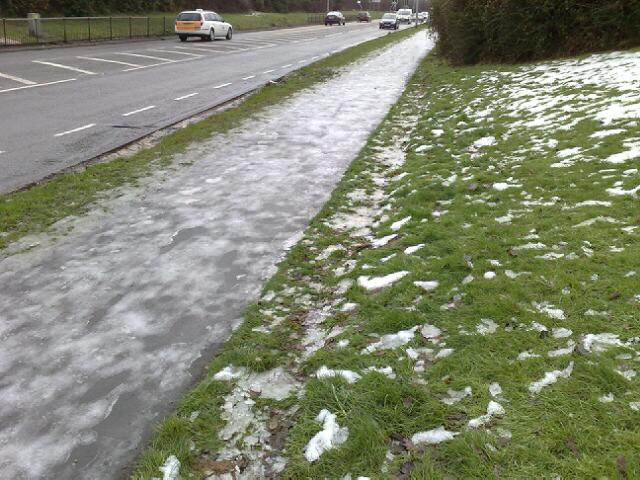
Path to hospital at junction of Nethermayne and the Knares, 24 December 2009

Path to hospital, 24 December 2009

These two pictures were taken of the main footpath to the principal site of Basildon and Thurrock University Hospitals on Christmas Eve 2009 – exactly one week after the heavy snow falls that caused chaos in South Essex. It was still iced over even when the snow on surrounding banks had melted and the roads had been gritted.

In the NHS Foundation Trust’s own words:

[We] primarily serve the almost 400,000 population of Basildon and Thurrock in South West Essex, plus some residents of the neighbouring districts of Brentwood (for whom we are the main provider of cardiology services) and Castle Point.

With a annual budget of £250 million, the Trust treats 63,000 inpatients and day cases, provides 270,000 outpatients consultations and attends to more than 90,000 Accident and Emergency (A&E) patients.

And pictured just above is the path people had to walk to reach that hospital, should they not be fortunate enough to drive a car.

I met an elderly constituent of mine as I walked to town that Thursday. He was incandescent. He is usually a charming conversationalist, but that day he had only three words for me as he gestured unsteadily with his walking stick at the ice: “It is wicked”.

The Basildon Recorder was forced by Essex County Council to issue an apology when it ran a story criticising the county for inadequate salt supplies. Apparently, there is no shortage:

“The county council would like to assure residents that Essex County Council continues to be fully prepared for icy winter conditions with more than sufficient supplies of gritting salt for the bad weather.”

So if there was no shortage, I can only assume that Essex County Council simply doesn’t care about pedestrian access to the major health facility in the south of the county. Surely, if there was salt, and it gave a stuff, Essex would have taken the time to grit this major pedestrian route? Winter 2008/2009 saw the highest excess winter mortality rates for ten years. It is hard to believe that figure will be lower for 2009/2010 if this Winter is harsher. Respiratory illnesses are just one set of conditions that are exacerbated by conditions in the winter months. (If you are really interested, there is a superb paper on the website of of the Centre for Public Health at the Liverpool John Moores University entitled Weather forecasting as a Public Health Tool). People need to be able to get to hospital – and that includes by foot.

This is the Met Office weather warning for the East of England, for Tuesday 5th January, issued on Monday 4th January:

“There is a moderate risk of severe weather affecting east and southeast England.

Outbreaks of sleet and snow will become heavier during Tuesday afternoon and evening, with an increasing risk of disruption to transport networks.

Issued at: 1124 Mon 4 Jan”

Sky News is warning Heavy Snow Set to Bring More Travel Chaos.

The question I have is: will Essex County Council heed the warnings and make an effort to ensure that key footpaths are snow and ice free this time around?

To finish, three simple things:

Stop throwing the taxes of hard-working local people at self-indulgent, speculative schemes.

Stop criticising the press for reflecting local concerns.

Start delivering a basic level of service: grit our roads and footpaths, especially where they provide access to major facilities such as hospitals.

Add to FacebookAdd to DiggAdd to Del.icio.usAdd to StumbleuponAdd to RedditAdd to BlinklistAdd to TwitterAdd to TechnoratiAdd to Yahoo BuzzAdd to Newsvine

Tories and IT procurement: headline-grabbing opportunism

Francis Maude has made the bold statement that the Tories will ban IT projects that cost over £100m. It looks good in the headlines. He said:

“Labour’s IT procurement process has been marked by a catalogue of failures, late deliveries and cost overruns.

“We need a freeze on signing up to yet more failed projects.”

You can read the full story in the Telegraph by following this link.

A week is clearly a long time in Tory politics.

On December 22  I blogged about the £5bn proposal by Lord Hanningfield‘s Tory administration in Essex to hand over the running of services it is unable to provide effectively itself to IBM. You can remind yourself of the story here.

Contrast the Tories’ willingness to talk tough on cash limits on  IT projects at the centre (probably quite sensible knowing how badly some of them have failed), with their example in local government in Essex. Unlike other local authorities, Essex are off-loading services that they clearly believe they are no longer capable of delivering. It strikes me as a comprehensive admission of political failure to deliver. If Maude’s boast is to have any credibility, the sheer untested lunacy of Hanningfield’s project demands robust intervention from Cameron et al.

Just as irresponsible spending on projects in Whitehall needs clamping down on, so local authorities, including Tory Essex, should not receive carte blanche to experiment with innovative IT projects at vast public expense.

Headline-grabbing opportunism is one thing. Dealing with your own IT cowboys is something entirely different.

Add to FacebookAdd to DiggAdd to Del.icio.usAdd to StumbleuponAdd to RedditAdd to BlinklistAdd to TwitterAdd to TechnoratiAdd to Yahoo BuzzAdd to Newsvine

Tory-run Essex County Council becomes Cameron’s sandbox

IBM takes on services in Essex as part of £5bn privatisation deal

It is one of those headlines that makes you wonder where on earth it will lead. I’ve spent the past hour wondering if my immediate Tweet in response was over the top and a misinterpretation of what is going on:

Essex Tories begin revolutionary dismantling of public services – with Cameron’s full support

It wasn’t.

This is a deal that has the potential to fundamentally alter the nature of local government in England. A Cameron win in 2010 could see a revolution in the provision of local services that strangles political differentiation, subjugates community priorities to an ideology of technocratic efficiency – and all whilst reassuring voters that these changes are merely efficient and (of course) apolitical.

Superficially, the attraction is obvious.

Politicians are held in contempt on a national and local level. (Ironically, Lord Hanningfield bridges the gap between the national expenses scandal and the crisis in local service provision in extraordinary fashion, with reports that detectives have sent files to the Crown Prosecution Service alleging fraud, just at the point that Essex County Council, which he leads, is condemned for its appalling record on children’s services.) What better way to score a political victory than to tacitly acknowledge that distrust by placing the delivery of services in the hands of a non-political and widely-respected industry leader such as IBM?

IBM has considerable experience of public service delivery in Canada, as the Times article linked in the headline shows. There is an impressively detailed exposition of its objectives and relationship with Canadian public services in IBM’s paper Service Canada – A New Paradigm in Public Service Delivery. Even a cursory reading demonstrates that IBM’s engagement in Canada is very, very different to what is being reported has been agreed with Hanningfield. Prioritising 21st Century public service delivery in a mountainous, multi-lingual country, that is the second largest in the world, yet the ninth least densely populated, is rather different from the Essex experience (Langdon Hills may boast “one of the most astonishing prospects to be beheld“, but. let’s face it, we’re not exactly talking the Rockies here). Yet even with these laudable objectives, the project has attracted criticism on a variety of levels, for its effect on women, its impact on health care and even concerns for national security. (A google search consisting of “public services” “wholesale privatization” and “canada” is revealing.)

I have no ideological objection to the delivery of public services through the private sector. I believe that the well-considered and appropriate out-sourcing of services and the importation of industry best practice have led to genuine improvements in service. The key to its success is the accountability that comes from having contracts that are carefully scrutinised, regularly reviewed and competitively tendered for.

At the same time, I am very conscious that public services are exactly that: services provided to the public by authorities that should be transparent, prepared for detailed scrutiny and, ultimately, held to account. There is a balance to be struck and the job of local politicians is to strike that balance, serving the needs of those they represent as best they can. Those in opposition draw attention to deficiencies in current services and offer an alternative programme for local priorities.

Ultimately, the people who pay for and use those services decide who they want in charge.

Hanningfield’s wheeling and dealing should send a chill through anyone who still places a value on choice, transparency, accountability, competition and social justice. Companies like IBM don’t invest in technological infrastructure to run services for a couple of years. They expect to be the partner of choice for many. The contract we are told is for eight – well beyond the date of the next County Council elections. And as many will have noticed,  it is measurably harder to extract detailed information from private sector partners, council officers nervously explaining that such information is restricted due to the need to observe commercial confidentiality (actually it isn’t, a lot of the time, but that’s another story).

Couple the Essex example with Tory-run Barnet’s attempts to experiment with ‘no-frills’ local government services – two-tier services that lead to extra charges or rebates depending on how much you need them – and everyone involved in the political conversation of the country should take note:

The Cameron revolution is under way before a single vote has been cast and it shows every sign so far of being as ideological, divisive and destructive as Thatcher’s.

We in Essex and Barnet may be living in Cameron’s sandbox today, but the results of these experiments could inform the local services of everyone tomorrow – for years and year to come.

Add to FacebookAdd to DiggAdd to Del.icio.usAdd to StumbleuponAdd to RedditAdd to BlinklistAdd to TwitterAdd to TechnoratiAdd to Yahoo BuzzAdd to Newsvine

UPDATE: Of snow, roads and hopeless Tory County Council incompetence

They’ve gritted. After two days. And 6″.

On Twitter this would be tagged #toryfail.

Add to FacebookAdd to DiggAdd to Del.icio.usAdd to StumbleuponAdd to RedditAdd to BlinklistAdd to TwitterAdd to TechnoratiAdd to Yahoo BuzzAdd to Newsvine

Of snow, roads and hopeless Tory County Council incompetence

I woke yesterday morning to the stunning sight of snow lying on the fields of the Lincolnshire Wolds. It had been barely more than a dusting when I had looked out of the window on the previous evening. The snow was thick on the road, too. The A16 snakes viciously past the village of Swaby, racing past the small row of houses where Em’s family live and on towards Louth. 4″ of snow is quite a sight:

Snow on the A16, Dec 19 2009

But hang on a minute. The A16 is the main road between Boston and Grimsby. It is the sort of rural A-road that wannabe Colin McRaes careen around in lunatic fashion, dodging the articulated lorries that stream steadily from end to end. It is the sort of rural A-road that Lincolnshire County Council have quite sensibly designated as a “Red Route”. What is a Red Route? It’s a road where there is a higher than average chance that you might get to answer some of life’s more profound questions should you be behind the wheel of a car. Particularly if your latest X-Box 360° or iPhone fix is Need for Speed™ SHIFT.

You can read more about Red Routes here on a page of the Lincolnshire County Council’s website reassuringly subtitled “A survival guide to Lincolnshire’s roads”. Apparently, car users represent a far higher proportion of those casualties recorded as KSI (Killed and Seriously Injured)  in Lincolnshire – a frightening  64%, compared to the national average of 46%.  If you are interested, you can read more about it here.

So. Red Routes. Dangerous. Particularly at speed.

Here – for the benefit of Lincolnshire’s Tory County Councillors – are some elementary facts about snow and its effects. It is usually forecast by the Met Office. It makes roads slippery. Slippery roads are dangerous roads. Red Route roads are dangerous roads that get a whole lot more dangerous.

So why is it that the cretins at County Hall (Lincolnshire) have yet to chuck a single piece of grit on sections of the A16 marked out as accident hot spots?

After last year and “The Great Grit Crisis” of 2008, you might expect a County Council that is looking out for the welfare of local residents, and which has access to the BBC Weather like the rest of us, to be a little quicker off the mark with the gritters than never. However, it was only after frustrated police demanded a snow plough be sent out that the A16 became vaguely usable.

As I am writing, with temperatures well below freezing, I hear the occasional rumble of wary drivers trundling past on the snow-covered unlit A16. I have yet to hear the reassuring rattle of a gritter. The prospect of the complacent uselessness of Lincolnshire County Council writ large if Cameron’s Tories win power at Westminster is truly frightening.

Add to FacebookAdd to DiggAdd to Del.icio.usAdd to StumbleuponAdd to RedditAdd to BlinklistAdd to TwitterAdd to TechnoratiAdd to Yahoo BuzzAdd to Newsvine