Geoff Williams’s campaign as Lib Dem candidate for South Basildon and East Thurrock #libdem #basildon

For those interested in following Geoff Williams’s campaign to be the Member of Parliament for South Basildon and East Thurrock, you can keep up-to-date in a couple of new ways.

If, like me, you are on Twitter, you can follow his Tweets on twitter.com/geoff4mp – just add him to your Twitter feed.

For those who are on Facebook (I made my first foray recently – more on that later), you can follow his campaign by becoming a fan on www.facebook.com/geoff4mp – feel free to post comments, ask questions and generally get to know what he’s about.

Add to FacebookAdd to DiggAdd to Del.icio.usAdd to StumbleuponAdd to RedditAdd to BlinklistAdd to TwitterAdd to TechnoratiAdd to Yahoo BuzzAdd to Newsvine

Local champion Geoff Williams selected to fight South Basildon and East Thurrock for the Lib Dems #basildon

Local activist and campaigner Geoff Williams has been selected to fight the seat of South Basildon and East Thurrock for the Liberal Democrats at the next General Election.

Geoff, who has been a local champion, successful campaigner and district councillor for many years, spoke to supporters this evening in the Allpress Hall at Dry Street Memorial Church. He made clear that this was a crucial election for Nick Clegg and the Liberal Democrats, the party’s gut instinct for fairness giving local people in South Basildon and East Thurrock a chance for real change at the election.

In response to questions, he said he was keen to get the Liberal Democrat message out across the towns and villages that comprise the new seat, pointing out that places such as Bulphan, Fobbing and Horndon-on-the-Hill are often overlooked by politicians.

More in the days to come…

In the meantime, congratulations Dad!

Geoff Williams following his selection as Lib Dem PPC for Basildon

Add to FacebookAdd to DiggAdd to Del.icio.usAdd to StumbleuponAdd to RedditAdd to BlinklistAdd to TwitterAdd to TechnoratiAdd to Yahoo BuzzAdd to Newsvine

Nuclear cheerleaders: Essex Tories embrace Brown’s Bradwell nuclear agenda – and decide residents’ views don’t matter #toryfail #green #nonewnuclear

“The Members of Essex County Council are very concerned that the Government is only undertaking a very limited public consultation on Bradwell being a suitable site for a replacement Nuclear Power Station. Members call upon the Government to widen this consultation across Essex so that all our residents have the opportunity to make their voices heard on this very important issue.”

This was the motion put forward by Essex Liberal Democrats at the meeting of Essex County Council on 15th December.

It looks pretty measured doesn’t it? It doesn’t indulge in party-political posturing. It doesn’t even pompously declare that “Liberal Democrats are very concerned” but uses the neutral “Members of Essex County Council are very concerned”. It doesn’t require the spending of large sums of taxpayers’ money or force the County Council to do something (heaven forfend!). It simply requests that the Government – the Labour Government – extend its very narrow consultation on a potential new nuclear power station at Bradwell to the rest of Essex (the existing Bradwell nuclear power station was decommissioned on 28 March 2002). The motion doesn’t put pro-nuclear supporters in a difficult position by offering an opinion as to whether nuclear power is a good thing or a bad thing. Rather, it simply makes the point that on an issue this big the whole of Essex should be consulted.

As motions go, particularly those designed to attract support from across the political spectrum, it’s pretty darn good. So more on the motion in just a moment.

First, it’s worth taking a moment to examine quite how appalling the consultation referred to is. Or rather – was. I think. To be honest, it isn’t so clear. On 9 December, the Department of Energy & Climate Change (DECC) issued a press release entitled “What does new nuclear mean for Essex?” It boasts:

“Residents of Essex are this weekend being asked to have their say on proposals to a build a new nuclear power station in the area……The announcement on new nuclear sites was made as part of a planning overhaul for big energy projects and ten potential new sites for nuclear energy were named in the draft Nuclear National Policy Statement. These sites are Bradwell, Braystones, Hartlepool, Heysham, Hinkley Point, Kirksanton, Oldbury, Sellafield, Sizewell and Wylfa. Bradwell was nominated by EDF, who are currently seeking to sell the site to a credible nuclear operator.

Following the nomination of the sites the Department of Energy and Climate Change is conducting a 15 week consultation to hear people’s views about the proposals.

The new Infrastructure Planning Commission will use the National Policy Statement when considering planning applications for new nuclear power stations. This consultation is an opportunity for local people to influence what the IPC should take into account when considering whether to grant consent or not.”

It looks promising. There is a fifteen week consultation. There is an opportunity for local people to influence what should be taken into account when considering whether to grant consent or not. In fact, the press release begins by saying “Residents of Essex are this weekend being asked to have their say on proposals to a build a new nuclear power station in the area”.

  • On Wednesday 9 December DECC issues its press release including consultation details.
  • On Thursday 10 December there is an exhibition in West Mersea.
  • On Friday 11 December there is an exhibition in Maldon.
  • On Saturday 12 December there is an exhibition in Bradwell-on-Sea.
  • And there were two “two public discussion events” – but no details were provided in the release. (They clearly weren’t intended for non-locals who I assume – hope – were at least leafleted.)

And… Er… That’s it.

Residents of Essex, eh?

Even though DECC describe the site in their press release as “near Chelmsford” there isn’t a consultation in Chelmsford. Despite it being a fifteen week consultation, Essex gets five highly localised events in the three days immediately after the press release going out. I may be atypical of your average Essex resident, but even despite my political interests, I don’t keep tend to keep track of Government department press releases day by day.

Good luck to those of you who do and managed to get there.

According to the website of West Mersea Council, West Mersea has a population of 6,925 people. According to the website of Maldon District CouncilMaldon has a population of approximately 60,700. The website of Bradwell Parish Council doesn’t provide any information on population – but Wikipedia lists the population as 877. According to the website of Essex County Council, the population of Essex is 1,396,400 (excluding Thurrock and Southend-on-Sea – though in the event of disaster, I am not convinced fallout is as discriminating as the Boundary Commission).

Of course the residents of those places should be consulted. However the Labour Government (DECC) and the Infrastructure Planning Commission think that consulting 0.05% (I am rounding up here) of the population of Essex is somehow giving residents of Essex the chance to have their say. As for the time given over to consultation, the DECC press release highlights a paltry three specified days in a fifteen week consultation.

It is nothing short of outrageous – a complete scandal in a 21st century liberal democracy.

And you would think that the Conservative Party, a national party of opposition, that controls the County Council, would want to stick up for the right of local people to be heard, regardless of its own policies on nuclear power.

Back to the motion…

Did the Conservatives support the Liberal Democrat motion?

Not a chance. The Tories voted against. They opposed the extension of the consultation to the rest of Essex and, by doing so, have effectively said our views don’t matter.

Essex County Council doesn’t record how people vote as a matter of course. Why should they – after all, you are not interested in what your elected representatives are doing, are you? Therefore, finding out which way your local representatives voted looks like being a case of emailing them directly.

You can find your way to the contact details for Essex County Councillors here. For those readers in Basildon, the following Conservative councillors may well have voted to prevent you having more information:

I have emailed each of them to ask if they were there on 15 December and, if they were, how they voted. If they opposed the motion, I have asked why they don’t believe the Government should consult the people in Basildon that they are elected to represent.

You might want to do the same.

I would be interested to know the reasons people vote as they do – so please add a comment to this blog piece!

Add to FacebookAdd to DiggAdd to Del.icio.usAdd to StumbleuponAdd to RedditAdd to BlinklistAdd to TwitterAdd to TechnoratiAdd to Yahoo BuzzAdd to Newsvine

Bazzo Christmas Update – Old Man Stan and Vin Harrop comment

Those of you who read the Bazzo Christmas piece may be interested to know that Steve from the Ugly Wuggly Puppet Company (the team behind Old Man Stan) has posted a lengthy comment. Vin Harrop, heritage director of Our Basildon, has also posted. You can find their comments by clicking here and scrolling down:

https://fragmentsandreflections.me/2010/01/03/bazzo-christmas-or-how-an-unconventional-pensioner-upset-basildon-district-council/#comments

If you have thoughts on the arts in Basildon to add, please do so.

And if you’ve not looked around the Our Basildon website I urge you to do so and see what a wealth of public art there is throughout the district. You can also check out the heritage trail that has been created.

Add to FacebookAdd to DiggAdd to Del.icio.usAdd to StumbleuponAdd to RedditAdd to BlinklistAdd to TwitterAdd to TechnoratiAdd to Yahoo BuzzAdd to Newsvine

Arrogance and disregard for the taxpayer: Hanningfield’s latest wheeze as Essex freezes #toryfail #snow

The sheer arrogance of Lord Hanningfield is unbelievable.

The leader of Essex County Council clearly thinks he is running his own version of Essex Bank, rather than leading an elected local authority. The latest venture from the Bank of Essex – surely the greatest testament to personal ego of any initiative in local government in recent years – is to offer a £100,000 overdraft facility to eligible businesses.

Excuse me?

Admitting you are no longer capable of running public services and handing them wholesale to IBM is one thing, but doing so as you extend the commercial operations of a bank that only exists because of your elected mandate is something entirely different. At no point do I recall my local successful candidate at the County Council Election, Cllr John Schofield, informing voters that he intended to be a party to such speculation with public funds: public funds provided by hard-working Council Tax payers.

According to the Frequently Asked Questions on the Banking on Essex website, all profits from the venture will be used to cover potential losses and protect taxpayers’ funds.

Where has Lord Hanningfield been for the last eighteen months?

Banks with a hundred-year tradition of providing commercial services haven’t been able to get this right in the current economic climate. How on earth can taxpayers have any confidence that self-aggrandising politicians will succeed where self-aggrandising bankers failed? More importantly, how can politicians, with little or no experience at running a bank, guarantee that the profits will cover the losses? I am not sure that assuring voters that you are working in partnership with a large banking organisation gives much confidence these days…

I suppose you could have a little more confidence if some care was taken with the presentation. However, that is clearly no concern for this commercial operation. Here is how the guarantee appears in the Banking on Essex FAQs (Frequently Asked Questions) at the time of writing:

“Will the initiative put tax payers’ money at risk?
The County Council is using all additional income earned to cover potential loses [sic] and protect tax payers’ funds.”

The italics are mine.

Essex is the Education Authority.

Essex is also attempting to generate a sense of commercial confidence.

The example above demonstrates why politicians should put their determination to write themselves into history to one side and stick to what they were elected to do: represent the interests of the people who put them in office.

Here is a reminder for Conservative councillors  John Schofield and Lord Hanningfield of matters that should be the priority for Essex County Council over the next few weeks:

Path to hospital at junction of Nethermayne and the Knares, 24 December 2009
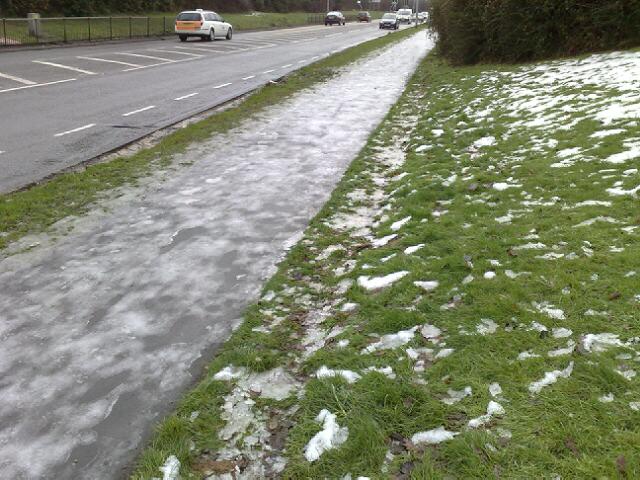
Path to hospital, 24 December 2009

These two pictures were taken of the main footpath to the principal site of Basildon and Thurrock University Hospitals on Christmas Eve 2009 – exactly one week after the heavy snow falls that caused chaos in South Essex. It was still iced over even when the snow on surrounding banks had melted and the roads had been gritted.

In the NHS Foundation Trust’s own words:

[We] primarily serve the almost 400,000 population of Basildon and Thurrock in South West Essex, plus some residents of the neighbouring districts of Brentwood (for whom we are the main provider of cardiology services) and Castle Point.

With a annual budget of £250 million, the Trust treats 63,000 inpatients and day cases, provides 270,000 outpatients consultations and attends to more than 90,000 Accident and Emergency (A&E) patients.

And pictured just above is the path people had to walk to reach that hospital, should they not be fortunate enough to drive a car.

I met an elderly constituent of mine as I walked to town that Thursday. He was incandescent. He is usually a charming conversationalist, but that day he had only three words for me as he gestured unsteadily with his walking stick at the ice: “It is wicked”.

The Basildon Recorder was forced by Essex County Council to issue an apology when it ran a story criticising the county for inadequate salt supplies. Apparently, there is no shortage:

“The county council would like to assure residents that Essex County Council continues to be fully prepared for icy winter conditions with more than sufficient supplies of gritting salt for the bad weather.”

So if there was no shortage, I can only assume that Essex County Council simply doesn’t care about pedestrian access to the major health facility in the south of the county. Surely, if there was salt, and it gave a stuff, Essex would have taken the time to grit this major pedestrian route? Winter 2008/2009 saw the highest excess winter mortality rates for ten years. It is hard to believe that figure will be lower for 2009/2010 if this Winter is harsher. Respiratory illnesses are just one set of conditions that are exacerbated by conditions in the winter months. (If you are really interested, there is a superb paper on the website of of the Centre for Public Health at the Liverpool John Moores University entitled Weather forecasting as a Public Health Tool). People need to be able to get to hospital – and that includes by foot.

This is the Met Office weather warning for the East of England, for Tuesday 5th January, issued on Monday 4th January:

“There is a moderate risk of severe weather affecting east and southeast England.

Outbreaks of sleet and snow will become heavier during Tuesday afternoon and evening, with an increasing risk of disruption to transport networks.

Issued at: 1124 Mon 4 Jan”

Sky News is warning Heavy Snow Set to Bring More Travel Chaos.

The question I have is: will Essex County Council heed the warnings and make an effort to ensure that key footpaths are snow and ice free this time around?

To finish, three simple things:

Stop throwing the taxes of hard-working local people at self-indulgent, speculative schemes.

Stop criticising the press for reflecting local concerns.

Start delivering a basic level of service: grit our roads and footpaths, especially where they provide access to major facilities such as hospitals.

Add to FacebookAdd to DiggAdd to Del.icio.usAdd to StumbleuponAdd to RedditAdd to BlinklistAdd to TwitterAdd to TechnoratiAdd to Yahoo BuzzAdd to Newsvine

Bazzo Christmas – or how an unconventional pensioner upset Basildon District Council

Basildon has long been very wrongly vilified as a cultural and creative desert. As anyone who lives here will tell you, there are tremendous opportunities to get involved in the arts, whether that’s singing with the likes of Basildon Choral Society, Billericay Choral Society or Basildon Operatic, getting involved with drama with the Basildon Players, stepping out with innumerable dance groups,  or enjoying works by creative artists like Dean Smith and Jeffrey Porter.

Through the Basildon Arts Trust, Basildon is home to a significant number of important post-war pieces of modern art.

Basildon District Council has also had a fair go at promoting the arts in the community, holding the first Basildon Black History Month in 2009 and, back in 2008, its Basildon Green Business Forum running the Basildon Art Challenge on the theme “Basildon is a Green Place to Be”.

Back in 1989, Basildon Council opened the Towngate Theatre – one of the more controversial capital projects undertaken in recent years and a regular political football between the local parties. After a period of closure, the Conservative administration has made an effort to get the theatre running again, though not without constant sniping that the existing building is inadequate. (One of the charges regularly levelled by the Tory administration is that the Towngate doesn’t have the capacity of modern theatres to attract the right sort of productions. This is a little disingenuous. The Council’s own seating capacity figures show it can take 546 seated or 775 standing. There are plenty of successful West End theatres with a smaller capacity e.g. the Cottesloe Theatre, the Donmar Warehouse, the Arts Theatre and the Fortune Theatre and I would be surprised if they had the backstage facilities, the bar and café facilities or the parking facilities of the Towngate Theatre. Basildon is 30 minutes out of London by c2c, one of the most reliable commuter lines in the country, and it is hard to wear “capacity” as an excuse for not putting more effort into making the Towngate Theatre more successful.)

So with this wealth of creative energy in Basildon, and with the Council not averse to encouraging it or tapping into it, it is a little amusing (bemusing?) to see administration members getting hot under the collar at the latest irreverence from the Ugly Wuggly Puppet Company.

Old Man Stan is a gruff, singing pensioner in the tradition of The Muppets who occasionally points the finger at the Council for various local inadequacies. Kevin Blake, the councillor responsible for for Arts and Leisure, hasn’t seen the funny side. He is reported in the Echo as saying:

“Have these people got nothing better to do than take the mickey out of Basildon and run down our town?

“Taking into account this was initially a campaign to get an arts festival, all they seem to want to do is continually criticise the council.

“It’s an enormous shame that a group of clearly talented people can’t put their talents to better use and demonstrate what a great town Basildon is.”

I like Kevin and he has demonstrated a significant commitment to leisure activity in Basildon. He and I might contest the balance of priorities between sport and the arts, but I hadn’t expected him to have a sense of humour failure on something as creatively silly as this.

Art has always been subversive. It has always poked fun at authority. It is one of the blessings of living in a free society. Just occasionally, folk need to chill out a little.

As for my view? I love it. I think it’s creative, irreverent, mischievous and funny.

Have a look – and if you think I am wrong and Kevin has a point I am missing, I would very much appreciate your comments.


Add to FacebookAdd to DiggAdd to Del.icio.usAdd to StumbleuponAdd to RedditAdd to BlinklistAdd to TwitterAdd to TechnoratiAdd to Yahoo BuzzAdd to Newsvine

PAVIS, Basildon Council and The Institute of Fundraising – cheque it out #cheques #fundraising #poverty

Jane Lutton’s comment to my previous article on cheques has prompted me to write another little piece.

Jane works for PAVIS Foundation for Visually Impaired People, a small registered  charity set up in 1998 that provides a tremendous range of services for those with sight difficulties. Jane’s concern is that it is this sort of charity – and I think that there must be hundreds around the United Kingdom – that will be disadvantaged by the removal of cheques, as proposed by the Payments Council [see this summary note for a reminder of the plans].  If PAVIS cannot identify the resources to invest in direct debit facilities to manage donations, then I presume that, if it can no longer raise the necessary funds, then this is a charity whose very existence could be determined by the usability and cost-effectiveness of any cheque replacement.

It is the threat to vulnerable individuals that concerns me most.

For instance, the Conservative administration at Basildon Council has decided that it is no longer cost-effective to provide housing benefit by cheque and so has announced it is to withdraw that option. The Cabinet member with responsibilities for resources, Cllr Phil Turner, claims it costs £10 to process each cheque, making it too expensive. In a further telling comment, he explains that it is more convenient for the claimant. It is refreshing to see that for all of Cameron’s Conservatives’ pretence at reinvention and identification with modern Britain, its members remain as patronisingly paternal in their treatment of those less fortunate than themselves. They, it would seem, are not entitled to decide what is the most convenient way for them to be paid.

For those who are might be defined as vulnerable, the threat is two-fold.

Firstly, the interplay between the continuing “electronification” of financial services will lead to a particular form of financial exclusion amongst those unwilling or unable to adapt to new technologies. If you think this is a small number of people, Lavinia Mitton’s 2008 study for the Joseph Rowntree Foundation, entitled Financial Inclusion in the UK: Review of Policy and Practice, will shock you with its reporting of a 2003 review in Scotland that showed that a third of disabled people in Scotland did not even have a current account with a cheque book. (There are two other superb studies on the JRT website, both ten years old, that look at financial exclusion: Understanding and combating ‘financial exclusion’ and Family finances in the electronic economy. Both highlight some of the issues that are coming to light in the current debate around cheques.) Andrew Harrop, for Age Concern, was similarly concerned:

“Many older people rely on cheques as their main form of payment and will be very worried about how they will manage if they are withdrawn.

“Our fear is that setting a date will give the green light to banks and retailers to withdraw cheques even earlier than 2018‚ as some already have.  It is vital that before cheques are phased out‚ the Payments Council ensures there is a practical‚ safe‚ paper-based alternative in place which serves the needs of this group.

“Chip and pin is problematic for many older and housebound people and we know 6.4 million over 65’s have never used the internet. Without cheques‚ we are very concerned people will be forced to keep large amounts of cash in their home‚ leaving them vulnerable to theft and financial abuse.

“We are being asked to take on trust that the banking industry will create an alternative people can use‚ but new forms of payment can take a long time to develop and no action has been taken to date.”

Secondly, as Jane’s example shows, there is a very real threat to the plethora of voluntary support services that provide assistance to the vulnerable.

By way of representative organisations, Jane mentions the Institute of Fundraising. In its own words:

“The Institute of Fundraising is the professional membership body for UK fundraising. Its mission is to support fundraisers, through leadership, representation, standards-setting and education, and it champions and promotes fundraising as a career choice.”

Sadly, in their list of top stories in fundraising, the issue of cheques doesn’t feature. This is a significant omission as, whilst it is unlikely that this decision can be reversed, development of a suitable alternative needs to be championed by an organisation that can represent the broad range of interests in fundraising – not just the corporate donors. If you are interested in raising this issue, even to establish their opinion, you can contact the Institute of Fundraising here.

Finally, the Lib Dems have started a group on their new social networking site ACT, which is dedicated to saving the cheque. You don’t have to be a party member to join ACT and the group is called Save The Cheque Campaign.

**

By way of a small distraction, Cllr Turner’s eagerness to refuse to pay by cheque is not matched by his readiness to refuse payment. Enter “cheque” into the Basildon Council Website  search facility and you produce 41 results (including the press release linked above). If you require reports from planning services, you are instructed to pay by cheque. If you are disabled and eligible for aid, you are instructed to pay the builder by cheque. If you want to get a season ticket you are to fill in a form – and pay by cheque. Paying fines? Cheque is an option. Rebate on your council tax? Basildon can pay this by cheque. I do not know if Cllr Turner is planning to cancel all these facilities shortly or if these cheques are somehow cheaper to process.  If I were less generous, I might think that he is starting with desperate people who will go through whatever Council hoops are forced on them in order to keep a roof over their heads (the comments on the Echo story linked in the main piece suggest that housing benefit claimants are not particularly popular and therefore an easy target for a Council wanting to save some money). Thoughts would of course be appreciated, together with suggestions for questions that should be asked.

Add to FacebookAdd to DiggAdd to Del.icio.usAdd to StumbleuponAdd to RedditAdd to BlinklistAdd to TwitterAdd to TechnoratiAdd to Yahoo BuzzAdd to Newsvine

China, Mercy and Akmal Shaikh #amnesty #humanrights #akmalshaikh

It is a sobering email to find yourself sending in the days immediately after Christmas:

Dear Ambassador Fu Ying,

I write to express my deep concern for Akmal Shaikh, who faces execution in China on December 29.

Akmal’s family has pleaded for his life to be spared, and my heart is with them at this terrible time. Akmal’s death, particularly during this holiday season, would destroy his children, his brother and his elderly mother, and tear the family apart.

I know that the Chinese people care deeply about family and I would like to join Akmal’s children in begging for mercy for their father.

This unusual case is not about politics, but about humanity and compassion — values that we share with the Chinese people. My plea to the Chinese authorities is based on the greatest respect for Chinese culture and for these shared values.

yours sincerely,

Ben Williams

If you’ve not done so yet, I would urge you to send it as soon as you can: to the Chinese Ambassador on secretary@chinese-embassy.org.uk and to the Prime Minister via the Number 10 website.

The case of Akmal Shaikh makes for tragic reading and one that, having had cause to have contact with mental health services in the UK, is very believable in terms of the circumstances of his arrest and subsequent explanation of events. Chinese criminal law recognises that mental incapacity reduces criminal responsibility, though the stark way it is written up in the Chinese criminal law suggests that there is a tremendous onus on the defendant to demonstrate diminution of responsibility due to mental ill health at the time the crime was committed.

Whilst the lack of facilities for the treatment of mental illness is a constant source of criticism in the British justice system, particularly in terms of prison care (see this BBC report for more info), a huge library of case law has been developed to help with the interpretation of circumstances (e.g. Wiki Mental Health, a continuously updated online database for professionals who need to understand mental health and the law). China has a powerfully symbolic opportunity to reveal a similarly sophisticated understanding of the complex issues of mental health. At the same time it would demonstrate that it is prepared to engage the language-deficient West in terms of European liberal democratic criminal law that can be readily understood.

For me, as citizen of country that is looking to foster enhanced trade relations with China’s provinces, and who has found himself having a small but real part in the conversation about such relationships, such a gesture would be a resonant signal that the identification of a shared global future is not some self-justifying, post-colonial Western construct – but a definite objective rooted in the practical, hard-nosed give-and-take of international politics and appreciated by a modern China willing to embrace the world.

***

Basildon District Council recently took part in a trade delegation organised by Essex County Council. Two councillors and two officers took part in the visit, which was to the Changzhou area of China’s Jiangsu province. It was reported by the Basildon Echo in this report. It was reported to the last Cabinet meeting (see item 7 on the Agenda) and received support as an initiative from both the Labour and Liberal Democrat groups (see Minute 812). Conservative Councillor Stephen Horgan, Deputy Leader of Basildon Council, was a member of that delegation and his blog report can be read here.

On November 7th, prior to the visit, I wrote to Conservative Councillor Tony Ball, Council Leader, raising amongst other things the imprisonment by the Jiangsu authorities of Guo Quan, the pro-democracy campaigner (see this Financial Times report). Guo Quan was the author of an open letter to the Chinese leaders Hu Jintao and Wu Bangguo calling for democratic government and multi-party elections [NB the later references to Falun Gong are disputed, apparently not appearing in the original Chinese version].  In my email, acknowledging the positive step this trade mission represented for Basildon, I made the following statement:

“As locally-elected politicians, we are the public face of a district that has been politically and economically shaped at a fundamental level by healthy competition between political parties. I hope you share my view that it is important to account for our robust democratic values in any dealings in Jiangsu Province and not see them set aside or devalued because they are in some way inconvenient.”

I don’t know if that statement was pompous, naïve or entirely appropriate.

I am yet to receive a response.

Add to FacebookAdd to DiggAdd to Del.icio.usAdd to StumbleuponAdd to RedditAdd to BlinklistAdd to TwitterAdd to TechnoratiAdd to Yahoo BuzzAdd to Newsvine

“Right to Buy” and the strange death of the New Town concept

Tim Montgomerie has tweeted that today is the 30th anniversary of the Right to Buy Scheme introduced by Margaret Thatcher.  There is no doubt in my mind that it is a policy that has fundamentally altered the shape and original purpose of the New Town concept, creating something of an identity crisis for these sprawling conurbations which local politicians of all parties are struggling to overcome. As suppliers of social housing on enormous scales, the New Towns, like Basildon, were inspired by the concept of  Garden Cities, in a time when big government still believed it could socially engineer society. The New Towns Act was passed in 1946 and, between then and 1970, 21 New Towns were built. In a glorious piece of propaganda, the Central Office of Information attempted to explain the concept of these sustainable living areas in an informative cartoon about an ordinary bloke called Charley:

Many of the concepts are eerily prescient in an era when we are concerned with carbon footprints and quality leaving spaces. It’s important to remember, however, that the New Towns are entirely artificial. Unlike other villages, towns and cities, the New Towns had no historic focal point to draw people together. Indeed, in most cases, a huge amount of effort was put into destroying the character and history of the original area, instead of building in sympathy with it. This parliamentary exchange from 1954, between Mr Bernard Braine (as he was then) and Sir Thomas Dugdale reveals how pressure for development land was paramount. In Basildon, this has led to local people asking serious questions about the origins of the place they live in and fighting hard to save what little remains of the pre-New Town identity (e.g. the efforts of the Chalvedon Hall Community Group).

When places are shiny and new, they are usually attractive places to live. However, a home, in its broadest understanding, is not just the fabric of the building – it is the infrastructure that supports a community: roads, utilities and recreational facilities amongst others. The prospect of a new home and services beyond the imagining must have seemed incredible to those leaving the bomb-shattered ruins of the East End. However, with the provision of social housing on unprecedented scales as the foundation of the New Town, it seems obvious with hindsight that  “Right to Buy” would have an enormous effect on their purpose and future expansion.

Don’t get me wrong: “Right to Buy” and its promotion of home ownership encapsulates a fundamentally liberal aspiration. I wouldn’t suggest turning back the clock. However, by encouraging the social housing stock to be sold off, without permitting local authorities to use the proceeds of sale to provide new social housing,  Thatcher effectively destroyed this visionary concept of confident, sustainable communities.  On a social level, the gap between those who could afford to buy and those who could not became immediately visible in the heart of local communities.  On a planning level, physical expansion was required to attempt to meet the needs of those who had been promised a home but for whom there were few council properties available.

Skip forward thirty years and look at the situation of the New Towns now.

Just as they were built at a similar time, their infrastructure is coming to the end of its life at the same time. What would have been an incredible headache for local and national government in any event has been exacerbated by the pressure placed on New Town roads, services and utilities. Doctors surgeries overflow, roads and footpaths crumble, drains and pipes block and burst as capacity is exceeded – and new development encroaches more and more onto the green belts that were designated to provide recreational relief from the urban environment, preserve the distinct identity of urban communities and retain a much-needed connection to our environment. There is a danger in the South East, with regional initiatives such as the Thames Gateway redevelopment, that towns and villages may simply disappear into an anonymous morass of urban sprawl. Government risks failing again to grasp that communities are self-determining and not engineered, spending vast quantities of taxpayers’ money on enormous and totemic projects instead of stimulating the local economy by assuring the basic fabric of the places in which we already live.

“Right to Buy” is not to blame for the ills of the New Town. However, just as we can appreciate the liberation of the individual and the creation of opportunities to satisfy aspiration that it represented, so we should recognise that the fundamental mistakes of its implementation, driven by Thatcher’s peculiarly ideological politics, have contributed significantly to the difficulties faced by local government in sustaining these enormous and artificial conurbations. More importantly, and regardless of government (local and national), the fact that local communities are determined to preserve their past is a reassuring demonstration of the hunger of local people to know and own the identity of the wider space in which they live.

If you are interested in the campaign to save Great Chalvedon Hall, please contact Gary on greatchalvedonhall@hotmail.co.uk who will be able to let you know how you can help.

Add to FacebookAdd to DiggAdd to Del.icio.usAdd to StumbleuponAdd to RedditAdd to BlinklistAdd to TwitterAdd to TechnoratiAdd to Yahoo BuzzAdd to Newsvine