Looking over Ellie’s art, and writing about the decision of the Council to remove “The Woodsman”, reminded me how beautiful this part of Essex is – in very different ways. Ellie’s art, as she explains in her words in my post below, is heavily influenced by the landscape of her childhood. We grew up nestled in a rural area that was an idyll for children raised on Enid Blyton. Dry Street in Langdon Hills is isolated from the New Town in terms of development and social culture (you might find my very early post on the new town interesting). However, we often took trips to the Estuary coastline, to Coal House Fort, from where we could see the effects of industrialisation very clearly.
With that in mind, I decided to create two galleries on my Flickr page to show off the very different beautiful aspects of the area we live in (both of which are linked in earlier posts but are easy to miss).
The first is of Langdon Hills and is a stunning display of the natural beauty that is available to us in Basildon. The second is of the industrialised Thames Estuary and presents a very different, but equally beautiful view of the same area. Both galleries show pictures of the landscapes to be found in the constituency of South Basildon and East Thurrock.
Some of the scenes are barely a mile apart. Enjoy – and marvel at this diverse and beautiful place.
So Ellie tends to hide her light under a bushel. However, we who know realise that she is an ultra-cool and talented artist whose work is fresh and exciting. I know you think I might say that, as she is my sister, but siblings are not always the kindest critics. I don’t have a good record to be honest. I was apparently interrupted by the neighbour attempting to place my brother (equally talented and ultra-cool) on the bonfire.
This was a long time ago.
Not recently. Anyway…
Most of her stuff is not online at the moment as she is still reworking her online gallery. However, I have decided to embarrass her on my blog by showing the world (well, those who read this) how talented she is.
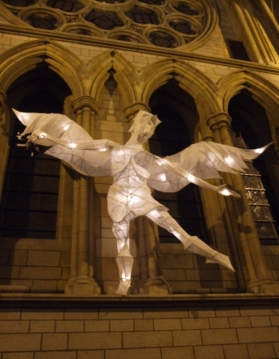
One of her early commissions was to work on The Compton Skyline Project in Brighton. It was a fantastic and ambitious piece of community art, installed on the roofs of houses and engaging local people in its conceptualisation and production. As well as painting, she is a dab-hand at sculpting and installations, working with both the Eden Project and Truro’s City of Lights Festival and Parade.
Ellie's installation of “Angel Gabriel” in Truro Cathedral, City of Lights 2007 - unattributed
She has also been a part of the creative team at Wildworks, the Cornish theatre company with a reputation for challenging and innovative theatre. Wildworks specialises in working with the landscapeand reworking mythical stories in a way that makes them relevant to the here and now. Recently, Wildworks put on the sensational show The Beautiful Journey. Have a look at the reviews. It’s a tremendous vote of confidence in her talents for her to be credited as a member of the team alongside her great friend, collaborator and house-mate, the equally talented and ultra-cool Myriddin Wannell(more on him another time!).
To give you a better idea of what fuels her creative imagination, probably best to read about Ellie in her own words:
Having grown up overlooking the Thames Estuary and it’s industrial and post-industrial landscape – oil refineries, anonymous edifices, scrub land and muddy-brown waters – it is of no surprise that when I moved to the other end of the country I landed at the heart of Cornwall’s contemporary mining landscape. Currently, I’m fascinated by these industrial yet ghostly and sombre places.
Most of my work is predominantly within the realms of drawing and painting, where I’m driven equally by the exploration of materials and the language of mark-making.”
Derelict tower at Coal House Fort, part of the landscape that inspired Ellie's early work
If anyone wants to see what else she has been up to, have a look at her CV. If you want to acquire a piece of her work or are interested in engaging her talents, drop me a line and I will put you in touch if you can’t track her down on the web!
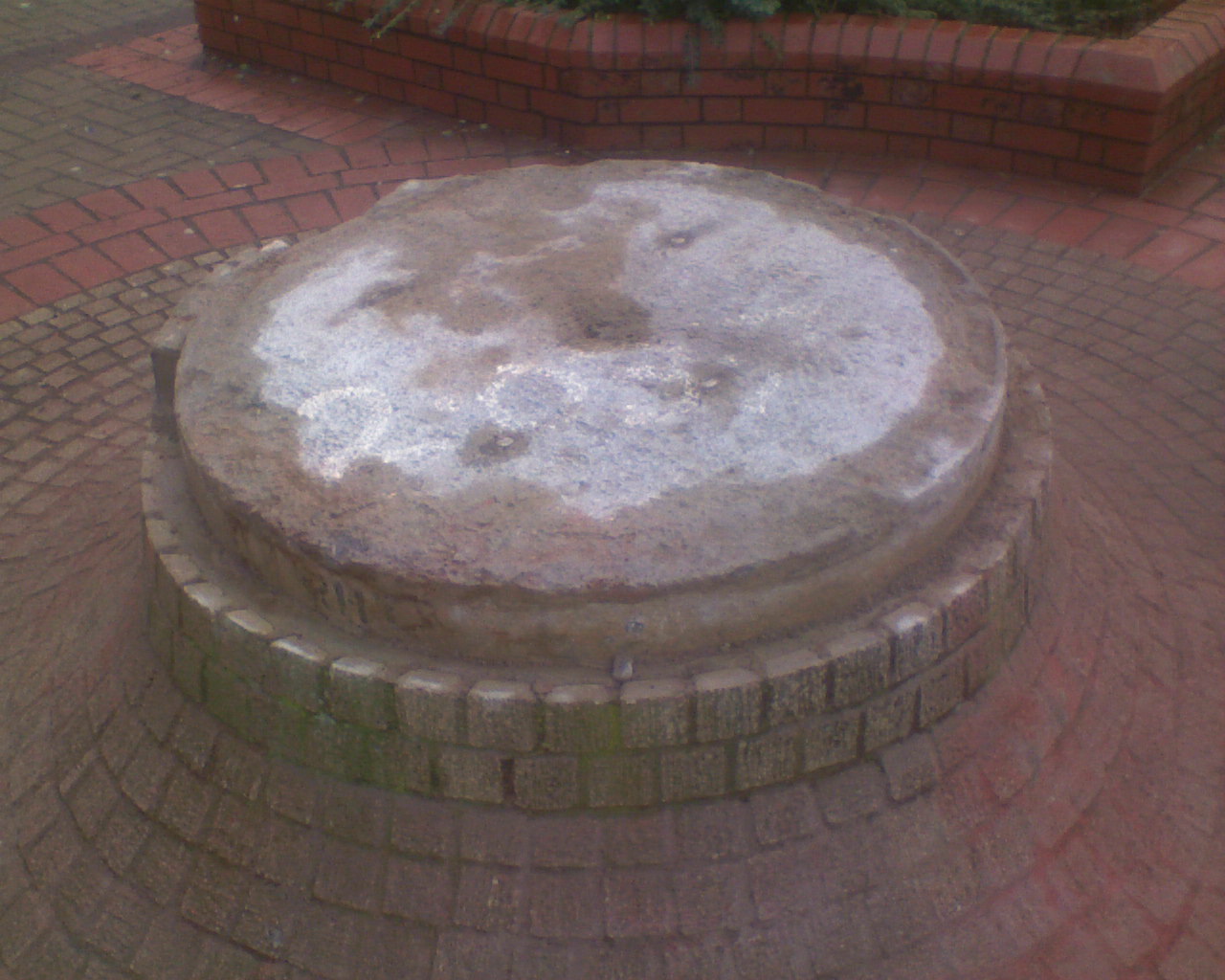
Yesterday, on my email, I received an email from Conservative-controlled Basildon District Council, linking to a press release on the future of Dave Chapple’s “Woodsman” sculpture. The Council has decided to remove the statue permanently (it is currently in storage) and replace it with the original town clock. As you can see, it says:
“A location for the statue is currently being found within the Park, and the woodsman will remain in storage until then.
Cllr Stephen Horgan, deputy leader of the Council, says: “The woodsman is a well loved piece of public art, and we believe that a new home at Wat Tyler Country Park is more suitable and appropriate, where he will be appreciated by the hundreds of thousands of people that visit the park each year.””
I am all for putting the clock back on display (where it can be properly seen from all four sides!). I am also for ensuring that hundreds of thousands of people get the opportunity to enjoy the unique and other-worldly charm of “The Woodsman”. However, in an act tantamount to municipal vandalism, Conservative councillors intend to remove the sculpture from the urban space for which it was created and place it in a country park – changing its context, function and form entirely.
There is no explanation as to why it is to be moved. We are left to speculate why Cllr Horgan advises that Wat Tyler Country Park will be “more suitable and appropriate”. Perhaps reinstating it so close to the Council’s offices would be a potent reminder of how successive administrations – including the current Conservative administration – have failed to take care of this significant contribution to Basildon’s artistic heritage?
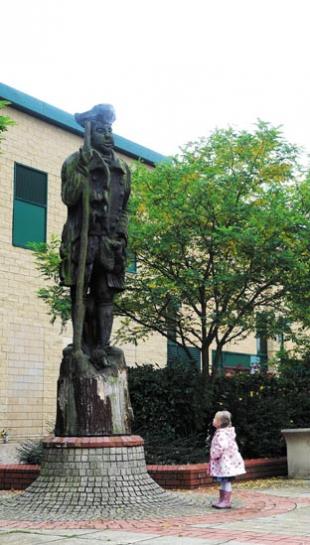
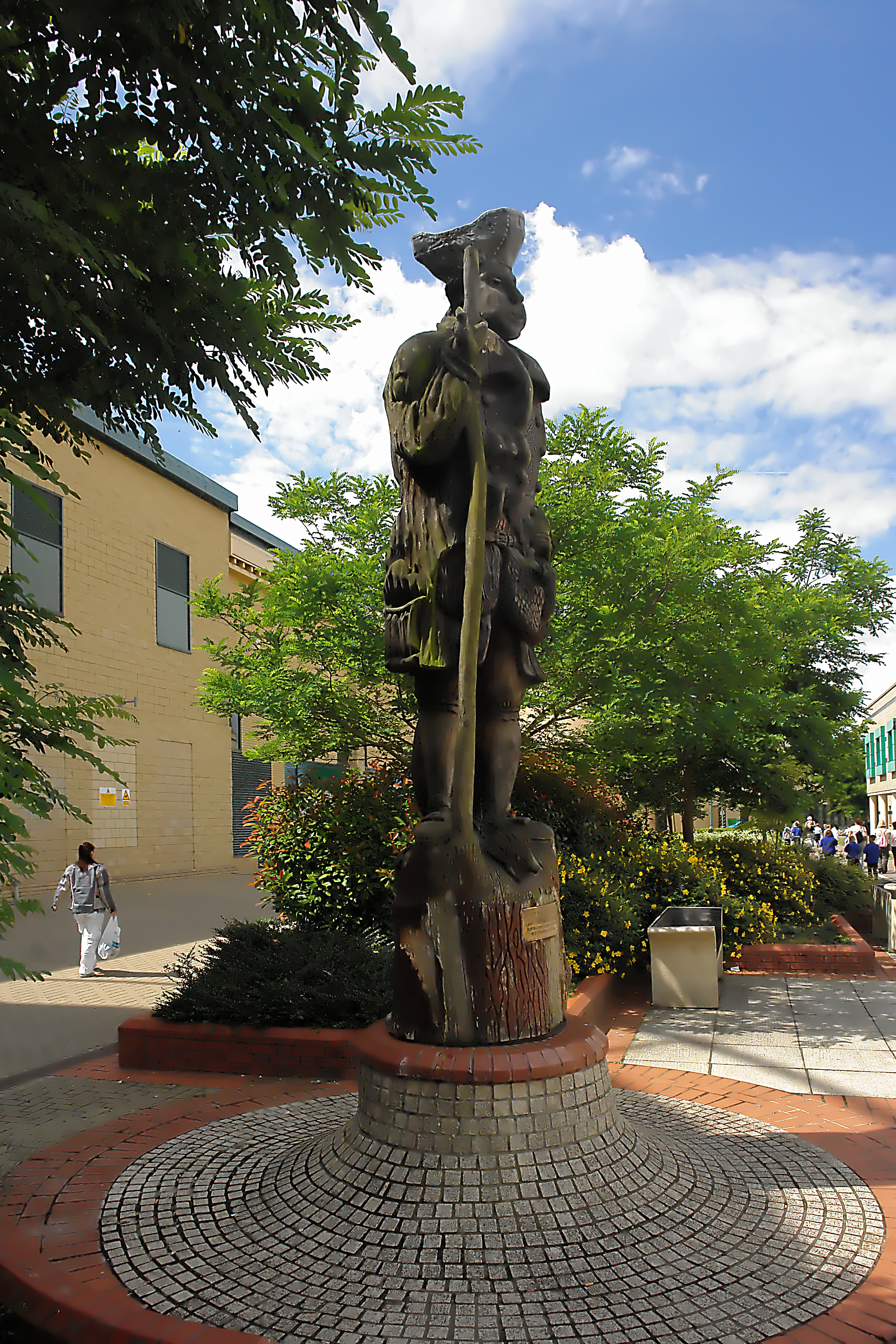
For me, “The Woodsman” isn’t just a quirky carving. Wood is a unique medium to work with. Unlike sculpting in bronze, from a cast, every single wooden carving, even if it appears the same, is very different. Each piece of wood has a different grain. Each piece of wood will have different knots to tax the skills of the carver. Hewn from local timber, from a tree felled in the Great Storm of 1987, “The Woodsman” is a unique piece of art designed to provoke thought and comment in the centre of a busy urban environment. In its original position, it broke up the concrete lines of the town and prompted a pause for thought, even if only a few seconds, to reflect on something that somehow managed to be both incongruous and perfectly situated at the same time.
“The Woodsman” was also a reminder of Basildon’s past. We’ve recently celebrated 60 years as a town. Prior to its construction, much of the area was fields and woodlands. Even now, Basildon is a place that contains areas of incredible natural beauty. It’s not without reason that Arthur Young, in his A Six Weeks’ Tour through the Southern Counties of England and Wales, wrote the following about Langdon Hills:
“The Woodsman” provided a connection to our history and that natural environment right in the middle of our town, where it could be enjoyed by those shopping, working, visiting the Council or passing through. We didn’t have to make a special trip to see it.
Finally, it also stood as a testament to the talents of Dave Chapple, who passed away on Friday 6th November 2009. Dave had even proposed a sculpture for the Millennium Domewhen the Government was seeking ideas for what to put inside. To my mind it was a stunning challenge to the material assumptions that have overtaken us, putting Christ at the centre of the building commissioned to mark the new millennium.
Dave Chapple with “The Woodsman” - Picture Esk, Flickr
Beautiful detail at the base of “The Woodsman” - Vin Harrop
“The Woodsman” in its rightful place - Vin Harrop
To my mind, we have lost something as a community when politicians are prepared to spend £38 million on a sporting complex, but those same politicians are not prepared to find the money, time or motivation to ensure that “The Woodsman” – created in Basildon, for Basildon – can be enjoyed by thousands in the space it was created for.
“The Woodsman” is a thing of beauty that tells a story far greater than many imagine.
The Town needs to remember its roots – and the people of the town want to know its history and be reminded how beautiful parts of our district truly are.
And The Politicians need to remember who they represent. They also need to remember the heritage – cultural and natural – that is entrusted to them.
If you are interested in seeing some of Dave Chapple’s other work, please see this online gallery.
For those interested in following Geoff Williams’s campaign to be the Member of Parliament for South Basildon and East Thurrock, you can keep up-to-date in a couple of new ways.
If, like me, you are on Twitter, you can follow his Tweets on twitter.com/geoff4mp – just add him to your Twitter feed.
For those who are on Facebook (I made my first foray recently – more on that later), you can follow his campaign by becoming a fan on www.facebook.com/geoff4mp – feel free to post comments, ask questions and generally get to know what he’s about.
Geoff, who has been a local champion, successful campaigner and district councillor for many years, spoke to supporters this evening in the Allpress Hall at Dry Street Memorial Church. He made clear that this was a crucial election for Nick Clegg and the Liberal Democrats, the party’s gut instinct for fairness giving local people in South Basildon and East Thurrock a chance for real change at the election.
In response to questions, he said he was keen to get the Liberal Democrat message out across the towns and villages that comprise the new seat, pointing out that places such as Bulphan, Fobbing and Horndon-on-the-Hill are often overlooked by politicians.
More in the days to come…
In the meantime, congratulations Dad!
Geoff Williams following his selection as Lib Dem PPC for Basildon
Sometimes you see something that literally takes your breath away.
I missed this last year – it was covered by the Guardian who reported on how Kseniya Simonova performed live on the final, keeping a nation spellbound and reducing the studio audience to tears with her sand art. Her performance mixed incredibly beautiful pictures with music and a story of Ukraine’s painful wartime history after the German invasion of 1941.
If you’ve seen it, look at it again and be reminded just how talented some people are. If you’ve not seen it, marvel at what those pictures in the sand on Cornish beaches could be.
Reporters sans Frontières is reporting that journalist Ali Taha and cameraman Ali Ahmed have been detained since since 2 January (as usual, the Syrian authorities are providing no information on the arrests):
“The continuing arbitrary arrests of journalists in Syria are disturbing,” Reporters Without Borders said. “The authorities provide no information about the legal grounds for these arrests and or the subsequent place of detention. This complete lack of transparency does not bode well.”
If you’ve not already noticed, Wikileaks is currently closed for business, facing a funding crisis. Wikileaks (different link which goes into the background of Wikileaks) has been a crucial tool for liberals and free speech campaigners in the battle against state censorship and corporate bullying. In 2008, it won The Economist New Media Award. In 2009, it shared the Amnesty International New Media Award.
YOU have the chance to make a difference. Don’t leave it to other people.
Make a donation. Let’s face it: $25 is a small price to pay to help turn the tide against corruption and secrecy.
In a shock announcement, Google, the internet search giant, has thrown down the gauntlet to the Chinese authorities by announcing that it is going to end the censorship of its Chinese operations. In an announcement on its official blog, the search engine giant cites specifically the attacks that have been made by cyber terrorists on human rights advocates.
Google earned condemnation from politicians and internet users around the world for its decision to self-censor its Chinese operations on Tuesday 24 January 2006. Critics pointed out the glaring contradiction between what it was doing – silencing the voices of those who had not earned the approval of Beijing’s regime – and its ten-point philosophy of operations, specifically points 6 and 8:
6. You can make money without doing evil
8. The need for information crosses all borders
Google’s decision is not just a challenge to Beijing. It is a challenge to those other corporate giants that hitherto have put profit before principle. Internet leaders Microsoft and Yahoo, as well as Cisco, one of the world’s leading manufacturer of networking equipment, have all been the subject of criticism for the way they have been prepared to satisfy the censorial instincts of the Chinese government, notably by members of the Congressional Human Rights Caucus in February 2006. Disturbingly, Reporters Sans Frontièresclaim Yahoo was responsible for passing personal information to the Chinese authorities, resulting in the jailing of journalist, poet and blogger Shi Tao. You can read some of Shi Tao’s writings on press freedom here. Please click the thumbnail below to be taken to his page on the website of Human Rights in China, founded by students and academics to promote universal human rights and advance their institutional protection in China:
We seem to have developed a tendency, misguided I think, to measure a country disproportionately by its economic reforms. China is no exception – and it certainly has reformed its economy out of all recognition in the past thirty years. The CIA World Fact Book makes the following observation on China’s economy (I still find it odd that the CIA put their World Fact Book online):
I can’t help feeling that attributing a country some nebulous value of “standing”, based predominantly on perceptions of the sophistication and liberality of its domestic market, risks eclipsing other considerations which are intrinsic to properly understanding a state and the country it governs. With China having 30 years of reform behind it, and with the current uncertainties dogging established Western free market economies in the current global economy, we are in danger of forgetting that the expression of Communism in state form has always been accompanied by instruments and policies of the state that are unacceptable in terms of human rights, free speech and human dignity. Akmal Shaikh becomes a footnote in the continuing evolution of economic relations as we establish trade missions for our benefit, regardless of China’s record on human rights and the treatment of those, like Guo Quan, who risk their life for the free expression we take for granted.
I cannot believe that it is without cost to our own humanity if we decide to subordinate principle to profit.
So from this Liberal – who is an ardent supporter of the basic principles of the free market – well done Google for at the very least giving us pause for thought.