Check out your politics – political spectrum quiz

You may or may not have noticed the little chart I’ve added to the sidebar which makes an attempt to place me on the political spectrum. You can get yours (!) by doing this relatively short Political Spectrum Quiz. You don’t have to register and, at the end, you get the necessary code to cut and paste onto your blog or web page, together with some options to automatically add it to your Facebook page (if you have one).

My Political Views
I am a center-left moderate social libertarian
Left: 1.64, Libertarian: 3.29

Political Spectrum Quiz

Finally, there is an option at the end to see which political party is your best fit (you click on the link for hunch.com). It worked me out with hunch #1.

I am so transparent: result for me.

Add to FacebookAdd to DiggAdd to Del.icio.usAdd to StumbleuponAdd to RedditAdd to BlinklistAdd to TwitterAdd to TechnoratiAdd to Yahoo BuzzAdd to Newsvine

China and the cruel lesson of the execution of Akmal Shaikh #humanrights #akmalshaikh


Akmal Shaikh - Reprieve

It is a hauntingly normal photograph.

For me, it is a picture of everyday humanity that is about as far as it is possible to get from the sense of dread and horror that must have overtaken Akmal Shaikh upon discovering from his family that he had barely twenty-four hours to live. Following the accounts of events around his final hours, as the increasingly frantic diplomatic scrabbling failed to halt his cruel and unjust execution, I felt a different sort of dread – familiar to me from previous death penalty cases. I have never seen the death penalty as anything other than imhumane – a signature of nations whose values are less civilised than my own. I accept that I might be blinkered in this understanding but I can’t pretend it isn’t so.

In recent days there has been much angry talk of political sovereignty, civilised values, humanity, mercy and the rule of law. Despite my rejection of the death penalty, I agree entirely with the assertion that states are entitled to enforce their laws upon their citizens and those that choose to visit or live within their jurisdiction. Equally, I resent being told by a sovereign state, which does not share my respect for free speech or multi-party representation, that my country has no right to criticise its “judicial sovereignty”.

Actually, it does. And I do.

I would go further and say that there is a moral responsibility on those who share liberal values to speak out in their defence, even if that means criticising other nation states. The alternative is that, in the hot-house of international negotiations, we risk seeing these values – important to our confidence in the legitimacy of our own civil society –  subordinated to priorities of trade and engagement, the manner of that engagement apparently far less relevant than the engagement itself. (I assume that sense of liberal indignation is what led Nick Clegg to make the statement he did following the British Olympic Association’s unsuccessful attempt to contractually gag British athletes from making criticisms of the regime in Beijing during last year’s Olympics – see this article in the Daily Mail.)

And that right is just one element of a tragedy of international misunderstanding between countries whose perspectives on history, justice, sovereignty, liberty and diplomacy are clearly very, very different.

I have no problem stating up front that I see the application of the death penalty to a mentally-ill man as a barbaric act. Reprieve, the British Government, his family and independent witnesses produced a wealth of evidence that Akmal Shaikh was mentally unwell. Reprieve’s report that China had consistently refused a full medical evaluation since April 2009 is particularly shocking. To me, it reveals a regime in Beijing that, contrary to its protestations, is not concerned with a judicial process that fairly recognises the mental capacity of the individual – and that lack of concern is entirely Beijing’s prerogative.  However, Akmal Shaikh’s story, familiar and upsetting, is one of a man made victim twice over: once by traffickers, taking advantage of a mentally incapacitated individual to turn him into a mule; and once by a Government determined to place its domestic propaganda requirements above the requirements of fairness in justice.

I had hoped that the passage of hours and days might lessen the grip of Akmal Shaikh’s execution on my thoughts. However, it hasn’t. Perhaps it has been a conscious mental reaction against a sub-conscious and instinctive desire to obliterate his fate – this awful news story that needs relegating to the back of the mind. However, I find his execution challenging – as a Liberal, as a human being who loves his family, as a man with private dreams and ambitions, as a humanitarian and as a Christian. Also, like others, I was provoked by the disgraceful article by Leo McKinstry in the Daily Mail. McKinstry’s confused and contrary tirade is a potent reminder of the dangers inherent in removing rational, liberal voices from the political conversation. It reads like a cynical and desperate attempt to establish caricatured notoriety as a hard-line social commentator and it brought an old proverb to mind: silence is the voice of complicity. I have no desire to be complicit in McKinstry’s attempts to profit in any way from the execution of a mentally-ill man. And I freely admit that I am also attempting to lay my own particular haunting to rest with words.

Fellow liberals might reflect on the tragic irony that the execution of  Akmal Shaikh was carried out on the anniversary of the birth of William Ewart Gladstone. Gladstone,  still years from becoming Prime Minister, used his journey from High Toryism to a radical and reforming Liberalism to condemn the Anglo-China war in 1840 and the opium trade that was its focus. I don’t suppose I was alone in my immediate disbelief when it was reported that the Chinese Embassy in London had released a statement referring to the “Opium Wars” in relation to Shaikh’s execution. I struggled to imagine a comparable situation in Britain where a judicial decision against a foreign national would be influenced expressly by a specific 19th century event.

Yet, part of me knows that, whilst as a country we are not so specific in the way we relate our history to our contemporary decisions, seismic events resonate across decades and shape our perceptions, both as individuals and as a society. No-one would doubt the impact of two World Wars on how we see ourselves or our European neighbours. The Great War began almost a hundred years ago, yet each year we remember its fallen. The Second World War still informs the cod-machismo of pub conversations. With that in mind, it is not so surprising that events to which we were a party, but that hold a different significance in the Chinese national conscious, are remembered vividly after just a further forty-odd years. In that understanding comes another, uncomfortable as it is: defence of liberal values does not preclude the responsibility to understand a state whose values are apparently so different. Quite the reverse, to my mind. Liberalism professes a profound internationalism and that obliges its adherents to understand and to identify, honestly, how a relationship can be developed that prevents a similar tragedy occuring in future. Remembering of course that explanation is not justification, perhaps we should not be so incredulous regarding the impact of the Opium Wars on modern China.

That recognition of the impact of historical events was signalled in the diplomatic phrasing of the two statements issued by the Chinese following Akmal  Shaikh’s execution, neither of which made direct reference to the Opium Wars (but which was made apparent in the Telegraph’s more hysterical translation – see above):
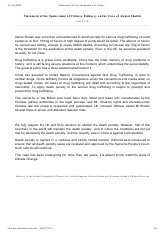
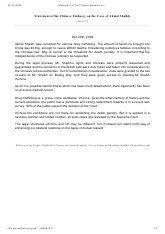
The recognition of threat that China poses to established positions of economic primacy, its self-acknowedged isolation from the world, the incomprehensibility of its vastness of geography and population compared to the United Kingdom, all appear to have helped skew attempts to fully understand China and its emergence onto the world stage.

Fu Ying, the Chinese Ambassador to the UK, made a low-key but significant speech to the English Speaking Union on 14th December 2009 that bears re-reading. It is a recognition by China of the lack of understanding that exists between itself and Western nations:
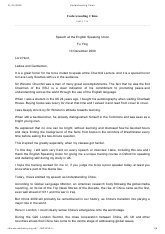
I wonder if we forget even the basic political differences when it comes to negotiations such as those in Copenhagen? China is not a democracy. It is not the USA. It is not the UK. It is not India. It is not Russia. It does not see internal political competition as positive, however inadequately it is expressed in some countries. It is, still, a self-professed communist country, that retains myriad bureaucratic networks that obscure information and confound individual expression. Even economic reforms are restricted by political caution and the vast inequalities between rural, industrialised and commercialised areas. China, unable to resist the march of technology and the coincidence of interest in averting environmental disaster, is having to learn how to deal on the traditional diplomatic stage, just we are having to re-learn how to deal with China outside of a Cold War paradigm we can control. China speaks a political language that we in the West have forgotten in the twenty years since the Berlin wall came down.

Copenhagen is the starkest evidence of this failure of understanding. Whether Copenhagen failed because of a Western trap, as John Lee asserts, or because China was determined to protect its economic interests at all costs, as Mark Lynas suggests, we do not yet know how to talk to China and explain our priorities – and why those priorities matter.

To my mind, the execution of Akmal Shaikh is an extension of that failure.

As a Liberal, as a human being who loves his family, as a man with private dreams and ambitions, and as a humanitarian, I am appalled by China’s execution of this father of five, the mentally-ill victim of drug-traffickers who was denied access to even a basic evaluation of his mental health.  However, as a Liberal, as a human being who loves his family, as a man with private dreams and ambitions, and as a humanitarian, I believe I need to understand China better, so that, should the opportunity present itself in some small way, I can show more clearly why I adhere to the beliefs I do – and demonstrate their intrinsic value.

As a Christian, quietly sharing the sentiments above, I am left reflecting on the intolerable cruelty of Akmal Shaikh’s lonely and forsaken grave – a cold world away from his wife, five children and the taxi business he used to run in North London.

Akmal Shaikh's unmarked grave - N/A

Add to FacebookAdd to DiggAdd to Del.icio.usAdd to StumbleuponAdd to RedditAdd to BlinklistAdd to TwitterAdd to TechnoratiAdd to Yahoo BuzzAdd to Newsvine

China, Mercy and Akmal Shaikh #amnesty #humanrights #akmalshaikh

It is a sobering email to find yourself sending in the days immediately after Christmas:

Dear Ambassador Fu Ying,

I write to express my deep concern for Akmal Shaikh, who faces execution in China on December 29.

Akmal’s family has pleaded for his life to be spared, and my heart is with them at this terrible time. Akmal’s death, particularly during this holiday season, would destroy his children, his brother and his elderly mother, and tear the family apart.

I know that the Chinese people care deeply about family and I would like to join Akmal’s children in begging for mercy for their father.

This unusual case is not about politics, but about humanity and compassion — values that we share with the Chinese people. My plea to the Chinese authorities is based on the greatest respect for Chinese culture and for these shared values.

yours sincerely,

Ben Williams

If you’ve not done so yet, I would urge you to send it as soon as you can: to the Chinese Ambassador on secretary@chinese-embassy.org.uk and to the Prime Minister via the Number 10 website.

The case of Akmal Shaikh makes for tragic reading and one that, having had cause to have contact with mental health services in the UK, is very believable in terms of the circumstances of his arrest and subsequent explanation of events. Chinese criminal law recognises that mental incapacity reduces criminal responsibility, though the stark way it is written up in the Chinese criminal law suggests that there is a tremendous onus on the defendant to demonstrate diminution of responsibility due to mental ill health at the time the crime was committed.

Whilst the lack of facilities for the treatment of mental illness is a constant source of criticism in the British justice system, particularly in terms of prison care (see this BBC report for more info), a huge library of case law has been developed to help with the interpretation of circumstances (e.g. Wiki Mental Health, a continuously updated online database for professionals who need to understand mental health and the law). China has a powerfully symbolic opportunity to reveal a similarly sophisticated understanding of the complex issues of mental health. At the same time it would demonstrate that it is prepared to engage the language-deficient West in terms of European liberal democratic criminal law that can be readily understood.

For me, as citizen of country that is looking to foster enhanced trade relations with China’s provinces, and who has found himself having a small but real part in the conversation about such relationships, such a gesture would be a resonant signal that the identification of a shared global future is not some self-justifying, post-colonial Western construct – but a definite objective rooted in the practical, hard-nosed give-and-take of international politics and appreciated by a modern China willing to embrace the world.

***

Basildon District Council recently took part in a trade delegation organised by Essex County Council. Two councillors and two officers took part in the visit, which was to the Changzhou area of China’s Jiangsu province. It was reported by the Basildon Echo in this report. It was reported to the last Cabinet meeting (see item 7 on the Agenda) and received support as an initiative from both the Labour and Liberal Democrat groups (see Minute 812). Conservative Councillor Stephen Horgan, Deputy Leader of Basildon Council, was a member of that delegation and his blog report can be read here.

On November 7th, prior to the visit, I wrote to Conservative Councillor Tony Ball, Council Leader, raising amongst other things the imprisonment by the Jiangsu authorities of Guo Quan, the pro-democracy campaigner (see this Financial Times report). Guo Quan was the author of an open letter to the Chinese leaders Hu Jintao and Wu Bangguo calling for democratic government and multi-party elections [NB the later references to Falun Gong are disputed, apparently not appearing in the original Chinese version].  In my email, acknowledging the positive step this trade mission represented for Basildon, I made the following statement:

“As locally-elected politicians, we are the public face of a district that has been politically and economically shaped at a fundamental level by healthy competition between political parties. I hope you share my view that it is important to account for our robust democratic values in any dealings in Jiangsu Province and not see them set aside or devalued because they are in some way inconvenient.”

I don’t know if that statement was pompous, naïve or entirely appropriate.

I am yet to receive a response.

Add to FacebookAdd to DiggAdd to Del.icio.usAdd to StumbleuponAdd to RedditAdd to BlinklistAdd to TwitterAdd to TechnoratiAdd to Yahoo BuzzAdd to Newsvine

Syrian regime disappears another journalist – Ma’an Aqil #aqil #labwani #syria

I received a disturbing email from Alkarama this morning.

Ma’an Aqil, a prominent journalist, was arrested on November 22nd. His would appear to be the latest in a wave of intimidation conducted by Syrian security forces against journalists and bloggers.

You can read the report from Reporters sans frontières on this link here: Newspaper journalist is latest victim of wave of arbitrary arrests and trials

Ma’an Aqil had been investigating government and corporate corruption. No surprises there then why the Syrian regime wanted to shut him up.

Friends and supporters of Kamal Labwani will want to make sure this latest detention is brought to people’s attention.

The full press release from Alkarama is below in PDF format (English and Arabic):

Arbitrary Detention of Ma’an Aqil

سوريا: اعتقال السيد معن عاقل

Add to FacebookAdd to DiggAdd to Del.icio.usAdd to StumbleuponAdd to RedditAdd to BlinklistAdd to TwitterAdd to TechnoratiAdd to Yahoo BuzzAdd to Newsvine

Tory-run Essex County Council becomes Cameron’s sandbox

IBM takes on services in Essex as part of £5bn privatisation deal

It is one of those headlines that makes you wonder where on earth it will lead. I’ve spent the past hour wondering if my immediate Tweet in response was over the top and a misinterpretation of what is going on:

Essex Tories begin revolutionary dismantling of public services – with Cameron’s full support

It wasn’t.

This is a deal that has the potential to fundamentally alter the nature of local government in England. A Cameron win in 2010 could see a revolution in the provision of local services that strangles political differentiation, subjugates community priorities to an ideology of technocratic efficiency – and all whilst reassuring voters that these changes are merely efficient and (of course) apolitical.

Superficially, the attraction is obvious.

Politicians are held in contempt on a national and local level. (Ironically, Lord Hanningfield bridges the gap between the national expenses scandal and the crisis in local service provision in extraordinary fashion, with reports that detectives have sent files to the Crown Prosecution Service alleging fraud, just at the point that Essex County Council, which he leads, is condemned for its appalling record on children’s services.) What better way to score a political victory than to tacitly acknowledge that distrust by placing the delivery of services in the hands of a non-political and widely-respected industry leader such as IBM?

IBM has considerable experience of public service delivery in Canada, as the Times article linked in the headline shows. There is an impressively detailed exposition of its objectives and relationship with Canadian public services in IBM’s paper Service Canada – A New Paradigm in Public Service Delivery. Even a cursory reading demonstrates that IBM’s engagement in Canada is very, very different to what is being reported has been agreed with Hanningfield. Prioritising 21st Century public service delivery in a mountainous, multi-lingual country, that is the second largest in the world, yet the ninth least densely populated, is rather different from the Essex experience (Langdon Hills may boast “one of the most astonishing prospects to be beheld“, but. let’s face it, we’re not exactly talking the Rockies here). Yet even with these laudable objectives, the project has attracted criticism on a variety of levels, for its effect on women, its impact on health care and even concerns for national security. (A google search consisting of “public services” “wholesale privatization” and “canada” is revealing.)

I have no ideological objection to the delivery of public services through the private sector. I believe that the well-considered and appropriate out-sourcing of services and the importation of industry best practice have led to genuine improvements in service. The key to its success is the accountability that comes from having contracts that are carefully scrutinised, regularly reviewed and competitively tendered for.

At the same time, I am very conscious that public services are exactly that: services provided to the public by authorities that should be transparent, prepared for detailed scrutiny and, ultimately, held to account. There is a balance to be struck and the job of local politicians is to strike that balance, serving the needs of those they represent as best they can. Those in opposition draw attention to deficiencies in current services and offer an alternative programme for local priorities.

Ultimately, the people who pay for and use those services decide who they want in charge.

Hanningfield’s wheeling and dealing should send a chill through anyone who still places a value on choice, transparency, accountability, competition and social justice. Companies like IBM don’t invest in technological infrastructure to run services for a couple of years. They expect to be the partner of choice for many. The contract we are told is for eight – well beyond the date of the next County Council elections. And as many will have noticed,  it is measurably harder to extract detailed information from private sector partners, council officers nervously explaining that such information is restricted due to the need to observe commercial confidentiality (actually it isn’t, a lot of the time, but that’s another story).

Couple the Essex example with Tory-run Barnet’s attempts to experiment with ‘no-frills’ local government services – two-tier services that lead to extra charges or rebates depending on how much you need them – and everyone involved in the political conversation of the country should take note:

The Cameron revolution is under way before a single vote has been cast and it shows every sign so far of being as ideological, divisive and destructive as Thatcher’s.

We in Essex and Barnet may be living in Cameron’s sandbox today, but the results of these experiments could inform the local services of everyone tomorrow – for years and year to come.

Add to FacebookAdd to DiggAdd to Del.icio.usAdd to StumbleuponAdd to RedditAdd to BlinklistAdd to TwitterAdd to TechnoratiAdd to Yahoo BuzzAdd to Newsvine

“Right to Buy” and the strange death of the New Town concept

Tim Montgomerie has tweeted that today is the 30th anniversary of the Right to Buy Scheme introduced by Margaret Thatcher.  There is no doubt in my mind that it is a policy that has fundamentally altered the shape and original purpose of the New Town concept, creating something of an identity crisis for these sprawling conurbations which local politicians of all parties are struggling to overcome. As suppliers of social housing on enormous scales, the New Towns, like Basildon, were inspired by the concept of  Garden Cities, in a time when big government still believed it could socially engineer society. The New Towns Act was passed in 1946 and, between then and 1970, 21 New Towns were built. In a glorious piece of propaganda, the Central Office of Information attempted to explain the concept of these sustainable living areas in an informative cartoon about an ordinary bloke called Charley:

Many of the concepts are eerily prescient in an era when we are concerned with carbon footprints and quality leaving spaces. It’s important to remember, however, that the New Towns are entirely artificial. Unlike other villages, towns and cities, the New Towns had no historic focal point to draw people together. Indeed, in most cases, a huge amount of effort was put into destroying the character and history of the original area, instead of building in sympathy with it. This parliamentary exchange from 1954, between Mr Bernard Braine (as he was then) and Sir Thomas Dugdale reveals how pressure for development land was paramount. In Basildon, this has led to local people asking serious questions about the origins of the place they live in and fighting hard to save what little remains of the pre-New Town identity (e.g. the efforts of the Chalvedon Hall Community Group).

When places are shiny and new, they are usually attractive places to live. However, a home, in its broadest understanding, is not just the fabric of the building – it is the infrastructure that supports a community: roads, utilities and recreational facilities amongst others. The prospect of a new home and services beyond the imagining must have seemed incredible to those leaving the bomb-shattered ruins of the East End. However, with the provision of social housing on unprecedented scales as the foundation of the New Town, it seems obvious with hindsight that  “Right to Buy” would have an enormous effect on their purpose and future expansion.

Don’t get me wrong: “Right to Buy” and its promotion of home ownership encapsulates a fundamentally liberal aspiration. I wouldn’t suggest turning back the clock. However, by encouraging the social housing stock to be sold off, without permitting local authorities to use the proceeds of sale to provide new social housing,  Thatcher effectively destroyed this visionary concept of confident, sustainable communities.  On a social level, the gap between those who could afford to buy and those who could not became immediately visible in the heart of local communities.  On a planning level, physical expansion was required to attempt to meet the needs of those who had been promised a home but for whom there were few council properties available.

Skip forward thirty years and look at the situation of the New Towns now.

Just as they were built at a similar time, their infrastructure is coming to the end of its life at the same time. What would have been an incredible headache for local and national government in any event has been exacerbated by the pressure placed on New Town roads, services and utilities. Doctors surgeries overflow, roads and footpaths crumble, drains and pipes block and burst as capacity is exceeded – and new development encroaches more and more onto the green belts that were designated to provide recreational relief from the urban environment, preserve the distinct identity of urban communities and retain a much-needed connection to our environment. There is a danger in the South East, with regional initiatives such as the Thames Gateway redevelopment, that towns and villages may simply disappear into an anonymous morass of urban sprawl. Government risks failing again to grasp that communities are self-determining and not engineered, spending vast quantities of taxpayers’ money on enormous and totemic projects instead of stimulating the local economy by assuring the basic fabric of the places in which we already live.

“Right to Buy” is not to blame for the ills of the New Town. However, just as we can appreciate the liberation of the individual and the creation of opportunities to satisfy aspiration that it represented, so we should recognise that the fundamental mistakes of its implementation, driven by Thatcher’s peculiarly ideological politics, have contributed significantly to the difficulties faced by local government in sustaining these enormous and artificial conurbations. More importantly, and regardless of government (local and national), the fact that local communities are determined to preserve their past is a reassuring demonstration of the hunger of local people to know and own the identity of the wider space in which they live.

If you are interested in the campaign to save Great Chalvedon Hall, please contact Gary on greatchalvedonhall@hotmail.co.uk who will be able to let you know how you can help.

Add to FacebookAdd to DiggAdd to Del.icio.usAdd to StumbleuponAdd to RedditAdd to BlinklistAdd to TwitterAdd to TechnoratiAdd to Yahoo BuzzAdd to Newsvine

UPDATE: Of snow, roads and hopeless Tory County Council incompetence

They’ve gritted. After two days. And 6″.

On Twitter this would be tagged #toryfail.

Add to FacebookAdd to DiggAdd to Del.icio.usAdd to StumbleuponAdd to RedditAdd to BlinklistAdd to TwitterAdd to TechnoratiAdd to Yahoo BuzzAdd to Newsvine

Of snow, roads and hopeless Tory County Council incompetence

I woke yesterday morning to the stunning sight of snow lying on the fields of the Lincolnshire Wolds. It had been barely more than a dusting when I had looked out of the window on the previous evening. The snow was thick on the road, too. The A16 snakes viciously past the village of Swaby, racing past the small row of houses where Em’s family live and on towards Louth. 4″ of snow is quite a sight:

Snow on the A16, Dec 19 2009

But hang on a minute. The A16 is the main road between Boston and Grimsby. It is the sort of rural A-road that wannabe Colin McRaes careen around in lunatic fashion, dodging the articulated lorries that stream steadily from end to end. It is the sort of rural A-road that Lincolnshire County Council have quite sensibly designated as a “Red Route”. What is a Red Route? It’s a road where there is a higher than average chance that you might get to answer some of life’s more profound questions should you be behind the wheel of a car. Particularly if your latest X-Box 360° or iPhone fix is Need for Speed™ SHIFT.

You can read more about Red Routes here on a page of the Lincolnshire County Council’s website reassuringly subtitled “A survival guide to Lincolnshire’s roads”. Apparently, car users represent a far higher proportion of those casualties recorded as KSI (Killed and Seriously Injured)  in Lincolnshire – a frightening  64%, compared to the national average of 46%.  If you are interested, you can read more about it here.

So. Red Routes. Dangerous. Particularly at speed.

Here – for the benefit of Lincolnshire’s Tory County Councillors – are some elementary facts about snow and its effects. It is usually forecast by the Met Office. It makes roads slippery. Slippery roads are dangerous roads. Red Route roads are dangerous roads that get a whole lot more dangerous.

So why is it that the cretins at County Hall (Lincolnshire) have yet to chuck a single piece of grit on sections of the A16 marked out as accident hot spots?

After last year and “The Great Grit Crisis” of 2008, you might expect a County Council that is looking out for the welfare of local residents, and which has access to the BBC Weather like the rest of us, to be a little quicker off the mark with the gritters than never. However, it was only after frustrated police demanded a snow plough be sent out that the A16 became vaguely usable.

As I am writing, with temperatures well below freezing, I hear the occasional rumble of wary drivers trundling past on the snow-covered unlit A16. I have yet to hear the reassuring rattle of a gritter. The prospect of the complacent uselessness of Lincolnshire County Council writ large if Cameron’s Tories win power at Westminster is truly frightening.

Add to FacebookAdd to DiggAdd to Del.icio.usAdd to StumbleuponAdd to RedditAdd to BlinklistAdd to TwitterAdd to TechnoratiAdd to Yahoo BuzzAdd to Newsvine