Cold war ghosts: legacies in concrete and film

At dinner last night, we talked about the way that the experience of war imprints itself on the experiences of individuals and societies differently, according to the war and the immediacy of its domestic impact.

Reflecting on that conversation, it struck me that growing up with the threat of Mutually Assured Destruction hanging over us left its own imprints. Less immediately dramatic, perhaps, than the years of evacuation, rationing and lights out of World War Two, but no less terrifying in its own insidious way, the Cold War offered plenty of sleepless nights to this over-active imagination.

I remember panicking when we were told that total annihilation was just four minutes away. Whenever the sirens were tested I found myself wondering if the radar I now know was based at Jodrel Bank had picked up inbound enemy missiles that would destroy my school and my family and the small world of Langdon Hills that I inhabited. I imagined Soviet tanks trundling through my childhood stamping ground of the Fränkische Schweiz and rolling across Western Europe, destroying everything in their path.

Television films like Threads and the Day After depicted the horrors of a nuclear Armageddon in chilling detail. I remember lying awake for nights, terrified of what would happen.

I also remember taking the bus to Romford to see Rocky IV in 1985 and being reassured that we would always beat the bad guys. How could we not be? Our plucky little hero was avenging his friend’s death and completed his training montage in the frozen Russian countryside with just a few logs at his disposal.

Drago on the other hand, his giant of an opponent, was wired up to the most sophisticated computers and pumped full of steroids – yet our man still triumphed and, in doing so, won the admiration of the Russian President.

Gloriously awful nonsense, but now, looking back, the parameters seem so much safer. In much the way that my father’s grandparents reflected on the unique camaraderie of the Second World War, the sense of social obligation and national community, I catch myself thinking back fondly to the geo-strategic certainty of a time when two superpowers leaned in on each other. The USA and the USSR were the hammer-beam roof of our geo-politics, creaking and immobile under the weight of their respective nuclear edifices.

In this changed world of terrorist cells, underground bombers, dirty bombs and cyber-warfare, such certainty seems oddly nostalgic. For me, that surreal stalemate of infinite nuclear escalation has woven itself into the fabric of memory, mischievously tangling itself with normative childhood archetypes of safety, and I find myself prompted to rueful reflection by the architecture of redundant physical structures or the clumsily amateurish animation of public information broadcasts.

They each harbour the childhood ghosts of lingering summers spent wondering on the end of the world.

The Nuclear Bunker at Kelvedon Hatch is a local example of such a building. I find a certain poignancy in the way that this extraordinary structure, disguised beneath a simple cottage and chillingly significant in its original purpose, has been reduced to such a level that it can now be hired out for parties. If you click the picture below you might see what I mean in the gallery that I have pulled together on Flickr.

Kelvedon Hatch Nuclear Bunker

In a similar way, the series of Protect and Survive public information films retain their ability to shock, despite their amateurishness. I still wonder if hiding under some doors and suitcases would ensure my survival in the event of a nuclear strike.

But perhaps the greatest reminder that this period in our history is dead and gone is the strange news that Latvia recently sold Skrunda, an entire Soviet-era town, now completely deserted. Click on the photo below and you will be transported to an eerie gallery on Flickr that paints a haunting picture of decaying urban sprawl  – its architecture, posters and purpose abandoned to the past.

skrunda

Here the ghosts of my childhood nightmares can still play amongst the radar stations and the tower blocks and the crumbling, brick-strewn classrooms.

Add to FacebookAdd to DiggAdd to Del.icio.usAdd to StumbleuponAdd to RedditAdd to BlinklistAdd to TwitterAdd to TechnoratiAdd to Yahoo BuzzAdd to Newsvine

Personal responsibility and the death of Common Sense

I am not usually one for these circular emails, but I received one today that made me smile a little.

We live in a world in which councils rip out public art because they are concerned people will climb on it, fall off and then sue; where teachers are castigated by parents for the indiscipline in class-rooms, yet are prevented from any physical contact to restrain or assist children in case they are sued; where local residents tell me that Council employees have warned them not to grit footpaths to help make them safer because if someone slips, the resident who did it is liable; and where people seem determined to ensure that as well as blaming someone else for their idiocy or misfortune, they are also allowed to profit from it.

This latter point is one that irks me most.

The ever-present threat of litigation undermines the need to ensure that serious failings of responsibility are properly and swiftly reviewed and, if appropriate, recompensed. At the same time, to minimise the chances of being sued, play equipment is removed, public art is pulled out and fenced off, and life loses its spiky richness. Much  more dangerously, it allows those who are absolutely opposed to the concept of fundamental human rights to hijack the discussion of responsibility and blame a compensation culture increasingly characterised by lack of personal responsibility on the Human Rights Act or simply “Europe”. It is mendacious politicking at its insidious worst: using people’s misinformed fears to further reinforce those fears and, by so doing, undermining necessary protections for the weak, the vulnerable and those who find themselves in a persecuted minority.

So don’t get me wrong.

There are plenty of times when blame should be very squarely apportioned on the shoulders of someone else or – more usually – some other organisation. However, there are also far too many excuses for our own inability to follow the instructions we are given and our failure to use the judgement that life’s experiences have given us.

It’s corny, trite even, and there’ll be plenty who’ll simply groan and roll their eyes. But maybe a few will agree that it’s worth a little reflection. I don’t agree with all of it (I want to make that clear before I get a liberal backlash!). I do, though, think that in its own, gently humorous way it captures  a sentiment shared privately by many people, in all walks of life: one that contains at least a degree of truth and that requires a common sense political response.

Anyway, I doubt the author or the person sent me this was expecting me to take it so seriously!

Common Sense – an obituary

Today we mourn the passing of a beloved old friend, Common Sense, who has been with us for many years. No one knows for sure how old he was, since his birth records were long ago lost in bureaucratic red tape. He will be remembered as having cultivated such valuable lessons as:

  • Knowing when to come in out of the rain;
  • Why the early bird gets the worm;
  • Life isn’t always fair;
  • And maybe it was my fault.

Common Sense lived by simple, sound financial policies (don’t spend more than you can earn) and reliable strategies (adults, not children, are in charge). His health began to deteriorate rapidly when well-intentioned but overbearing regulations were set in place. Reports of a 6-year-old boy charged with sexual harassment for kissing a classmate, teens suspended from school for using mouthwash after lunch, and a teacher fired for reprimanding an unruly student, only worsened his condition.

Common Sense lost ground when parents attacked teachers for doing the job that they themselves had failed to do in disciplining their unruly children. It declined even further when schools were required to get parental consent to administer sun lotion or an aspirin to a student, but could not inform parents when a student became pregnant and wanted to have an abortion.

Common Sense lost the will to live as the religious organisations became businesses – and criminals received better treatment than their victims. Common Sense took a beating when you couldn’t defend yourself from a burglar in your own home and the burglar could sue you for assault.

Common Sense finally gave up the will to live after a woman failed to realize that a steaming cup of coffee was hot.  She spilled a little in her lap and was promptly awarded a huge settlement.  Common Sense was preceded in death by his parents, Truth and Trust, by his spouse, Discretion, by his daughter, Responsibility, and by his son, Reason.

He is survived by his four stepbrothers; I Know My Rights, I Want It Now, Someone Else Is To Blame and I’m A Victim.

Not many attended his funeral because so few realised he was gone.

If you still remember him, pass this on.  If not, join the majority and do nothing.

Add to FacebookAdd to DiggAdd to Del.icio.usAdd to StumbleuponAdd to RedditAdd to BlinklistAdd to TwitterAdd to TechnoratiAdd to Yahoo BuzzAdd to Newsvine

Technorati… Clever stuff

So I have decided to link this blog to Technorati.

They require me to prove that I am writing this blog and have supplied me with a piece of cunning code to publish. So here we go…

PHCJEWR8ARNG

All very secret squirrel!

“Mother and Child” iced over again #basildon

You may recall that a couple of weeks ago I posted a picture of the “Mother and Child” statue in Basildon Town Centre covered in ice. Thursday morning I was in Basildon very early and the statue looked spectacular. I thought it worth sharing a picture.

“Mother and Child” iced over again

“Mother and Child” iced over again

Add to FacebookAdd to DiggAdd to Del.icio.usAdd to StumbleuponAdd to RedditAdd to BlinklistAdd to TwitterAdd to TechnoratiAdd to Yahoo BuzzAdd to Newsvine

“Born of Hope”: Amateur movie-making magic that needs to be seen! Really! #lotr #bornofhope

“Every time I go to a movie, it’s magic, no matter what the movie’s about…”

So said Stephen Spielberg, and if anyone should know about the magic of cinema it is Spielberg. From Raiders of the Lost Ark to E.T. to Schindler’s List and Saving Private Ryan, Spielberg has made some of the most memorable films of modern cinema.

I have always loved film.

Em and I regularly immerse ourselves in these other worlds, be they the latest Hollywood blockbusters or, when the mood takes us, a film from abroad. The poignant beauty of Uzak, the mischievous brilliance of Amarcord and the stark honesty of 35 Shots of Rum are among the films that have helped us pass many a Sunday afternoon curled on the sofa. If we are feeling brave we might try some of the more obscure and occasionally extreme cinema from around the world. In these moments we’ve flinched at the likes of Requiem for a Dream by Darren Aronofsky, sat shell-shocked through examples of the New French Extremity and laughed at the comic-book ultra-violence of Asian martial arts movies such as The Machine Girl. Or if it has been a particularly crappy week at work, it’s hard to beat a bit of Quentin Tarantino to Pulp Fiction or Kill Bill those particularly Inglorious Basterds you work with…

And, just sometimes, there is something so truly magical about a film that it burns itself into the memory, taking on a peculiar reality all of its own that weaves its narrative into your imagination in vivid and brilliant ways.
I remember, for instance, the first time I became aware of Star Wars, the fantastical saga by George Lucas set in a galaxy far, far away. Dad had scooped up my cousin and me and taken us off to Chelmsford (I think it was Chelmsford!) to see The Jungle Book. As we went into the cinema we could see the queues for Star Wars. And as I gazed up at a cinema screen for the very first time, the trailer, accompanied by the majesty of John Williams‘s towering score,  blew me away, taking my overactive imagination off to the Millenium Falcon and the race to rescue Princess Leia from the clutches of Darth Vader (it was a long time before I realised I really wanted to be Han Solo, not Luke Skywalker). Years later I finally saw the film and I remember how excited I was when I learned I would finally get to see it, albeit on a small television rather than the big screen.
Now, my film horizons broadened, I can appreciate its homage to the Western genre and see where Lucas was influenced by the heroic samurai in the films of Akira Kurosawa.

It was a similar sense of childish excitement that gripped me in anticipation of the start of Peter Jackson‘s Lord of the Rings trilogy. I remember the dark flickerings on the screen and the spine-tingling hush in the dark theatre as Cate Blanchette‘s Galadriel whispered: “The world is changed. I feei it in the water, I feel it in the earth. I smell it in the air. Much that once was is lost. For none now live who remember it.”

There is something quite awesome about Jackson’s capacity to fully immerse you in a world of elves and orcs, dark lords and lost kings and the Lord of the Rings trilogy deservedly won Total Film’s “Epic of the decade” accolade. Even now, eight years on (eight years!), I still get goosebumps when I picture that spectacular scene where Gandalf, riding Shadowfax, leads two thousand riders under the command of Éomer to charge down Saruman’s Uruk-hai. (And yes, I don’t care that it is different in the book – it works on film!)

When a series of films has captured your imagination so completely, it is with a sense of dread that you stumble across stories on the internet of fan-made films. There is nothing quite like the post-ironic comment of a clever-dick student spoof to destroy the sense of childish wonder that fuels excited reminiscinces. On first reading about “Born of Hope” I groaned inwardly and thought that, after the eye-watering budgets that Jackson needed to transport us to Middle Earth, a fan film would be a truly dreadful exercise in wrecking the magic of his majestic trilogy.

My trepidation was hugely magnified when I learned that the director, Kate Madison, was also writer, star, budget manager, wardrobe manager, producer, prop maker, costume designer and camera operator.

I couldn’t have been more wrong.

“Born of Hope” is a stunningly realised homage to Jackson’s interpretation of Middle Earth. Madison, who spent her life savings of £8000 on the film, topped up with £17,000 in donations inspired by a trailer she posted on YouTube, has created something truly remarkable that complements Jackson’s trilogy in a way you cannot conceive until you’ve seen it.

Everything about it is first rate.

The acting, the battle scenes, the score, the costumes, the camera work, the dialogue… If there is such a thing as genius in film-making, then Madison is surely such.

The story of Arathorn and Gilraen, the parents of Aragorn, is barely a couple of paragraphs buried in the appendices of Tolkien’s sprawling saga. Madison has somehow turned these few lines that most will probably have never read into a gripping story of love, loss and battle that is entirely worthy of Jackson.

If this all sounds loony, and you think I am exaggerating, read the four star review “Born of Hope” received in The Times – and watch it free on You Tube.

Kate Madison’s gift to all of us who loved Jackson’s trilogy is 71 minutes of magic that evoke the shivers you felt the first time you saw the Nazgûl emerge from the shadows – and reminds you of those heart-pounding adrenaline surges as you glimpsed a flash of Aragorn’s blade or Gimli’s axe or Legolas’s deft bowmanship.

“Born of Hope” is £25,000, incredible talent and a whole lot of movie love.

You’ll never see Epping Forest the same way again.

UPDATE:

Due to a copyright claim by Konami Digital Entertainment CoLtd “Born of Hope” is no longer available on YouTube (what the hell is all the corporate vulturing about?). However, it is now available to watch on Daily Motion. Enjoy the brilliant efforts of Kate Madison and her cast and crew.

Add to FacebookAdd to DiggAdd to Del.icio.usAdd to StumbleuponAdd to RedditAdd to BlinklistAdd to TwitterAdd to TechnoratiAdd to Yahoo BuzzAdd to Newsvine

This blog, cheques, and the concerns of the world…

One of the interesting things about WordPress is that it tells you what terms have been used in search engines that have subsequently led someone to look at your blog. Until just now I had never looked at the running total – it is actually very surprising and highlights that there is a single issue that is interesting people more than anything else: cheques.

There are all sorts of reasons why that might be – but one of them is a very real concern about the future of cheques. Government should keep in mind that this is something that is continuing to worry people long after it has faded from the front page. People on low incomes and in voluntary organisations need a real alternative that doesn’t require mastering complicated technologies.

Anyway, I thought that, for your interest, I would share the table of search terms from time-to-time. The number in square brackets is the number of times that search has been made. Perhaps you recognise your own!

cheque [58]
woodsman town square essex [6]
ben williams fragments [6]
akmalshaikh [4]
akmal shaikh grave [3]
ben williams liberal democrat [3]
basildon lib dem council blog motorboat [3]
german association of judges,anwar al bu [3]
chequeing out [3]
the woodsman basildon [2]
facebook woodsman [2]
the woodsman sculpture basildon [2]
a specific cruel execution [2]
al bunni german association judges award [2]
ben williams blog basildon [2]
photo of recent execution in china [2]
akmalshaikh death [2]
smell of baking and house sells [2]
cheque picture [2]
you tube sand art ukraine got talent [2]
the woodsman facebook group [2]
german judges anwar bunni prize [2]
fragments and reflections [2]
ibm signs £5bn deal to run tory councils [2]
essex county canada local government [2]
“notify me of follow-up comments” [1]
essex council privatize services [1]
grit boston lincolnshire roads [1]
essex lib dem [1]
rewriting sentence fragments the desire [1]
basildon council gritting [1]
essex ibm cameron [1]
ibm take over essex county council [1]
january reflections thoughts [1]
akmalshaikh bbc [1]
akmal shaikh execution is right decision [1]
wikileaks [1]
essex county council ibm children’s serv [1]
essex county council political blogs [1]
running on hopeless roads [1]
cruel execution pictures [1]
great chalvedon hall [1]
+”akmal shaikh” +”circumstances of his a [1]
paintings, lincolnshire wolds in the sno [1]
chinese ambassador akram shaikh [1]
oldest-surviving cheque [1]
emma n900 [1]
essex county council two tier [1]
iphone fingers sticky [1]
ibm essex county canada [1]

Add to FacebookAdd to DiggAdd to Del.icio.usAdd to StumbleuponAdd to RedditAdd to BlinklistAdd to TwitterAdd to TechnoratiAdd to Yahoo BuzzAdd to Newsvine

Welsh poet laureate Gillian Clarke: a poem for Haiti

Sometimes poetry can bring home the reality of a situation like nothing else. Walking through Coombe Woods last weekend, listening to the Today programme, they had a feature on the live poetry reading being held in aid of Haiti. The Welsh poet laureate Gillian Clarke read a poem she had written specifically for the event.

You can hear it on the BBC website.

The post of Welsh national poet is very recent, created in 2005. Gillian Clarke is only the third poet to hold the post and her work is a potent reminder of the power of poetry to capture the raw essence of an event or situation, even in this technology-obsessed age.

Add to FacebookAdd to DiggAdd to Del.icio.usAdd to StumbleuponAdd to RedditAdd to BlinklistAdd to TwitterAdd to TechnoratiAdd to Yahoo BuzzAdd to Newsvine

What do Tesco and China have in common? Honest…

With China’s most recent Internet crackdown, and privacy campaigners periodically rumbling about Tesco’s ‘Big Brother’ Clubcard arrangements, you could be forgiven for thinking the answer is something hyper-linked.

However, this time it’s not.

I don’t know what is stirring in the heavenly ether but, with curious synchronicity, it would seem that in both Tesco and China there has been an outbreak of public pyjama-wearing.

I must confess that it has never occurred to me to head to either the supermarket or Shanghai in my pyjamas, even though there is a 24 hour garage at the Roundacre roundabout with a neat little M&S attached.

Anyway, from what I can deduce, it would seem that when the pyjamas are in latitudinal alignment, the prognosis for ex-pig farmers and errant footballers is uncomfortable…

For more on the Tesco story take a look at the BBC.

Fore more on the Shanghai story see this Boing Boing post.

Add to FacebookAdd to DiggAdd to Del.icio.usAdd to StumbleuponAdd to RedditAdd to BlinklistAdd to TwitterAdd to TechnoratiAdd to Yahoo BuzzAdd to Newsvine

“Be-Longing”: Eva Sajovic’s exhibition opens at the 198 #sajovic #gypsies #travellers #roma

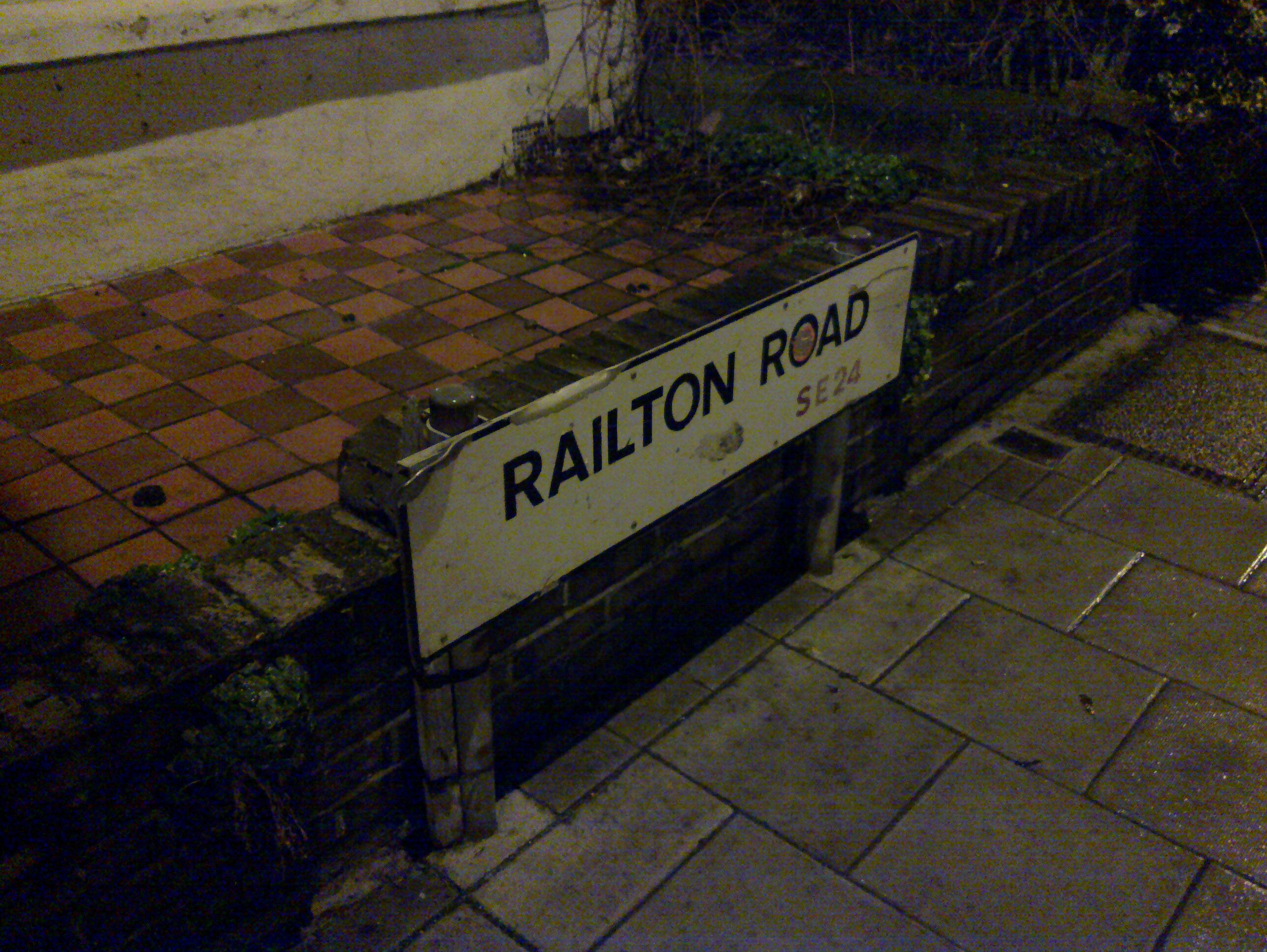
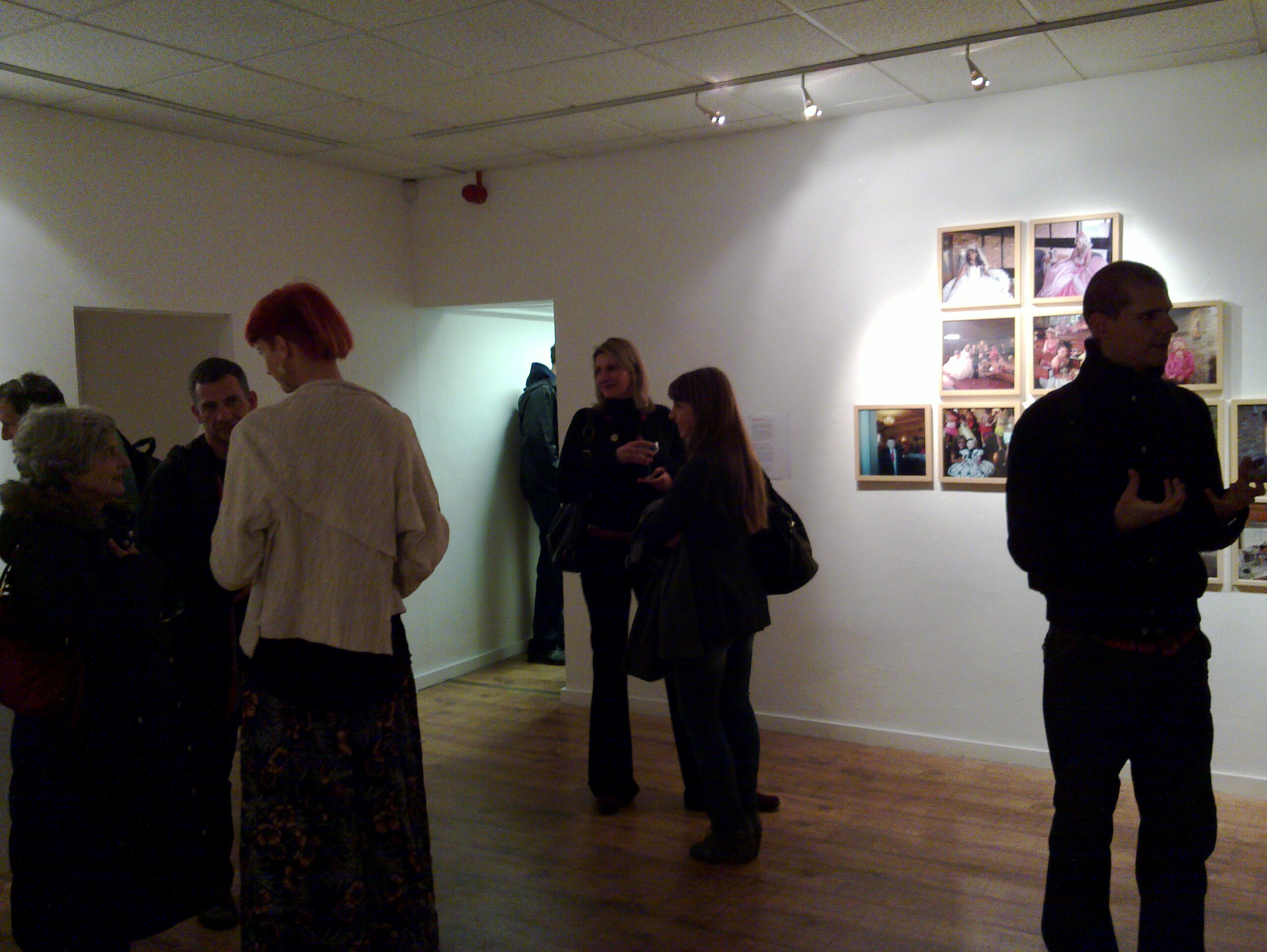
Wednesday evening, after work, I took a taxi to 198 Railton Road, home to 198 Contemporary Arts and Learning. A few days earlier I had received an invitation to the preview of its new exhibition of photographs by Eva Sajovic, the Slovenian artist I have blogged about previously.

To call 198 a gallery is to do it a disservice. Rather, it describes itself in the following way:

“198 is a pre-eminent cultural space in Brixton, which explores the rich diversity of artistic practices informed by globalisation and emerging cultural identities.”

Sajovic’s exhibition, focused as it is on the experiences of Gypsies, Roma and Travellers in the United Kingdom, Italy and Slovenia, could not find a more appropriate home. The minimalist, white-washed lines of the 198 are the perfect contrast with Sajovic’s vibrant pictures that capture the raw and sometimes confused emotions that arise at the intersection of diverse migratory cultures and the settled community. Perhaps most humbling is the sheer force of will required by Gypsies, Roma and Travellers to maintain their traditions and social structures in the face of overwhelming hostility, mistrust and misrepresentation. As Sajovic’s pictures, and their accompanying stories remind us, the persecution of difference is as great today as ever it was – the UK, Italy and Slovenia representative of European societies where society appears to deem it acceptable to discriminate against travelling communities in a way that it would not contemplate with those from other minorities.

Eva Sajovic's “Be-Longing” at the 198

Eva Sajovic's “Be-Longing” at the 198

For me, talking to two Travellers living in Southwark, the greatest irony is that the value that drives them to maintain their traditions above any other is the same as that of their fiercest conservative critics: family. It is the belief in inter-generational support, of the transmission of knowledge and tradition from one generation to another, that creates the tremendous familial bonds in travelling communities. How sad it is that as the settled community laments the loss of that ideal, the communities that are the object of so much of its hatred earn that ire as a consequence of living out that same ideal. Sajovic spoke movingly of the warmth and generosity with which she was received upon gaining the trust of the communities she worked with. For me it all gives Matthew 7 a very modern context:

“Do not judge others, and you will not be judged. For you will be treated as you treat others. The standard you use in judging is the standard by which you will be judged. And why worry about a speck in your friend’s eye when you have a log in your own? How can you think of saying to your friend, ‘Let me help you get rid of that speck in your eye,’ when you can’t see past the log in your own eye? Hypocrite! First get rid of the log in your own eye; then you will see well enough to deal with the speck in your friend’s eye.”

Matthew 7, 1-5, New Living Translation

An exhibition of photographers of travelling communities may not be the first thing that comes to mind when thinking how to spend a couple of hours of an evening. However, this initiative represents another small but very important step in helping to foster understanding between settled and travelling traditions that are steeped in a mutual suspicion that is centuries-old. Be adventurous and give it a go – and see something special from an exciting new talent.

And enjoy Brixton and the 198.

Add to FacebookAdd to DiggAdd to Del.icio.usAdd to StumbleuponAdd to RedditAdd to BlinklistAdd to TwitterAdd to TechnoratiAdd to Yahoo BuzzAdd to Newsvine

“Mother and Child” in ice

Em and I were struck in town by how beautiful the “Mother and Child” statue looked yesterday afternoon with the fountain flowing. As we got closer we realised that the water had frozen on parts of the statue.

“Mother and Child” in ice

“Mother and Child” in ice

Add to FacebookAdd to DiggAdd to Del.icio.usAdd to StumbleuponAdd to RedditAdd to BlinklistAdd to TwitterAdd to TechnoratiAdd to Yahoo BuzzAdd to Newsvine