Chequeing up on the Payments Council

A couple of weeks ago I decided to write to the Payments Council regarding the future of payment options for those such as voluntary organisations and the less well-off. It was not my best-written email, despite its brevity, but it is a correspondence that speaks for itself and so I am publishing it here. Please feel free to offer your comments.

Me

Dear Sir/Madam,

I would be grateful if you could let me know what work you are aware is being done in either the public or private sector on the issue of cheque replacement, especially for 1.) families on lower incomes and 2.) for those who are uncomfortable and resistant to a technology-based solution.

Yours sincerely,

Ben Williams

The Payments Council

Mr Williams

Thank you very much for taking the time to write to the Payments Council to register your concern about the decision to set a target date for the closure of cheque clearing in 2018.  Firstly I must apologise for not responding to you earlier but it is taking me longer than I’d expected to answer all the emails and letters that we have received.  There have been over 450 of them and I want to ensure that I respond to as many points raised as possible so that we understand people’s different issues.

One thing I’d like to stress from the outset is that in the short term this means no change to how we use cheques, as 2018 remains eight years away.  We have made very clear commitments that the Board will only decide to go through with closure in 2018 if, by 2016, suitable alternatives are in place and being successfully used.  Obviously removing cheque books now would not be feasible as so many people rely on them but that is not what was agreed.  Importantly we completely recognise that as things stand there are not enough easily accessible alternatives to cheques for a range of individuals (as well as charities, small businesses and schools).  That’s one of the reasons that the target date is enough of a way off to ensure that the necessary work is done on alternatives, that they are bedded in and that they meet everybody’s needs.

The Payments Council first started looking at the future of cheques two years ago and undertook a public consultation but felt that more information was required before making any decision on this issue in 2008.  All parties that we have consulted recognise that the number of cheques we use is in terminal decline: cheque use has declined 40% in five years and only half of the cheques written in the UK are personal cheques with businesses writing the other half.  In many ways we really had no choice but to completely review the future of cheques taking into account the changing pattern of use by individuals, businesses and retailers.  Without us putting a plan in place for the future, we could see a number of banks moving away from cheques and customers suffering but there being no work to develop an industry alternative.  This way there will be a concerted effort to ensure that alternatives exist.

Since the publicity over the decision, a number of representative groups that we have not discussed this with so far have got in touch to refer their specific issues to us.  These range from the impact that stopping cheques will have on the level of donations amongst the myriad of small clubs and societies that exist, through the impact on those people that group represents to the need to provide dual signature authorisation for existing transactions.  In the latter case, there are online solutions available and we would expect banks to explore other alternatives to those functions that cheques currently offer.  This year we want to concentrate on this area and we will be arranging a series of workshops to explore solutions with the voluntary sector.

One aspect that has proven useful over the last couple of months is that a number of people have got in touch to highlight the key areas where alternatives to cheques will be really required.  You won’t be surprised that these mirror the issues that you mention.  Obviously there are some alternatives already in existence – not all of these, however, suit everybody and there is certainly more work that can be done by the Payments Council to demonstrate what options suit which type of existing cheque use.

A number of people have asked what they would use instead of cheques for small gifts and personal payments and an alternative will need to exist if the proposal to close the cheque clearing is to go ahead.  One option that will be reviewed is whether a paper voucher – that can be electronically processed – would be practicable.

I can see how paying sole tradesmen is a concern but there are alternatives already and with some additional work, these issues can be tackled by banks.  Mobile card machines are easily available although they may not be priced as attractively as they need to be to encourage their use, but they are increasingly used by very small outlets.  One of the problems with cheques for small tradesmen is that they have to pay them in to the bank and wait for them to clear so they can get their money.  In all cases, electronic transfers and card payments are quicker; and we expect to see more use of direct electronic transfers not just between individuals but between small businesses too.  Increasingly people use the Faster Payments service to transfer money between individuals or to pay small service providers – actually that’s how I paid a recent bill from the plumber.

We completely understand the concerns this proposal may cause some who are older themselves or have elderly relatives and I would like to reassure you that we are not trying to force people who feel uncomfortable banking online down that route.

I appreciate that my comments may not assuage your overall concern but I would like to re-assure you that we’re talking about gradual change and helping people understand what options exist rather than suddenly finding in 7-8 years time that cheques aren’t accepted.  The Payments Council was set up to look at what type of payments we need overall as a country for the kind of business (as individuals and businesses) we all do and the payments we make.  It is not a purely banking industry body: to that end, there are four independent Directors sitting on the Board and I’ll ensure that they receive a copy of your correspondence.  Three of the independent Directors chair the User Forums covering consumer, corporate and small business interests and have been discussing the issues on cheque use for some time.

You may have no interest in reading how we came to this decision but we have published a report The Future of Cheques in the UK on our website along with two fact sheets for consumers and small businesses http://www.paymentscouncil.org.uk/media_centre/press_releases_new/-/page/855/.  If you would prefer a paper copy, please let me know and I’d be happy to send on a copy (my telephone number is at the bottom of this email).  As alternatives to cheques for different types of use become clearer, we will be updating the fact sheets and ensuring we communicate as widely as possible about any developments.

I hope you don’t mind me writing such a detailed response but obviously you raise important issues that we need to take into account.

Again thanks for writing and apologies again for my dilatory response.

Kind regards

Sandra Quinn

Director of Communications

Add to FacebookAdd to DiggAdd to Del.icio.usAdd to StumbleuponAdd to RedditAdd to BlinklistAdd to TwitterAdd to TechnoratiAdd to Yahoo BuzzAdd to Newsvine

Progressive reformers desert Labour: John Kampfner on why he’s now backing the Lib Dems

The journalist John Kampfner has established a formidable reputation as broadcaster, writer, political campaigner and commentator.

In 2002 he won awards  for Journalist of the Year and Film of the Year from the Foreign Press Association for his documentary on the Middle East, The Dirty War. Under his editorship from  2005 to 2008, The New Statesman reached its highest circulation figures in thirty years. In 2006 The British Society of Magazine Editors gave him their award for Political Editor of the Year. Both the Observer and the Evening Standard listed his book Freedom for Sale as one of their books of the year for 2009.

Yesterday, Kampfner published an article in the Guardian and a pamphlet through CentreForum, “Lost labours”, both of which address Labour’s record of failure and its betrayal of the British people’s trust. He explains his difficult decision to switch his political allegiance away from Labour to Nick Clegg’s Liberal Democrats, arguing that only they can ensure a fairer Britain and urging other reformers on the centre left to acknowledge the Liberal Democrats as the most progressive force in British politics.

If you are uncertain of the case that politicians make for themselves, take a moment to read Kampfner’s coherent and compelling account.

If you are interested in finding out more about John Kampfner, check out his listing on evri where you will find a number of video clips of debates and commentaries on a range of political issues.

Add to FacebookAdd to DiggAdd to Del.icio.usAdd to StumbleuponAdd to RedditAdd to BlinklistAdd to TwitterAdd to TechnoratiAdd to Yahoo BuzzAdd to Newsvine

Eva Sajovic seminar – “The future of travelling communities” #sajovic #roma #travellers #gypsies

Eva Sajovic’s “Be-Longing” exhibition is still running at the 198.

On Tuesday there is an all-day seminar on the future of travelling communities, chaired by Brian Foster of the Inner London Traveller Education Consortium.

Those taking part include:

The programme is set our below:

Programme

10.30 – 11.00 Registration and Coffee

11.00 – 11.10 Introduction

11.10 – 11.30 Prof. Thomas Acton

11.30 – 11.50 Rocky Deans

11.50 – 12.00 Bobby Rostas

12.00 – 12.05 Brian Foster

12.05 – 12.45 Panel Discussion

12.45 – 1.00 Q&A

1.00 – 1.45 Lunch

1.45 – 2.00 Patricia Knight

2.00 – 2.15 Dada Felja, RSG

2.15 – 2.30 Tricia Bowie Phillips, STAG

2.30 – 2.50 Prof. Judith Okely

2.50 – 3.10 Damian LeBas

3.10 – 3.15 Brian Foster

3.15 – 3.45 Panel Discussion

3.45 – 4.00 Q&A

Better community understanding depends on people being prepared to take an interest in things that at first seem one removed from their immediate environment.

Book yourself a place by emailing info@198.org.uk.

Add to FacebookAdd to DiggAdd to Del.icio.usAdd to StumbleuponAdd to RedditAdd to BlinklistAdd to TwitterAdd to TechnoratiAdd to Yahoo BuzzAdd to Newsvine

Fearing franchise change: why it is a mistake to ditch C2C

As a commuter and regular weekend passenger it is very easy to vent about the state of the railways.

Make that rant about the state of the railways.

I have always resented the insidious shift in terminology that, over the years, has seen me redesignated as a customer. I can choose where I buy my fruit and veg. I can’t choose who provides the train I get on. (More on that another time).

My family will have lost count of the number of occasions I have erupted on the phone about the basket-case services provided on the railways at weekends. Why is it that in one of the most prosperous Western countries, in the 21st Century, we still can’t run a comprehensive week and weekend service? It is a pathetic indictment of our national capacity to organise.

Taxi drivers will know my outbursts about the fact that the Germans appear to be able to run (and maintain and repair) a huge national rail network, with far fewer problems than us Brits, and with timetables that link in buses and trams. To the minute. It is astonishing we cannot, bearing in mind our national readiness to computerise and database our entire existence. (Sod the ID card database – lets try and get our buses to meet our trains!)

And on various occasions Em and I have cursed the running of short trains at busy times and the resultant cram into trains which simply aren’t designed for standing.

As I said. It is very easy to rant.

Much harder is crediting rail companies for their successes. And some, with the unlikeliest parent companies, have successes in abundance.

C2C operates the busy commuter line between Shoeburyness and London Fenchurch Street. There is a further loop line from Barking to Pitsea that runs through the old towns along the north flank of the eastern stretches of the Thames. These include the vast industrial wildernesses of Rainham and Dagenham, as well as Tilbury Town and East Tilbury, both of which have extensive maritime histories of civil and military significance, and the towns of Grays and Stanford-le-Hope, each home to a rapidly expanding commuting population.

I use Basildon, Laindon and Pitsea and, on the fastest trains, am a mere 25 minutes from central London.

C2C is owned by Network Rail, the company that ruined the East coast main line. I’ve always been a little schizophrenic on rail privatisation. To me, the railways as a service industry, unlike say HMV, but – as we have privatisation – I have wanted to see healthy and sensible competition to drive up standards. When Grand Central appeared on the scene, challenging National Express (the then principal operator on the East Coast Main Line), Em and I cheered, loving their livery, the uniformed presence of enthusiastic staff and the refurbishment of the well-designed intercities, with seats that line up with windows. Even now, Grand Central are going from strength to strength, introducing refurbished Class 180s and committing to re-engineering their existing High Speed Trains.

The Government were right to strip them of their franchise on that line.

I don’t know much about the East Anglia routes and how they operated. All I know are the anecdotal complaints from friends and colleagues bemoaning the state of their trains and stations. They suggest, unscientifically, that the decision to remove that franchise was justified.

C2C is different.

C2C is one of the very real success stories. And yet the Government has decided, apparently, that National Express will not be allowed to bid to retain the franchise. To my mind it is madness to punish the franchise operator, and a clearly able and committed management team, because of the various sins of the parent company.

When C2C announced that it was to change its livery from the distinctive purple and yellow to National Express’s bland white, I wrote to C2C expressing my dismay. Why on earth rebrand as failure? Why spend tens of thousands of pounds of commuter cash on making yourself look like a company that is despised? It was the most peculiar piece of PR – unless of course you were the owners of C2C and desperately wanted to repair your reputation by having it more closely associated with success.

Unlike the rest of the failed National Express rail enterprise, the team that manage C2C has shown a very real dedication to their passengers and services.

Unlike many lines, C2C manage all the stations as well as the trains. The only station managed by Network Rail is Fenchurch Street. (West Ham is managed by London Underground.) The difference between the investment at Fenchurch Street (minimal) and elsewhere on the line is marked.

New doors, stairs, waiting rooms, information systems and security systems have all been provided by C2C.

The management team engage passengers regularly, with meetings between a representative passenger panel and C2C – and C2C actually respond. C2C produces Commuter News, a monthly ad-free informative newsletter that explains the causes of problems, highlights coming improvements and draws attention to the engineering works scheduled for weekends.

C2C modernised its entire fleet of trains – yet retains a sense of the old romance with trains named after those who have worked their lives on the railways. They have won awards for introducing regenerative breaking across the entire fleet – something that has made them one of the most environmentally-conscious train-operating companies in Europe.

Most ironically, whilst the Department for Transport rail against National Express and C2C, both the Department for Energy and Climate Change and the Foreign and Commonwealth Office point to C2C as an exemplar of a UK train success story.

It would seem that this tired and failing Labour Government is either ideologically sclerotic or determined to prioritise a petty retribution over genuine achievement in the passenger’s interest.

If there is any sense left in Government, Adonis and his crew will at least allow National Express to bid. Regardless of their other failures, National Express/C2C know this line, have shown commitment to their trains, stations and passengers.

They have transformed the “misery line” into one that regularly tops the customer satisfaction surveys and became the first in the country to achieve a punctuality score of 96%.

Ditching C2C would be a big mistake.

Add to FacebookAdd to DiggAdd to Del.icio.usAdd to StumbleuponAdd to RedditAdd to BlinklistAdd to TwitterAdd to TechnoratiAdd to Yahoo BuzzAdd to Newsvine

The Woodsman Poacher galvanises Basildon’s creative communities #woodsman #toryfail

With delicious irony, the spirit of Wat Tyler has been stirred in Basildon’s creative communities by the way in which Basildon Council dumped Dave Chapple’s Woodsman Poacher sculpture at the park that bears Tyler’s name. I am sure Wat Tyler, who led a peasant army in revolt against financial dictats from the King (a poll tax, actually), would smile at the way Basildon artists are speaking out in opposition to local politicians who are quite happily rake in our taxes, but appear to have no respect for what the community actually wants.

Yesterday, The Echo reported how on Monday “More than 50 painters, sculptors, performers, heritage bosses, and other members of the arts community gathered for their inaugral meeting.” Liz Grant, who worked with other local artists to convene the meeting, describes it brilliantly:

“We had lots of people from across the arts spectum, which is fantastic for a first meeting.

“The Woodsman has been the catalyst for the group’s formation.

“We see it as a symbol of how the artistic community and the public feel about how the arts are being dealt with by Basildon’s current council and the previous one.

“It’s a symbol of all that’s wrong with how the council is operating.”

To my mind it is quite incredible how the plight of a single wooden statue has brought together Basildon’s creative communities in a way nothing else has. Steve Waters is one of the artists behind Old Man Stan, and his quote in The Echo captures succinctly the way in which the treatment of Dave Chapple’s creation has caused people to take a stand:

“We now have one united voice for the arts community in Basildon.

“The Woodman is what has brought us all together.

“We don’t want it to happen again, or ever be forgotten.”

Too damn right we don’t.

There was unanimous agreement on a motion of no confidence in the way that the Council currently engages those involved in the arts – and the way it looks after Basildon’s valuable collection of public art. As someone who has blogged variously about The Woodsman, public art in Basildon, the Wat Tyler sculpture trail and the Motorboat Museum, it was truly heartening to learn that all these issues were discussed.

What is particuarly exciting about this venture is that it is professionals and amateurs alike who are involved. Quite simply, it’s local people saying they want to have a say in how their public spaces look – and how their interests are supported – in just the same way that sport and other leisure activities are supported.

Politicians might think they can shrug this off. I don’t think they can.

Many of those who enjoy participating in the arts – creating things, making things, acting things, singing things, watching things, listening to things – get fed up with being treated as the Cinderella sector, left to sweep up the crumbs whilst the ugly homogeneous stepsisters “Sport” and “Leisure” receive the funding and the attention.

My own view, as someone involved in local politics and the local art scene, is that we attempt to tell people what they want at our peril. For me it comes back to the “raucous, unpredictable capacity of people” that lends our communities power and vibrancy and which, when untied in a single shout, demands attention as the voice of local people that help pay the Council’s way.

Being involved in the arts, involved in Basildon’s creative communities, is about being involved with each other, in all its glorious messiness.

Some things we’ll love.

Some things we’ll hate.

Some things we’ll think are pointless.

And some things we’ll disagree on.

But some things – like The Woodsman Poacher – will make us realise that we have much more in common than we think.

If you want to get involved, the next meeting is on Monday 22nd March at 7.00pm, St Martin’s Church Hall. Please call Elizabeth Grant on 07939 122864 for further details.

If you think Basildon deserves better than bulldozers and excuses, come along.

And finally, for those politicians who still think that all this really doesn’t matter, there’s a salutory lesson on Facebook.

Friends for the The Woodsman Poacher? 1,651.

Friends on the campaign page of Basildon’s Tory candidate? 150.

The Woodsman Poacher rests his case…

Add to FacebookAdd to DiggAdd to Del.icio.usAdd to StumbleuponAdd to RedditAdd to BlinklistAdd to TwitterAdd to TechnoratiAdd to Yahoo BuzzAdd to Newsvine

We breed ’em tough in Basildon… Chickens that is

Coming from a farming family who, in latter days, have kept chickens and ducks, whilst growing large quantities of over-sized vegetables, I have always taken a philosophical view of nature’s brutalities and the fact that foxes are a constant threat.

In my youth I was a fan of Roald Dahl’s Fantastic Mr Fox, which I regard as a witty and subversive take on things agricultural. They are very easy to over-romanticise, with their handsome looks and lithe movements, and you can forget that actually they are cunning little devils capable of slipping bolts, climbing wire and flicking hatches. when it comes to chickens, they’re not above killing the lot and taking only one or two.

Funny then (though not for the fox), to read in Metro about a very different turning of the tables.  Chickens lend themselves to groansome puns, so the journo has some fun with “a murder most fowl”.

Anyway, it would appear that chickens in Basildon are made of sterner stuff than your average Rhode Island Red. Dude the cockerel, Izzy, Pongo and Pecky clearly had other ideas than becoming the latest take-out meal for a passing fox. I can only imagine what Michelle Cordell feeds them on. (I have a sneaking suspicion that I know where these chickens hang out!)

Hats off to Basildon’s tougher breed of chook.

Add to FacebookAdd to DiggAdd to Del.icio.usAdd to StumbleuponAdd to RedditAdd to BlinklistAdd to TwitterAdd to TechnoratiAdd to Yahoo BuzzAdd to Newsvine

“They fear an old man” – the disappearing of Haitham al-Maleh #almaleh #syria

One of the country’s leading champions of those imprisoned in Syria for human rights abuses is  Maureen Thomas. The journalist Christiane Schlötzer recently sent her a copy of her article about the disappearance of Haitham al-Maleh that first appeared in the Süddeutsche Zeitung last weekend. Geoff Williams has translated that article.

“They fear an old man”

How a 72 yr old lawyer disappeared in Damascus

Haiham Maleh, Süddeutsche Zeitung

After  lawyer Haitham Maleh gave his last interview he received a telephone call. He was to report the next day to an office of the secret service. Maleh didn’t. A day later three men in civilian clothes were waiting for the 78-yr-old when he arrived to unlock his car, at midday, in the middle of Damascus. The three strangers overpowered him and forced him into a car. Now the Syrian lawyer gives no more interviews. Instead, his son  Iyas Maleh is giving them, and this week in Berlin he has been recalling his father’s fate.

It was the week in which the USA appointed an ambassador to Syria for the first time in five years of diplomatic ice-age. President Obama sees Syria as a signficant player in the Middle East and would like to release the country from its close alliance with Iran. Iyas Maleh regards the approach to Damascus  by the West with scepticism. “The offer to improve relations must be linked to conditions” is his demand. “Syria has to show that it respects human rights.” Europe cannot simply “turn away” Maleh told the Süddeutsche Zeitung . He didn’t understand that both the Union (CDU/CSU) and the FDP stressed in Parliament (Bundestag) recently that deportations to Syria should remain possible. The opposition had demanded a stop to them.

Iyas Maleh did not know where his father was for eight days after his kidnap in Damascus on 14th  October 2009. When he then  appeared before a military court it became clear to the son that it would be a long time  until his father was freed. The charge against him is one of “spreading false information and so undermining national morale”, an accusation frequnetly used “when they want to throw someone in prison. Punishment is 3 to 15 yrs imprisonment”.  Haitham Maleh has already served six years in jail. He was chairman of a prohibited “human rights organisation” in Syria. Most recently, in written articles and an interview with the London-based Arabic TV company  Barada TV  he insisted on the rule of law within the state and criticised state corruption.

Thanks to a letter smuggled out of prison Iyas knows that his father has to sleep on the floor of an overcrowded cell. Iyas Maleh was also once arrested, in 1980, after which he fled to the USA. The 49-year-old computer engineer has not returned to Syria since. He has three siblings also living abroad. Their father remained in Syria.

“This allegedly so powerful Syrian government is afraid of an old man,” he says bitterly.

Translated by Geoff Williams


Add to FacebookAdd to DiggAdd to Del.icio.usAdd to StumbleuponAdd to RedditAdd to BlinklistAdd to TwitterAdd to TechnoratiAdd to Yahoo BuzzAdd to Newsvine

Syria: Koki, Aqil and other journalists freed by regime – a glimmer of hope for Kamal, Hytham, Anwar and colleagues? #labwani #syria

Alkarama have reported that Ma’an Aqil and Abdul Rahman Koki have been freed by the Syrian government within days of each other.

Aqil, a journalist in Damascus, was arrested on 22 November 2009 and was detained arbitrarily for three months (I blogged about his detention in December). Alkarama report that he was released Tuesday 23 February 2010.

Yesterday, Alkarama reported that Abdul Rahman Koki was released on Tuesday 16 February 2010, following a presidential pardon.

In both cases Alkarama had referred the cases to the UN Working Group on Arbitrary Detention.

Reporters Sans Frontières also report that two other journalists, Ali Taha and Ali Ahmed, have also been released after weeks of arbitrary detention.

Whilst being cautious not to overstate the significance of these releases, they offer a faint glimmer of hope in so far as the Syrian regime appears willing to free individuals who have clearly been prepared to challenge the government domestically and, in Koki’s case, be directly critical of  it. As Alkarama notes, we must take this opportunity to remind the Syrian authorities of their responsibility towards international human rights law and urge them to release all prisoners of conscience, including Kamal al-Labwani, Hytham al-Maleh and Anwar al-Bunni.

Add to FacebookAdd to DiggAdd to Del.icio.usAdd to StumbleuponAdd to RedditAdd to BlinklistAdd to TwitterAdd to TechnoratiAdd to Yahoo BuzzAdd to Newsvine

Brown, bullying and international perceptions

Regardless of the truth of the bullying allegations surrounding Brown and Number 10, they appear to be creating an even less savoury picture of goings on with our friends in the international community.

Apple Daily runs an online news channel called Next Media that, instead of using actors, animates its newscasts in order to make them more exciting. Launching simultaneously on 26 November 2009 in Taiwan and Hong Kong, it quickly courted controversy with parents complaining about explicit, erotic and violent content. If you are interested, Media, the marketing and communications newspaper for Asia-Pacific carries an interesting article on the rows surrounding Apple Daily on its website.

In any event, the sales-boosting bullying furore around Rawnsley’s new book, The End of the Party, has clearly attracted attention in the Asia-Pacific region and has made its way into the most extraordinary news bulletin I’ve yet seen on the matter:

It is difficult to know quite what to make of the provocative way in which Next Media presents current affairs. Suffice to say that their coverage of the bizarre legal dispute in Colarado over who owns the head of Mary Robbins (the Robbins family or Arizona’s Alcor Life Extension Foundation) suggests they like to sensationalise sensational stories.

However entertaining it is, it makes me grateful for the BBC and public service broadcasting.

Add to FacebookAdd to DiggAdd to Del.icio.usAdd to StumbleuponAdd to RedditAdd to BlinklistAdd to TwitterAdd to TechnoratiAdd to Yahoo BuzzAdd to Newsvine

David Cameron’s Conservatives: Tories break Pickles dirty tricks pledge [The Fib List No. 4] #toryfail

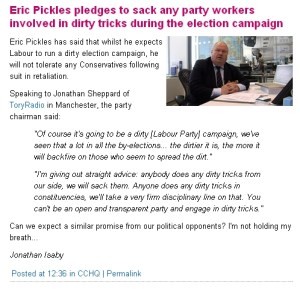
Last October, Eric Pickles, Chairman of the Conservative Party, made a very bold pledge:

However, the stricture from Eric Pickles doesn’t appear to have been picked up in Solihull. Sophie Shrubsole, Conservative Future Area Chair for Birmingham, Solihull and Coventry, excitedly marshalled her student troops after a request from Conservative Campaign Headquarters (CCHQ) to encourage students across the country to gather in Warwick and disrupt last  speech by the Prime Minister:

Paul Waugh of the Evening Standard, who broke the story, wonders on his blog if Eric Pickles will be true to his earlier comments.

More specifically, I would imagine that Pickles has at least two courses of action he should consider:

  1. An inquiry to establish which party official at CCHQ was encouraging such dirty tricks and sack them;
  2. Disciplinary action against Shrubsole as a party officer for continuing to organise this planned disruption in clear contravention of his instructions.

The sad fact is though that, despite his pledge, Pickles will do nothing and the Conservative Party will seek to ignore this first clear example of dirty tricks – or explain it away as student hijinx.

There really is nothing quite so grubby and hypocritical as a Conservative Party desperate for power at any cost.