Slaying the trolls: rape, Twitter and free speech on the Internet

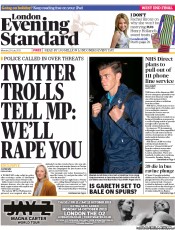
London_Evening_Standard_30_7_2013It was with a sickened sense of incredulity I read the front page story of yesterday’s Evening Standard:

“Twitter Trolls Tell MP: We’ll Rape You”

Following Stella Creasy’s support for Caroline Criado-Perez, who was herself subjected to vile rape threats on Twitter for having the temerity to suggest that our bank notes should recognise the contribution women have made to our national success, it seems Twitter’s women-hating brigade have decided attack is the best form of defence.

I hesitate to use the word “trolls” in the context of men threatening rape.

It is a word that risks lessening the offensiveness and dangerousness of the words they choose to use. It also risks lessening the offensiveness and dangerousness of them, the men that make such threats, by decontextualising the perpetrators. A troll means different things to different people: the quasi-comical lumbering beast of popular culture; those punk-haired childhood toys that look like Child’s Play casting rejects; the dark and monstrous creatures of myth and fantasy; or dysfunctional “saddos” that should “get a life”.

In terms of the Internet, particularly, it is too easy to latch on to this latter idea. It is too easy to suggest that such threats should be dismissed as the mindless (and harmless) ranting of sexually dispossessed indequates. That those who feel threatened (generally women) should grow a thicker skin, particularly if they wish to enter the realm of the Internet (coincidentally designed and dominated, at least in terms of its architecture and maintenance, by men).

It also creates and reinforces a perverse sense of camaraderie and community. Persecutors present as the persecuted. They seek canonisation from their peers for defying the intrusions of the amorphous entity known as “the state” into their domain. It is a domain where, despite the fact that this domain and their freedom to explore it only exists courtesy of the state of which they are citizens, and the physical security and economic infrastructure which that state provides, “the state” and all that accompanies it (such as the rule of law) is evil: only the techno-anarchic, as defined by this self-selecting twisted-moralising techno-prophet elite, can be good.

Part of the hysterical rhetoric deployed is that this sort of censorship is the preserve of “feminazis”. Anyone familiar with the etymology of that word will know it was popularised by right-wing chat show host Rush Limbaugh in his attack on supporters of the pro-choice lobby. Suddenly, it was okay to conflate the term “feminist” with “National Socialism”, a genocidal quasi-religious totalitarian ideology, in order to mock and bring down those who chose to take a public stance on critical issues of women’s health. A quick trawl of the Internet reveals casual use of this term in Internet forum debate on the issue, as well as men seeking to deny that the rape threats were even made in the first place.

I don’t suppose it will be long before Criado-Perez’s assertion that “this is not a feminist issue” will be used both to undermine her credibility with feminist colleagues and, in complete contradiction, to attack her for her feminism. My reading of her comments is that she is making clear that this is an issue that has – or should have – currency beyond those who define themselves as feminist, not that this is not an issue for feminists. It is an issue that many might well identify as a feminist issue, but that we as a society should all be concerned with. It would be regretful if a well intentioned headline, designed to broaden participation and engage those who would normally stay outside such debates – not least of all because of the way some vocal and antagonistic participants use the terms “feminist” and “feminazi” to derogate and intimidate opponents – provided unintended cover for those who would prefer to retreat entirely from uncomfortable discussions of gender, identity and security (see the quote from Professor Mark Griffiths in this BBC story on Criado-Perez’s experiences and the wider issue of cyberbullying: Twitter abuse: Why cyberbullies are targeting women).

We need to slay these trolls – and even the very concept of them. We need to put abusers back in context. We need to remove their self-styled outlaw identity, where they seek to aggregate the romantic pioneer legacy of the Wild West to themselves and to the exclusion of those who choose not to engage in threats to violate other human beings. Like the rapists they emulate, these abusers are fathers, sons, brothers, husbands, boyfriends and lovers, banal in their evil. Like the rapists they seek to emulate they have mothers, daughters, sisters, wives, girlfriends and lovers. They are men, real human beings who have lost touch with the qualities that make them human – at least, such qualities as make them functional members of a liberal and democratic society in which all should feel safe to carry on their own business without the oppression of the state or other individuals in that society.

You hope that these individuals would not talk to their mothers, daughters, sisters, wives, girlfriends or lovers in the language they choose to address a stranger. (I resent describing them as “men” almost as much as I am reticent about calling them “trolls”. Unfortunately, I can’t escape the fact of their gender. Perhaps I should use the term “males” as “female” and “females” seem to be the nouns of choice when men engage in the casual objectification of women.)  You also hope, perhaps forlornly, that they would be angry as hell if a man approached a woman they loved and said he was going to rape her. If it were someone I loved who was threatened in that manner, I hope I would have the guts to punch their lights out.

If anyone doubts the extent of the challenge, it is worth reading Cath Elliot’s thought-provoking Guardian piece from October 2011 and the response it provoked in comments from readers: Facebook is fine with hate speech, as long as it is directed at women. One particular argument provoked a storm of angry comments from indignant readers, predominantly (though not all) men:

“What Facebook and others who defend this pernicious hate speech don’t seem to get is that rapists don’t rape because they’re somehow evil or perverted or in any way particularly different from than the average man in the street: rapists rape because they can. Rapists rape because they know the odds are stacked in their favour, because they know the chances are they’ll get away with it.”

This was immediately seized upon as Elliot saying that all men are potential rapists. Comments under her article include:

“So any man will rape if he thinks he can get away with it? Is that what you’re saying Cath? That were rape to be legalised tomorrow we’d all be doing it?” [04 October 2011, 11.18am]

“Given that even using the disputed maximum figure for number of rapes committed per year you wind up with only 1 in 500 men actually being rapists I’d say that that does make them pretty different from the ‘average man’.” [04 October 2011, 11.22am]

“Oh. That’s absolutely disgusting, by the way. I hope you’ll clarify you’re not seriously suggesting the ‘average man’ would be out there, raping away, if they thought they could.” [04 October 2011, 11.33am]

At no point did Elliot make an equivalence between rapists and non-rapists. Quite the opposite in fact. She makes the distinction based on their actions. In the end she responded with her own comment:

“I didn’t say they were the ‘same as’ I said they weren’t ‘particularly different from’, and they’re not, apart from one key thing – the fact that they’re rapists!

I’m actually surprised that so many posters here seem to think rapists are some kind of special alien-like breed, easily distinguishable from everyone else. Well they’re not. As someone else has pointed out in the thread, they’re brothers, fathers, uncles, neighbours and so on, ordinary men in just about every way except for one – they’re prepared to commit this heinous crime whereas the vast majority of other, decent men are not.”  [04 October 2011 1.17pm]

She makes the point on contextualisation: that these men are like other men, enjoying the same relationships as non-rapists. They do not appear different, even though their monstrous actions set them worlds apart. If you want to get an idea of the kind of person who makes such threats, read this piece by Emma Barnett, the Telegraph’s Women’s Editor, on her radio interviews with two Internet trolls who attempt to “defend” their “right” to make rape threats online.

I wonder if those who scream “Free Speech” in defence of the right of men to threaten the rape of women on the Internet, whether to intimidate or just “for a laugh”, have really thought through what it is they are calling to protect? Before joining the chorus of indignation, anyone who is in doubt as to the vileness and impact of rape should talk to a rape survivor.

Hear them describe the fear and the sickening sense of violation and the powerlessness and the destruction of self-esteem and the ruin of identity. Hear the anger and the self-blame and the vilifications that have been caused by another man. If you are a man, wrestle uncomfortably with your instinctive sense of affront and indignation at any gender generalisations about men and male behaviour and realise they are being made by a woman who has had her identity reduced to object, a thing which a man felt entitled to violate.

To those who are critical of my gender-specific language, I am of course aware that men are raped and the horrific nature of each instance of rape is not altered by the gender of the victim. However, that still doesn’t change the fact that the vast majority of rape victims are women. Get your head around the fact that official UK government statistics reveal that some 85,000 women are raped on average each year. That is over 230 a day. Then realise that means the offence has been reported and recorded and so unreported offences, which are no less real to victims too terrified or ashamed or resigned to report their rape, mean the real figure is much higher.

And then think what it means when a man says the following to a woman, whether in private or in the street or in a virtual forum: “I am going to rape you.”

Rape survivor stories make for harrowing reading. It is an offence that defies our sense of what is right on every conceivable level. Those who think that we who are offended by rape threats and jokes (without even being threatened) should grow thicker skins should themselves pause to consider how desensitisation to language is a very real thing. The recent history of popular culture is testament to that.

After all, we have learned as a society to tolerate language that our parents and, even more so, our grandparents, would not. Some of us have championed that as liberating. Some of us have bemoaned a collapse in standards of manners and social etiquette. Still others, myself included, have done both, casually accepting this change in the moral value of language without real challenge, assimilating vulgarities into our own speech despite the things we believe, bemoaning that vulgarity in others, yet also unwilling to see society return to a more censorious age. We may like it, we may not like it, we may champion it, we may hate it, but no-one would seriously question that Western society today is more acclimatised to the use of certain words than a generation ago.

Prevalence of such words, through use and reuse, has, inevitably, extended social acceptability. However, there is a world of difference between the freedom to use offensive words as we choose, with no intrinsic or constructed intent, and the use of phrases that are clearly constructed to create fear through expressed intent – targeted hatred designed deliberately to impact fundamentally on identity and a sense of self, of place. And whether we are content to live in a society in which casual disregard for such intent is a socially acceptable norm is a question we all have a responsibility to answer.

For me, in this particular debate, the cry of “Free Speech” is a modern-day Chimera, a monster conjured up by techno-demonologists to strike fear into the hearts of a non-expert majority who rightly fear a censorious state that interferes with political expression and the way we choose to live our lives. It is intended to terrify liberals into feeling that common sense has no place in a liberal democracy. It seeks to drive them into knee-jerk defences against an authority that, manifested in the state, is deemed amoral by the very fact that its pronouncements could arguably bear the label “moral”. It seeks to create a false and binary choice between one particular and romanticised meme of an anarchic Internet, which is fundamentally good, and the opposite and obvious evils of a liberal totalitarianism, worthy of the worst excesses of Arendt or Orwell. To up the ante, this is often presented as an insidious precursor to the totalitarian regimes we witness and condemn in a variety of real world manifestations. Unlike for many of its inhabitants, there are no shades of grey at all in the Internet’s potential states of existence.

I wonder if we are still intimidated by technology? I wonder if for those who aren’t in on the workings of the illusion there is still something mystical about the Internet that means we are terrified it will suddenly vanish if we apply some of the ground rules to this virtual playground that we use to order our physical space? Do we regard these techno-demonologists, who function as the Internet’s high priests, in much the same manner that the inhabitants of Oz regard the Wizard in Frank Baum’s The Wonderful Wizard Of Oz? One of Baum’s biographers, Rebecca Loncraine, describes the story as a critique of power that demonstrates how “easily people who lack belief in themselves can become willing participants in the deceptions practised by manipulative figures who rule over them.” [“The Real Wizard of Oz The Life and Times of L. Frank Baum”, New York, Penguin Group, 2005, p. 179.]

The same liberals that vociferously deny that the existence of a free society depends on the right of its citizens to bear automatic weapons become less sure of their ground and even mute at the thought of tweets in this virtual, “unreal” realm leading to prosecutions and imprisonment in the “real” world (I would suggest that “unreal” and “real” are increasingly unsustainable distinctions in terms of the interface between the virtual and the physical). Yet were this their mother or daughter or sister in the street, they would not hesitate to recognise the threat for what it is. For me, the fallacy of the rapist tweeters’ argument is demonstrated clearly by the way it collapses under the weight of its intrinsic illogicality: “Our right to say what we like, no matter its reception, is one to which we attach such value that it must be protected at all costs, but yet, don’t worry, because it is also so valueless that you can simply disregard it completely when we exercise it.”

If we start from the presumption that freedom of speech matters, which for me it does, and at a very fundamental level, then surely it cannot be divorced from the responsibilities I accrue as a member of the society that protects that freedom? I am free to say what I like in the United Kingdom. I am also free to understand that if I say certain things, there will be certain consequences. That is part of the social contract I enter into by participating in a society that has decided to protect its minorities from words and behaviour that may make them feel threatened for simply existing.

The social contract is in part defined by law and in part by the the informal ways in which we interact with each other socially to establish appropriate behaviours. In modern parlance we might describe these unwritten, normative rules as “crowd-sourced”. I may choose to disregard the contract, or even refuse to recognise it, but that does not change the fact of its existence. (In understanding that, it beggars belief that we have not yet recognised how some words and behaviour can make a much larger segment of the population feel threatened for simply existing. That is an argument for another day but, thankfully, at least making threats of rape carries a criminal sanction.)

Beyond grand ideas of a social contract there is a much more banal and immediate reality (evil may be banal, but so is reality). Twitter might appear to be an anarchic public space, but it is actually a privately provided platform, run by a company that must operate in the real world of rules and corporate responsibility. Users of Twitter sign up to Terms of Service. These include the following provisions:

“We reserve the right at all times (but will not have an obligation) to remove or refuse to distribute any Content on the Services, to suspend or terminate users, and to reclaim usernames without liability to you. We also reserve the right to access, read, preserve, and disclose any information as we reasonably believe is necessary to (i) satisfy any applicable law, regulation, legal process or governmental request, (ii) enforce the Terms, including investigation of potential violations hereof, (iii) detect, prevent, or otherwise address fraud, security or technical issues, (iv) respond to user support requests, or (v) protect the rights, property or safety of Twitter, its users and the public.”

Granted, users are at liberty to not read them or to read them and disregard them. However, Twitter is also perfectly entitled to remove users’ access if they are breached. Similarly, as users with equal access to this private platform, those who feel the terms of service have been breached, for instance if an “applicable law, regulation, legal process or governmental request” has not been complied with, are perfectly entitled to report their concerns. Whether Twitter then discharges its own contractual responsibilities appropriately is another matter entirely and a part of the focus of the current debate: the way it has been slow to act until public pressure has mounted suggests a depressing subordination of substantive concern to image.

This is not an unusual phenomena. It characterises much of the debate about the Internet and the way, particularly, that private companies who provide virtual platforms appear keen to protect profit margins by perpetuating iconic imagery, such as that of the Internet outlaw, in order to sustain associations with traditional user groups. Perhaps, ironically, it is the very fact that the Internet and social media is becoming more widely accessible to non-theists, and thus potentially more profitable, that is causing these companies pause for thought.

Whether driven by economics, a recognition of what is right and what is wrong, or simply common-sense, at least there are some signs of responsiveness. On the same day that the Evening Standard carried that headline, Twitter was reported as saying that it would install a report abuse button on every tweet, despite previously arguing that it was not necessary.

First the Bank of England and now Twitter. Caroline Criado-Perez is emerging as a very serious and inspirational force to be reckoned with. (If you still want to add your name to Kim Graham’s petition in support of Criado-Perez, calling for a Twitter abuse button, you can find it here.)

I am a liberal to my core.

I believe that the rule of law is fundamental to a prosperous and peaceful society. I believe that governments should err on the side of extreme caution in matters of intervention where it could be construed as an assault on freedom of speech. I also believe that we should put the “trolls” back in context as real individuals with abusive behaviours that demand consequences. Those who seek to hide criminality in the form of threats of rape behind something as valuable as freedom of speech place themselves at liberty of sanction. Freedom of speech matters too much for it to become the preserve of rapists and those who believe they have an unfettered right to engage in society’s private and public spaces without regard for the freedom of all of that society’s citizens.

[Updated 31.7.13]

The nuisance IT call taken to the next level?

I imagine that many of you are familiar with this one.

The phone line clicks, there is a long pause and then an individual with a very strong accent, usually from the Indian sub-continent, checks your name and then announces that he is called “Frank” and is calling you from Microsoft (!) because their servers (!!) have detected that your computer has a very bad problem (!!!).

A quick scan on the ‘net reveals that it is a tried and tested scam, with commentators as varied as Mumsnet, the Nuisance Call police and the tech geeks of the anti-virus forums at AVG all reporting this particular con.

It basically involves trading on a combination of fear and people’s ignorance about the way the Internet and their computers work. You receive a patient explanation that “they” have detected unusual activity on your computer which is probably a serious virus. They then offer to remove it for a fee and, if you are doubtful and not yet persuaded, they offer to set up remote-control of your machine to show you exactly what they are talking about. All of which  looks mightily impressive if you don’t know what you are being shown, but which is invariably misleading, inaccurate or irrelevant.

I guess their hope is that, by this time, the expectation is that you are suitably terrified that your computer could be remotely hacking the Pentagon or running a zombie network. You will be panicking so much that you will hand over your hard-earned shekels to “Frank”, probably in the form of your credit card details (you numpty!), eternally grateful that at least someone is looking out for you. (And, of course, impressed by Microsoft’s unmatched level of customer engagement.)

I suppose I have received this call on  thirty or so occasions over the years and have had varying amounts of fun responding to it. The other day, however, I received a novel variation which left me unsure whether to be impressed at the sheer chutzpah of our man “Frank”, or in despair at the general level of ignorance that means this scam has any viability whatsoever.

As on previous occasions, there was the familiar pause, the familiar accent (I actually think I might quite like “Frank” in other circumstances and could envisage sitting down to dinner and a cold beverage to discuss life, the universe and the finer points of telephone harassment), the confirmatory introduction and then…

“Mr Williams… I am calling you from the technical department of the World Wide Web.”

Think about that for the moment and the cultural implications of such a statement. It suggests that the World Wide Web, that we all use daily, has taken on a transcendental state of existence as a unified, identifiable entity that we all simply accept (and clearly accept without question in considerable numbers). It conjures a vision of Willy Wonka-esque workers, striving tirelessly to ensure that the World Wide Web is kept running 24/7/365.

It was the strangest experience – a little like being called by the plumbing department of Heaven.

I decided that, as this was a Significant Call, the only thing to do was to explore the issue in tones of grateful incredulity. At last, after a lengthy explanation of what had been detected, I asked “Frank” earnestly for the password. I didn’t explain what the password was for. I had no idea what it was for, either. I simply stated that I could see how serious it was and that as it definitely needed addressing it was now time for him to give me the password.

“Frank” was confused. He was definitely not amused.

I don’t blame him particularly. I don’t suppose I would be too amused if I was working that sort of scam on a phone farm and came up against a smug smart arse who clearly new something about how his computer works and wasn’t going to be taken for a ride. It will not surprise you to learn that we parted on less than happy terms and so I don’t suppose we will be sharing that drink any time soon.

So are we so gullible in our unquestioning embrace of technology that we could believe that we might get a call from the web’s technical department? Or is “Frank” actually a quiet revolutionary, out to subvert this scam by making random calls in such nonsense terms that the whole conceit collapses under the weight of its own absurdity?

Perhaps “Frank” is merely as bored with the script as the rest of us and so tried a little improvisation.

Kudos, “Frank”, if so.

And “Frank”, next time you call, don’t be surprised if you are greeted by a very excitable me:

“Oh, Wow! This is such a coincidence! You’re calling from the technical department of the World Wide Web! And you’ve just called the technical department of the Internet!”

Rape: the shocking failure of our legal system – and our media

According to figures released by the Home Office, Ministry of Justice and the Office for National Statistics, more and more incidents of women being raped in England and Wales are being recorded:

2009/10

2010/11

2011/12

Rape of a female

13,902

14,589

14,767

Rape of a male

1,172

1,303

1,274

That is a total of 47,007 incidents of recorded rape over a three year period.

And the number of convictions for rape in that same period (and yes, I know there is no absolute read-across between the offences and convictions)?

1,372.

Yet these figures don’t reveal the horrific extent of rape and serious sexual offences in England and Wales: the report also shows that 57% of women told someone but not the police of a rape or serious sexual assault. 28% told no-one.

And then the questions…

There were “only” 40 non-custodial sentences for rape in 2011. Excuse me? Why were there any?

Apparently “Since 2005, there have been fewer than seven Suspended Sentences Orders (SSOs) given each year for rape of a female and none have been given for rape of a male.” What does the fact that any SSOs have been given  say about differences in perceptions between rape of a female and rape of a male?

Another shocking statistic is that, on average, it is 722 days from the moment someone is raped until the completion of the case. That is almost two years of reliving the hell of what happened in order to secure justice. Why should someone have to wait so long?

There are  so many important questions that arise from this report it is difficult to know where to start.

The figures should hit home like an iron bar hammered in your face.

They should be screamed across the  front page of every newspaper. They are utterly appalling – and reveal a shocking affront to justice that reminds us we are light years from ensuring that rape victims receive the support they need to ensure perpetrators are brought to justice.

And now, in the wake of Leveson, is the ideal time for the press to demonstrate their worth. After all, we’ve had plenty of self-indulgent hand-wringing in recent months, most notably about the important role played by our newspapers in our public life and democracy. In his evidence to Leveson, The Sun’s editor, Dominic Mohan, extolled his paper’s virtues (Para. 60):

“It distils complex important issues of the day, including politics, finance and law into concise readable copy which educates and entertains.”

So, on a day when official statistics reveal such a shocking failure of our investigative and legal processes, on an issue that clearly straddles law and politics, what was this bastion of our free press’s front page?

The_Sun_newspaper_front_page

Perhaps we would expect such crassness and double-standards from The Sun. But what were the front pages of most the other main UK papers today?

This slideshow requires JavaScript.

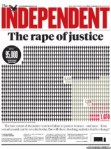
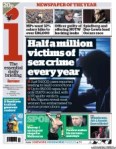
Only two national newspapers ran the story on their front pages: The Independent and i – the quality tabloid off-shoot of The Independent:

Metro, the newspaper given out free in major cities, also had it on its front page.

Where were all the others?

Where was The Guardian,  never usually bashful in its self-promotion as the left-wing champion of women’s rights and awareness of issues that particularly affect women? Who knows. It certainly doesn’t consider this report front page news. Even after the Savile report was released, The Independent still had this story as a second headline on its website. By contrast, it was the 17th headline on The Guardian Online – appalling.

What does this lack of interest say about a media more concerned with itself than getting to the core of issues that affect hundreds of thousands of people in the most horrendous ways?

It is a corroboration of the silence and inaction that characterises our society’s approach to rape – an approach that continues to allow rapists to escape justice. With Savile, with the horrors of Steubenville and Delhi, perhaps this might just change. Perhaps. But we shouldn’t kid ourselves that any of these are, in and of themselves, the answer.

As Deborah McIlveen, policy and services manager at Women’s Aid, told the Independent:

“Despite all that is known about rape and sexual violence, the justice system still fails to hold most rapists to account and so fails to deliver victim safety, public protection and management of perpetrator risk. These men are free to continue to rape and this is unacceptable, harmful and illegal.

“Most rape victims can identify their abuser, and many of these will be their partners or ex-partners.  This ongoing failure to secure convictions will continue to leave women and young people vulnerable and in potentially risky situations.”

And as spokeswoman for Rape Crisis England and Wales told the Independent:

“The figures are shocking but sadly not that surprising. There has been lots of publicity and measures put in place to try and increase the conviction rate around rape and sexual abuse. But it looks like it is not having as much effect as we would like.

“It is a chicken and egg situation: women do not report offences because they know they are very unlikely to get a conviction. They know they would have to put themselves through a system which is very traumatic and are likely to come out at the other end with no justice.”

If it matters to you, read the report for yourself. Ask questions.

And don’t be silent.

Crazy, Stupid, Gun Love: Piers Morgan’s bizarre and frightening interview with Alex Jones on gun control

I’m a Facebook follower of Upworthy, the social media site that sets out its mission: “To make meaningful stories go viral.” A particular story arrived today, clipping an interview on Monday night between Piers Morgan and Alex Jones, a pro-gun campaigner and radio host who co-organised a petition to deport Morgan from the USA (where he has a regular presenter’s slot on CNN) for offering supportive gun-control comments in the wake of Sandy Hook.

I’m not a fan of Morgan – but he exemplifies everything that is right in a calm and measured presenter. By contrast, Jones is frankly terrifying.

I hope Upworthy don’t mind – I am going to reproduce their commentary in full.

Piers Morgan decided to advocate gun control after Sandy Hook. That caused this radio host, Alex Jones, who has millions of listeners (listeners I’d prefer to never meet), to create a petition to have Piers deported.

Being the reasonable bloke he is, Piers invited Alex on his show to have a civil debate about guns. What follows is the most jaw-droppingly incoherent interview I have ever seen, in two deranged parts. The fact that this interview actually made Piers Morgan the most tolerable person on TV for 14 minutes isn’t even the craziest thing about it.

If this is what we’re up against in the reasonable gun law debate, no wonder nothing gets done. Piers should get the Medal of Honor for not requesting a medical team to come tranquilize Alex and have him committed.

Upworthy – Act I: The Dumbening

  • At :30, in a hint at what’s about to happen, Jones gets things started by changing the subject completely, and then crafting a disconnected slew of sentence fragments.
  • At 2:10-2:36, Alex threatens to burn America to the ground if he doesn’t get his way.
  • At 2:50, Alex reminds Piers (for the first of many times) that Americans once fought a war against the British. Piers responds with the kind of scathing, passive-aggressive restraint that the British have spent centuries mastering.
  • At 3:48, Alex talks about marine biology.
  • At 4:25, Alex talks about his favorite part of “Mad Max.”
  • At 6:40, Piers gives up on getting anything coherent out of him.

Act II: All Aboard The Conspiracy Train

  • From 0-0:18, Piers suggests calming things down and actually having something resembling a coherent conversation. And then Alex starts speaking again, thus anything resembling healthy discourse ceases to exist.
  • At 1:33, Alex thinks an AR-15 will protect him from the largest military in the world and accuses all American soldiers of being potential traitors. Also, HITLER.
  • At 2:35, no judgment here, I just want to transcribe what Jones just managed to say, “A study out of Hawaii killed 292 million people.” He also requests that you google “Democide”, so for balance sake, click here.
  • At 4:22, Alex quotes his favorite part of “Soylent Green” or “Dawn of the Dead.”
  • From 4:51-5:40, Piers decides to let America in on the inner workings of Alex’s brain.
  • At 5:40 … 5:40. Don’t cheat and skip ahead to this. Just be ready for it. Trust me on this one. It’s like “Masterpiece Theatre.”
  • Aaaaand at 6:27, Piers finally says what the rest of us are thinking.

Words we (I) hate

Marist Poll, the polling organisation that works out of Marist College, has released details of its survey of the most irritating words in the English language. Obviously, this has a US slant, though it’s surprising how they actually tick a box on this side of the Atlantic, too (perhaps because some are clearly American):

  1. Whatever
  2. Like
  3. You know
  4. Just sayin’
  5. Twitterverse
  6. Gotcha
  7. Unsure

I’d like to chuck in the following words/phrases:

  1. Aks (the word is “ask” – and no, you don’t sound “street”)
  2. Lulz (it’s not a word – it’s derived from the text speak acronym “lol” and you sound a prat)
  3. Fleg (don’t even go there)
  4. I personally (grrr)
  5. Shouldn’t of (have!)
  6. Absolutely (yes…)
  7. Sick (it does NOT mean good – it is what happens after you’ve been a dick and drunk too much – or caught the norovirus)

Please feel free to add your own pet hates.

Outrage at Californian rapist’s appeal secured on an arcane legal anomaly

The phrase “The law is an ass” was coined in a play entitled “Revenge for Honour” that was probably written by Henry Glapthorne and published by (and frequently mistakenly attributed to)  George Chapman in 1654.

Both the title and the wrangle over identity are bitterly ironic, following the decision of the Los Angeles-based 2nd District Court of Appeal to overturn a three-year sentence for rape on the basis of an arcane legal anomaly dating back to 1872.

According to the Los Angeles Times, the Court of Appeal has interpreted the statute thus:

A man who impersonates someone in order to have sexual intercourse may be guilty of rape only if the victim was married and the man was pretending to be her husband.

You can read the full opinion of The People v. Julio Morales here, where a picture is painted of a young woman (identified only as “Jane Doe”) enjoying a night out with friends, going home, deciding not to have sex with her boyfriend as they had no condoms – and then being raped by a man pretending to be her boyfriend. It is quite clear that in any right-thinking understanding of the concept of rape, Julio Morales is guilty without question. Indeed, reading the judgement, the prosecution contend that he admitted his guilt. Yet, because she was unmarried, and he was impersonating a boyfriend, not a husband, he is apparently not guilty of rape.

So what the hell sort of legal system allows this sort of specious contention to come between a young woman, whose life has been wrecked, and justice?

As a non-lawyer, who could scarcely believe what he was hearing on the radio this morning, I can only think that it is a legal system in which the moral compass of those who interpret the law is subordinated to the irrelevant technicalities of archaic legislation, almost certainly written by men, to benefit men, at a time when General Edward Richard Sprigg Canby was chasing Indians back across Lost River in the Modoc War. Had you heard of General Edward Richard Sprigg Canby? I hadn’t until I started looking at this case and what else was going on in California in 1872. I doubt that “Jane Doe” had either.

Take time to read the opinion.

And forget the technicalities for a moment. Think about those involved as merely people. The victim. The lawyers. The perpetrator. Think about them as merely people in a civilised society. Think about the purpose of the law in that civilised society. Think about its purpose in a modern, socially-aware Western democracy that contends it is working to make its communities secure places in which everyone, regardless of gender, can live, love, play and work safely. Contrast that purpose with what we can only imagine its nascent role to be in the early 1870s, four years before the last stand of George Armstrong Custer and the Sioux Nation at the Battle of Little Bighorn in 1876.

Which of those lawyers behind the appeal could possibly look that woman in the eye and say that the in 21st Century Los Angeles of today they were acting in all good conscience, believing that their client did not actually rape her?

So there we have it. A young woman in 2012 is brutalised and subsequently denied justice because legislators and lawyers derive their basis for legal decision from a past that is completely irrelevant to her life experience today.

Yes, the Court of Appeal urged legislators to act. Yes, legislators have agreed to act.

And yes. The law is an ass.

I hope the retrial of Julio Morales proves otherwise – and provides a measure of justice for “Jane Doe”.

Cold calling, Bockwurst and dying manners (mine)

It happens at least three times a day, according to my telephone’s log. Sometimes it can be three times an hour.

Someone I don’t know, in a place I have never been to, places a call through a robot dialler and attempts to convince me that, despite a suspiciously subcontinental accent, they are called Belinda – or jauntily assures me with a pleasant Scottish twang that I signed up to receive marketing calls from their clients (what sort of imbecile would knowingly do that?!).

Who are these people who make these calls – and how has it become socially acceptable to force yourself on someone’s time like some irresistible cyber-pedlar? When did it become okay to ignore the pitifully ineffective Telephone Preference Service system so that a student in Glasgow or a housewife in Bangalore can drag you out of the loo, only for you to hear the ghost in the machine click and the line fall dead, your tormentor waiting until you resume your thronely duties to try again?

Sometimes, in my more conspiratorial moments, I wonder if TPS sells lists of numbers just to piss us off.

It is yet another mark of the slow and painful death of manners in the modern age (see Kino rage: the death of cinema etiquette (or… Be quiet!)). It strikes me as quite ironic, really, that while political parties – generally not the most popular of organisations – go to great lengths and expense to ensure their phone lists are TPS-compliant, following the guidance of the Information Commissioner’s Office, it is companies, sales canvassers and charities – yes, even sodding charities – that regularly show a maverick disregard for the law.

So, in an act of defiance which makes me feel a little more like Han Solo (assisting rather than leading the Rebellion), I have taken to rarely answering my land-line unless I recognise the number – or I want a little sport.

Callers for my ex-wife, who left ten years ago, or my ex-partner, who left a year and a half ago, are met with a stunned silence and a stifled sob, before being angrily told they have just dredged up the most painful of memories that I have spent many years trying to bury. (Just to be clear, for anyone who might be concerned I am suffering relationship-related PTSD, this is not true.) In the wrong moment, callers for “Is that Mr Williams?” may simply encounter the version of me that has suspended all rules of civility and receive a stream of epithets worthy of the bluest sergeant major. More mischievously, I might assent to their request to speak to him if they provide the right password. That can be a source of some bafflement.

Or asking extremely technical and detailed questions, before declining.

Or simply answering “yes” to every question.

And finally, those concerned people from Windows (yeah, right) who are at pains to tell me that there is a problem with my computer and that I need their very expensive computer services are usually flummoxed if I request details of the IP address they logged for my computer. Or better still, if I deny the existence of the computer at all and express my concern that there is clearly one planted in the house and operating without my knowledge and request their assistance locating it.

I don’t buy this crap about them “just doing their job”. Of course they are – but their job is intrusive and bloody annoying. If I were being paid to walk around behind people in the street in a giant sausage suit and stick Bockwurst in their ears I would be rightly pilloried for being an annoying arse. “Just doing my job” is not a defence that would get me very far – particularly if those people had paid for a service in all good faith that expressly prohibited people from following them around in giant sausage suits and sticking Bockwurst in their ears. Therefore, when you interrupt the film I am watching, or the book I am reading in the bathroom (currently the rather brilliant collection of short stories by William Trevor), or the long-range sniper shot I am just about to take on the Operation Firestorm map, you’ll have to forgive me if my reaction abandons socially acceptable norms.

In responding like this, I realise that the last laugh is probably on me. I am adopting behaviours that further erode the Blyton-esque values of trust and politeness and goodwill and friendliness that were the bedrock of my growing-up and which seem increasingly absent in many of today’s social transactions.

But they started it. They broke the rules first. Not me.

So. Game on.

Other tips for dealing with cold callers greatly appreciated.

Kino rage: the death of cinema etiquette (or… Be quiet!)

What is it about cinema? I’ve always loved it and we are spoiled today with an array of multiplexes. With their smaller studio screens they have even recognised that there is a market for art house and foreign cinema, as well as the latest blockbuster, so even those of a more discerning taste can find something to watch.

However, today’s excursion to Skyfall, a second viewing, mid-week and starting at just about tea time, was an eye-opener as far as the behaviour of other cinemas-goers  went. Perhaps at 40 I am becoming a curmudgeonly old git. On the other hand, perhaps my twat toleration levels are severely depleted. Anyway, herewith some handy thoughts to make communal viewing a more pleasurable experience, inspired by unprecedented levels of cretinous behaviour at today’s screening.

Start time

It used to be that you had to buy a local newspaper to find out what was on at the local cinema. Now, though, with a little initiative, you can find the start time listed online. Ain’t technology great? Knowing when the film begins is Very Handy. It means you don’t have to walk in after the adverts, after the trailers and after the opening sequences. Yes, that goes for all TWELVE of you that did that today. You can actually enjoy the whole film (!) if you turn up on time.

Seats

Cinemas generally allocate seats. You can find your seat reference handily printed on your ticket. Don’t be a twat and pretend that you didn’t know you were sitting in the premium seats when you only paid for standard. It’s only embarrassing for you when you are asked to move.

Fidgeting

Sit still. I realise this is a challenge in our ADHD-addled 21st Century world, but honestly. The length of the film can be found online. If you can’t sit still, don’t bloody ruin it for the rest of us by fidgeting like an arse and making your chair squeak.

Food and drink

It’s a cinema. Not a restaurant. Of course have a snack or sweets. But EAT QUIETLY. And certainly with your mouth shut, unlike the munching fules that insisted on rustling their popcorn today before chomping away with their mouths open, so we could all share in the sonorous delights of their mastication.

The loo

Go before the film. Trust me. It’s the best plan. As above, you can tell how long the film lasts. You know how long you can usually go without going. So go before. And don’t order that bucket-sized Pepsi which is a diabetes bomb waiting to explode. You never know when you are going to rub up against the person who won’t move or stand up to let you out. Plan ahead.

Phones

Does this really need saying? Turn them off! You are not James Bond, even if you think you are. You are not going to be called into action. If you are awaiting an important call, or are concerned about the welfare of someone else, get your priorities right and get out of the cinema. It’s not like you have to wait years for it to come out on DVD. You are NOT more special than the rest of us and you really can survive without a text message for two hours. There was a time when people went their entire lives without sending or receiving texts. No, honestly. It is true.

Talking

Don’t! Again, does this really need saying? The odd whisper? Of course. A gasp of surprise? Definitely. Laughter? If appropriate. Talking? NEVER!

And finally?

Follow these simple rules and enjoy the film. Or else…

V-Day – One Billion Rising: an essential revolution

1br-logo-web

Someone I am close to recently sent me the link to One Billion Rising. The statistics are absolutely shocking.

One in three women on our planet will be raped or beaten in her lifetime. Just think about that for a moment. Think of the number of people that means. It is a staggering and numbing statistic which should be a call to arms for right-minded people everywhere.

One Billion Rising is an Internet movement harnessing the power of global social networking to take a peaceful stand across the world against violence against women, using the power of dance.

Surely it must be the responsibility of those of us who think we are right-minded to consider the consequences of cultural norms and narratives that perpetuate the circumstances in which such violence is perpetrated? Rape culture is not a figment of the feminist imagination. Yes, it is a shocking term  that makes many of us feel uncomfortable. Yes, it switches many people off. But it is very real and silence is safety’s worst enemy.

And rape culture is not always overt. It is the rolled eyes of good people who embarrassedly dismiss the lecherous remarks and whistling of “mates” as offensive but harmless, effectively validating the objectification of women through inaction. It is the zealous liberalism that subordinates the fear felt by women on the street to the ‘right’ to say what we want, to whom we want, all in the name of ‘free speech’. It is the badly-lit subway or council estate built and not maintained without thought given to the safety of those who use them, providing instead havens for harassers and predators. It is the everyday language that excludes and belittles and generates a sense of inferiority.

John Stuart Mill’s ‘Harm principle‘ has been fundamental to my liberalism since I first stumbled across it: the only purpose for which power can be rightfully exercised over any member of a civilized community, against  their will, is to prevent harm to others. It is not an academic exercise. It is a practical guide to organising our communities and society and we urgently need to develop an understanding of how damaging our failure to act on behaviour that can lead to such statistics as those highlighted by One Billion Rising.

Why do I care? Why do I “bang on about it” (as one friend put it)?

Because it matters. Simple as.

Everyone is entitled to live their lives peaceably and as they choose – and without fear, particularly of this most vile and humiliating crime.

So.

Join One Billion Rising. In their words:

RISE!

  • It is February 14, 2013. Leave your work, leave your school, interrupt the day, dance, and demand an end to the violence!

  • Make February 14, 2013 a “day of action” by organizing your friends or colleagues to volunteer at local women’s shelters or service centers – promote your plan on the OBR Facebook page and across your own social networks.

  • Consider the impact of your rising. What mark can you and those who rise with you leave behind in your community?  Organize to change a law, get more funding for women’s programs, or model new non-violent ways of being in your city, office, or college.

This is the message  I received on signing up:

Thank you for joining ONE BILLION RISING, V-Day’s most ambitious campaign yet.

When we started V-Day 14 years ago, we had the outrageous idea that we could end violence against women. Since then, hundreds of thousands of V-Day activists in audiences and on stages in over 140 countries have come together to demand an end to violence against women and girls. The funds we’ve raised together have kept organizations’ doors open, and the issue front and center in local media.

But still today, the United Nations states that 1 in 3 women on the planet will be beaten or raped during her lifetime that’s more than one billion women and girls alive today.

V-Day wants the world to see our collective strength, showing them exactly what one billion looks like.

ONE BILLION RISING is a promise that on February 14th, 2013, we will ensure that millions of women and men rise up around the world to say, “ENOUGH. The violence ends NOW.”

Ben, there is so much more to come. But for right now, you can help us launch ONE BILLION RISING with a few simple actions:

ONE BILLION RISING will make the earth move by uniting us through dance across every country.

Ben, I look forward to dancing, striking and rising to end violence against women and girls together with you.

In solidarity,

Eve Ensler
Playwright, Founder of V-Day
One Billion Rising

Find your local Rising here.

Reflections on a Spring morning’s commute

Each morning the C2C trains trundle into London, beginning their journey in Shoeburyness, the end of the line that lies in close proximity to the secrecy-shrouded MOD facilities of the tidal island of Foulness. One hour and ten minutes later they arrive in Fenchurch Street, the oft-forgotten commuter terminal for East Essex that hides between the contradiction of gleaming office blocks and ramshackle reminders of older, darker London such as the East India Arms.

These trains pass through the seaside excitements of Southend, on past the old-now-fashionable fishing town of Leigh and then through the connurbation of Pitsea, which, with the closure of the Motorboat Museum, has almost lost its struggle to retain a sense of its own maritime connections. From Pitsea the journey enters the sprawl of Basildon, the brash young upstart neighbour of both Pitsea and Laindon, both of which were the principal local urban centres prior to the Whitehall social laboratory experiment which was the New Towns Act 1946.

Between Laindon and the sleepiness of West Horndon lies my favourite part of my daily commute: the Bulphan Fen.

Yes, I love the bleak industrial landscape of the detours via the loop line, forced on weary travellers by endless engineering works: the vast and towering complexes of Dagenham; the faded, crumbling decay of Tilbury’s dockside menace; and the empty mystery of Purfleet and its invisible military history. Yes, I love, too, the changing landscape of East London, where clean, proud new build sits between the higgledy-piggledy tangle of scrap-yards, brick-arch businesses and the shells of now-forgotten commercial giants of Britain’s imperial past.

However, for me, nothing touches the vast, rural emptiness of the Bulphan Fen for its capacity to reassure, by reminding me I have truly left the loud metropolitan chaos of the city behind me. Perhaps it is because it is the stretch I have travelled for more years than any other, the daily schoolboy journey to Upminster a daily and extravagant adventure that took me far from the country comfort of Langdon Hills. Whatever the reason, nothing gives me the calm reassurance of the prospect of home as much as this small stretch of a rural England that is quickly vanishing.

In Summer, the setting sun casts long, warm shadows that stretch from field to field, heralding barbecue-weekends, the easy company of family sharing a glass or two under the reaches of the old vine and the wistful strains of Finzi or Vaughn-Williams teasing our souls with the melancholia of English poems and promises.

In Autumn, tendrils of mist snake between the trees and hang low in the fields. They lend the landscape an ethereal shroud worthy of Tolkein that disguises agricultural purpose and hides the pylon sentinels in their silent vigil over this corner of South Essex.

In Winter, icy frosts glitter on earth as hard as iron. These last two years such frosts foretold the blizzards which saw our landscape reborn white and pristine, the dangers of broken road and path buried by snows that harbour their own cruelties and hazards.

And in today’s Spring morning, green fields sparkled with dew under cloudless blue skies and commuters burred quietly with refreshing wonder about the sunshine, its bold appearance vanquishing the greyness of February’s dying season.

I love the Bulphan Fen – and its enduring promise of home.