More news from Eva Sajovic, who writes regarding a new exhibition for Gypsy Roma Traveller History Month, this time remembering the Holcaust against the Roma and Sinti in Nazi-occupied Europe.
Hosted at the Mile End Art Pavillion, the exhibition promises to be a shockingly intimate and comprehensive documentation of the disenfranchisement, persecution and genocide of the Roma and Sinti communities, the photographs and personal testimonies challenging viewers to consider this episode in the context of post-war prejudice and persecution across Europe.
June 2010 will be the third year that Britain has celebrated Gypsy Roma Traveller History Month.
There is a shocking amount of ignorance about the historic and cultural identities of the travelling communities in Britain. Few who are concerned about the impact of travellers on the greenbelt will pause to think about traditions that extend back half a millennium, more rooted in the history of the British isles than many would ever imagine.
“Quite simply, ignorance about who we are and where we come from leads to ruined lives. Gypsy, Roma and Traveller History Month celebrates our culture and history by tackling the negative stereotyping and prejudices that have led to this situation.”
Gypsy, Roma, Traveller, History Month has gained international significance, Gay McDougall, United Nations Independent Expert on Minority issues, issuing a statement welcoming the United Kingdom’s commitment to recognising the contribution of Gypsy, Roma and Traveller communities to British society [see the PDF below].
This year promises to offer the widest range of activities to engage the settled community yet. I hope it crosses your path in places other than this blog. More than anything, I hope we are all big enough to rise to the challenge of considering Gypsy, Roma and Traveller issues with an open mind.
Eva Sajovic has emailed to say that her phenomenal and moving exhibition about the lives of the travelling community now has two new exciting venues.
If you missed it the first time around, you now have an opportunity to see the work of an extraordinarily talented artist as she brings to life stories that would ordinarily be lost to most of us, even though they are written in the fabric of the community about us.
You can see this exciting exhibition, that tells the story of some of the most persecuted communities in our country, at the following locations:
Exhibition 27th May – 30th June 2010
Central Hackney Library, 1 Reading Lane London, E8 1GQ
Tel: 020 8356 5239
Exhibition 1st – 30th June 2010
West Norwood Library, Norwood High Street, London, SE27 9JX
Michael Condron emailed today with details of his latest sculptures.
Interested readers, and particularly those in the Basildon Arts Collective, may recall that at the height of the furore surrounding The Woodsman I blogged on several occasions about Condron’s works of public art, bemoaning the treatment meted out to Progression.
I’ve extracted the photographs from his email and placed them in the gallery below.
Enjoy them, admire them and appreciate a quite extraordinary local talent. And then question why it is that Basildon’s Conservative administration have consistently demonstrated such hostility to public art, including Condron’s own Progression.
Most of you will be familiar with the ubiquitous Lolcats. Well, I presume the same enterprising group of students that have taken to spending their afternoons defacing Tory posters on the Rage Against The Election photo wall have put together a website devoted to… Lolcleggz.
If you like Nick Clegg and like the Lolcats humour, there are dozens of Nick Clegg pictures for you to chuckle over at lolcleggz.com.
Those of you of a creative disposition may be interested to know that the theatre company Supporting Wall have commissioned the first five plays of a new Parliament.
For those not familiar with them, Supporting Wall are a small but exciting company of players who have received rave reviews for their production Moonfleece, an exploration of the inner-city, urban-myth psychology of BNP activism.
In an exciting experiment in political theatre, all five plays will be written, cast and rehearsed within twenty-four hours of the polls closing. The one-off performance will be at 8pm on the 8th May at the New Players Theatre.
Those playwrights announced so far include:
Che Walker (The Frontline, Been So Long);
Rex Obano (Slaves);
Anders Lustgarten (A Day at the Racists);
Phil Willmott (director of Once Upon a Time at the Adephi)
Tickets are £10 each and are available onlineor by calling 020 7478 0135 (Soho Theatre)/08444 771 000 (TicketWeb). All profits will be donated to the Hansard Sociey.
Along with the anger that has been unleashed by the election, as witnessed by the Rage Against the Election Facebook Group, is a huge amount of creativity from artists wanting to express their anger at other parties or their support for the Lib Dems. Here are a few of my favourites:
1990 and Twin Peaks had been the subject of fevered classroom conversation for weeks. There had been teasers and trailers. Deliciously, it was airing on BBC2. Mark and I were in our final year of sixth form, enjoying a friendship that had been long in the making: a knowledge of each other in primary school refined by the ruin of other friendships in secondary school and a discovery of shared interests in gaming and cards and quirky television.
Twin Peaks, the product of the warped creative genius of David Lynch and Mark Frost, was unlike anything else that had been on television. It was the 1990s and it was the first decade I felt I could truly own, really aware of the music and film and television informing the media culture we were growing up in. It was also the last Century of a dying Millennium and somehow the dark weirdness of Twin Peaks seemed utterly appropriate. And from the slow motion opening credits, accompanied by Angelo Badalamenti’s haunting score, I knew we were hooked.
The murder of Laura Palmer – and the seductive overtures of Sherilyn Fenn’s Audrey Horne – would overshadow our final school days.
That all seems a long time ago now and in the intervening years I forgot the specific qualities that made Twin Peaks uniquely brilliant. More sadly, friendships faded and with them the remembrance of things that made them live so vividly at the time.
Then, several years back I spotted Twin Peaks on DVD.
I couldn’t resist. I wanted to know if it had stood the test of time. And I wasn’t disappointed.
Like the very best wine and the very best whisky it had improved. In an almost Lynchian way, it didn’t feel dated – perhaps because so many of the usual markers that age television of a period (technology, city fashions etc) are absent. Instead it was fresh and provocative. And, once again, Twin Peaks accompanied the transformation of a relationship – this time in a very much better direction.
Having previously watched the whole of Sex and the City back to back with Em, Twin Peaks was always going to be something of a contrast. However, we were immediately immersed in Lynch’s mischievous and murderously dark envisioning, lapping up Agent Cooper’s humorous musings, Audrey Horne’s sensuous teasings and hankering after a mug of “damn fine coffee” and a slice of cherry pie.
Lynch is one of our favourite directors.
Even at his most disturbing, there is something shockingly honest about his camera and what it sees. Wild at Heart is one of the films that sticks most in my memory, my Midnight Cowboy or The Graduate, seeing it for the first time after I moved away from home to begin my studies in Hull. Nicolas Cage and Laura Dern give two career-defining performances in this twisted celluloid nightmare that somehow veers just the right side of kitsch, ricocheting through the violent badlands of an America that is only equalled by that of Quentin Tarantino and Oliver Stone in its capacity for brutality. IMDb has a long list of film trivia that is testament to the influences on Lynch and which he recognises in Twin Peaks through wry asides and visual tributes.
Em loved it.
And we both shared the same enormous frustration at learning that the release of Series Two had been held up by legal wranglings. I was particularly keen to get hold of it as I had – have – seen every episode except the very last. Mark never spoiled it for me and I don’t know to this day how the series resolved.
On several consecutive August excursions to Cornwall we asked the guy in Moods and Visions, in Falmouth’s George’s Arcade, if it had been released. We always left empty-handed, wondering if we would ever get to sit down with Coop again.
Then, quite by chance, walking past Basildon’s HMV just last week, I saw it.
Series Two.
Tonight we went back to Twin Peaks and picked up where we left off. It is gloriously bonkers and I am glad to be back home.
Buy it. Watch it.
Enjoy it for the uniquely brilliant piece of extended television theatre it is.
And just in case you are reading, Mark, here’s another little reminder of 1990…
My Paloma-fabulous sister Ellie texted to let me know that The Enchanted Palace project with Wildworks that she and Myth have been working on has attracted a rave review in the Guardian. Ellie has devoted much of her effort to the creation of The Room of Royal Secrets, telling the disturbing story of Peter the Wild Boy.
Found in the forests of Hanover, near Hamelin (the town at the centre of the Pied Piper legend), Peter was brought to London by King George I, who was also Duke of Hanover. Achieving celebrity status in an era without X-Factor, Twitter and Facebook, Peter’s life inspired Daniel Dafoe to write a book about him Mere Nature Delineated: Or a Body Without a Soul with the following subtitle:
“Being observations on the young forester lately brought to Town from Germany. With suitable applications. Also, a brief dissertation upon the usefulness and necessity of fools, whether political or natural.”
However, Roger Moorehouse, in an extensive article on Peter’s life, reminds us that the notion of fame as fleeting and cruel isn’t confined to this era of d-list stars and throwaway magazines:
“Peter quickly became a celebrity. On one level, tales of his antics busied the London gazettes. Jonathan Swift, whose fictional ‘Yahoos’ Peter appeared to personify, noted sourly that “there is scarcely talk of anything else”… But Peter could not to live up to the popular interest invested in him and a fickle public quickly abandoned him in favour of the next unfortunate.”
In the peculiar way of things related to that other world of monarchs and royal households, Peter, now living an anonymous life away from the city, remained looked after. As Moorehouse writes: “His keep was paid by the Crown for nearly 60 years, through three reigns, and, when he died, a brass tablet was erected to his memory at royal expense.”
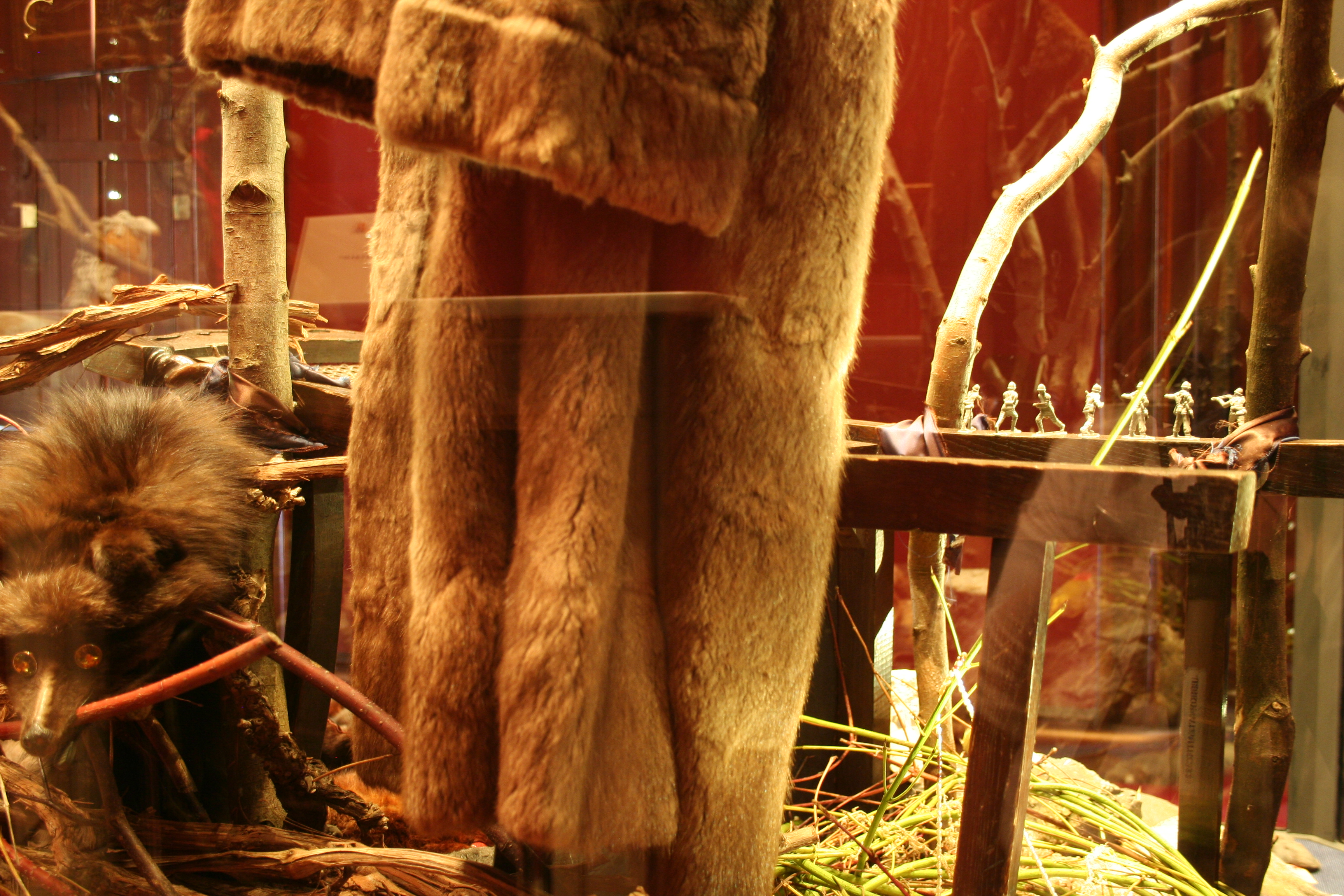
Ellie has essentially been creating a den, the sort of place Peter might have lived in and sought comfort in when retreating from a world of courtesans and pages, princes and princesses:
Writing in Friday’s Guardian, Amy Stone is well aware of the long-standing tensions between fashion and art, yet is bold in her assessment of the success of The Enchanted Palace:
“The show also (whisper it) makes for fantastic art: ghostly, ethereal and layered with subtext. These are museum pieces created for an exhibition true to the conviction that high fashion and high drama go hand in hand. Curators should take note: no more dutiful dusting down of designer archives, please. Fashion’s very essence is living, breathing and moving – something its art shows should cotton on to.”
The Guardian also wrote about The Enchanted Palace on 25 March, after the press preview, describing what visitors to the rooms will encounter and how they can interact with this immense creation of Wildworks and co.
I imagine that Leonardo Da Vinci is the person most of us would call to mind if asked to think of an individual who embraced both the abstract world of mathematics and the tangible world of artistic creation.
However, poking around on the internet I came across the work of George W. Hart, a sculptor who is also a research professor in the department of computer science at the State University of New York in Stony Brook, New York. Hart specialises in geometry, one of his publications being the online Encyclopedia of Polyhedra, in which he writes:
“Polyhedra have an enormous aesthetic appeal and the subject is fun and easy to learn on one’s own… The more you know about polyhedra, the more beauty you will see.”
He could not be more right, for Hart is also a sculptor.
The picture that prompted me to this blog piece is below. It is a stunning testament to the beauty of mathematical forms translated into sculpture. Here, he describes it in his own words:
“Here is one of my favorite sculptures: Roads Untaken. A mosaic of three exotic hardwoods (yellowheart, paela, and padauk) with walnut “grout,” it is 17 inches in diameter, and stands 21 inches on the base. Those are the natural colors; it is just oiled, not stained. The ball just rests on the three struts, so it can be lifted and returned in any orientation.”
Roads Untaken, George W. Hart
For more of Hart’s hypnotic creations, take a look at the section of his website on geometric sculpture.




 Those of you of a creative disposition may be interested to know that the theatre company Supporting Wall have commissioned the first five plays of a new Parliament.



 Fragments and Reflections