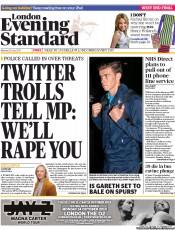
 It was with a sickened sense of incredulity I read the front page story of yesterday’s Evening Standard:
“Twitter Trolls Tell MP: We’ll Rape You”
Following Stella Creasy’s support for Caroline Criado-Perez, who was herself subjected to vile rape threats on Twitter for having the temerity to suggest that our bank notes should recognise the contribution women have made to our national success, it seems Twitter’s women-hating brigade have decided attack is the best form of defence.
I hesitate to use the word “trolls” in the context of men threatening rape.
It is a word that risks lessening the offensiveness and dangerousness of the words they choose to use. It also risks lessening the offensiveness and dangerousness of them, the men that make such threats, by decontextualising the perpetrators. A troll means different things to different people: the quasi-comical lumbering beast of popular culture; those punk-haired childhood toys that look like Child’s Play casting rejects; the dark and monstrous creatures of myth and fantasy; or dysfunctional “saddos” that should “get a life”.
In terms of the Internet, particularly, it is too easy to latch on to this latter idea. It is too easy to suggest that such threats should be dismissed as the mindless (and harmless) ranting of sexually dispossessed indequates. That those who feel threatened (generally women) should grow a thicker skin, particularly if they wish to enter the realm of the Internet (coincidentally designed and dominated, at least in terms of its architecture and maintenance, by men).
It also creates and reinforces a perverse sense of camaraderie and community. Persecutors present as the persecuted. They seek canonisation from their peers for defying the intrusions of the amorphous entity known as “the state” into their domain. It is a domain where, despite the fact that this domain and their freedom to explore it only exists courtesy of the state of which they are citizens, and the physical security and economic infrastructure which that state provides, “the state” and all that accompanies it (such as the rule of law) is evil: only the techno-anarchic, as defined by this self-selecting twisted-moralising techno-prophet elite, can be good.
Part of the hysterical rhetoric deployed is that this sort of censorship is the preserve of “feminazis”. Anyone familiar with the etymology of that word will know it was popularised by right-wing chat show host Rush Limbaugh in his attack on supporters of the pro-choice lobby. Suddenly, it was okay to conflate the term “feminist” with “National Socialism”, a genocidal quasi-religious totalitarian ideology, in order to mock and bring down those who chose to take a public stance on critical issues of women’s health. A quick trawl of the Internet reveals casual use of this term in Internet forum debate on the issue, as well as men seeking to deny that the rape threats were even made in the first place.
I don’t suppose it will be long before Criado-Perez’s assertion that “this is not a feminist issue” will be used both to undermine her credibility with feminist colleagues and, in complete contradiction, to attack her for her feminism. My reading of her comments is that she is making clear that this is an issue that has – or should have – currency beyond those who define themselves as feminist, not that this is not an issue for feminists. It is an issue that many might well identify as a feminist issue, but that we as a society should all be concerned with. It would be regretful if a well intentioned headline, designed to broaden participation and engage those who would normally stay outside such debates – not least of all because of the way some vocal and antagonistic participants use the terms “feminist” and “feminazi” to derogate and intimidate opponents – provided unintended cover for those who would prefer to retreat entirely from uncomfortable discussions of gender, identity and security (see the quote from Professor Mark Griffiths in this BBC story on Criado-Perez’s experiences and the wider issue of cyberbullying: Twitter abuse: Why cyberbullies are targeting women).
We need to slay these trolls – and even the very concept of them. We need to put abusers back in context. We need to remove their self-styled outlaw identity, where they seek to aggregate the romantic pioneer legacy of the Wild West to themselves and to the exclusion of those who choose not to engage in threats to violate other human beings. Like the rapists they emulate, these abusers are fathers, sons, brothers, husbands, boyfriends and lovers, banal in their evil. Like the rapists they seek to emulate they have mothers, daughters, sisters, wives, girlfriends and lovers. They are men, real human beings who have lost touch with the qualities that make them human – at least, such qualities as make them functional members of a liberal and democratic society in which all should feel safe to carry on their own business without the oppression of the state or other individuals in that society.
You hope that these individuals would not talk to their mothers, daughters, sisters, wives, girlfriends or lovers in the language they choose to address a stranger. (I resent describing them as “men” almost as much as I am reticent about calling them “trolls”. Unfortunately, I can’t escape the fact of their gender. Perhaps I should use the term “males” as “female” and “females” seem to be the nouns of choice when men engage in the casual objectification of women.) You also hope, perhaps forlornly, that they would be angry as hell if a man approached a woman they loved and said he was going to rape her. If it were someone I loved who was threatened in that manner, I hope I would have the guts to punch their lights out.
If anyone doubts the extent of the challenge, it is worth reading Cath Elliot’s thought-provoking Guardian piece from October 2011 and the response it provoked in comments from readers: Facebook is fine with hate speech, as long as it is directed at women. One particular argument provoked a storm of angry comments from indignant readers, predominantly (though not all) men:
“What Facebook and others who defend this pernicious hate speech don’t seem to get is that rapists don’t rape because they’re somehow evil or perverted or in any way particularly different from than the average man in the street: rapists rape because they can. Rapists rape because they know the odds are stacked in their favour, because they know the chances are they’ll get away with it.”
This was immediately seized upon as Elliot saying that all men are potential rapists. Comments under her article include:
“So any man will rape if he thinks he can get away with it? Is that what you’re saying Cath? That were rape to be legalised tomorrow we’d all be doing it?” [04 October 2011, 11.18am]
“Given that even using the disputed maximum figure for number of rapes committed per year you wind up with only 1 in 500 men actually being rapists I’d say that that does make them pretty different from the ‘average man’.” [04 October 2011, 11.22am]
“Oh. That’s absolutely disgusting, by the way. I hope you’ll clarify you’re not seriously suggesting the ‘average man’ would be out there, raping away, if they thought they could.” [04 October 2011, 11.33am]
At no point did Elliot make an equivalence between rapists and non-rapists. Quite the opposite in fact. She makes the distinction based on their actions. In the end she responded with her own comment:
“I didn’t say they were the ‘same as’ I said they weren’t ‘particularly different from’, and they’re not, apart from one key thing – the fact that they’re rapists!
I’m actually surprised that so many posters here seem to think rapists are some kind of special alien-like breed, easily distinguishable from everyone else. Well they’re not. As someone else has pointed out in the thread, they’re brothers, fathers, uncles, neighbours and so on, ordinary men in just about every way except for one – they’re prepared to commit this heinous crime whereas the vast majority of other, decent men are not.” [04 October 2011 1.17pm]
She makes the point on contextualisation: that these men are like other men, enjoying the same relationships as non-rapists. They do not appear different, even though their monstrous actions set them worlds apart. If you want to get an idea of the kind of person who makes such threats, read this piece by Emma Barnett, the Telegraph’s Women’s Editor, on her radio interviews with two Internet trolls who attempt to “defend” their “right” to make rape threats online.
I wonder if those who scream “Free Speech” in defence of the right of men to threaten the rape of women on the Internet, whether to intimidate or just “for a laugh”, have really thought through what it is they are calling to protect? Before joining the chorus of indignation, anyone who is in doubt as to the vileness and impact of rape should talk to a rape survivor.
Hear them describe the fear and the sickening sense of violation and the powerlessness and the destruction of self-esteem and the ruin of identity. Hear the anger and the self-blame and the vilifications that have been caused by another man. If you are a man, wrestle uncomfortably with your instinctive sense of affront and indignation at any gender generalisations about men and male behaviour and realise they are being made by a woman who has had her identity reduced to object, a thing which a man felt entitled to violate.
To those who are critical of my gender-specific language, I am of course aware that men are raped and the horrific nature of each instance of rape is not altered by the gender of the victim. However, that still doesn’t change the fact that the vast majority of rape victims are women. Get your head around the fact that official UK government statistics reveal that some 85,000 women are raped on average each year. That is over 230 a day. Then realise that means the offence has been reported and recorded and so unreported offences, which are no less real to victims too terrified or ashamed or resigned to report their rape, mean the real figure is much higher.
And then think what it means when a man says the following to a woman, whether in private or in the street or in a virtual forum: “I am going to rape you.”
Rape survivor stories make for harrowing reading. It is an offence that defies our sense of what is right on every conceivable level. Those who think that we who are offended by rape threats and jokes (without even being threatened) should grow thicker skins should themselves pause to consider how desensitisation to language is a very real thing. The recent history of popular culture is testament to that.
After all, we have learned as a society to tolerate language that our parents and, even more so, our grandparents, would not. Some of us have championed that as liberating. Some of us have bemoaned a collapse in standards of manners and social etiquette. Still others, myself included, have done both, casually accepting this change in the moral value of language without real challenge, assimilating vulgarities into our own speech despite the things we believe, bemoaning that vulgarity in others, yet also unwilling to see society return to a more censorious age. We may like it, we may not like it, we may champion it, we may hate it, but no-one would seriously question that Western society today is more acclimatised to the use of certain words than a generation ago.
Prevalence of such words, through use and reuse, has, inevitably, extended social acceptability. However, there is a world of difference between the freedom to use offensive words as we choose, with no intrinsic or constructed intent, and the use of phrases that are clearly constructed to create fear through expressed intent – targeted hatred designed deliberately to impact fundamentally on identity and a sense of self, of place. And whether we are content to live in a society in which casual disregard for such intent is a socially acceptable norm is a question we all have a responsibility to answer.
For me, in this particular debate, the cry of “Free Speech” is a modern-day Chimera, a monster conjured up by techno-demonologists to strike fear into the hearts of a non-expert majority who rightly fear a censorious state that interferes with political expression and the way we choose to live our lives. It is intended to terrify liberals into feeling that common sense has no place in a liberal democracy. It seeks to drive them into knee-jerk defences against an authority that, manifested in the state, is deemed amoral by the very fact that its pronouncements could arguably bear the label “moral”. It seeks to create a false and binary choice between one particular and romanticised meme of an anarchic Internet, which is fundamentally good, and the opposite and obvious evils of a liberal totalitarianism, worthy of the worst excesses of Arendt or Orwell. To up the ante, this is often presented as an insidious precursor to the totalitarian regimes we witness and condemn in a variety of real world manifestations. Unlike for many of its inhabitants, there are no shades of grey at all in the Internet’s potential states of existence.
I wonder if we are still intimidated by technology? I wonder if for those who aren’t in on the workings of the illusion there is still something mystical about the Internet that means we are terrified it will suddenly vanish if we apply some of the ground rules to this virtual playground that we use to order our physical space? Do we regard these techno-demonologists, who function as the Internet’s high priests, in much the same manner that the inhabitants of Oz regard the Wizard in Frank Baum’s The Wonderful Wizard Of Oz? One of Baum’s biographers, Rebecca Loncraine, describes the story as a critique of power that demonstrates how “easily people who lack belief in themselves can become willing participants in the deceptions practised by manipulative figures who rule over them.” [“The Real Wizard of Oz The Life and Times of L. Frank Baum”, New York, Penguin Group, 2005, p. 179.]
The same liberals that vociferously deny that the existence of a free society depends on the right of its citizens to bear automatic weapons become less sure of their ground and even mute at the thought of tweets in this virtual, “unreal” realm leading to prosecutions and imprisonment in the “real” world (I would suggest that “unreal” and “real” are increasingly unsustainable distinctions in terms of the interface between the virtual and the physical). Yet were this their mother or daughter or sister in the street, they would not hesitate to recognise the threat for what it is. For me, the fallacy of the rapist tweeters’ argument is demonstrated clearly by the way it collapses under the weight of its intrinsic illogicality: “Our right to say what we like, no matter its reception, is one to which we attach such value that it must be protected at all costs, but yet, don’t worry, because it is also so valueless that you can simply disregard it completely when we exercise it.”
If we start from the presumption that freedom of speech matters, which for me it does, and at a very fundamental level, then surely it cannot be divorced from the responsibilities I accrue as a member of the society that protects that freedom? I am free to say what I like in the United Kingdom. I am also free to understand that if I say certain things, there will be certain consequences. That is part of the social contract I enter into by participating in a society that has decided to protect its minorities from words and behaviour that may make them feel threatened for simply existing.
The social contract is in part defined by law and in part by the the informal ways in which we interact with each other socially to establish appropriate behaviours. In modern parlance we might describe these unwritten, normative rules as “crowd-sourced”. I may choose to disregard the contract, or even refuse to recognise it, but that does not change the fact of its existence. (In understanding that, it beggars belief that we have not yet recognised how some words and behaviour can make a much larger segment of the population feel threatened for simply existing. That is an argument for another day but, thankfully, at least making threats of rape carries a criminal sanction.)
Beyond grand ideas of a social contract there is a much more banal and immediate reality (evil may be banal, but so is reality). Twitter might appear to be an anarchic public space, but it is actually a privately provided platform, run by a company that must operate in the real world of rules and corporate responsibility. Users of Twitter sign up to Terms of Service. These include the following provisions:
“We reserve the right at all times (but will not have an obligation) to remove or refuse to distribute any Content on the Services, to suspend or terminate users, and to reclaim usernames without liability to you. We also reserve the right to access, read, preserve, and disclose any information as we reasonably believe is necessary to (i) satisfy any applicable law, regulation, legal process or governmental request, (ii) enforce the Terms, including investigation of potential violations hereof, (iii) detect, prevent, or otherwise address fraud, security or technical issues, (iv) respond to user support requests, or (v) protect the rights, property or safety of Twitter, its users and the public.”
Granted, users are at liberty to not read them or to read them and disregard them. However, Twitter is also perfectly entitled to remove users’ access if they are breached. Similarly, as users with equal access to this private platform, those who feel the terms of service have been breached, for instance if an “applicable law, regulation, legal process or governmental request” has not been complied with, are perfectly entitled to report their concerns. Whether Twitter then discharges its own contractual responsibilities appropriately is another matter entirely and a part of the focus of the current debate: the way it has been slow to act until public pressure has mounted suggests a depressing subordination of substantive concern to image.
This is not an unusual phenomena. It characterises much of the debate about the Internet and the way, particularly, that private companies who provide virtual platforms appear keen to protect profit margins by perpetuating iconic imagery, such as that of the Internet outlaw, in order to sustain associations with traditional user groups. Perhaps, ironically, it is the very fact that the Internet and social media is becoming more widely accessible to non-theists, and thus potentially more profitable, that is causing these companies pause for thought.
Whether driven by economics, a recognition of what is right and what is wrong, or simply common-sense, at least there are some signs of responsiveness. On the same day that the Evening Standard carried that headline, Twitter was reported as saying that it would install a report abuse button on every tweet, despite previously arguing that it was not necessary.
First the Bank of England and now Twitter. Caroline Criado-Perez is emerging as a very serious and inspirational force to be reckoned with. (If you still want to add your name to Kim Graham’s petition in support of Criado-Perez, calling for a Twitter abuse button, you can find it here.)
I am a liberal to my core.
I believe that the rule of law is fundamental to a prosperous and peaceful society. I believe that governments should err on the side of extreme caution in matters of intervention where it could be construed as an assault on freedom of speech. I also believe that we should put the “trolls” back in context as real individuals with abusive behaviours that demand consequences. Those who seek to hide criminality in the form of threats of rape behind something as valuable as freedom of speech place themselves at liberty of sanction. Freedom of speech matters too much for it to become the preserve of rapists and those who believe they have an unfettered right to engage in society’s private and public spaces without regard for the freedom of all of that society’s citizens.
[Updated 31.7.13]


 Fragments and Reflections