Name that tune – for when you are stuck on the music in that new ad

This may not be news to many of you, but I have stumbled across a great little site which does exactly what it says on the tin: TV ad music.

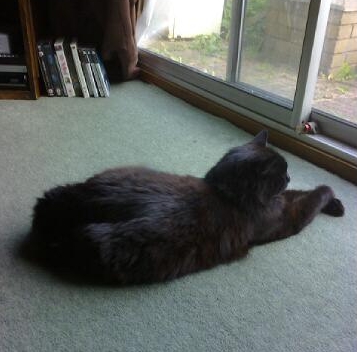
Adverts are, occasionally, real works of art. The Guinness ads always stick in my mind as being genius. So often they are made all the more memorable by the music. The one that bugged me until recently was the new ad for Walkers Baked. It’s not a work of art by any means, but I do like the tune. To be honest, it struck me as a decent theme tune for my cat, a handsomely thuggish, black Norwegian Forest Cat (alongside the theme tune for the Crazy 88 in Kill Bill):

Caddy - surveying his dominion

Enter http://www.tvadmusic.co.uk/.

All these years of watching ads and wondering who wrote the music… Solved! And the answer was Air. Described as “French electronic knob twiddlers”.

Click the cat above and hit play for a taster…


Add to FacebookAdd to DiggAdd to Del.icio.usAdd to StumbleuponAdd to RedditAdd to BlinklistAdd to TwitterAdd to TechnoratiAdd to Yahoo BuzzAdd to Newsvine

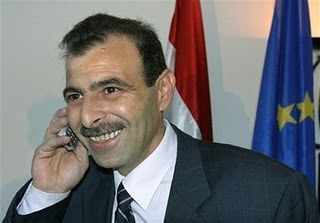
Anwar Al-Bunni: Smiling and with his head held high… #albunni #allabwani #amnesty #syria

Anwar al-Bunni - photo released by family

On Wednesday I blogged about the German Association of Judges awarding Anwar al-Bunni their prestigious human rights prize. On that page is a link to an article by Peter Franck und Ruth Jüttner of Amnesty International Berlin. My German is just about passable enough for me to be able to recognise that their words merited a fuller, more accurate translation. Thankfully, as a professional linguist, Dad’s German is better than mine…

Peter and Ruth paint a picture in words of a dignified and noble man, and his extraordinary family, who have peaceably defied authority to defend the human rights of their Syrian countrymen – much like Anwar’s friend and colleague, Kamal al-Labwani. I have tried to contact the authors to ask if I might post a translation, but so far to no avail. I hope they will forgive me my eagerness to post their words in English, that more might read about the efforts of Anwar al-Bunni.

Please click the picture below to be taken to the German original:
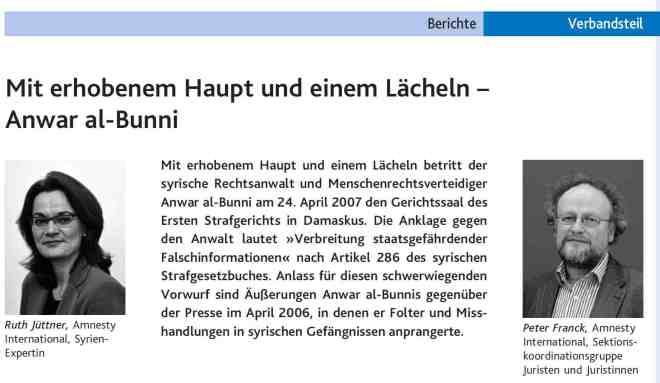
The translation which follows is a direct text translation, with only very slight editing for form. I have taken the liberty of inserting some links if you wish to find out more information. Thanks Dad for performing the translation so quickly and so effectively. I hope you all find Peter and Ruth’s words as inspiring and humbling a read as I did.
Translator Geoff Williams

Smiling and with his head held high…

Peter Franck und Ruth Jüttner, translated by Geoff Williams

On 24 April 2007, smiling, and with his head held high, the Syrian lawyer and human rights defender Anwar al-Bunni entered the courtroom of the No.1 Criminal Court in Damascus. In accordance with Article 286 of the Syrian Criminal Code he was charged with the “promulgation of false information likely to endanger the state.” The reason for this serious allegation were statements made to the press by Anwar al-Bunni in April 2006 in which he denounced torture and maltreatment in Syrian prisons.

In concrete terms, the lawyer had demanded to know the causes for the death of 26 yr old Mohammed Schaher Haysa. This young man was detained for several months at an unknown location. In April 2006 the authorities had handed over his body, which showed traces of torture, to his family. During his trial Anwar al-Bunni demanded that the Syrian authorities should investigate the death of Mohammed Shaher Haysa.  The court did not, however, pursue the allegations of serious mistreatment and instead sentenced Anwar al-Bunni to five years’ imprisonment.

This draconian sentence provoked consternation amongst the family, supporters and defenders of al-Bunni, being far more severe than the three-year sentence usually imposed in similarly staged trials. Anwar al-Bunni accepted the judgement with composure and described the trial and verdict as a “politically motivated and blatant contravention of the right to freedom of expression, aimed at terrorising and intimidating the Syrian public and politically active citizens.”

It was not the first time that Anwar al-Bunni had demanded that the courts should investigate maltreatment and torture. In June  2002 he had defended the non-violent  political activist Aref Dalilah before the Supreme Court for State Security in Damascus. This court  was established five years after the imposition of the state of emergency in March 1968 and deals solely with cases of a political nature or which have a relevance to state security.

Proceedings before this court fall far short of the international standards for fair trials.  There is no appeal against decisions of the court, defendants have limited access to legal support and judges at the court have wide ranging discretion with regard to the format of the proceedings. This was also clear in the trial of Aref Dalilah. When Anwar al Bunni insisted that his client’s accusations of maltreatment should be recorded  and investigated he was forcibly removed from the courtroom by security officers. The presiding judge subsequently withdrew from him his accreditation to appear as a lawyer before the Supreme Court for State Security.

A month later Aref Dalilah, former Dean of the Faculty of Economics at the University of Aleppo, was sentenced to 10 years imprisonment for his support for political reform. In August 2008, after 7 years largely spent in solitary confinement, the 65 year-old was released as part of a presidential amnesty.

When still a young man within his family, Anwar al-Bunni, the second youngest of seven brothers and sisters, suffered persecution and years of incarceration because of his political activity. Since the late 1970’s four of his siblings have been imprisoned time and again for political reasons in various Syrian prisons and under appalling conditions.

Until the 1990’s the conditions in Syrian prisons were so degrading, humiliating and brutal that they amounted to systematic torture. According to later press statements from his older brother Akram, there were times when Anwar al-Bunni and their mother were the only members of the family not in prison and divided up visits to family members imprisoned in different prisons in different places between themselves.

When Anwar al-Bunni commenced his law studies in 1979 at the University of Damascus three of his brothers and one sister were in prison on political grounds. After a few years practice as a lawyer he undertook the defence of political prisoners in the courts and founded a committee to press for the release of political prisoners.

After the death of President Hafez al-Hassad and the succession of his son Bashar in June 2000, there was something of a political thaw, which has come to be known as the “Damascus Spring”. A sense of new horizons, inspired by the young president’s promise to drive reform forward, spread across the country. Numerous discussion circles developed amongst the populace where members of the opposition and intellectual debated the routes to political change, democracy and the achievement of human rights. During this period, together with other prominent human rights lawyers, Anwar al-Bunni founded in 2001 one of the first human rights organisations, the “Human Rights Association in Syria” (HRAS) which sought official recognition from the authorities.

Despite the regime’s return to an authoritarian style of leadership and massive suppression of dissent, Anwar al-Bunni continued his determined and courageous support for the victims of indiscriminate state violence. He was unflinching in his criticism of the 40 year-old state of emergency which aided and abetted the abuse of human rights on a huge scale. He remained in contact with journalists, foreign diplomats and with international human rights organisations. He informed the world public about the politically motivated trials of  activists campaigning peacefully for democratic change and about the conditions of his clients’ imprisonment.

The authorities reacted with sanctions intended to intimidate him. He was repeatedly brought before the Damascus bar association, was disciplined and temporarily barred from practising. He was harassed, intimated, threatened and kept under surveillance by the security services. In December 2003, intending to travel to Weimar to receive the city’s human rights prize on behalf of the reformist politician Riad Seif, at that time  and still today imprisoned, he was refused permission to trav el. An EU funded Human Rights Centre under his directorship was closed down by the authorities  in March 2006 only days after opening. Not only Anwar al-Bunni but his family also has been subject to punitive measures. In May 2007, just one month after he received his sentence, his wife Ragheda Issa Rafiki was deprived, with no reason given, of her civil servant post by order of Prime Minister Muhammed Naji al-Otri.

The 50 year-old lawyer has been in prison for three-and-a-half years in atrocious conditions. He shares a cell with thirty others, all convicted criminals. Both other prisoners as well as prison officers have physically brutalised and humiliated him. And yet his spirit is not broken. On behalf of a number of non-violent political prisoners he has repeatedly addressed open letters to the UN High Commission for Human Rights and the Syrian president, drawing attention to the conditions of their imprisonment. Anwar al-Bunni himself suffers from arthritis, a condition made worse by lack of movement and the dampness of the cells.

Add to FacebookAdd to DiggAdd to Del.icio.usAdd to StumbleuponAdd to RedditAdd to BlinklistAdd to TwitterAdd to TechnoratiAdd to Yahoo BuzzAdd to Newsvine

Nuclear cheerleaders: Essex Tories embrace Brown’s Bradwell nuclear agenda – and decide residents’ views don’t matter #toryfail #green #nonewnuclear

“The Members of Essex County Council are very concerned that the Government is only undertaking a very limited public consultation on Bradwell being a suitable site for a replacement Nuclear Power Station. Members call upon the Government to widen this consultation across Essex so that all our residents have the opportunity to make their voices heard on this very important issue.”

This was the motion put forward by Essex Liberal Democrats at the meeting of Essex County Council on 15th December.

It looks pretty measured doesn’t it? It doesn’t indulge in party-political posturing. It doesn’t even pompously declare that “Liberal Democrats are very concerned” but uses the neutral “Members of Essex County Council are very concerned”. It doesn’t require the spending of large sums of taxpayers’ money or force the County Council to do something (heaven forfend!). It simply requests that the Government – the Labour Government – extend its very narrow consultation on a potential new nuclear power station at Bradwell to the rest of Essex (the existing Bradwell nuclear power station was decommissioned on 28 March 2002). The motion doesn’t put pro-nuclear supporters in a difficult position by offering an opinion as to whether nuclear power is a good thing or a bad thing. Rather, it simply makes the point that on an issue this big the whole of Essex should be consulted.

As motions go, particularly those designed to attract support from across the political spectrum, it’s pretty darn good. So more on the motion in just a moment.

First, it’s worth taking a moment to examine quite how appalling the consultation referred to is. Or rather – was. I think. To be honest, it isn’t so clear. On 9 December, the Department of Energy & Climate Change (DECC) issued a press release entitled “What does new nuclear mean for Essex?” It boasts:

“Residents of Essex are this weekend being asked to have their say on proposals to a build a new nuclear power station in the area……The announcement on new nuclear sites was made as part of a planning overhaul for big energy projects and ten potential new sites for nuclear energy were named in the draft Nuclear National Policy Statement. These sites are Bradwell, Braystones, Hartlepool, Heysham, Hinkley Point, Kirksanton, Oldbury, Sellafield, Sizewell and Wylfa. Bradwell was nominated by EDF, who are currently seeking to sell the site to a credible nuclear operator.

Following the nomination of the sites the Department of Energy and Climate Change is conducting a 15 week consultation to hear people’s views about the proposals.

The new Infrastructure Planning Commission will use the National Policy Statement when considering planning applications for new nuclear power stations. This consultation is an opportunity for local people to influence what the IPC should take into account when considering whether to grant consent or not.”

It looks promising. There is a fifteen week consultation. There is an opportunity for local people to influence what should be taken into account when considering whether to grant consent or not. In fact, the press release begins by saying “Residents of Essex are this weekend being asked to have their say on proposals to a build a new nuclear power station in the area”.

  • On Wednesday 9 December DECC issues its press release including consultation details.
  • On Thursday 10 December there is an exhibition in West Mersea.
  • On Friday 11 December there is an exhibition in Maldon.
  • On Saturday 12 December there is an exhibition in Bradwell-on-Sea.
  • And there were two “two public discussion events” – but no details were provided in the release. (They clearly weren’t intended for non-locals who I assume – hope – were at least leafleted.)

And… Er… That’s it.

Residents of Essex, eh?

Even though DECC describe the site in their press release as “near Chelmsford” there isn’t a consultation in Chelmsford. Despite it being a fifteen week consultation, Essex gets five highly localised events in the three days immediately after the press release going out. I may be atypical of your average Essex resident, but even despite my political interests, I don’t keep tend to keep track of Government department press releases day by day.

Good luck to those of you who do and managed to get there.

According to the website of West Mersea Council, West Mersea has a population of 6,925 people. According to the website of Maldon District CouncilMaldon has a population of approximately 60,700. The website of Bradwell Parish Council doesn’t provide any information on population – but Wikipedia lists the population as 877. According to the website of Essex County Council, the population of Essex is 1,396,400 (excluding Thurrock and Southend-on-Sea – though in the event of disaster, I am not convinced fallout is as discriminating as the Boundary Commission).

Of course the residents of those places should be consulted. However the Labour Government (DECC) and the Infrastructure Planning Commission think that consulting 0.05% (I am rounding up here) of the population of Essex is somehow giving residents of Essex the chance to have their say. As for the time given over to consultation, the DECC press release highlights a paltry three specified days in a fifteen week consultation.

It is nothing short of outrageous – a complete scandal in a 21st century liberal democracy.

And you would think that the Conservative Party, a national party of opposition, that controls the County Council, would want to stick up for the right of local people to be heard, regardless of its own policies on nuclear power.

Back to the motion…

Did the Conservatives support the Liberal Democrat motion?

Not a chance. The Tories voted against. They opposed the extension of the consultation to the rest of Essex and, by doing so, have effectively said our views don’t matter.

Essex County Council doesn’t record how people vote as a matter of course. Why should they – after all, you are not interested in what your elected representatives are doing, are you? Therefore, finding out which way your local representatives voted looks like being a case of emailing them directly.

You can find your way to the contact details for Essex County Councillors here. For those readers in Basildon, the following Conservative councillors may well have voted to prevent you having more information:

I have emailed each of them to ask if they were there on 15 December and, if they were, how they voted. If they opposed the motion, I have asked why they don’t believe the Government should consult the people in Basildon that they are elected to represent.

You might want to do the same.

I would be interested to know the reasons people vote as they do – so please add a comment to this blog piece!

Add to FacebookAdd to DiggAdd to Del.icio.usAdd to StumbleuponAdd to RedditAdd to BlinklistAdd to TwitterAdd to TechnoratiAdd to Yahoo BuzzAdd to Newsvine

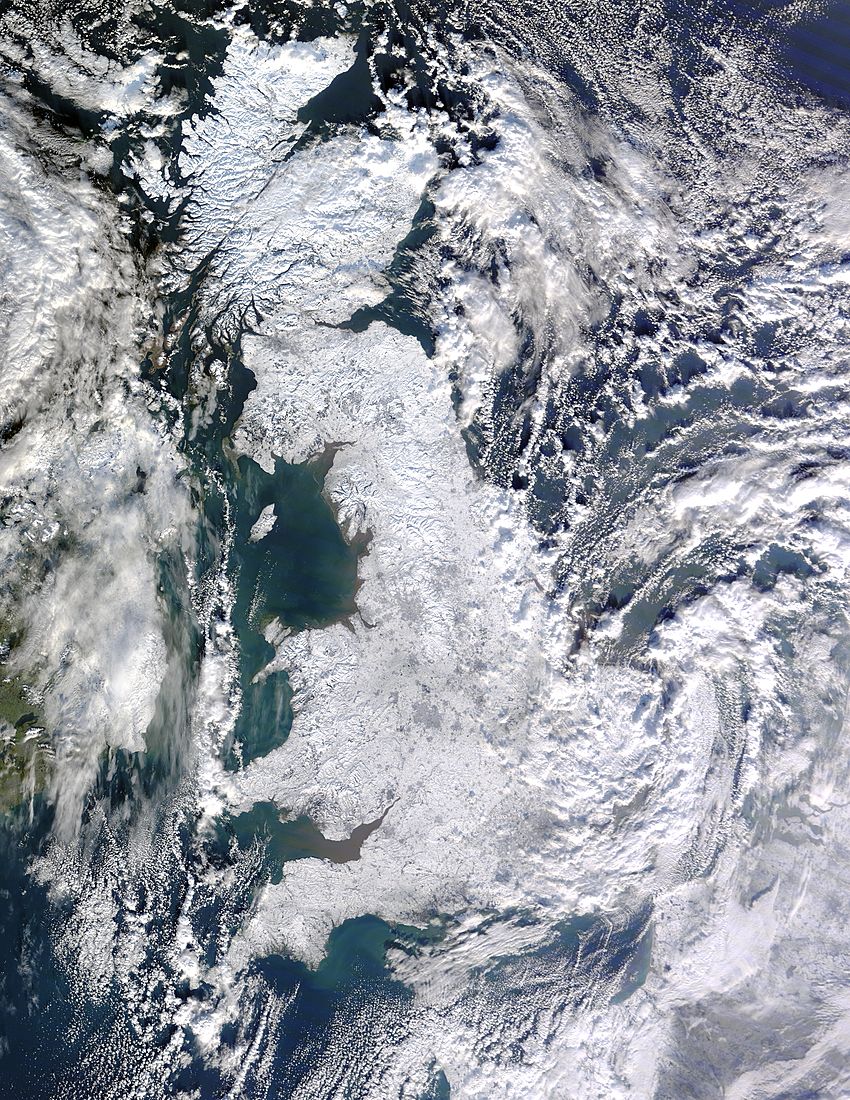
Beautiful Nature: Frozen Britain

Words can’t do it justice…

Click and wonder at the marvel of human inventiveness – and the beauty of our planet.

Frozen Britain - NASA

Add to FacebookAdd to DiggAdd to Del.icio.usAdd to StumbleuponAdd to RedditAdd to BlinklistAdd to TwitterAdd to TechnoratiAdd to Yahoo BuzzAdd to Newsvine

Kamal Labwani and the West’s appalling indifference #eu #syria #labwani

Last October, I wrote to over a hundred senior officials and politicians, many of whom are based in Brussels. I wanted to draw attention to Syria’s continual violation of human rights and  flagrant disregard for the UN’s International Covenant on Civil and Political Rights as the European Union was intending to sign an Association Agreement with Syria. I wrote very directly about the situation of Kamal al-Labwani.

You can read my text here:

Email r.e. EU Association Agreement and Kamal

The only person who could be bothered to respond was Liz Lynne, the Liberal Democrat MEP, who wrote back to me on the 6th November to say she was taking my concerns up with Benita Ferrero-Waldner, European Commissioner for External Relations and European Neighbourhood Policy (if it wasn’t a distraction I would ask who the hell the rest of the elected politicians I wrote to think they are, disregarding correspondence as they enjoy the salaries and expenses I am part-paying for). You can read that email in full below:

Response from Liz Lynne MEP r.e. EU Association Agreement and Kamal

Yesterday, and demonstrating impressive commitment, I received a further email from Liz Lynne to which she attached a letter from Baroness Catherine Ashton, the new High Representative of the European Union for Foreign Affairs and Security Policy. Read it – and be angry:

Ashton response to Liz Lynne

If you clicked the link to Ashton’s official page above you will have seen it is headed up with the following quote:

“I am looking forward to working closely with colleagues in the Council, the Commission, the European Parliament and the Member States to strengthen Europe’s foreign policy. We will do this with determination and with full respect for the values that the European Union stands for, above all peace and prosperity, freedom and democracy, the rule of law and the universality and indivisibility of human rights.”

What pointless drivel from a pointless politician.

The total press comment on her official site consists of two statements of congratulations following appointments and a statement of shock following the Lakki Marwat bombing.

No action.

No condemnation.

No statements of stiff resolve.

Instead, her words are the grey, empty platitudes we fear from out-of-touch politicians – politicians we still hope might be moved to action by the personalisation of the problems they otherwise put behind them at the end of the day. If this is what being “the best person for the job” means, as Baroness Ashton claims she is, then the words in her email are a damning indictment of the impotency of this newly-created position. Ashton points out in that report that EU leaders were “comfortable” with her appointment. I am sure they were: Ashton is clearly not someone for rocking the boat, but rather is happy to continue a policy of engagement that talks tough on human rights and political freedom, but achieves nothing:  maintain the status quo of holding our collective noses as we conduct business as usual.

I am glad she is at least “worried”. I am also worried.

This was Kamal in Basildon in 2005, standing proudly by his artwork with Chris Hyde and his great friend and supporter Maureen Thomas:

Kamal, Chris Hyde (L) and Maureen Thomas (R)

This was Kamal in 2006, peering from a prison cell:

Kamal behind bars

I am worried.

I am shocked.

I am bloody furious that my friend, who shares our values of freedom of expression, freedom of thought and peaceful dissent, languishes in a Syrian hell-hole whilst supposedly powerful politicians like Baroness Cathy Ashton appear to think that his incarceration is incidental to a “comprehensive political dialogue and longer term relationship that can build trust and ensure progress on human rights issues.”

What possesses these people to write such coded cant? She doesn’t even mention the fact that once signed, the agreement can be suspended if human rights violations are evidenced. Too embarrassing perhaps as people might question why it was being signed in the first place?

Look at those two pictures.

Think about them and what they represent.

Think of the gentle family man, the artist, the doctor, who is imprisoned because he wants his family, friends, colleagues and countrymen to enjoy the chance to talk freely, to believe and think what they want, to worship as they choose (or not) and to associate socially and politically without interference from state-sponsored goons.

If you are involved in politics, whichever party or none, ask yourself why you got involved – and if you could write the words of Baroness Ashton? (And don’t give me patronising rubbish about “a complex situation”,  “difficult discussions” and “diplomatic sensitivities” – you know I’ve heard them all.)

And if those pictures anger you, if the complacency of politicians and officials who are charged with representing our values as a country abroad frustrates you, if you abhor the political double-speak that expresses concern whilst the ink dries, then click one of the links below and take action:

Familiarise yourself with Kamal, his experiences and his beautiful, moving paintings

Write to Gordon Brown, our Prime Minister

If you are a UK national, sign the petition r.e. Kamal and the EU Trade Association Agreement

If you are on Twitter, Tweet the link to the petiton by cut and pasting the following: http://bit.ly/TZ4R7

Join Kamal’s facebook page

Thank you Liz Lynne for being interested – and for acting.

And shame on the rest of you, Liberals and non-Liberals alike, for your indifference.

You know who you are.

Show us why we should continue to even consider you worth our confidence.

Add to FacebookAdd to DiggAdd to Del.icio.usAdd to StumbleuponAdd to RedditAdd to BlinklistAdd to TwitterAdd to TechnoratiAdd to Yahoo BuzzAdd to Newsvine

Detained Syrian human rights activist Anwar al-Bunni receives prestigious German award #albunni #syria #un

On April 24 2007 Anwar al-Bunni, human rights activist and friend and colleague of my friend, Kamal al-Labwani, was sentenced to five years in prison on charges of “spreading false or exaggerated news that could weaken national morale”. He had been detained since May 2006 in harsh conditions and abused by his guards. On 20 May, Kamal suffered a similar fate: sentenced to twelve years, later extended by a further three.

On 1 May 2008, Anwar al-Bunni was selected to receive an award from the Irish organisation Front Line, the International Foundation for the Protection of Human Rights Defenders. In June 2008 Martin Sheen and former Taoiseach Bertie Ahern TD joined Front Line to celebrate his courage.

Just recently, in December 2009, Anwar’s courage and commitment to human rights was recognised again.

In December 2009 the  German Association of Judges awarded Anwar al-Bunni its prestigious human rights prize, recognition that is intended to strengthen and further respect for universal human rights and basic freedoms.

Those of us privileged enough to live in liberal democracies, where free speech is taken for granted, should keep good people like Anwar al-Bunni, Kamal al-Labwani, Mohannad al-Hussani, Haitham al-Maneh and Ma’an Aqil at the forefront of our thinking. We should not forget the sacrifice they and their families are making in order that, one day, they might enjoy those same freedoms. In that struggle, the Syrian government might remember that it is a signatory to the United Nations’ International Covenant on Civil and Political Rights and ask itself how detention of these peaceful dissenters conforms with the commitments it has made as a member of the international community.

Whether in the UK, the US, Germany, or elsewhere in the EU, each of us should continue to hound our leaders to keep the Syrian regime under as much pressure as possible. It is only the spotlight remaining on the likes of Anwar, Kamal, Mohannad, Haitham and Ma’an that will ensure that Syria eventually faces up to its responsibilities – and its failure to adhere to the standards of conduct to be expected of a country that wants to be taken seriously on the international stage.

Add to FacebookAdd to DiggAdd to Del.icio.usAdd to StumbleuponAdd to RedditAdd to BlinklistAdd to TwitterAdd to TechnoratiAdd to Yahoo BuzzAdd to Newsvine

Apples aren’t always green: one more reason why I am glad I got a Nokia #n900 #iphone #greenpeace #green

It’s a peripheral consideration for many when making a choice as to the make of phone to buy – and it certainly wasn’t one of mine. However, I have since discovered the Greenpeace International guide to Greener Electronics and I will be paying more attention in future to the companies I buy from.

I am simply glad that Nokia beats the competition by a mile.

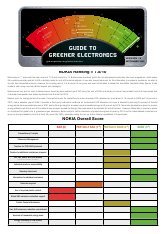
If you go to the Greener Electronics page, you will see the little graphic of a hand-held device. Click the number 13 to see the latest report, from September 2009. With a complex formula for scoring the major companies out of ten, Nokia is the only company to score more than 7.

You can read Greenpeace International’s report on Nokia, which puts them 1st, and see how they arrived at the score of 7.5, by clicking on the thumbnail below:

By contrast, Apple may have improved its standing from 11th to 9th, but, by clicking on the thumbnail below, you can see its score is still a paltry 4.9:

Power Geek Enthusiast vs. Flash Git competition aside, there is a real issue here about the ways in which companies that manufacture mass market devices for international distribution respond to real world concerns such as the environmental impact of their commercial activities. If those issues interest you, you can read the full Greenpeace International report by clicking on the thumbnail below:

So there we go.

Apples aren’t always green…

Add to FacebookAdd to DiggAdd to Del.icio.usAdd to StumbleuponAdd to RedditAdd to BlinklistAdd to TwitterAdd to TechnoratiAdd to Yahoo BuzzAdd to Newsvine

Bazzo Christmas Update – Old Man Stan and Vin Harrop comment

Those of you who read the Bazzo Christmas piece may be interested to know that Steve from the Ugly Wuggly Puppet Company (the team behind Old Man Stan) has posted a lengthy comment. Vin Harrop, heritage director of Our Basildon, has also posted. You can find their comments by clicking here and scrolling down:

https://fragmentsandreflections.me/2010/01/03/bazzo-christmas-or-how-an-unconventional-pensioner-upset-basildon-district-council/#comments

If you have thoughts on the arts in Basildon to add, please do so.

And if you’ve not looked around the Our Basildon website I urge you to do so and see what a wealth of public art there is throughout the district. You can also check out the heritage trail that has been created.

Add to FacebookAdd to DiggAdd to Del.icio.usAdd to StumbleuponAdd to RedditAdd to BlinklistAdd to TwitterAdd to TechnoratiAdd to Yahoo BuzzAdd to Newsvine

Arrogance and disregard for the taxpayer: Hanningfield’s latest wheeze as Essex freezes #toryfail #snow

The sheer arrogance of Lord Hanningfield is unbelievable.

The leader of Essex County Council clearly thinks he is running his own version of Essex Bank, rather than leading an elected local authority. The latest venture from the Bank of Essex – surely the greatest testament to personal ego of any initiative in local government in recent years – is to offer a £100,000 overdraft facility to eligible businesses.

Excuse me?

Admitting you are no longer capable of running public services and handing them wholesale to IBM is one thing, but doing so as you extend the commercial operations of a bank that only exists because of your elected mandate is something entirely different. At no point do I recall my local successful candidate at the County Council Election, Cllr John Schofield, informing voters that he intended to be a party to such speculation with public funds: public funds provided by hard-working Council Tax payers.

According to the Frequently Asked Questions on the Banking on Essex website, all profits from the venture will be used to cover potential losses and protect taxpayers’ funds.

Where has Lord Hanningfield been for the last eighteen months?

Banks with a hundred-year tradition of providing commercial services haven’t been able to get this right in the current economic climate. How on earth can taxpayers have any confidence that self-aggrandising politicians will succeed where self-aggrandising bankers failed? More importantly, how can politicians, with little or no experience at running a bank, guarantee that the profits will cover the losses? I am not sure that assuring voters that you are working in partnership with a large banking organisation gives much confidence these days…

I suppose you could have a little more confidence if some care was taken with the presentation. However, that is clearly no concern for this commercial operation. Here is how the guarantee appears in the Banking on Essex FAQs (Frequently Asked Questions) at the time of writing:

“Will the initiative put tax payers’ money at risk?
The County Council is using all additional income earned to cover potential loses [sic] and protect tax payers’ funds.”

The italics are mine.

Essex is the Education Authority.

Essex is also attempting to generate a sense of commercial confidence.

The example above demonstrates why politicians should put their determination to write themselves into history to one side and stick to what they were elected to do: represent the interests of the people who put them in office.

Here is a reminder for Conservative councillors  John Schofield and Lord Hanningfield of matters that should be the priority for Essex County Council over the next few weeks:

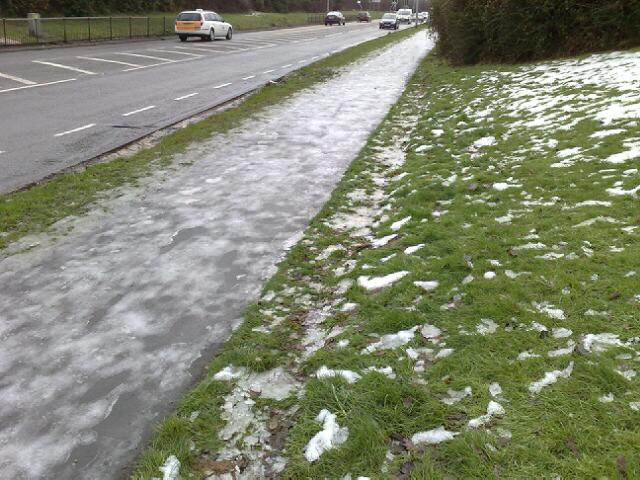
Path to hospital at junction of Nethermayne and the Knares, 24 December 2009

Path to hospital, 24 December 2009

These two pictures were taken of the main footpath to the principal site of Basildon and Thurrock University Hospitals on Christmas Eve 2009 – exactly one week after the heavy snow falls that caused chaos in South Essex. It was still iced over even when the snow on surrounding banks had melted and the roads had been gritted.

In the NHS Foundation Trust’s own words:

[We] primarily serve the almost 400,000 population of Basildon and Thurrock in South West Essex, plus some residents of the neighbouring districts of Brentwood (for whom we are the main provider of cardiology services) and Castle Point.

With a annual budget of £250 million, the Trust treats 63,000 inpatients and day cases, provides 270,000 outpatients consultations and attends to more than 90,000 Accident and Emergency (A&E) patients.

And pictured just above is the path people had to walk to reach that hospital, should they not be fortunate enough to drive a car.

I met an elderly constituent of mine as I walked to town that Thursday. He was incandescent. He is usually a charming conversationalist, but that day he had only three words for me as he gestured unsteadily with his walking stick at the ice: “It is wicked”.

The Basildon Recorder was forced by Essex County Council to issue an apology when it ran a story criticising the county for inadequate salt supplies. Apparently, there is no shortage:

“The county council would like to assure residents that Essex County Council continues to be fully prepared for icy winter conditions with more than sufficient supplies of gritting salt for the bad weather.”

So if there was no shortage, I can only assume that Essex County Council simply doesn’t care about pedestrian access to the major health facility in the south of the county. Surely, if there was salt, and it gave a stuff, Essex would have taken the time to grit this major pedestrian route? Winter 2008/2009 saw the highest excess winter mortality rates for ten years. It is hard to believe that figure will be lower for 2009/2010 if this Winter is harsher. Respiratory illnesses are just one set of conditions that are exacerbated by conditions in the winter months. (If you are really interested, there is a superb paper on the website of of the Centre for Public Health at the Liverpool John Moores University entitled Weather forecasting as a Public Health Tool). People need to be able to get to hospital – and that includes by foot.

This is the Met Office weather warning for the East of England, for Tuesday 5th January, issued on Monday 4th January:

“There is a moderate risk of severe weather affecting east and southeast England.

Outbreaks of sleet and snow will become heavier during Tuesday afternoon and evening, with an increasing risk of disruption to transport networks.

Issued at: 1124 Mon 4 Jan”

Sky News is warning Heavy Snow Set to Bring More Travel Chaos.

The question I have is: will Essex County Council heed the warnings and make an effort to ensure that key footpaths are snow and ice free this time around?

To finish, three simple things:

Stop throwing the taxes of hard-working local people at self-indulgent, speculative schemes.

Stop criticising the press for reflecting local concerns.

Start delivering a basic level of service: grit our roads and footpaths, especially where they provide access to major facilities such as hospitals.

Add to FacebookAdd to DiggAdd to Del.icio.usAdd to StumbleuponAdd to RedditAdd to BlinklistAdd to TwitterAdd to TechnoratiAdd to Yahoo BuzzAdd to Newsvine

Sell your house and seduce an Australian with simple, delicious, freshly-baked bread #recipe #cooking

It’s true!

You’ll make your house smell more homely if the fragrance of freshly baked bread is wafting through the rooms (assuming that your viewers don’t have coeliac disease). And a survey of 4000 Australians placed the smell of freshly baked bread at the top of the list.

The real reasons for baking your own bread though are:

1. It’s so tasty

2. You know what’s in it

3. It is totally easy

There is also enormous satisfaction to be had in creating something so fundamental to life and that has been baked with similar ingredients for centuries. With that in mind I’ve decided to share the version of the family bread recipe that has made it down the Partridge/Williams wing of the clan. The really great thing about bread is that once you have the basics you can experiment with all sorts of ingredients and create your own distinct variant. And believe me – bread come more basic than this!

You’ll need a few things: flour; water; salt; dried yeast; 1 mixing bowl; scales; measuring jug; 3 baking tins; small knob of butter; oven.

It’d help if you had a few other things but they are not essential: 3 tea towels; 1 wooden rolling board; oven gloves; 1 cooling wire rack.

Flours

Before I go on to the how, a little bit on flours. I use a variety of different ones, including strong brown bread flour, strong white bread flour, strong wholemeal bread flour and wholegrain rye flour. There’s nothing fancy or special about them and I usually get the 2kg bags (apart from the rye which seems to come in 1kg bags). I always use a mix, half and half, but you can mix them up as you like. My usual mix is half strong brown and half strong white. Half strong brown and half strong wholemeal is delicious. Being a diabetic in denial, but trying to face up to the fact of it, I did a half rye and half wholemeal mix today. More on that later. If you want a simple starter, go for half strong white and half strong brown.

The bread bit

Mixing your dough

Pour 2 pounds of strong brown flour into the mixing bowl.

Add 2 sachets of dried yeast.

Add 5 teaspoons of salt.

Add 2 pounds of strong white flour.

Add 2 pints of lukewarm water (I use lukewarm water to kick-start the yeast).

Easy – it is all 2s except the salt. I would keep a little flour and a little water on standby, too, just  in case you need to adjust the mix slightly. However, the 2s, if exactly measured, seem to just work and give a dough of great consistency.

Mix it all up. It’ll take about 10 minutes to knead your dough. To begin with it’ll feel dead icky and it’ll look like it’ll never come together. Just keep going, mixing it up and scrunching with your fingers. Eventually, it’ll turn into a beautiful dough which will be firm, springy and somehow just feel right. If it’s a little too sticky add a bit of flour and knead in. If it’s a little too dry, splash some water and knead in.

First rise

Next, cover your bowl with a tea towel and let the bread rise. I prefer a warm room and I like to give it a couple of hours. The dough should pretty much double in size and there’ll be an unmistakable yeasty smell.

Before you begin the next step, prepare your bread tins. Smear a third of the knob of butter around each of the bread tins with your fingers. This is so the loaves slip out easily after baking.

Second rise

Flour a wooden rolling board (or a sideboard), take the dough and knock it back down to size on the boad. I like to really smack it around at this point, rolling it, pummelling it and generally working out the frustrations of the week. When you have a nice, fleshy dough, roll it into a sausage and then slice into three equal pieces.  Note: this helps contain your nascent Dexter.

Take each piece of dough in turn and give it a further good going over. Roll the smaller pieces into three even sausages and plop them into the three baking tins.

Cover them with a tea towel and leave them to rise again. It’ll take around 45 minutes, depending on how warm the room is, and you want the dough to be 1.5cm to 2cm above the top of the tins. About half an hour into this second rise, put your oven on gas mark 7 and pre-heat your oven.

Baking

Once you think they are ready (remember – 1.5 to 2cm above the top of the tin) place your tins side-by-side in your oven.

Cook your loaves for 35 mins.

When the pinger goes, take one out, slip it out of the tin into your other hand and tap the base. It should sound hollow. If it does, you can take the others out. If not, slip it back into the tin, pop it back in the oven and give them another five minutes. (NB You’ll work this bit out, but it’s sensible to wear oven gloves.)

When you are finished, take them out of their tins, wrap each loaf in a tea towel and place it on the wire rack to cool.

Voilà! House-selling, Aussie-seducing goodness that you can impress your Gran with!

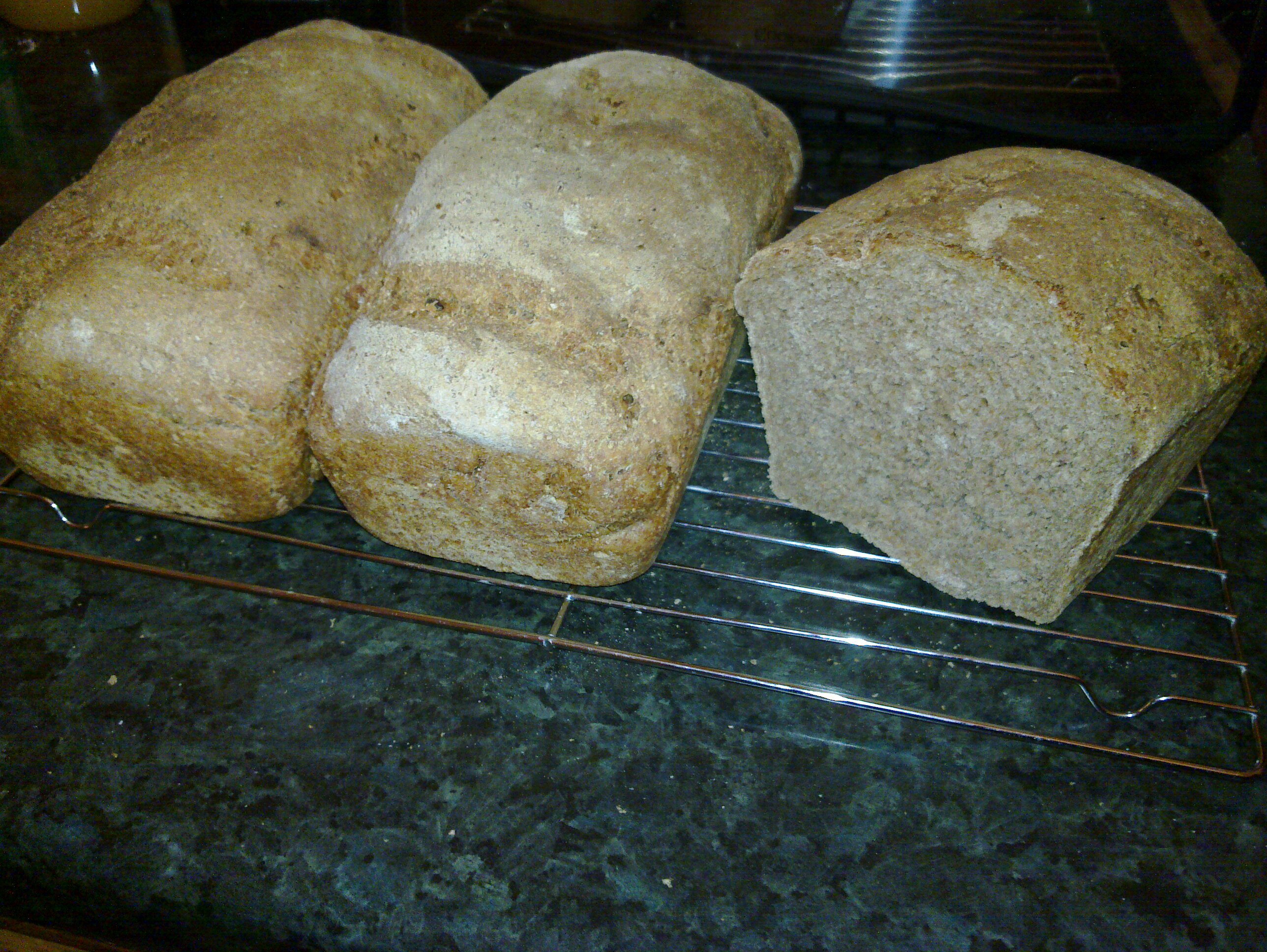
Half strong wholemeal and half wholegrain rye – no Australians in sight

Rye is different

Be warned that if you use rye, your rises will be very different. Rye rises more slowly, even in a fifty-fifty mix, and doesn’t rise as far. Today was my first go with rye (I’ve baked with wheat flours for twenty years) and it was a messy business. The dough is stickier and has a more granular consistency than a 100% wheat mix. I let it rise for sixteen hours and it barely doubled in size (it developed a semi-hard crust in that time that got crushed back into the dough on the pummelling for the second rise). I gave the dough around two and a half hours for the second rise and whacked the loaves in the oven at a smidgeon over 1cm above the tins. Cooking time was the same 35 mins.

And they are still delicious!

Add to FacebookAdd to DiggAdd to Del.icio.usAdd to StumbleuponAdd to RedditAdd to BlinklistAdd to TwitterAdd to TechnoratiAdd to Yahoo BuzzAdd to Newsvine