BBC World Service on Syria

Haytham al-Maleh was arrested after an interview with opposition TV

Thank you to Maureen Thomas for drawing my attention to two important internet broadcasts by the BBC World Service. The first is with Iyas Maleh, whose father Haytham al-Maleh was imprisoned by the Syrian regime last year. He talks here about the circumstances that led to his arrest and the character of one of Syria’s greatest defenders of human rights.

The second is with Joshua Landis, the American Middle East expert who gives an expert analysis of the situation in Syria.

You can find both interviews on the BBC page Syria: The Prospects for Political Change.

Joshua Landis blogs frequently on Syria and  in 2005 carried an interview with Kamal al-Labwani from 2005, conducted by Joe Pace. It is well worth reading.

Add to FacebookAdd to DiggAdd to Del.icio.usAdd to StumbleuponAdd to RedditAdd to BlinklistAdd to TwitterAdd to TechnoratiAdd to Yahoo BuzzAdd to Newsvine

If you missed the winner of “Ukraine’s Got Talent”… Here she is from September last year – stunning stuff

Sometimes you see something that literally takes your breath away.

I missed this last year – it was covered by the Guardian who reported on how Kseniya Simonova performed live on the final, keeping a nation spellbound and reducing the studio audience to tears with her sand art. Her performance mixed incredibly beautiful pictures with music and a story of Ukraine’s painful wartime history after the German invasion of 1941.

If you’ve seen it, look at it again and be reminded just how talented some people are. If you’ve not seen it, marvel at what those pictures in the sand on Cornish beaches could be.

Add to FacebookAdd to DiggAdd to Del.icio.usAdd to StumbleuponAdd to RedditAdd to BlinklistAdd to TwitterAdd to TechnoratiAdd to Yahoo BuzzAdd to Newsvine

Wikileaks – free speech needs YOU now #wikileaks #freespeech #amnesty

If you’ve not already noticed, Wikileaks is currently closed for business, facing a funding crisis. Wikileaks (different link which goes into the background of Wikileaks) has been a crucial tool for liberals and free speech campaigners in the battle against state censorship and corporate bullying.  In 2008, it won The Economist New Media Award. In 2009, it shared the Amnesty International New Media Award.

YOU have the chance to make a difference. Don’t leave it to other people.

Make a donation. Let’s face it: $25 is a small price to pay to help turn the tide against corruption and secrecy.

Add to FacebookAdd to DiggAdd to Del.icio.usAdd to StumbleuponAdd to RedditAdd to BlinklistAdd to TwitterAdd to TechnoratiAdd to Yahoo BuzzAdd to Newsvine

Google redeems its reputation – and throws down the gauntlet to China #china #freespeech

In a shock announcement, Google, the internet search giant, has thrown down the gauntlet to the Chinese authorities by announcing that it is going to end the censorship of its Chinese operations. In an announcement on its official blog, the search engine giant cites specifically the attacks that have been made by cyber terrorists on human rights advocates.

Google earned condemnation from politicians and internet users around the world for its decision to self-censor its Chinese operations on Tuesday 24 January 2006. Critics pointed out the glaring contradiction between what it was doing – silencing the voices of those who had not earned the approval of Beijing’s regime – and its ten-point philosophy of operations, specifically points 6 and 8:

6. You can make money without doing evil

8. The need for information crosses all borders

Google’s decision is not just a challenge to Beijing. It is a challenge to those other corporate giants that hitherto have put profit before principle. Internet leaders Microsoft and Yahoo, as well as  Cisco, one of the world’s leading manufacturer of networking equipment, have all been the subject of criticism for the way they have been prepared to satisfy the censorial instincts of the Chinese government, notably by members of the Congressional Human Rights Caucus in February 2006. Disturbingly, Reporters Sans Frontières claim Yahoo was responsible for passing personal information to the Chinese authorities, resulting in the jailing of journalist, poet and blogger Shi Tao. You can read some of Shi Tao’s writings on press freedom here. Please click the thumbnail below to be taken to his page on the website of Human Rights in China, founded by students and academics to promote universal human rights and advance their institutional protection in China:

We seem to have developed a tendency, misguided I think, to measure a country disproportionately by its economic reforms. China is no exception – and it certainly has reformed its economy out of all recognition in the past thirty years. The CIA World Fact Book makes the following observation on China’s economy (I still find it odd that the CIA put their World Fact Book online):

“China’s economy during the past 30 years has changed from a centrally planned system that was largely closed to international trade to a more market-oriented economy that has a rapidly growing private sector and is a major player in the global economy. Reforms started in the late 1970s with the phasing out of collectivized agriculture, and expanded to include the gradual liberalization of prices, fiscal decentralization, increased autonomy for state enterprises, the foundation of a diversified banking system, the development of stock markets, the rapid growth of the non-state sector, and the opening to foreign trade and investment. Annual inflows of foreign direct investment rose to nearly $84 billion in 2007. China has generally implemented reforms in a gradualist or piecemeal fashion. In recent years, China has re-invigorated its support for leading state-owned enterprises in sectors it considers important to “economic security,” explicitly looking to foster globally competitive national champions.”

I can’t help feeling that attributing a country some nebulous value of “standing”, based predominantly on perceptions of the sophistication and liberality of its domestic market,  risks eclipsing other considerations which are intrinsic to properly understanding a state and the country it governs. With China having 30 years of reform behind it, and with the current uncertainties dogging established Western free market economies  in the current global economy, we are in danger of forgetting that the expression of Communism in state form has always been accompanied by instruments and policies of the state that are unacceptable in terms of human rights, free speech and human dignity. Akmal Shaikh becomes a footnote in the continuing evolution of economic relations as we establish trade missions for our benefit, regardless of China’s record on human rights and the treatment of those, like  Guo Quan, who risk their life for the free expression we take for granted.

I cannot believe that it is without cost to our own humanity if we decide to subordinate principle to profit.

So from this Liberal – who is an ardent supporter of the basic principles of the free market – well done Google for at the very least giving us pause for thought.

Add to FacebookAdd to DiggAdd to Del.icio.usAdd to StumbleuponAdd to RedditAdd to BlinklistAdd to TwitterAdd to TechnoratiAdd to Yahoo BuzzAdd to Newsvine

Detained Syrian human rights activist Anwar al-Bunni receives prestigious German award #albunni #syria #un

On April 24 2007 Anwar al-Bunni, human rights activist and friend and colleague of my friend, Kamal al-Labwani, was sentenced to five years in prison on charges of “spreading false or exaggerated news that could weaken national morale”. He had been detained since May 2006 in harsh conditions and abused by his guards. On 20 May, Kamal suffered a similar fate: sentenced to twelve years, later extended by a further three.

On 1 May 2008, Anwar al-Bunni was selected to receive an award from the Irish organisation Front Line, the International Foundation for the Protection of Human Rights Defenders. In June 2008 Martin Sheen and former Taoiseach Bertie Ahern TD joined Front Line to celebrate his courage.

Just recently, in December 2009, Anwar’s courage and commitment to human rights was recognised again.

In December 2009 the  German Association of Judges awarded Anwar al-Bunni its prestigious human rights prize, recognition that is intended to strengthen and further respect for universal human rights and basic freedoms.

Those of us privileged enough to live in liberal democracies, where free speech is taken for granted, should keep good people like Anwar al-Bunni, Kamal al-Labwani, Mohannad al-Hussani, Haitham al-Maneh and Ma’an Aqil at the forefront of our thinking. We should not forget the sacrifice they and their families are making in order that, one day, they might enjoy those same freedoms. In that struggle, the Syrian government might remember that it is a signatory to the United Nations’ International Covenant on Civil and Political Rights and ask itself how detention of these peaceful dissenters conforms with the commitments it has made as a member of the international community.

Whether in the UK, the US, Germany, or elsewhere in the EU, each of us should continue to hound our leaders to keep the Syrian regime under as much pressure as possible. It is only the spotlight remaining on the likes of Anwar, Kamal, Mohannad, Haitham and Ma’an that will ensure that Syria eventually faces up to its responsibilities – and its failure to adhere to the standards of conduct to be expected of a country that wants to be taken seriously on the international stage.

Add to FacebookAdd to DiggAdd to Del.icio.usAdd to StumbleuponAdd to RedditAdd to BlinklistAdd to TwitterAdd to TechnoratiAdd to Yahoo BuzzAdd to Newsvine

China and the cruel lesson of the execution of Akmal Shaikh #humanrights #akmalshaikh


Akmal Shaikh - Reprieve

It is a hauntingly normal photograph.

For me, it is a picture of everyday humanity that is about as far as it is possible to get from the sense of dread and horror that must have overtaken Akmal Shaikh upon discovering from his family that he had barely twenty-four hours to live. Following the accounts of events around his final hours, as the increasingly frantic diplomatic scrabbling failed to halt his cruel and unjust execution, I felt a different sort of dread – familiar to me from previous death penalty cases. I have never seen the death penalty as anything other than imhumane – a signature of nations whose values are less civilised than my own. I accept that I might be blinkered in this understanding but I can’t pretend it isn’t so.

In recent days there has been much angry talk of political sovereignty, civilised values, humanity, mercy and the rule of law. Despite my rejection of the death penalty, I agree entirely with the assertion that states are entitled to enforce their laws upon their citizens and those that choose to visit or live within their jurisdiction. Equally, I resent being told by a sovereign state, which does not share my respect for free speech or multi-party representation, that my country has no right to criticise its “judicial sovereignty”.

Actually, it does. And I do.

I would go further and say that there is a moral responsibility on those who share liberal values to speak out in their defence, even if that means criticising other nation states. The alternative is that, in the hot-house of international negotiations, we risk seeing these values – important to our confidence in the legitimacy of our own civil society –  subordinated to priorities of trade and engagement, the manner of that engagement apparently far less relevant than the engagement itself. (I assume that sense of liberal indignation is what led Nick Clegg to make the statement he did following the British Olympic Association’s unsuccessful attempt to contractually gag British athletes from making criticisms of the regime in Beijing during last year’s Olympics – see this article in the Daily Mail.)

And that right is just one element of a tragedy of international misunderstanding between countries whose perspectives on history, justice, sovereignty, liberty and diplomacy are clearly very, very different.

I have no problem stating up front that I see the application of the death penalty to a mentally-ill man as a barbaric act. Reprieve, the British Government, his family and independent witnesses produced a wealth of evidence that Akmal Shaikh was mentally unwell. Reprieve’s report that China had consistently refused a full medical evaluation since April 2009 is particularly shocking. To me, it reveals a regime in Beijing that, contrary to its protestations, is not concerned with a judicial process that fairly recognises the mental capacity of the individual – and that lack of concern is entirely Beijing’s prerogative.  However, Akmal Shaikh’s story, familiar and upsetting, is one of a man made victim twice over: once by traffickers, taking advantage of a mentally incapacitated individual to turn him into a mule; and once by a Government determined to place its domestic propaganda requirements above the requirements of fairness in justice.

I had hoped that the passage of hours and days might lessen the grip of Akmal Shaikh’s execution on my thoughts. However, it hasn’t. Perhaps it has been a conscious mental reaction against a sub-conscious and instinctive desire to obliterate his fate – this awful news story that needs relegating to the back of the mind. However, I find his execution challenging – as a Liberal, as a human being who loves his family, as a man with private dreams and ambitions, as a humanitarian and as a Christian. Also, like others, I was provoked by the disgraceful article by Leo McKinstry in the Daily Mail. McKinstry’s confused and contrary tirade is a potent reminder of the dangers inherent in removing rational, liberal voices from the political conversation. It reads like a cynical and desperate attempt to establish caricatured notoriety as a hard-line social commentator and it brought an old proverb to mind: silence is the voice of complicity. I have no desire to be complicit in McKinstry’s attempts to profit in any way from the execution of a mentally-ill man. And I freely admit that I am also attempting to lay my own particular haunting to rest with words.

Fellow liberals might reflect on the tragic irony that the execution of  Akmal Shaikh was carried out on the anniversary of the birth of William Ewart Gladstone. Gladstone,  still years from becoming Prime Minister, used his journey from High Toryism to a radical and reforming Liberalism to condemn the Anglo-China war in 1840 and the opium trade that was its focus. I don’t suppose I was alone in my immediate disbelief when it was reported that the Chinese Embassy in London had released a statement referring to the “Opium Wars” in relation to Shaikh’s execution. I struggled to imagine a comparable situation in Britain where a judicial decision against a foreign national would be influenced expressly by a specific 19th century event.

Yet, part of me knows that, whilst as a country we are not so specific in the way we relate our history to our contemporary decisions, seismic events resonate across decades and shape our perceptions, both as individuals and as a society. No-one would doubt the impact of two World Wars on how we see ourselves or our European neighbours. The Great War began almost a hundred years ago, yet each year we remember its fallen. The Second World War still informs the cod-machismo of pub conversations. With that in mind, it is not so surprising that events to which we were a party, but that hold a different significance in the Chinese national conscious, are remembered vividly after just a further forty-odd years. In that understanding comes another, uncomfortable as it is: defence of liberal values does not preclude the responsibility to understand a state whose values are apparently so different. Quite the reverse, to my mind. Liberalism professes a profound internationalism and that obliges its adherents to understand and to identify, honestly, how a relationship can be developed that prevents a similar tragedy occuring in future. Remembering of course that explanation is not justification, perhaps we should not be so incredulous regarding the impact of the Opium Wars on modern China.

That recognition of the impact of historical events was signalled in the diplomatic phrasing of the two statements issued by the Chinese following Akmal  Shaikh’s execution, neither of which made direct reference to the Opium Wars (but which was made apparent in the Telegraph’s more hysterical translation – see above):
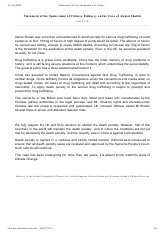
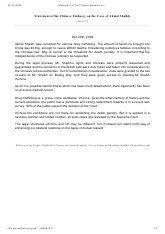
The recognition of threat that China poses to established positions of economic primacy, its self-acknowedged isolation from the world, the incomprehensibility of its vastness of geography and population compared to the United Kingdom, all appear to have helped skew attempts to fully understand China and its emergence onto the world stage.

Fu Ying, the Chinese Ambassador to the UK, made a low-key but significant speech to the English Speaking Union on 14th December 2009 that bears re-reading. It is a recognition by China of the lack of understanding that exists between itself and Western nations:
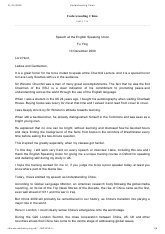
I wonder if we forget even the basic political differences when it comes to negotiations such as those in Copenhagen? China is not a democracy. It is not the USA. It is not the UK. It is not India. It is not Russia. It does not see internal political competition as positive, however inadequately it is expressed in some countries. It is, still, a self-professed communist country, that retains myriad bureaucratic networks that obscure information and confound individual expression. Even economic reforms are restricted by political caution and the vast inequalities between rural, industrialised and commercialised areas. China, unable to resist the march of technology and the coincidence of interest in averting environmental disaster, is having to learn how to deal on the traditional diplomatic stage, just we are having to re-learn how to deal with China outside of a Cold War paradigm we can control. China speaks a political language that we in the West have forgotten in the twenty years since the Berlin wall came down.

Copenhagen is the starkest evidence of this failure of understanding. Whether Copenhagen failed because of a Western trap, as John Lee asserts, or because China was determined to protect its economic interests at all costs, as Mark Lynas suggests, we do not yet know how to talk to China and explain our priorities – and why those priorities matter.

To my mind, the execution of Akmal Shaikh is an extension of that failure.

As a Liberal, as a human being who loves his family, as a man with private dreams and ambitions, and as a humanitarian, I am appalled by China’s execution of this father of five, the mentally-ill victim of drug-traffickers who was denied access to even a basic evaluation of his mental health.  However, as a Liberal, as a human being who loves his family, as a man with private dreams and ambitions, and as a humanitarian, I believe I need to understand China better, so that, should the opportunity present itself in some small way, I can show more clearly why I adhere to the beliefs I do – and demonstrate their intrinsic value.

As a Christian, quietly sharing the sentiments above, I am left reflecting on the intolerable cruelty of Akmal Shaikh’s lonely and forsaken grave – a cold world away from his wife, five children and the taxi business he used to run in North London.

Akmal Shaikh's unmarked grave - N/A

Add to FacebookAdd to DiggAdd to Del.icio.usAdd to StumbleuponAdd to RedditAdd to BlinklistAdd to TwitterAdd to TechnoratiAdd to Yahoo BuzzAdd to Newsvine