Urgent: Amnesty appeal as Haitham al-Maleh’s health fails #syria #amnesty #almaleh #labwani

haytham al-malehVery worrying news from Amnesty International regarding the health of Hytham al-Maleh.

Haitham al-Maleh was born in Damascus, in 1931 holds a degree in Law from Damascus University and a diploma in public international law. He is an award-winning human rights activist and lawyer. On 7 December 2004 he received an award from the National Advisory Committee (French) for Human Rights for his research on torture. He received his award from the French ambassador in Damascus in a special ceremony because the authorities prevented him from travelling to Paris. On 11 March 2006 he was awarded a Dutch medal in recognition of his courageous struggle for human rights.

The text of Amnesty’s recent press release is reproduced below.

Please write as requested by Amnesty.



URGENT ACTION

Haitham al-Maleh’s health failing

Prisoner of conscience Haitham al-Maleh is very ill, and he has not taken any of the medication he needs since 11 February.

Since 11 February, the authorities have not allowed detainees in ‘Adra prison to obtain medication from anywhere but the prison pharmacy. Haitham al-Maleh will only take medication provided by his family, because he believes the prison pharmacy’s medicine is of poor quality.

He was brought before a military judge in Damascus on 22 February to face new charges of “insulting the president” and “slandering a governmental body”, in a public hearing. These charges were based on information from a prisoner detained for a non-political offence. Haitham al-Maleh said the information consisted of “lies and acts of provocation” by the prisoner.

Diplomats and two Italian lawyers representing the International Federation for Human Rights, an international non-governmental organization that aims at improving human rights protection, who had come to observe the trial session, were not allowed to attend. Haitham al-Maleh’s wife, who was present in court, was not allowed to shake his hand or talk to him. On his way out, security officers dragged him away from her when they embraced.

According to those who did attend the hearing, Haitham al-Maleh was so frail that his voice was weak. He had passed out during the week before the hearing, because he had not received his medication. The day after the hearing, the new charges were dropped under a presidential amnesty for prisoners convicted of minor offences, but the charges brought against him on 3 November still stand.

Conditions in ‘Adra prison are poor. Haytham al-Maleh sleeps on a mattress on the floor in an overcrowded cell. He has diabetes and an overactive thyroid gland and has not had any medication since 11 February, although he needs to take regular medication to treat both conditions. His health is deteriorating. Individuals suffering from diabetes and an overactive thyroid gland who do not take medication are at risk of severe weight loss, falling into a coma, and even heart and kidney failure. Unlike other detainees in ‘Adra prison, Haytham al-Maleh is usually accompanied by a prison officer when meeting with the prison doctor.

PLEASE WRITE IMMEDIATELY in Arabic, English, French or your own language:

Urging the authorities to release Haytham al-Maleh immediately and unconditionally, as he is a prisoner of conscience, detained solely for the peaceful exercise of his right to freedom of expression.

President

Bashar al-Assad
Presidential Palace
al-Rashid Street
Damascus, Syrian Arab Republic
Fax: +963 11 332 3410
Salutation: Your Excellency

Minister of Interior

His Excellency Major Sa’id Mohamed Samour
Ministry of Interior
‘Abd al-Rahman Shahbandar Street
Damascus, Syrian Arab Republic
Fax: +963 11 222 3428
Salutation: Your Excellency

Copies to: Minister of Foreign Affairs

His Excellency Walid al-Mu’allim
Ministry of Foreign Affairs
Abu Rummaneh
al-Rashid Street
Damascus, Syrian Arab Republic
Fax: +963 11 332 7620
Salutation: Your Excellency

Additional Information

Haitham al-Maleh was charged by a military judge on 3 November with “conveying false news”, “weakening national sentiment” and “slandering a governmental body”. These charges relate to his public criticism of human rights violations and corruption by Syrian officials, which included a phone interview in September with a Europe-based satellite channel, Baradda TV.

Kamal al-Labwani

Prison authorities often encourage prisoners charged with or convicted of non-political offences to inform on political prisoners and prisoners of conscience. On 23 April, Kamal al-Labwani, a prisoner of conscience was given an additional term of three years in prison by the First Criminal Military Court in Damascus for “broadcasting false or exaggerated news which would affect the morale of the country” under article 286 of the Penal Code. This sentence was added to the 12-year term he was already serving on account of his work advocating peaceful reform in the country. This new sentence was based on the testimony of a prisoner in his cell in ‘Adra prison that Kamal al-Labwani had returned from one of the hearings of his previous trial and spoken disparagingly of the government. Kamal al-Labwani denied the charge and said prisoners detained for non-political offences were working in conjunction with the prison authorities, who had ignored his complaints that he had been assaulted twice in the prison.

Walid al-Bunni

Another prisoner of conscience, Walid al-Bunni, is serving a 30-month sentence for his involvement in the Damascus  Declaration for Democratic National Change, a coalition of unauthorized political parties, human rights organizations and pro-democracy activists from across the political spectrum. He was brought before Damascus Criminal Court on a new charge of “conveying false news” on 4 May 2009, based on the testimony of another prisoner. The new charge was finally dropped on 17 June 2009 and Walid al-Bunni was acquitted.

Add to FacebookAdd to DiggAdd to Del.icio.usAdd to StumbleuponAdd to RedditAdd to BlinklistAdd to TwitterAdd to TechnoratiAdd to Yahoo BuzzAdd to Newsvine

Syria: Koki, Aqil and other journalists freed by regime – a glimmer of hope for Kamal, Hytham, Anwar and colleagues? #labwani #syria

Alkarama have reported that Ma’an Aqil and Abdul Rahman Koki have been freed by the Syrian government within days of each other.

Aqil, a journalist in Damascus, was arrested on 22 November 2009 and was detained arbitrarily for three months (I blogged about his detention in December). Alkarama report that he was released Tuesday 23 February 2010.

Yesterday, Alkarama reported that Abdul Rahman Koki was released on Tuesday 16 February 2010, following a presidential pardon.

In both cases Alkarama had referred the cases to the UN Working Group on Arbitrary Detention.

Reporters Sans Frontières also report that two other journalists, Ali Taha and Ali Ahmed, have also been released after weeks of arbitrary detention.

Whilst being cautious not to overstate the significance of these releases, they offer a faint glimmer of hope in so far as the Syrian regime appears willing to free individuals who have clearly been prepared to challenge the government domestically and, in Koki’s case, be directly critical of  it. As Alkarama notes, we must take this opportunity to remind the Syrian authorities of their responsibility towards international human rights law and urge them to release all prisoners of conscience, including Kamal al-Labwani, Hytham al-Maleh and Anwar al-Bunni.

Add to FacebookAdd to DiggAdd to Del.icio.usAdd to StumbleuponAdd to RedditAdd to BlinklistAdd to TwitterAdd to TechnoratiAdd to Yahoo BuzzAdd to Newsvine

Corpse-eating robots, Jedi and computer games – did James Cameron understate the Terminator threat? #darpa #eatr #jedi

Robot dietary requirements and Jedi

I am definitely not the first person to have blogged about the wince-inducing news that the American military have developed robots that can power themselves by eating organic material. However, I’ve not read much that speculates on what interesting things could happen if you marry this robot technology with several other recent developments in the field of computing – like “adaptive behaviour” for instance. (I use “interesting” in that very British way: gross understatement, superficial calm and underlying blind panic all at once.)

The Energetically Autonomous Tactical Robot (EATR – geddit?!) was sponsored as a business project by the Defense Advanced Research Projects Agency (DARPA). This is the U.S. Government’s geek arm, where techno-nerds work on things like removing debris from space and developing an autonomous walking quadruped platform. (Basically they are all Star Wars fans and want to build a real life Imperial AT-AT – George Lucas should sue for breach of patent. And I bet they all put “Jedi” in the religion box on census forms.)

DARPA has been responsible for lots of sci-fi military technology.

They sponsored the development of the MQ1-Predator. This is the un-manned drone missile platform that costs $4.5 million a pop and that enterprising Iraqis hacked using a €30 piece of software called SkyGrabber – PayPal accepted. (If you are not quite sure yet what you’d do with your very own MQ1-Predator there is a trial version here).

Rather more “out there” DARPA projects include research into military-trained beesremote-control rats and thought-controlled weapon systems (see ST081-022) . (If you are feeling really brave, there are 522 pages of declassified projects for 2010-2011 on the DARPA website. )

I first became aware of EATR in a report by Stephen Sackur on Radio 4, excerpted from a report he prepared for the BBC World Service. (If you’ve time, have a listen. It is chilling.)

In it, the scientist behind the technology explains rather lamely that its diet would be restricted to a vegetarian one as eating human corpses would be against the Geneva Conventions.

Really?! I am glad they are straight about that!

Considered in isolation, I can fully accept that the problem we are dealing with here is one to do with the ethics of the individuals charged with programming these robots. There is only a problem with the Geneva Conventions if someone set the parameters for their diet too widely. (I am not entirely convinced on this point. I am diabetic – and I know something about the vagaries of diet control.)

Chaos Theory and “adaptive behaviour”

All well and good.

However, a few weeks ago, I was among those who marvelled at Professor Jim Al-Khalili’s programme “The Secret Life of Chaos”, a scientific tour de force which sought to outline the role played by chaos theory in producing the order we see about us every day. Whether or not you accept his assertion that the simple yet unpredictable rules of chaos which underpin evolutionary theory are the sole reason for our existence (rules best depicted by the infinitely variable intricacies of the Mandelbrot set) his analysis of process and the role of mathematics in revolutionising our understanding of biological processes was simply brilliant. (As it happens, I disagree with his assertion that this understanding takes science beyond philosophy and religion – for even if you argue this understanding to be true, there is still no scientific explanation for the existence of this behaviour-dictating rule-set in the first place. Btw you should really watch the Mandelbrot set zoom sequence above. It is incredible.).

One fascinating part of that programme was a demonstration of evolutionary behaviour in successive generations of computer avatars. Games software has often been at the cutting edge of computer technology. The increasingly complex coding necessary to create more life-like games enjoys a symbiotic relationship with computer hardware manufacturers producing faster and more powerful computer chips.

The software development company Natural Motion grew out of work at Oxford University, commercialising research into human and animal movement. Co-founder Torsten Reil, described as an “animating neural biologist”, worked on creating simulations of nervous systems based on genetic algorithms. He and his team set out to teach stick figures to walk using virtual neural networks analogous to that bit of the nervous system in the spine, something described in computer terms as “adaptive behaviour”. (It’s important to distinguish between this “learning” process (complex) and simply programming a computer avatar to walk (simple). This was the former, effectively the computer-generated avatar teaching itself how to walk).

Reil’s team started with lots of neural networks. By their very nature, those in this first generation were going to behave in a random manner. However, a genetic algorithm selected those examples that showed some promise, for example the avatar managing a small step rather than falling over, and then included that behaviour in the next generation of avatars. In twenty generations, the avatars had taught themselves to walk in a straight line.  If you are interested, there is the most phenomenal video available at Technology, Entertainment, Design: Ideas Worth Spreading, in which Reil gives an inspirational and fascinating presentation to a live studio audience:

Natural Motion’s white paper on “Dynamic Motion Synthesis”, published in March 2005, sums up the power of adaptive behaviour technology:

“[If] animation assets are synthesised by a sufficiently fast CPU, they need not be static but can be dynamic and adaptive. This means that animations can be fully interactive and adapt to user input and a changing or unpredictable environment.”

This technology is now an integral part of computer game design in some of the world’s largest studios. Natural Motion’s endorphin technology is used by firms like Sony and Electronic Arts, whilst its morpheme software is used by Codemasters and Eidos, amongst others.

What if?

The moment I heard Sackur’s piece on Radio 4, I found myself asking the “What if?” question.

What if some bunch of loons, with a multi-billon dollar budget, thought that there might be some merit in at least experimenting with a synthesis of EATR and adaptive behaviour technology? Could those be the sort of loons that spend millions on bot-bees and robo-rats? The very same techno-brilliant weapons nerds you might find digging into the deep pockets of DARPA?

Throw the robo-rat technology into the mix and suddenly the prospect of a corpse-eating robot, that adapts itself to its fighting environment and, from time to time, turns captured soldiers into DARPA’s version of the “Borg” (or even EATR’s version of the “Borg” – the ones it doesn’t eat, anyway), and suddenly it all looks even more alarming.

Is it really too fanciful to conceive of robots that are imprinted with an evolutionary artificial intelligence and that then calculate it is in their best survival interests to over-ride the protocols relating to the Geneva Conventions, eat the corpses of dead soldiers to remain fuelled and re-deploy captured enemy combatants by remote control to bolster their offensive capabilities? After Abu Ghraib, Guantanamo Bay, Project MK-ULTRA and Binyam Mohamed, reliance on the programming ethics of human beings seems a rather flimsy defence. It seems even flimsier in a context of unconventional warfare, billion-dollar research budgets and ever-diminishing physical resources.

Tech-heads and Terminators

James Cameron’s Terminator franchise depicts a world in which an artificially intelligent computer, Skynet, takes over the world, with computer-controlled robots deployed to destroy humanity. The long trailer for Terminator 2: Judgement Day gives you a pretty good idea of what it is all about. Not even Cameron had Arnie eating the corpses of fallen fighters for fuel. (Incidentally, for all you conspiracists out there, Skynet does indeed exist as a family of military satellites providing strategic communications to the UK Armed Forces and its NATO allies on coalition operations).

We may laugh about these things, but as we do, teams of DARPA boffins are beavering away in the classified bowels of the U.S. Department of Defense. If EATR, robo-rats and mind-control target acquisition are declassified, we can only wonder at what is going on behind DARPA’s firmly closed doors – and suddenly Cameron’s Skynet is looking distinctly ZX-81 compared to what could be coming down the military technology track…

And now for something (not) completely different…

In the meantime, rest assured that it’s not just the DARPA boffins that risk losing the techno-weaponry plot. Deep in the badlands of Texas, the gun nuts of Mil-Spec Monkey™ have discovered a need for flash-lights that double as submachine guns.

I kid you not.

Watch… And snigger. Or groan. And be glad you don’t live in Texas.

Add to FacebookAdd to DiggAdd to Del.icio.usAdd to StumbleuponAdd to RedditAdd to BlinklistAdd to TwitterAdd to TechnoratiAdd to Yahoo BuzzAdd to Newsvine

Kamal Labwani: parliamentary archives page #labwani

Since Kamal was illegally imprisoned by the Syrian regime in Adra Prison, in 2005, numerous of our democratically elected representatives have raised his plight in our national and international parliaments. I have trawled through the websites of the UK Parliament and the European Parliament to consolidate the various representations in one place. I have also linked again to the petition running on the Number 10 website.

Some of you may wonder why I bother.

To some, Kamal is just one more unfortunate political progressive caught on the wrong side of an unreconstructed Middle Eastern dictator.

Not to me.

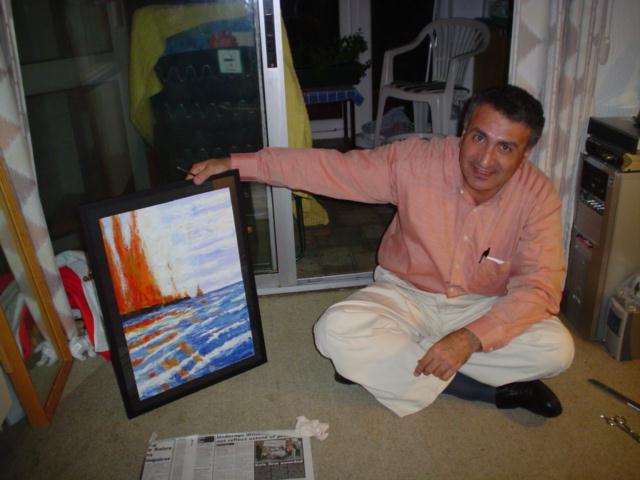
I bother because he is an artist, a philosopher, a radical and a Liberal.

Most of all, though, I bother because he is my friend.

Please take a look at this parliamentary archives page and be grateful for our own freedoms and democracy.

Add to FacebookAdd to DiggAdd to Del.icio.usAdd to StumbleuponAdd to RedditAdd to BlinklistAdd to TwitterAdd to TechnoratiAdd to Yahoo BuzzAdd to Newsvine

Syria and Human Rights in the European Parliament, September 2009 #eu #syria# labwani

I don’t suppose I am alone in not paying much attention to what our representatives say in the European Parliament.

It is a mistake not to. Trawling through the archives I found the text of a debate from September last year in which the cases of Muhannad Al-Hassani, Kamal Al-Labwani and Anwar Al-Bunni are all referenced.
Take a moment to read it and realise that there is a point to what these people do – and we should be supporting them in their efforts.

Kamal, Anwar and Muhannad need us to.

Add to FacebookAdd to DiggAdd to Del.icio.usAdd to StumbleuponAdd to RedditAdd to BlinklistAdd to TwitterAdd to TechnoratiAdd to Yahoo BuzzAdd to Newsvine

BBC World Service on Syria

Haytham al-Maleh was arrested after an interview with opposition TV

Thank you to Maureen Thomas for drawing my attention to two important internet broadcasts by the BBC World Service. The first is with Iyas Maleh, whose father Haytham al-Maleh was imprisoned by the Syrian regime last year. He talks here about the circumstances that led to his arrest and the character of one of Syria’s greatest defenders of human rights.

The second is with Joshua Landis, the American Middle East expert who gives an expert analysis of the situation in Syria.

You can find both interviews on the BBC page Syria: The Prospects for Political Change.

Joshua Landis blogs frequently on Syria and  in 2005 carried an interview with Kamal al-Labwani from 2005, conducted by Joe Pace. It is well worth reading.

Add to FacebookAdd to DiggAdd to Del.icio.usAdd to StumbleuponAdd to RedditAdd to BlinklistAdd to TwitterAdd to TechnoratiAdd to Yahoo BuzzAdd to Newsvine

Syrian repression of free speech continues as two more journalists are “disappeared” #syria #freespeech #humanrights

Reporters sans Frontières is reporting that journalist Ali Taha and cameraman Ali Ahmed have been detained since since 2 January (as usual, the Syrian authorities are providing no information on the arrests):

“The continuing arbitrary arrests of journalists in Syria are disturbing,” Reporters Without Borders said. “The authorities provide no information about the legal grounds for these arrests and or the subsequent place of detention. This complete lack of transparency does not bode well.”

Click here to read the full report.

These are the latest in a wave of arbitrary arrests that the Syrian security services have been carrying out for months.

Add to FacebookAdd to DiggAdd to Del.icio.usAdd to StumbleuponAdd to RedditAdd to BlinklistAdd to TwitterAdd to TechnoratiAdd to Yahoo BuzzAdd to Newsvine

Wikileaks – free speech needs YOU now #wikileaks #freespeech #amnesty

If you’ve not already noticed, Wikileaks is currently closed for business, facing a funding crisis. Wikileaks (different link which goes into the background of Wikileaks) has been a crucial tool for liberals and free speech campaigners in the battle against state censorship and corporate bullying.  In 2008, it won The Economist New Media Award. In 2009, it shared the Amnesty International New Media Award.

YOU have the chance to make a difference. Don’t leave it to other people.

Make a donation. Let’s face it: $25 is a small price to pay to help turn the tide against corruption and secrecy.

Add to FacebookAdd to DiggAdd to Del.icio.usAdd to StumbleuponAdd to RedditAdd to BlinklistAdd to TwitterAdd to TechnoratiAdd to Yahoo BuzzAdd to Newsvine

Google redeems its reputation – and throws down the gauntlet to China #china #freespeech

In a shock announcement, Google, the internet search giant, has thrown down the gauntlet to the Chinese authorities by announcing that it is going to end the censorship of its Chinese operations. In an announcement on its official blog, the search engine giant cites specifically the attacks that have been made by cyber terrorists on human rights advocates.

Google earned condemnation from politicians and internet users around the world for its decision to self-censor its Chinese operations on Tuesday 24 January 2006. Critics pointed out the glaring contradiction between what it was doing – silencing the voices of those who had not earned the approval of Beijing’s regime – and its ten-point philosophy of operations, specifically points 6 and 8:

6. You can make money without doing evil

8. The need for information crosses all borders

Google’s decision is not just a challenge to Beijing. It is a challenge to those other corporate giants that hitherto have put profit before principle. Internet leaders Microsoft and Yahoo, as well as  Cisco, one of the world’s leading manufacturer of networking equipment, have all been the subject of criticism for the way they have been prepared to satisfy the censorial instincts of the Chinese government, notably by members of the Congressional Human Rights Caucus in February 2006. Disturbingly, Reporters Sans Frontières claim Yahoo was responsible for passing personal information to the Chinese authorities, resulting in the jailing of journalist, poet and blogger Shi Tao. You can read some of Shi Tao’s writings on press freedom here. Please click the thumbnail below to be taken to his page on the website of Human Rights in China, founded by students and academics to promote universal human rights and advance their institutional protection in China:

We seem to have developed a tendency, misguided I think, to measure a country disproportionately by its economic reforms. China is no exception – and it certainly has reformed its economy out of all recognition in the past thirty years. The CIA World Fact Book makes the following observation on China’s economy (I still find it odd that the CIA put their World Fact Book online):

“China’s economy during the past 30 years has changed from a centrally planned system that was largely closed to international trade to a more market-oriented economy that has a rapidly growing private sector and is a major player in the global economy. Reforms started in the late 1970s with the phasing out of collectivized agriculture, and expanded to include the gradual liberalization of prices, fiscal decentralization, increased autonomy for state enterprises, the foundation of a diversified banking system, the development of stock markets, the rapid growth of the non-state sector, and the opening to foreign trade and investment. Annual inflows of foreign direct investment rose to nearly $84 billion in 2007. China has generally implemented reforms in a gradualist or piecemeal fashion. In recent years, China has re-invigorated its support for leading state-owned enterprises in sectors it considers important to “economic security,” explicitly looking to foster globally competitive national champions.”

I can’t help feeling that attributing a country some nebulous value of “standing”, based predominantly on perceptions of the sophistication and liberality of its domestic market,  risks eclipsing other considerations which are intrinsic to properly understanding a state and the country it governs. With China having 30 years of reform behind it, and with the current uncertainties dogging established Western free market economies  in the current global economy, we are in danger of forgetting that the expression of Communism in state form has always been accompanied by instruments and policies of the state that are unacceptable in terms of human rights, free speech and human dignity. Akmal Shaikh becomes a footnote in the continuing evolution of economic relations as we establish trade missions for our benefit, regardless of China’s record on human rights and the treatment of those, like  Guo Quan, who risk their life for the free expression we take for granted.

I cannot believe that it is without cost to our own humanity if we decide to subordinate principle to profit.

So from this Liberal – who is an ardent supporter of the basic principles of the free market – well done Google for at the very least giving us pause for thought.

Add to FacebookAdd to DiggAdd to Del.icio.usAdd to StumbleuponAdd to RedditAdd to BlinklistAdd to TwitterAdd to TechnoratiAdd to Yahoo BuzzAdd to Newsvine

Anwar Al-Bunni: Smiling and with his head held high… #albunni #allabwani #amnesty #syria

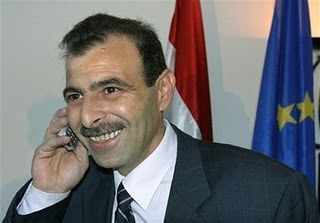
Anwar al-Bunni - photo released by family

On Wednesday I blogged about the German Association of Judges awarding Anwar al-Bunni their prestigious human rights prize. On that page is a link to an article by Peter Franck und Ruth Jüttner of Amnesty International Berlin. My German is just about passable enough for me to be able to recognise that their words merited a fuller, more accurate translation. Thankfully, as a professional linguist, Dad’s German is better than mine…

Peter and Ruth paint a picture in words of a dignified and noble man, and his extraordinary family, who have peaceably defied authority to defend the human rights of their Syrian countrymen – much like Anwar’s friend and colleague, Kamal al-Labwani. I have tried to contact the authors to ask if I might post a translation, but so far to no avail. I hope they will forgive me my eagerness to post their words in English, that more might read about the efforts of Anwar al-Bunni.

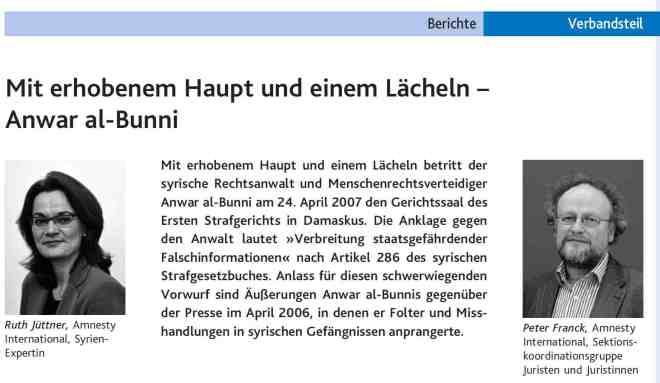
Please click the picture below to be taken to the German original:

The translation which follows is a direct text translation, with only very slight editing for form. I have taken the liberty of inserting some links if you wish to find out more information. Thanks Dad for performing the translation so quickly and so effectively. I hope you all find Peter and Ruth’s words as inspiring and humbling a read as I did.

Translator Geoff Williams

Smiling and with his head held high…

Peter Franck und Ruth Jüttner, translated by Geoff Williams

On 24 April 2007, smiling, and with his head held high, the Syrian lawyer and human rights defender Anwar al-Bunni entered the courtroom of the No.1 Criminal Court in Damascus. In accordance with Article 286 of the Syrian Criminal Code he was charged with the “promulgation of false information likely to endanger the state.” The reason for this serious allegation were statements made to the press by Anwar al-Bunni in April 2006 in which he denounced torture and maltreatment in Syrian prisons.

In concrete terms, the lawyer had demanded to know the causes for the death of 26 yr old Mohammed Schaher Haysa. This young man was detained for several months at an unknown location. In April 2006 the authorities had handed over his body, which showed traces of torture, to his family. During his trial Anwar al-Bunni demanded that the Syrian authorities should investigate the death of Mohammed Shaher Haysa.  The court did not, however, pursue the allegations of serious mistreatment and instead sentenced Anwar al-Bunni to five years’ imprisonment.

This draconian sentence provoked consternation amongst the family, supporters and defenders of al-Bunni, being far more severe than the three-year sentence usually imposed in similarly staged trials. Anwar al-Bunni accepted the judgement with composure and described the trial and verdict as a “politically motivated and blatant contravention of the right to freedom of expression, aimed at terrorising and intimidating the Syrian public and politically active citizens.”

It was not the first time that Anwar al-Bunni had demanded that the courts should investigate maltreatment and torture. In June  2002 he had defended the non-violent  political activist Aref Dalilah before the Supreme Court for State Security in Damascus. This court  was established five years after the imposition of the state of emergency in March 1968 and deals solely with cases of a political nature or which have a relevance to state security.

Proceedings before this court fall far short of the international standards for fair trials.  There is no appeal against decisions of the court, defendants have limited access to legal support and judges at the court have wide ranging discretion with regard to the format of the proceedings. This was also clear in the trial of Aref Dalilah. When Anwar al Bunni insisted that his client’s accusations of maltreatment should be recorded  and investigated he was forcibly removed from the courtroom by security officers. The presiding judge subsequently withdrew from him his accreditation to appear as a lawyer before the Supreme Court for State Security.

A month later Aref Dalilah, former Dean of the Faculty of Economics at the University of Aleppo, was sentenced to 10 years imprisonment for his support for political reform. In August 2008, after 7 years largely spent in solitary confinement, the 65 year-old was released as part of a presidential amnesty.

When still a young man within his family, Anwar al-Bunni, the second youngest of seven brothers and sisters, suffered persecution and years of incarceration because of his political activity. Since the late 1970’s four of his siblings have been imprisoned time and again for political reasons in various Syrian prisons and under appalling conditions.

Until the 1990’s the conditions in Syrian prisons were so degrading, humiliating and brutal that they amounted to systematic torture. According to later press statements from his older brother Akram, there were times when Anwar al-Bunni and their mother were the only members of the family not in prison and divided up visits to family members imprisoned in different prisons in different places between themselves.

When Anwar al-Bunni commenced his law studies in 1979 at the University of Damascus three of his brothers and one sister were in prison on political grounds. After a few years practice as a lawyer he undertook the defence of political prisoners in the courts and founded a committee to press for the release of political prisoners.

After the death of President Hafez al-Hassad and the succession of his son Bashar in June 2000, there was something of a political thaw, which has come to be known as the “Damascus Spring”. A sense of new horizons, inspired by the young president’s promise to drive reform forward, spread across the country. Numerous discussion circles developed amongst the populace where members of the opposition and intellectual debated the routes to political change, democracy and the achievement of human rights. During this period, together with other prominent human rights lawyers, Anwar al-Bunni founded in 2001 one of the first human rights organisations, the “Human Rights Association in Syria” (HRAS) which sought official recognition from the authorities.

Despite the regime’s return to an authoritarian style of leadership and massive suppression of dissent, Anwar al-Bunni continued his determined and courageous support for the victims of indiscriminate state violence. He was unflinching in his criticism of the 40 year-old state of emergency which aided and abetted the abuse of human rights on a huge scale. He remained in contact with journalists, foreign diplomats and with international human rights organisations. He informed the world public about the politically motivated trials of  activists campaigning peacefully for democratic change and about the conditions of his clients’ imprisonment.

The authorities reacted with sanctions intended to intimidate him. He was repeatedly brought before the Damascus bar association, was disciplined and temporarily barred from practising. He was harassed, intimated, threatened and kept under surveillance by the security services. In December 2003, intending to travel to Weimar to receive the city’s human rights prize on behalf of the reformist politician Riad Seif, at that time  and still today imprisoned, he was refused permission to trav el. An EU funded Human Rights Centre under his directorship was closed down by the authorities  in March 2006 only days after opening. Not only Anwar al-Bunni but his family also has been subject to punitive measures. In May 2007, just one month after he received his sentence, his wife Ragheda Issa Rafiki was deprived, with no reason given, of her civil servant post by order of Prime Minister Muhammed Naji al-Otri.

The 50 year-old lawyer has been in prison for three-and-a-half years in atrocious conditions. He shares a cell with thirty others, all convicted criminals. Both other prisoners as well as prison officers have physically brutalised and humiliated him. And yet his spirit is not broken. On behalf of a number of non-violent political prisoners he has repeatedly addressed open letters to the UN High Commission for Human Rights and the Syrian president, drawing attention to the conditions of their imprisonment. Anwar al-Bunni himself suffers from arthritis, a condition made worse by lack of movement and the dampness of the cells.

Add to FacebookAdd to DiggAdd to Del.icio.usAdd to StumbleuponAdd to RedditAdd to BlinklistAdd to TwitterAdd to TechnoratiAdd to Yahoo BuzzAdd to Newsvine