Curiosity might prove the biggest challenge of all

20120806-curiosityThe rover Curiosity launched from Cape Canaveral on 26 November 2011 and landed in Gale Crater, Mars, on 6 August 2012. Those of us who spend our days in the whirl of headlines about politics and sport and celebrities may have missed the steady stream of quiet but sensational revelations from the latest robot sent by NASA to investigate Mars, our nearest planetary neighbour.

A month or so ago there was a brief flurry of international media interest after a strange metallic-looking object was discovered. This provoked a wealth of chatter on the Internet, with conspiracy theorists revisiting the wilder realms of speculation. (Afficionados of Internet conspiracies may recall the flurry of posts when NASA pulled this photo from the batch of official photos released from Curiosity just after it landed.)

All of which is fun for techno geeks like me, but misses the crucial point of the Curiosity mission and its potential significance.

Since landing, Curiosity has been picking its way over the arid surface of Mars, attempting to assess whether conditions have ever existed that could have supported microbial life. To that end it has been looking for evidence of any role played by water in the planet’s history, not least of all because it is no secret that this mission has been created with a view to a potential manned exploration and scientists want a better understanding of the Martian environment.

Today, the BBC reported on the incredible discovery of rock that confirms earlier findings from Curiosity that neutral water once existed in the Gale Crater. NASA’s own website  contains this pretty stunning admission: “Curiosity’s analyzed rock sample proves ancient Mars could have supported living microbes.” NASA confidently proclaim that Curiosity is now seeing a trend in water presence on Mars.

Why does all this matter?

Because the revelation that life could exist elsewhere other than Earth strikes at the theological and philosophical heart of thinking that has informed the way we organise our societies for millennia. Everything, from myriad individual personal destinies (tragic and otherwise), to the political, judicial, economic and social organisation of communities, nations and entire civilisations, has been affected by the belief that life has only ever existed here, in this one special place: Earth.

How do the major religions of the world respond if it is proved conclusively that life once existed elsewhere in our Solar System, let alone the Milky Way or the Universe? Could they adapt to accommodate a revelation at least as shattering to established world views as the Copernican revolution – or would they continue to maintain a position like that of the Heliocentrists, becoming increasingly irrelevant and absurd over time?

We might not think it matters – but there was a time when recognition that our Sun orbited the Earth was axiomatic to an assessment of the authenticity of belief. Could those who profess faith adjust to accommodate the enormity of the truth that life once existed elsewhere – and might exist now elsewhere – without seeing the entire edifice of that faith crumble?

I suspect those who claim truth only in the most fundamentalist of interpretations will have the hardest journeys of all.
The pencil photographs of Kelvin Okafor

If you’ve not yet come across them, the drawings of Kelvin Okafor are something else. They are pencil illusions, stunning graphite recreations by eye from photographs, each taking between 80 and 100 hours to complete.

The talent of some people is simply extraordinary.

This slideshow requires JavaScript.

The largest wave ever surfed?

I’ve always loved Point Break, Kathryn Bigelow’s surf and shooting action movie in which Patrick Swayze leads the ex-Presidents, a gang of surfer criminals who are infiltrated by rookie cop Keanu Reeves. There’s lots of mystical man-bonding and heroics, but somehow it does manage to capture the amazing power of the ocean and the thrill of hunting for that perfect wave.

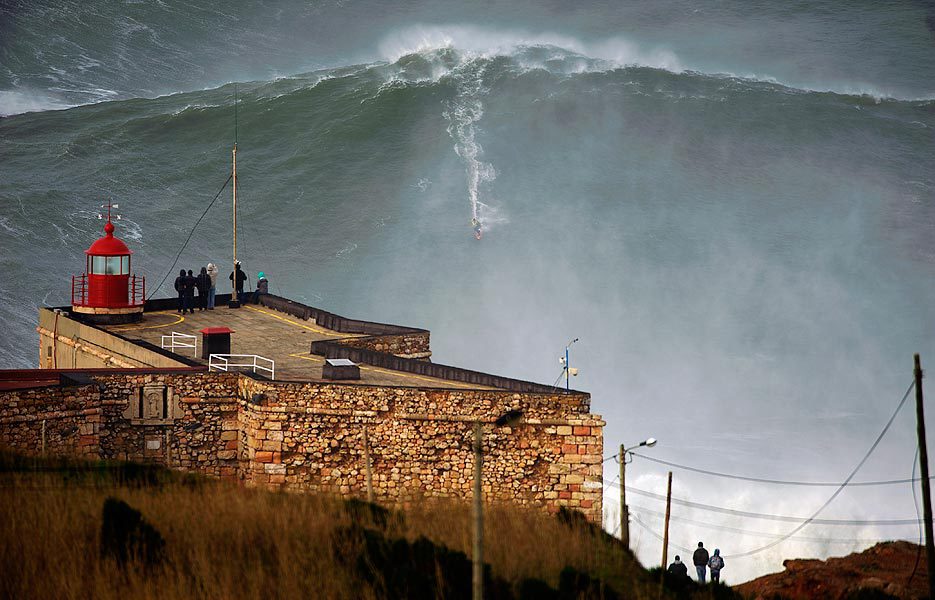
On Tuesday 29th January, Keali’i Mamala towed out Garrett McNamara to surf on the monster swells off Praia do Norte, Nazaré, Portugal.

McNamara held the record for the largest wave ever surfed, a 90-foot beast also caught at Nazaré. What he may or may not have known, was that he was just about to break his own record, surfing a Leviathan wave that, as a body boarder more used to Cornish summer swells, I can barely contemplate: 100 feet high.

surf-portugal-8-935x600

To give you an idea how tall that is, it’s roughly seven Routemaster buses stacked on top of each other.

This trailer gives you an idea of how the sea looked that day:

And this is the wave in question, with McNamara surfing it:

Extraordinary.

A travesty of choice on Old Kent Road

I have recently rediscovered the joy of Monopoly.

In the days before HMV broke, I spotted a very attractive retro edition, in a wooden box, and I decided that as I couldn’t find my childhood box that I would buy it (my old version was a deluxe edition in a black box that included a locomotive token). After all, what better way could there be to pass the long winter evenings than to accrue a personal property fortune?

I was quickly and rudely reminded that there are no ideological bars to winning. My opponent, no, my enemy, a self-styled ex-Socialist Worker who is more than a little sceptical of my own liberal political values, proved to be the most ruthless and cunning capitalist I have ever come across. There was no mercy shown – she led from the beginning and destroyed me five times. Once or twice and I would put it down to a roll of the die. Five times and I was definitely the victim of the socialist incarnation of Donald Trump. (Personally, I think Monopoly provides a safe environment in which socialists can surrender to base instincts and act like the rest of us. That sound you can hear is the sound of me running for cover.)

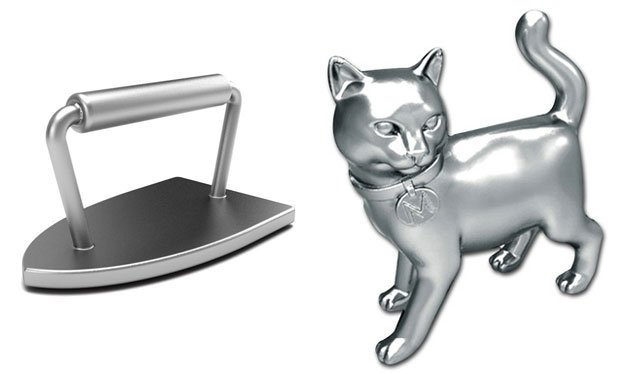
Still licking my wounds, you could imagine my shock when Hasbro offered a world wide vote to replace a historic playing piece with a diamond ring, a guitar, a toy robot, a helicopter and a cat. The result of that vote? The iron bought it, securing just 8 percent of the vote, and was replaced with… a cat.

Now, I am a cat fan. I admire their cunning, their cold, calculating capacity for dissembling, their ruthless survival instincts and the juxtaposition between the lean, mean killing machine that most of them think they are and the fact that they are often the animal kingdom equivalent of Norman Wisdom, exhibiting a tremendous propensity for slapstick. I would say I own one, but I am pretty sure he owns me.

What a cat isn’t – or what it shouldn’t be – is a Monopoly playing token. To my mind, the iron was one of the more elegantly designed pieces. The cat that replaces it is pug ugly.

Monopoly_casts_aside_the_iron_in_favour_of_the_catI indicated earlier that I can understand the general sentiment towards cats. We also live in a world in which we take refuge in cute things and fluffiness, and perhaps moreso amongst the social demographic that is likely to be taking part in online votes on game tokens. However, applying the same logic to the piece that was rejected, what does it say about the younger generation’s relationship with the iron? Judging from the crumpled trousers I see hanging off the backsides of “cool” types, it says pretty much everything. I wonder if irons are going to go the same way as the cassette tape? In ten years’ time, I can imagine a wide-eyed child pointing at an iron and murmuring incredulously: “Mummy, what is that?”

As it happens, it’s not the first time that pieces have been retired or changed. My retro edition partially recreates the 1935 edition and doesn’t include the wheelbarrow, introduced in 1937.  However, it also doesn’t include three other tokens that were retired in the 1950s: the purse, the rocking horse and the lantern (the wheelbarrow already introduced, the 1950s saw the introduction of the man on horse and the dog). Other retired tokens include the sack of money (which existed in the 1999-2007 editions, having won a contest over a piggy bank and a bi-plane), a man on horseback and a Howitzer (!).

In the end it is probably that I am just not good at change. So I’ll just hanker after this classic set, knowing that if only I could have the lantern I’d win every time…

Tokkens web monopoly photos T6


Poem: This Week’s Snow

This Week’s Snow

It buried all beneath a
blanket of little white lies,
each flake guilty of
momentarily erasing
all our broken truths – a
cracked road, a crumbled
wall, the spill of yesterday’s
life from an up-turned bin –
and in communion with
the great pretence of
all things clean and new.


And even as we danced like
mad and, with joy, like children,
made our own untruths – to
stay away and steal a day –
we knew our feet would scuff
and press and churn to ruin,
that brightest white would
turn to grey and, once more,
with sudden chill, we recalled
the lies we tell, how snow is
never liquid paper for the soul.

A patient, publicity-shy (and patronising!) puss

There’s something amusingly patronising about the way this cat handles its owner, determined to make the point that it rather wishes to be left alone. You can just imagine what’s going through its mind. Jim Davis’s Garfield probably captures it…

images

Poem: A Drunk Lover Of Words

The Drunk Lover Of Words


I should write, in this fug of

alcohol and dreams and snow,

with words like ripe cherries

waiting to be plucked and eaten,

sweet and sour and stony-hearted.


This should be my Ulysses, my Emma,

my Don Quixote, my Scoop, my

Lolita, my Lucky Jim, my Austerlitz,

my Clarissa, my Catch-22, my Nausea, my

Jane Eyre, my Heart of Darkness.


I should write, in this haze of

bravura and need and dust,

with words like rare jewels

yearning to be shaped and polished,

bright and hard and beautiful.


This should be my Entirely, my Howl,

my Dover Beach, my V, my

Still I Rise, my Life Is Fine, my Brown Penny,

my America, my Dream Deferred, my Romance, my

Always, my Deaths and Entrances.


I will write, in this riot

of caffeine and lust and night,

with words like cut arrows

aching to be nocked and loosed,

straight and true and hitting home.

Beauty from brokenness: more street art from OakoAk

Street artists have a unique eye for taking things that most of us walk past, or regard as ugly or broken, and making them into something very different. Funny, surreal, thought-provoking and sometimes just beautiful, there is a tremendous variety of street art out there around the world.

It can provoke passionate discussion, with some dismissing it as merely an excuse for graffiti. Somehow, though, I think it is more than that, saying something about the urban areas in which we live, and giving value back to things that have lost their value and (sometimes purpose) through decay, damage and vandalism.

One of my favourites is OakoAk, described on his own website as a “French artist who likes to play with urban elements”. His work is simpler than some, often eschewing perspective illusions and instead going for the comic,  occasionally tugging a heart-string.

Here’s a selection of some of his most recent, courtesy of Bored Panda:

This slideshow requires JavaScript.

Vision thing: the 3D Star Trek technology that eliminates computer displays

“Electronic junk narrows our life space…”

Maxim Kamanin

Sometimes it feels like Hollywood is running to catch up with real life. And sometimes, real life seems even less believable than Hollywood’s penchant for technological exaggeration.

From the middle of nowhere comes an invention that might just revolutionise the way we interact with technology – in pretty much every way. Maxim Kamanin, a youngster from a remote village in southern Russia, is the inventor of a new form of display that may eliminate the need for computer screens entirely, freeing us up to work far more creatively with technology.

Displair literally puts digital images into the air, creating fully penetrable 3D images which can be viewed and manipulated. It is completely astonishing – like something out of Star Trek. It uses a cloud-inspired technology (and not cloud as it is usually thought of in computer tech terms) which somehow remains remarkably stable across varying temperatures. The Displair wiki entry goes into more detail.

From artists, architects and designers, to teachers, surgeons and inventors, the creative ways in which it could be used are immense.

The web-film site Focus Forward Films has a video of this astonishing invention in operation:

Poem: A Commute Diverted

A Commute Diverted

We shoved and shuffled

in this brighter morning,

blue skies and sun

belying warmth,

cloudy breath and

huddled shiver an

overture to our opera

of epithets and sighs:

a tragi-comic Tannhäuser,

on West Ham’s platform stage.