Poem: The Promise

I debated putting this up. I wasn’t going to dip into the back catalogue. However, I wrote this a couple of years ago and was reminded of it by a weather forecast promising snow. It was also written at the turning of the year and so I can still plead New Year.

Snow creates a momentary illusion of a new world, a blank canvas on which to write the day and as a child I always thought that it lay for weeks. In truth, it only lay for days and, as with many things, my recollections benefit from a gloriously over-active imagination.

Still, even now, my heart skips a beat when I wake to blanket of snow and everything looks pristine. Childish, perhaps, but as C. S. Lewis wrote: “When I became a man I put away childish things, including the fear of childishness and the desire to be very grown up.”

The Promise

In a curious loneliness of friends,
despite the quiet regard of strangers,
we beg our days – so fast and few – not fade,
but lie, like snow, the virgin fall that sings
audacious promise and begs us step into
a world renewed, where scars are hid and
tired paths are lost to love’s adventure.

In the coldest reckoning of our hours,
as frosts are whispered through our night,
I crave the comfort of your creased smile,
the shudder of your aching limbs,
your weary arms that give up the promise
of your quickening, breaking, bleeding heart:
the safer silence of another year.

Coming soon… A history of noise

Noise.

It fills our lives. It is something that is so constant that I doubt any of us really experience true silence except perhaps on a few occasions in our lives. There is the daily burr that forms a soundtrack to our lives that we barely pay attention to any more. There are the phones chirruping away, cars passing, doors closing, papers shuffling, colleagues talking at the water cooler, footsteps in the corridor. The list is endless.

In more peaceful places there is still noise: the wind in the trees, birds singing, the sea on the shore, the rustle of grass as we walk. Even now, in this house, with no music playing, the windows double-glazed and with the heating currently off, I can hear the whirr of the computer’s fan and my fingers clicking on the keyboard (and what a joy it is to be typing on a real keyboard, not a laptop or a Blackberry). At other times there might be the creak of pipes or the sound of the house settling after the day or a distant siren howling through the town.

Interestingly, pretty much the world’s quietest place isn’t in the middle of nowhere at all. It is at Orfield Laboratories, in their anechoic chamber:

anechoic chamberAnechoic means echo free and this chamber is designed to completely absorb sound waves and create an experimental space in which there can be absolute silence. Somehow or other I suspect that I would end up being driven mad by the sound of the blood rushing in my ears!

Anyway, browsing Facebook, the feed of an old friend with whom I wish I kept in better touch flashed up a link to a blog: Noise – A human history. Starting Monday 18 March, this 30-part series will explore the role of sound in the past 100,000 years of human history As it says on the blog:

“Recorded on location around the world, it will take us from the shamanistic trance-music of our cave-dwelling ancestors, the babel of ancient Rome, the massacre of noisy cats in pre-revolutionary Paris, and the sonic assaults of trench warfare, right through to our struggle to find calm in the cacophony of a modern metropolis. This is not about sound in the abstract: it is about sound as a matter of life and death, pain and pleasure, feeling and intellect. People, and their past behaviours, are at the heart of it.”

Sound has always fascinated me – how we become attuned to some sounds and not to others, how music can bend our emotions, how people communicate, how we hear the world when we actually stop to listen. Something tells me that this series will be quite special.

Check it out – and those of you who enjoy quality radio, listen out for it.

Poem: The House Alone

The House Alone

I know a strange aloneness tonight –
Though noise ruled the day,
The house stands quiet now,
An absence of sounds conquering the
Loud and shrill and banging.

There is a whine of blood and air
Where chatter had displaced thinking –
And I think I miss the sound of you,
Restless and laughing, love and
Madness in the stories we shared.

I know a strange aloneness tonight –
Though light ruled the day,
The house stands dark now,
Shadows and glimmers banishing the
Harsh and artificial.

There is a dance of soft colours
Where brightness had blinded seeing –
And I think I miss the sight of you,
Restless and laughing, love and
Mischief in the comfort of friends.

Dick Turpin: Horrible Histories rock the highwayman

A few days ago I couldn’t help post up the Horrible Histories take on Vikings and their great soft rock ballad. This time it’s Dick Turpin who gets the rock history treatment – and did you know he was caught out by his handwriting? Nor did I!

Three amazing artists

Some people are just amazingly talented. Here are examples of the work of three artists that took my breath away. They each use our environment in very different ways.

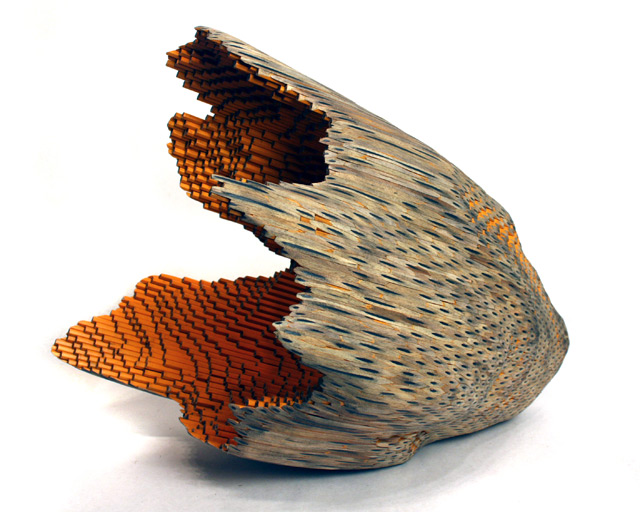
Jessica Drenk was born and grew up in Montana, developing a tremendous affinity for the natural world around her, background that has had a very deep influence on her art.  As reported by arts blog This Is Colossal:

Drenk’s most recent sculptures are a series called Implements, each of which begins with a mass of standard No. 2 pencils that have been tightly glued together. Using an electric sander she then molds the piece into a form that seems more likely to have originated in a dark cave or deep within the ocean than from a school desk. Of her work she says:

“By transforming familiar objects into nature-inspired forms and patterns, I examine how we classify the world around us. Manufactured goods appear as natural objects, something functional becomes something decorative, a simple material is made complex, and the commonplace becomes unique. In changing books into fossilized remnants of our culture, or in arranging elegantly sliced PVC pipes to suggest ripple and wave patterns, I create a connection between the man-made and the natural.”

drenk-3Haroshi is a self-taught artist from Japan. This skull, made from recycled skateboard decks, is just awesome.

haroshi-1Finally, Vadim Zaritsky is a former army office turned artist and entymologist – and uses the wings of dead butterflies, found either beside the road or thrown out from collections. In his own words on Oddity Central:

“Butterfly collectors know that some wings are considered – collectors call it trash,” Zaritsky says. “If the wings are damaged, if they have partially faded, specialists would usually put them aside. It’s a shame to throw them away but you cannot use them either. In time, the bits may become infested with pests and you have to throw everything away anyway.”

Vadim-Zaritsky-butterfly-wings-550x406

Rape: the shocking failure of our legal system – and our media

According to figures released by the Home Office, Ministry of Justice and the Office for National Statistics, more and more incidents of women being raped in England and Wales are being recorded:

2009/10

2010/11

2011/12

Rape of a female

13,902

14,589

14,767

Rape of a male

1,172

1,303

1,274

That is a total of 47,007 incidents of recorded rape over a three year period.

And the number of convictions for rape in that same period (and yes, I know there is no absolute read-across between the offences and convictions)?

1,372.

Yet these figures don’t reveal the horrific extent of rape and serious sexual offences in England and Wales: the report also shows that 57% of women told someone but not the police of a rape or serious sexual assault. 28% told no-one.

And then the questions…

There were “only” 40 non-custodial sentences for rape in 2011. Excuse me? Why were there any?

Apparently “Since 2005, there have been fewer than seven Suspended Sentences Orders (SSOs) given each year for rape of a female and none have been given for rape of a male.” What does the fact that any SSOs have been given  say about differences in perceptions between rape of a female and rape of a male?

Another shocking statistic is that, on average, it is 722 days from the moment someone is raped until the completion of the case. That is almost two years of reliving the hell of what happened in order to secure justice. Why should someone have to wait so long?

There are  so many important questions that arise from this report it is difficult to know where to start.

The figures should hit home like an iron bar hammered in your face.

They should be screamed across the  front page of every newspaper. They are utterly appalling – and reveal a shocking affront to justice that reminds us we are light years from ensuring that rape victims receive the support they need to ensure perpetrators are brought to justice.

And now, in the wake of Leveson, is the ideal time for the press to demonstrate their worth. After all, we’ve had plenty of self-indulgent hand-wringing in recent months, most notably about the important role played by our newspapers in our public life and democracy. In his evidence to Leveson, The Sun’s editor, Dominic Mohan, extolled his paper’s virtues (Para. 60):

“It distils complex important issues of the day, including politics, finance and law into concise readable copy which educates and entertains.”

So, on a day when official statistics reveal such a shocking failure of our investigative and legal processes, on an issue that clearly straddles law and politics, what was this bastion of our free press’s front page?

The_Sun_newspaper_front_page

Perhaps we would expect such crassness and double-standards from The Sun. But what were the front pages of most the other main UK papers today?

This slideshow requires JavaScript.

Only two national newspapers ran the story on their front pages: The Independent and i – the quality tabloid off-shoot of The Independent:

Metro, the newspaper given out free in major cities, also had it on its front page.

Where were all the others?

Where was The Guardian,  never usually bashful in its self-promotion as the left-wing champion of women’s rights and awareness of issues that particularly affect women? Who knows. It certainly doesn’t consider this report front page news. Even after the Savile report was released, The Independent still had this story as a second headline on its website. By contrast, it was the 17th headline on The Guardian Online – appalling.

What does this lack of interest say about a media more concerned with itself than getting to the core of issues that affect hundreds of thousands of people in the most horrendous ways?

It is a corroboration of the silence and inaction that characterises our society’s approach to rape – an approach that continues to allow rapists to escape justice. With Savile, with the horrors of Steubenville and Delhi, perhaps this might just change. Perhaps. But we shouldn’t kid ourselves that any of these are, in and of themselves, the answer.

As Deborah McIlveen, policy and services manager at Women’s Aid, told the Independent:

“Despite all that is known about rape and sexual violence, the justice system still fails to hold most rapists to account and so fails to deliver victim safety, public protection and management of perpetrator risk. These men are free to continue to rape and this is unacceptable, harmful and illegal.

“Most rape victims can identify their abuser, and many of these will be their partners or ex-partners.  This ongoing failure to secure convictions will continue to leave women and young people vulnerable and in potentially risky situations.”

And as spokeswoman for Rape Crisis England and Wales told the Independent:

“The figures are shocking but sadly not that surprising. There has been lots of publicity and measures put in place to try and increase the conviction rate around rape and sexual abuse. But it looks like it is not having as much effect as we would like.

“It is a chicken and egg situation: women do not report offences because they know they are very unlikely to get a conviction. They know they would have to put themselves through a system which is very traumatic and are likely to come out at the other end with no justice.”

If it matters to you, read the report for yourself. Ask questions.

And don’t be silent.

Remote-controlled quadcopter – I want one (please)

This has to be the ultimate gadget junky’s toy!

Flight control specialists DJI-Innovations have released a consumer toy version of their radio-controlled flight platforms – and it looks like a hell of a lot of fun.

The Phantom quadcopter is a technological mini-marvel. It can hit 6m/s vertically and 10m/s horizontally, has a range of 300m, built-in GPS for fly-home programming (i.e. if it goes out of range, it’ll fly home and land itself if the GPS signal is strong enough) and a flying time of between 10 and 15 minutes. It can also automatically land itself if the battery is low.

It also comes with a mount for the phenomenal GoPro range of video cameras. Beyond the geeky fun value, the potential for amateur film-makers wanting a different perspective, or the likes of conservationists, gardeners etc. who want to see how things appear from the air looks immense.

Tech blog gizmag has an extended review.

So if anyone is feeling generous, I’ll have one of each, please.

Bob Newhart on the origins of tobacco

“Bob” Newhart, born George Robert Newhart in Austin, Chicago in 1929, is an American actor and comedian with a fascinating and varied career. I first came across him guesting on Desperate Housewives.

In awarding him a Peabody Award for the Bob Newhart Show in 1961, the board said:

… a person whose gentle satire and wry and irreverent wit waft a breath of fresh and bracing air through the stale and stuffy electronic corridors. A merry marauder, who looks less like St. George than a choirboy, Newhart has wounded, if not slain, many of the dragons that stalk our society. In a troubled and apprehensive world, Newhart has proved once again that laughter is the best medicine.

His routines are characterised by a deadpan delivery and one of his classics is entitled “Introducing Tobacco To Civilisation”, performing a very funny riff on how we started smoking.

Sometimes humour stays fresh across the decades.

Crazy, Stupid, Gun Love: Piers Morgan’s bizarre and frightening interview with Alex Jones on gun control

I’m a Facebook follower of Upworthy, the social media site that sets out its mission: “To make meaningful stories go viral.” A particular story arrived today, clipping an interview on Monday night between Piers Morgan and Alex Jones, a pro-gun campaigner and radio host who co-organised a petition to deport Morgan from the USA (where he has a regular presenter’s slot on CNN) for offering supportive gun-control comments in the wake of Sandy Hook.

I’m not a fan of Morgan – but he exemplifies everything that is right in a calm and measured presenter. By contrast, Jones is frankly terrifying.

I hope Upworthy don’t mind – I am going to reproduce their commentary in full.

Piers Morgan decided to advocate gun control after Sandy Hook. That caused this radio host, Alex Jones, who has millions of listeners (listeners I’d prefer to never meet), to create a petition to have Piers deported.

Being the reasonable bloke he is, Piers invited Alex on his show to have a civil debate about guns. What follows is the most jaw-droppingly incoherent interview I have ever seen, in two deranged parts. The fact that this interview actually made Piers Morgan the most tolerable person on TV for 14 minutes isn’t even the craziest thing about it.

If this is what we’re up against in the reasonable gun law debate, no wonder nothing gets done. Piers should get the Medal of Honor for not requesting a medical team to come tranquilize Alex and have him committed.

Upworthy – Act I: The Dumbening

  • At :30, in a hint at what’s about to happen, Jones gets things started by changing the subject completely, and then crafting a disconnected slew of sentence fragments.
  • At 2:10-2:36, Alex threatens to burn America to the ground if he doesn’t get his way.
  • At 2:50, Alex reminds Piers (for the first of many times) that Americans once fought a war against the British. Piers responds with the kind of scathing, passive-aggressive restraint that the British have spent centuries mastering.
  • At 3:48, Alex talks about marine biology.
  • At 4:25, Alex talks about his favorite part of “Mad Max.”
  • At 6:40, Piers gives up on getting anything coherent out of him.

Act II: All Aboard The Conspiracy Train

  • From 0-0:18, Piers suggests calming things down and actually having something resembling a coherent conversation. And then Alex starts speaking again, thus anything resembling healthy discourse ceases to exist.
  • At 1:33, Alex thinks an AR-15 will protect him from the largest military in the world and accuses all American soldiers of being potential traitors. Also, HITLER.
  • At 2:35, no judgment here, I just want to transcribe what Jones just managed to say, “A study out of Hawaii killed 292 million people.” He also requests that you google “Democide”, so for balance sake, click here.
  • At 4:22, Alex quotes his favorite part of “Soylent Green” or “Dawn of the Dead.”
  • From 4:51-5:40, Piers decides to let America in on the inner workings of Alex’s brain.
  • At 5:40 … 5:40. Don’t cheat and skip ahead to this. Just be ready for it. Trust me on this one. It’s like “Masterpiece Theatre.”
  • Aaaaand at 6:27, Piers finally says what the rest of us are thinking.

Poem: On recalling a pigeon with a torn wing

We stopped and stared – young and old,
city shark and office cleaner,
the sensitive and the usually oblivious –
each hoping we might fix this small
and broken fearful bundle
hopping madly through the crowds,
its frailty and incompleteness
drawing out our wishes
for a healing or the serendipitous.

We walked on by – rich and poor,
business sort and volunteer,
the parent and the usually compassionate –
each hoping to forget the tall
but broken fearful bundle
huddled in the doorway,
his frailty and incompleteness
authored by a sad misfortune
or, uncomfortably, by chance and us.