Lights Under bushels – my little cousin’s travel writing

So I have always loved my cool cousin and not just because he is called Kit. Which is definitely cool.

It turns out that he likes German – and for his year out he is working at the Hotel Gasthof Stern in Gößweinstein, where he seems to be having a whale of a time. Bernd and Heike run Gasthof Stern with all the love and attention they would expend on their own home. Kit seems to be fitting right in and will be looking to help see them bumped up from a four to five on Tripadvisor.

Anyway, the main reason for writing this post was to give a plug to Kit’s blog. Funny, well-written and well worth checking out, he seems to have been keeping this talent for word-smithing very quiet.

Hope you enjoy his musings.

Bonfire Night and Halloween come together in Langdon Hills

There is something deliciously primal about a decent bonfire.

The best take time and effort to build. The hours spent cutting wood in different seasons, from field and copse, heaped up on Saturday mornings and Sunday afternoons. The brambles cleared from the hedge. The scrub cleared from the meadow.

That wood has its own unremarkable stories.

The branch of an old, dying pear tree, broken under the weight of its own fruit. It had lain there on the lawn like some skeletal limb bedecked with pears. I dragged it through the arch and slung it high.

A leylandii, a gift from a cousin, planted as a tiny sapling in 1976. Over the years it grew to a tremendous height but it cast such a dark gloom on the garden that nothing could grow in its shadow. Matt, who cut it down, said that no-one was really sure how high they grew in the UK, as they were always brought down before they reached their potential. It was a difficult decision to fell it, but, as it crashed down, light flooded in to coax new blooms from hitherto dead earth. We cut it up where it lay, tugging it from the slopes where it grew to its funeral pyre.

The magnificent birch that stood in the meadow but was claimed by the  Great Storm of 1987. It crushed Mrs Croft’s old iron roller as it fell. In time new growth sprouted and, like the old apple tree by the “camp” that was also claimed by the winds that night, it began a new life, growing horizontally. To clear round it I cut back some of those new branches, hanging over hedge and ditch.

These were just my recent efforts.

Underneath lay the results of earlier culls by other hands on other days. Birch, holly, fir, oak, chestnut, ash, blackthorn, bramble and nettle all heaped up together, weathering quietly in rain and frost and snow and under Summer’s lazy sunshine. As we lived our lives, so the wood seasoned, day by day, week by week, month by month, year by year.

I don’t know how many times we postponed the decision to light that bonfire over the last two or three years.

Three times? Four?

As time passes, people enter and leave our lives. Some get caught up with other things. Some simply drift away. Each decision not to burn changes the configuration of companions who might eventually come together for that final striking of the match.

Tonight we gathered in the gloaming, the table laden with beer and jacket potatoes and sausages and toffee apples and cakes. We were a motley mixture of three generations, all young at heart, each of us missing family and friends who might otherwise have joined us – some of us more reflective than others.

Paths and our feast were lit with hurricane lamps, the smell of burning paraffin a strange comfort that evoked memories of past happy times.  Rod had set his moth trap on the lawn. The three youngest had carved pumpkins – eerie, flickering imps that watched us silently through the evening.

There is something about that sort of gathering that I love – the camaraderie, the friendship, the food, the excitement of children adventuring safely in the dark. Then there is that moment of nervous quiet as the match is struck, all those looking on willing it to catch properly. And finally, the cheers as the paper is lit and the kindling fired. When a little person tugged at my arm and looked up at me with big wide eyes, her words took me straight back to my own childhood. “This is my first ever bonfire!” she exclaimed, nervous and eager all at once.

It was a spectacular bonfire.

It caught from a single strike, the hiss and spit of the kindling soon becoming a roar as flames leapt into the dark, showering the meadow with sparks, and raging through the heap before us. The food was delicious and the beer refreshing. We talked and laughed against the whine and crack of the blaze and small hands held glow tubes and sparklers, colours dancing away like magic into the night.

Everyone there had lost someone.

Everyone there was missing someone.

Everyone there was enjoying the comfort of family and friends.

Before we finished, Rod checked his moth-trap. He called us over excitedly. Inside was a rare moth that in all his years searching on the hills he had never found: Merveille du Jour. How apt to end the evening with the Marvel of the Day.

Enjoy the pictures.

This slideshow requires JavaScript.

And the video.

Autumn colours

Out in the meadow and I saw these leaves. So time for a quick snap and my first posting from the Samsung Galaxy S2.

Poems, Prayers and Promises… Do they still write them like this?

I have an eclectic musical taste that roams the genres and I can find myself listening to anything from Finzi and Mozart, to Counting Crows, The Jayhawks, Guns N’Roses, Linkin Park and Sick Puppies, all via the Pet Shop Boys, “Ibiza dance” and Lady Ga Ga. Not forgetting of course Led Zeppelin, U2, Nightwish, The Village People etc etc…

Nothing gets to me though quite like John Denver and there is one album in particular that defines him for me: Poems, Prayers and Promises.

It was his fourth album and every song is an acoustic musical masterpiece (except “The Box”, Kendrew Lascelles’s stunning anti-war poem, read with genuine agony by Denver on the last track of side two). His beautiful tenor soars and swoops, occasionally tinged with a spine-tingling melancholy, and the lyrics are homely, humbling and thought-provoking without being trite.

Perhaps it is because it is the first non-classical record I heard Mum and Dad play that it means so much to me. Perhaps it is because it conjures safe memories of lying on the carpet in pools of dappled sunlight, thinking that days like that could never end. Perhaps it is because it has been the soundtrack to many a long car journey to Cornwall. Or perhaps it is because its calm simplicity lets me find my centre, even in the hardest times.

John Denver died in 1997. What a beautiful legacy to leave.

From “Poems, Prayers and Promises”

The days they pass so quickly now

Nights are seldom long

And time around me whispers when it’s cold

The changes somehow frighten me

Still I have to smile

It turns me on to think of growing old

For though my life’s been good to me

There’s still so much to do

So many things my mind has never known

I’d like to raise a family

I’d like to sail away

And dance across the mountains on the moon


I have to say it now

It’s been a good life all in all

It’s really fine

To have the chance to hang around

And lie there by the fire

And watch the evening tire

While all my friends and my old lady

Sit and watch the sun go down


And talk of poems and prayers and promises

And things that we believe in

How sweet it is to love someone

How right it is to care

How long it’s been since yesterday

What about tomorrow

What about our dreams

And all the memories we share

Vodpod videos no longer available.

Reflections on a Spring morning’s commute

Each morning the C2C trains trundle into London, beginning their journey in Shoeburyness, the end of the line that lies in close proximity to the secrecy-shrouded MOD facilities of the tidal island of Foulness. One hour and ten minutes later they arrive in Fenchurch Street, the oft-forgotten commuter terminal for East Essex that hides between the contradiction of gleaming office blocks and ramshackle reminders of older, darker London such as the East India Arms.

These trains pass through the seaside excitements of Southend, on past the old-now-fashionable fishing town of Leigh and then through the connurbation of Pitsea, which, with the closure of the Motorboat Museum, has almost lost its struggle to retain a sense of its own maritime connections. From Pitsea the journey enters the sprawl of Basildon, the brash young upstart neighbour of both Pitsea and Laindon, both of which were the principal local urban centres prior to the Whitehall social laboratory experiment which was the New Towns Act 1946.

Between Laindon and the sleepiness of West Horndon lies my favourite part of my daily commute: the Bulphan Fen.

Yes, I love the bleak industrial landscape of the detours via the loop line, forced on weary travellers by endless engineering works: the vast and towering complexes of Dagenham; the faded, crumbling decay of Tilbury’s dockside menace; and the empty mystery of Purfleet and its invisible military history. Yes, I love, too, the changing landscape of East London, where clean, proud new build sits between the higgledy-piggledy tangle of scrap-yards, brick-arch businesses and the shells of now-forgotten commercial giants of Britain’s imperial past.

However, for me, nothing touches the vast, rural emptiness of the Bulphan Fen for its capacity to reassure, by reminding me I have truly left the loud metropolitan chaos of the city behind me. Perhaps it is because it is the stretch I have travelled for more years than any other, the daily schoolboy journey to Upminster a daily and extravagant adventure that took me far from the country comfort of Langdon Hills. Whatever the reason, nothing gives me the calm reassurance of the prospect of home as much as this small stretch of a rural England that is quickly vanishing.

In Summer, the setting sun casts long, warm shadows that stretch from field to field, heralding barbecue-weekends, the easy company of family sharing a glass or two under the reaches of the old vine and the wistful strains of Finzi or Vaughn-Williams teasing our souls with the melancholia of English poems and promises.

In Autumn, tendrils of mist snake between the trees and hang low in the fields. They lend the landscape an ethereal shroud worthy of Tolkein that disguises agricultural purpose and hides the pylon sentinels in their silent vigil over this corner of South Essex.

In Winter, icy frosts glitter on earth as hard as iron. These last two years such frosts foretold the blizzards which saw our landscape reborn white and pristine, the dangers of broken road and path buried by snows that harbour their own cruelties and hazards.

And in today’s Spring morning, green fields sparkled with dew under cloudless blue skies and commuters burred quietly with refreshing wonder about the sunshine, its bold appearance vanquishing the greyness of February’s dying season.

I love the Bulphan Fen – and its enduring promise of home.

Population 51,201 and Waldo the bird is dead… It is gloriously bonkers and I am glad to be back home

“The owls are not what they seem…”

I remember it vividly.

1990 and Twin Peaks had been the subject of fevered classroom conversation for weeks. There had been teasers and trailers. Deliciously, it was airing on BBC2. Mark and I were in our final year of sixth form, enjoying a friendship that had been long in the making: a knowledge of each other in primary school refined by the ruin of other friendships in secondary school and a discovery of shared interests in gaming and cards and quirky television.

Twin Peaks, the product of the warped creative genius of David Lynch and Mark Frost, was unlike anything else that had been on television. It was the 1990s and it was the first decade I felt I could truly own, really aware of the music and film and television informing the media culture we were growing up in. It was also the last Century of a dying Millennium and somehow the dark weirdness of Twin Peaks seemed utterly appropriate. And from the slow motion opening credits, accompanied by Angelo Badalamenti’s haunting score, I knew we were hooked.

The murder of Laura Palmer – and the seductive overtures of Sherilyn Fenn’s Audrey Horne – would overshadow our final school days.

That all seems a long time ago now and in the intervening years I forgot the specific qualities that made Twin Peaks uniquely brilliant. More sadly, friendships faded and with them the remembrance of things that made them live so vividly at the time.

Then, several years back I spotted Twin Peaks on DVD.

I couldn’t resist. I wanted to know if it had stood the test of time. And I wasn’t disappointed.

Like the very best wine and the very best whisky it had improved. In an almost Lynchian way, it didn’t feel dated – perhaps because so many of the usual markers that age television of a period (technology, city fashions etc) are absent. Instead it was fresh and provocative. And, once again, Twin Peaks accompanied the transformation of a relationship – this time in a very much better direction.

Having previously watched the whole of Sex and the City back to back with Em, Twin Peaks was always going to be something of a contrast. However, we were immediately immersed in Lynch’s mischievous and murderously dark envisioning, lapping up Agent Cooper’s humorous musings, Audrey Horne’s sensuous teasings and hankering after a mug of “damn fine coffee” and a slice of cherry pie.

Lynch is one of our favourite directors.

Even at his most disturbing, there is something shockingly honest about his camera and what it sees. Wild at Heart is one of the films that sticks most in my memory, my Midnight Cowboy or  The Graduate, seeing it for the first time after I moved away from home to begin my studies in Hull. Nicolas Cage and Laura Dern give two career-defining performances in this twisted celluloid nightmare that somehow veers just the right side of kitsch, ricocheting through the violent badlands of an America that is only equalled by that of Quentin Tarantino and Oliver Stone in its capacity for brutality. IMDb has a long list of film trivia that is testament to the influences on Lynch and which he recognises in Twin Peaks through wry asides and visual tributes.

Em loved it.

And we both shared the same enormous frustration at learning that the release of Series Two had been held up by legal wranglings. I was particularly keen to get hold of it as I had – have – seen every episode except the very last. Mark never spoiled it for me and I don’t know to this day how the series resolved.

On several consecutive August excursions to Cornwall we asked the guy in Moods and Visions, in Falmouth’s George’s Arcade, if it had been released. We always left empty-handed, wondering if we would ever get to sit down with Coop again.

Then, quite by chance, walking past Basildon’s HMV just last week, I saw it.

Series Two.

Tonight we went back to Twin Peaks and picked up where we left off. It is gloriously bonkers and I am glad to be back home.

Buy it. Watch it.

Enjoy it for the uniquely brilliant piece of extended television theatre it is.

And just in case you are reading, Mark, here’s another little reminder of 1990…

Add to FacebookAdd to DiggAdd to Del.icio.usAdd to StumbleuponAdd to RedditAdd to BlinklistAdd to TwitterAdd to TechnoratiAdd to Yahoo BuzzAdd to Newsvine

Another beautiful Sunday

“All in the April evening,

April airs were abroad.”

On our way to dinner this evening, Emma and I decided to walk the hundred yards or so of unmade back lanes, arriving at Mum and Dad’s through the field beside Hillcroft.

April harbours beautiful light, a cacophony of Spring birdsong and distinct scents that each evoke fragments of memories like few other things can. The western verge of Northlands Approach had been cleared for the first time in years and the smell of damp earth bursting with fresh green life was heady. The sun had already slipped behind Coombe Woods, the clouds buffed in pink grey above the silhouette of trees. As we turned into Coombe Drive we could hear the birds in full voice before sundown, thrushes, blackbirds, robins, tits, finches and sparrows vying for air time, invisible yet at the same time more real and present in tunes than ever a band is on an MP3 player.

Walking up the field, it was great to feel the soft, damp grass under our feet, lush and spongy. Picking our way slowly to the top of the rise, by the woodshed, I stopped to take a picture.

Another perfect Sunday.

Sunset at Hillcroft

Add to FacebookAdd to DiggAdd to Del.icio.usAdd to StumbleuponAdd to RedditAdd to BlinklistAdd to TwitterAdd to TechnoratiAdd to Yahoo BuzzAdd to Newsvine

The Enchanted Palace wins Guardian plaudits… Go Ellie! #wildworks

My Paloma-fabulous sister Ellie texted to let me know that The Enchanted Palace project with Wildworks that she and Myth have been working on has attracted a rave review in the Guardian. Ellie has devoted much of her effort to the creation of The Room of Royal Secrets, telling the disturbing story of Peter the Wild Boy.

Found in the forests of Hanover, near Hamelin (the town at the centre of the Pied Piper legend), Peter was brought to London by King George I, who was also Duke of Hanover. Achieving celebrity status in an era without X-Factor, Twitter and Facebook, Peter’s life inspired Daniel Dafoe to write a book about him Mere Nature Delineated: Or a Body Without a Soul with the following subtitle:

“Being observations on the young forester lately brought to Town from Germany. With suitable applications. Also, a brief dissertation upon the usefulness and necessity of fools, whether political or natural.”

However, Roger Moorehouse, in an extensive article on Peter’s life, reminds us that the notion of fame as fleeting and cruel isn’t confined to this era of d-list stars and throwaway magazines:

“Peter quickly became a celebrity. On one level, tales of his antics busied the London gazettes. Jonathan Swift, whose fictional ‘Yahoos’ Peter appeared to personify, noted sourly that “there is scarcely talk of anything else”… But Peter could not to live up to the popular interest invested in him and a fickle public quickly abandoned him in favour of the next unfortunate.”

In the peculiar way of things related to that other world of monarchs and royal households, Peter, now living an anonymous life away from the city, remained looked after. As Moorehouse writes: “His keep was paid by the Crown for nearly 60 years, through three reigns, and, when he died, a brass tablet was erected to his memory at royal expense.”

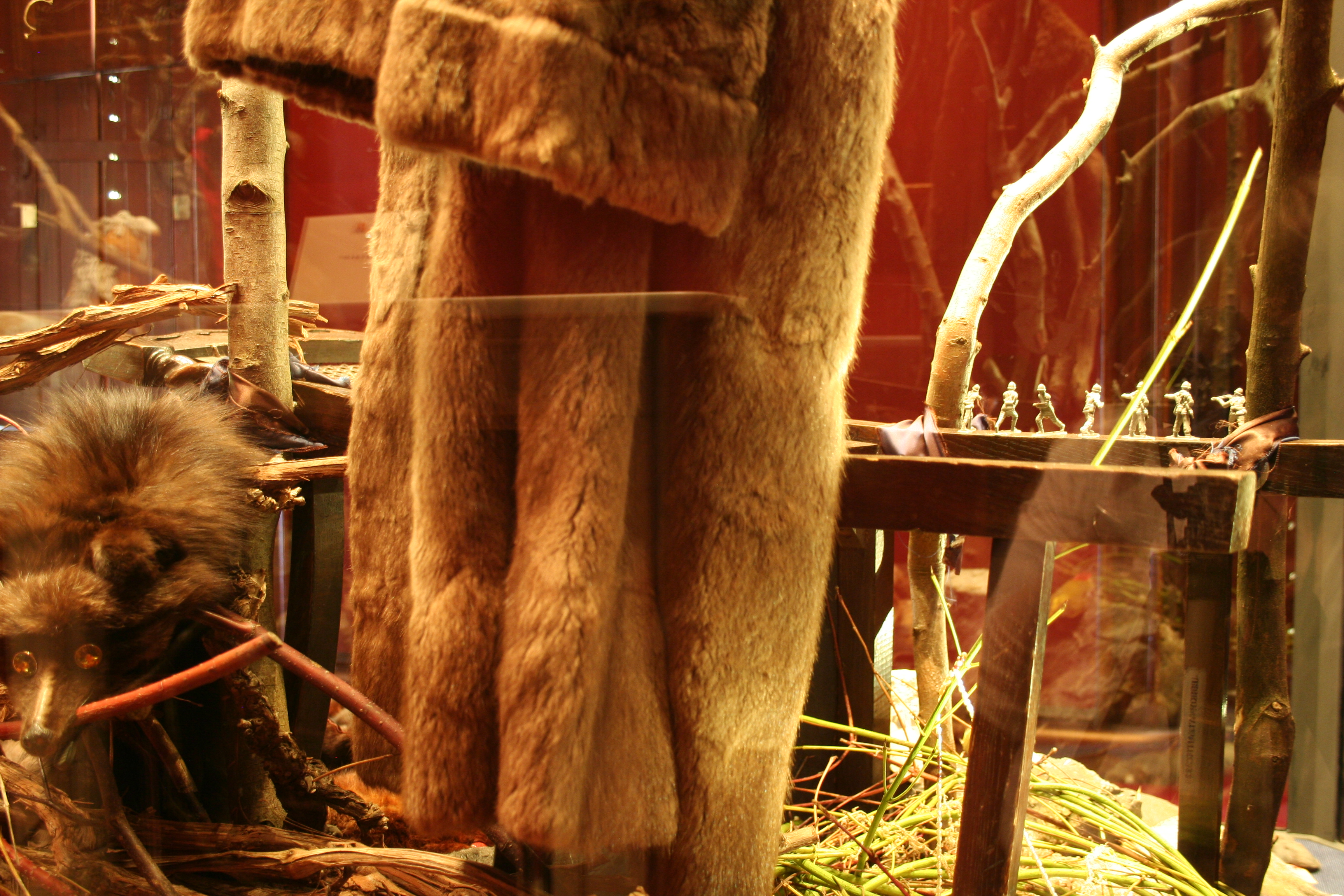
Ellie has essentially been creating a den, the sort of place Peter might have lived in and sought comfort in when retreating from a world of courtesans and pages, princes and princesses:

Writing in Friday’s Guardian, Amy Stone is well aware of the long-standing tensions between fashion and art, yet is bold in her assessment of the success of The Enchanted Palace:

“The show also (whisper it) makes for fantastic art: ghostly, ethereal and layered with subtext. These are museum pieces created for an exhibition true to the conviction that high fashion and high drama go hand in hand. Curators should take note: no more dutiful dusting down of designer archives, please. Fashion’s very essence is living, breathing and moving – something its art shows should cotton on to.”

The Guardian also wrote about The Enchanted Palace on 25 March, after the press preview, describing what visitors to the rooms will encounter and how they can interact with this immense creation of Wildworks and co.

I can’t wait to go.


Add to FacebookAdd to DiggAdd to Del.icio.usAdd to StumbleuponAdd to RedditAdd to BlinklistAdd to TwitterAdd to TechnoratiAdd to Yahoo BuzzAdd to Newsvine

The fabulous Paloma Faith at the Shepherd’s Bush Empire

It’s rare for Em and I to have the time or energy to go out in the week.

Every now and then, though, browsing around the net late at night, you stumble across something at exactly the moment you need it. At a pretty low point, I noticed Paloma Faith had added an extra concert to her sold-out two-gig finale at the O2 Shepherd’s Bush Empire. I snapped up a pair of tickets to the very last night of her month-long UK tour.

I don’t think I had been to see a gig in Hammersmith since I saw Queensrÿche on their  Operation: Mindcrime tour in November 1990 (remember that, Stringbean?).

There was something of a hiatus in my concert-going between 1991 and 2009.  I left off with Guns and Roses at Wembley Stadium on 31 August 1991 and resumed with a Jazz Café turn by the brilliant Mark Olson and Gary Louris of The Jayhawks on 12 May 2009. That was quickly followed by 14 May 2009’s stunning turn by Counting Crows at Wembley Arena. The review in The Times didn’t do it justice.

So going to see Paloma Faith was part of my on-going campaign to ensure I don’t slip back into a nineteen-year bad habit of not enjoying live music.

Hammersmith is a great part of London. It feels edgier and grubbier and more alive than the museum space of Westminster, a feeling heightened by a sharp March wind, soft rays of light from a setting sun and the collision of sharp scents – ozone, grilled and spiced meats, exotic tobacco and patchouli.

In a confident gig-going frame of mind I led Em purposefully through the streets of Hammersmith, having chosen to get out at Goldhawk Road tube station (I didn’t even know there was a Goldhawk Road tube station until we were sitting on the District Line at 6.15pm!). Having a pretty good head for directions, I found the Empire quickly and we joined the queue, feeling a little smug that we had found the place with little fuss. Unfortunately, I found the wrong queue, and on reaching the door we stepped out of the one for the stalls and joined the back of the one on the other side of the building for the upper tier.

It was well worth the wait.

The concert opened with Josh Weller, an indie popster with the most incredible hairstyle who previously collaborated with Paloma Faith on the single It’s Christmas (And I Hate You). His band were tight and their songs polished, though most of his set was ruined for me by the woman behind who insisted on talking (read shouting) to her friend through the entire performance (it was nearly a Jack Reacher moment). It was refreshing, too, to see a support act talking so fondly about the head-liner – he clearly has a huge amount of respect for his headlining colleague.

When Paloma Faith finally appeared, a few minutes after 9pm, we roared our approval.

I couldn’t get my head around the fact that this was her first UK tour.

She had energy and confidence and polish in spades, each number note perfect and delivered with phenomenal passion. With a dry and kooky sense of humour, she was backed up by a band of extraordinary talent, who were able to heavy-ify and disco-ify her songs according to Paloma’s mischievous wishes. Introducing her songs with a humorous and relaxed delivery, she was beautifully blunt about the journalist who had accused her of insecurities for highlighting her influences, saying she simply believed in saying “thank you”. She then launched straight into a superb rendition of Billie Holiday’s God Bless The Child.

And how did she bounce around the stage in what looked like four-inch heels? That is definitely a girl mystery.

If you know her debut album, Do You Want The Truth Or Something Beautiful?, you’ll know that each song is a creative juxtaposition of melodic even jaunty pop and haunting, occasionally heart-breaking, lyrics. For Romance Is Dead she selected a gentleman from the audience to serenade, hamming up her weary resignation to a love-life of plastic flowers and greasy fingerprints. Later, She poignantly reminded us of the loss of her friend that inspired My Legs Are Weak.

At the very end, closing the formal set list with Play On, and teasing her audience over the possibility of an encore as only someone with a working knowledge of burlesque could do, she had, by dint of omission, left us in no doubt as to her final number – the sing-along pop anthem New York. As the band struck up and Paloma pointed her mic to the audience for the sing-along choruses, it was great to know we were indeed at the start of something beautiful.

I was reading tips recently on how to write reviews and an “expert” writer cautioned would-be reviewers against describing something as “brilliant” or “fantastic”.

Well sod that.

It was a fantastic night out and Paloma Faith was simply brilliant. She will play on for a long time to come – and we can be grateful for that.

Add to FacebookAdd to DiggAdd to Del.icio.usAdd to StumbleuponAdd to RedditAdd to BlinklistAdd to TwitterAdd to TechnoratiAdd to Yahoo BuzzAdd to Newsvine

If you’ve not done so, meet Jack Reacher #reacher

“Men want to be him, women want to be with him…”

Like everyone, I have a secret vice or two. One of these is a penchant for airport thrillers, the sort of unputdownable page-turner that lets you be the bone-crunching, Glock-packing loner-hero you always intended to be before discovering computer games, cheese sandwiches and DVD box-sets.

The apotheosis of this page-projected  fantasy-self has to be Jack Reacher.

There are moments on late night vomit-comets out of Fenchurch Street when I consider swinging into action, despatching anti-social hoods left, right and centre. Then I remember I’ve only got a handful of shirts and that, combined with a pathological fear of getting my nose broken, lead me usually to consider waiting until I am more suitably attired.

Andy Martin, writing in the Independent, sums up Reacher brilliantly: “Reacher is a moody, modern outsider figure, one of the great anti-heroes. He is anti-capitalism, anti-materialism, anti-religion, with a fondness for anarchy and revolution: a liberal intellectual with machismo, and arms the size of Popeye’s.”

I am sure those who know me can spot the similarity.

It is more than a little ironic that Jack Reacher, the all-American action hero, romantic loner and chivalrous sharpshooter, is actually the creation of a Brit, Lee Child, who turned to writing at forty after losing his job with Granada TV. David Smith’s 2008 profile piece in the Guardian gives hope to all of us who are still nurturing hopes of becoming international best-selling authors.

So why my puppyish over-excitement?

Last weekend I happened to pass by Waterstone’s and discovered that Lee Child’s latest Reacher book was out: 61 Hours. And it’s brilliant. As friends and family can testify, the Smallest Room in the House doubles as the Lesser Library – and I am locking myself away in there with Jack Reacher on a regular basis.

There are rumours, too, of a Jack Reacher film, though nothing more recent than 2008 (on a cursory trawl). And whilst not strictly in keeping with Child’s description of Reacher, I can’t get away from the idea of him being played by the brilliant and chiselled Christopher Melloni, better known to many as Elliot Stabler in Law and Order: Special Victims Unit.

So if you’ve not done so already, and enjoy a pulp read with plenty of action and fast-plotted twists, introduce yourself to Jack Reacher and check out The Killing Floor. And if you are a UK inquisitive, you might want to check out Jack Reacher’s official UK fan site, too.

And one final warning.

If you are a lager lout on a late night last train out of London and you see me wearing jeans… Watch out.

Add to FacebookAdd to DiggAdd to Del.icio.usAdd to StumbleuponAdd to RedditAdd to BlinklistAdd to TwitterAdd to TechnoratiAdd to Yahoo BuzzAdd to Newsvine