This is why cats are cool

I’ve always liked cats.

I’m a fan of dogs, of course, but cats just do it for me with that slightly snide cunning, that sense that they really are the sharpest tools in the box. In that spirit, meet Kido – a very cool cat who plays a shell game and wins every time.

That said, I think mine would rip my throat out if I tried to get him to perform on camera…


Coming soon… A history of noise

Noise.

It fills our lives. It is something that is so constant that I doubt any of us really experience true silence except perhaps on a few occasions in our lives. There is the daily burr that forms a soundtrack to our lives that we barely pay attention to any more. There are the phones chirruping away, cars passing, doors closing, papers shuffling, colleagues talking at the water cooler, footsteps in the corridor. The list is endless.

In more peaceful places there is still noise: the wind in the trees, birds singing, the sea on the shore, the rustle of grass as we walk. Even now, in this house, with no music playing, the windows double-glazed and with the heating currently off, I can hear the whirr of the computer’s fan and my fingers clicking on the keyboard (and what a joy it is to be typing on a real keyboard, not a laptop or a Blackberry). At other times there might be the creak of pipes or the sound of the house settling after the day or a distant siren howling through the town.

Interestingly, pretty much the world’s quietest place isn’t in the middle of nowhere at all. It is at Orfield Laboratories, in their anechoic chamber:

anechoic chamberAnechoic means echo free and this chamber is designed to completely absorb sound waves and create an experimental space in which there can be absolute silence. Somehow or other I suspect that I would end up being driven mad by the sound of the blood rushing in my ears!

Anyway, browsing Facebook, the feed of an old friend with whom I wish I kept in better touch flashed up a link to a blog: Noise – A human history. Starting Monday 18 March, this 30-part series will explore the role of sound in the past 100,000 years of human history As it says on the blog:

“Recorded on location around the world, it will take us from the shamanistic trance-music of our cave-dwelling ancestors, the babel of ancient Rome, the massacre of noisy cats in pre-revolutionary Paris, and the sonic assaults of trench warfare, right through to our struggle to find calm in the cacophony of a modern metropolis. This is not about sound in the abstract: it is about sound as a matter of life and death, pain and pleasure, feeling and intellect. People, and their past behaviours, are at the heart of it.”

Sound has always fascinated me – how we become attuned to some sounds and not to others, how music can bend our emotions, how people communicate, how we hear the world when we actually stop to listen. Something tells me that this series will be quite special.

Check it out – and those of you who enjoy quality radio, listen out for it.

A tale of three astronauts – and Soichi Noguchi’s photographs

Once upon a time in a galaxy far, far away…

Or something like that.

It was actually 1983 and Langdon Hills, Essex – and two friends, Bob and Ben, dreamed of becoming astronauts.

They used to sneak off to the school library in Lincewood Junior School  to look at space books. They wrote to NASA. They wrote space stories and they made space project books.

Then one day reality bit, as it tends to, and the dream died. One got embroiled in politics and the other joined the army (no prizes for guessing which I didn’t do!).

However, just at the time that Ben and Bob were dreaming space, Soichi Noguchi was in his penultimate year at Chigasaki-Hokuryo High School, about to study Aeronautical Engineering at Tokyo University.  In 1996, while Ben was stepping into Parliament for the first time, Noguchi was selected to train as an astronaut.

Noguchi was later lucky enough to travel to the International Space Station. His official NASA biography  is enough to make a Ben or a Bob green with envy:

SPACE FLIGHT EXPERIENCE: STS-114 Discovery (July 26-August 9, 2005) was the Return to Flight mission during which the Shuttle docked with the International Space Station and the crew tested and evaluated new procedures for flight safety and Shuttle inspection and repair techniques.  Noguchi served as MS-1 and EV-1 and performed 3 EVAs (spacewalks) totaling 20 hours and 5 minutes.  After a 2-week, 5.8 million mile journey in space, the orbiter and its crew of seven astronauts returned to land at Edwards Air Force Base, California.

Noguchi next launched aboard a Soyuz TMA-17 spacecraft on December 21, 2009, from the Baikonur Cosmodrome in Kazakhstan, docking with the International Space Station two days later to join Expedition 22 crew.  He became the first Japanese to fly on Soyuz as left-seat Flight Engineer.  For the next 161 days, Noguchi lived and worked aboard the International Space Station as a Flight Engineer on Expedition 22/23, accomplishing Kibo full configuration assembly complete.  The Expedition 23 crew returned to a safe landing in central Kazakhstan on June 2, 2010.  In completing this long duration mission, Noguchi logged 163 days in space.

Whilst in space, Noguchi took a series of amazing pictures which he tweeted from the ISS. Below is a selection of some of my favourites.

In the mean time, neither Bob nor Ben have lost their interest in space. Bob assures Ben that he is delaying his visit to Jodrell Bank until Ben can get up there.

And both can take heart from the fact that Soichi Noguchi is at least seven years older than either of them and so there’s time yet for them to get their butts up to the ISS.

This slideshow requires JavaScript.

Poem: A Dead Bird On A Coastal Footpath

It seems that some of you liked my New Year’s Day poem, so here’s another. January is always a gloomy month and it’s good to look ahead to the warmer months of Spring and Summer and this poem was written whilst walking one of my favourite coastal footpaths. It’s not particularly well-crafted, but for me at least it is evocative of the place (Cornwall) and warmer days.

A Dead Bird On A Coastal Footpath

The songstress lies with her

garland of flies,

her mouth pressed to dirt,

her coppered breast still,

still like the Sheep’s-bit

that mourns her passing.


A glass eye gazes at

the gilded skies,

where arias were sung,

where she used to dance,

dance on the apron

of her topaz stage.


She could only dream

the sweetest verses,

dying as we passed,

dying with her songs,

songs we’ve forgotten

of dusk and berries.

Poem: New Year’s Day

Inspired by my walk at Mucking on January 1st 2013. Photos and a brief account are a few posts below this.

New Year’s Day

I walked alone beneath
the cavern skies,
purple clouds hung in
mourning of the Old Year,
long shadows cast on
wet green fields that
hid the silent rot of
myriad ordinary lives.

I watched alone across
the salted marsh,
startled birds in flight
over slate grey waters,
endless eddies of the
river ebbing out a
tide that drowned the rust of
long lost anchors.

I listened alone above
a sea-fresh wind,
words and songs lost in
Nature’s restless murmur,
and recalled the plans
of those yesteryears
that once burned bright and fierce
on New Year’s Day.

A bracing New Year’s Day walk… Welcome 2013

There is something quite bleakly beautiful about the countryside that lies against the Essex coast. The vast skies over flat scrub and grassland, the silhouettes of trees against the horizon as the sun sets, and the cold reaches of the Thames, snaking its way past Southend, Mucking and Tilbury, can conjure feelings of a romantic loneliness. It was the perfect surrounding for a New Year Day’s walk, a chance to walk and think and take in the beauty of the countryside I am lucky to live so close to.

At Mucking, the Mucking Marshes Landfill provided one of the largest landfill sites in Western Europe. Until very recently, the barges floating down the Thames, carrying London’s municipal waste in bright yellow containers, were a familiar sight. At the end of 2010, with the expiration of its extension on its waste license, Mucking Tip stopped taking waste. Now, the site has been capped and the amazing Essex Wildlife Trust has established its largest and most ambitious project yet, Thurrock Thameside Nature Park, creating a safe haven for dozens of birds and other wildlife, both common and rare. With a visitor centre providing stunning views over the Thames estuary and a café with welcome refreshments, EWT have  created something really quite special on this stretch of the Essex coastline.

Some photos from today’s excursion below.

This slideshow requires JavaScript.

A Spring morning’s walk

Life has its way of providing food for thought – sometimes more than it is reasonable to expect a person to digest. And much as a good walk can provide suitable repair after a heavy dinner, so a walk is often the best way to get one’s head around the various challenges that life throws up. Between national and local politics, happenings to friends, and other personal events, a long walk was long overdue.

I have a favoured route.

I walk along Nethermayne and past the hospital, turning into Dry Street. I head past the farm where I spent so much of my childhood, past my church and on to One Tree Hill Country Park. From there I walk through Northlands Woods, around Sutton Woods and in to Coombe Woods. Finally, I arrive back on to Dry Street, before ending up at Hillcroft for coffee.

On the way you can’t help but be moved by the beauty and serenity of the countryside. I think I have reflected previously that you could never imagine that you are just twenty-five miles from London. The sounds of traffic on the A13 is blocked out by trees and hills and fields. The sun was glorious this morning, and the sky blue. The rape fields were bright with their yellow crop. The bluebells are at their height, though they seem fewer in number than in previous years. A lack of sun, perhaps, or sustenance for the elusive muntjac deer that live in the woods?

Between Northlands and Sutton lie ancient administrative boundaries with interesting purposes and delineations. Thankfully, there are still a few people about the hills who know the stories of the past. Local social histories are fragile things and there seems less and less time for them in this increasingly busy and technologically-demanding world. With so much emphasis on the future, we often forget that there is a rich seam of learning to be had in investigating the history of the places about us.

Anyway, I thought I would share this morning’s walk in pictures.

This slideshow requires JavaScript.

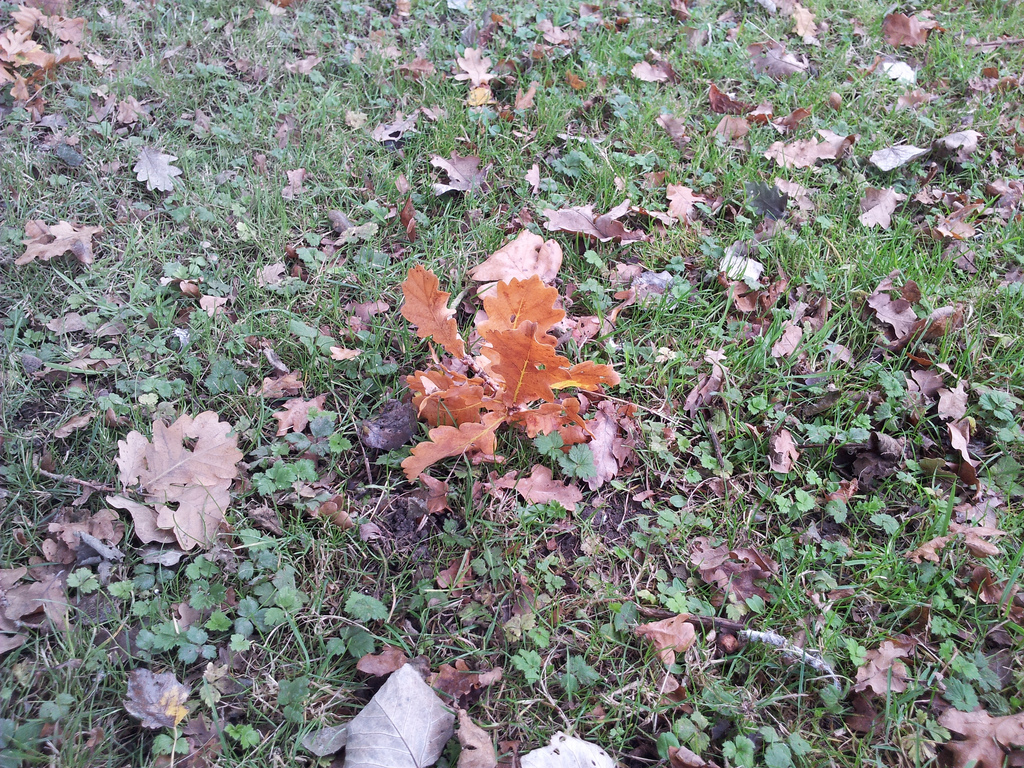
Autumn colours

Out in the meadow and I saw these leaves. So time for a quick snap and my first posting from the Samsung Galaxy S2.

Great news from the RSPB – Small birds bounce back

Small birds bounce back

31 March 2011

Over 600,000 people took part in this year’s RSPB Big Garden Birdwatch, a record breaking number watching their garden birds.

And their counts revealed that some of the smaller birds that decreased in numbers last year, bounced back this year.

Sightings of goldcrests, the UK’s smallest birds, doubled, long tailed tits increased by a third and coal tits increased by a quarter.

The long, harsh winter of 2009/2010 hit birds like long-tailed tits, goldcrests and coal tits with all three species dropping significantly in last years’ Big Garden Birdwatch.

Although smaller birds can be particularly badly affected by harsh winters, a good breeding season can help reverse declines, and these new results suggest that may have been the case in 2010.

Thousands of people were also lucky enough to see waxwings.

The striking birds flood to the UK from Scandinavia every few winters and this year saw an influx, known as a ‘waxwing winter.’

Waxwings are bold birds that are comfortable feeding around our towns and cities, and over 7,000 were counted in this year’s survey, in almost 1,000 gardens.

Big Garden Birdwatch Co-ordinator Sarah Kelly says: ‘It’s fantastic that so many people stepped up for nature by taking part. We were really interested to see how the small birds fared, after such a disastrous last year. It appears that many may have had a decent breeding season and have been able to bounce back a little.

‘But we mustn’t be complacent –another hard winter could see numbers back down so it’s important everyone continues to feed their garden birds.’

RSPB Scientist Mark Eaton says: ‘We knew this was going to be a bumper year for waxwings as we’d had so many reports from all over the UK.

‘But the Big Garden Birdwatch is the first indicator of exactly how many were seen in gardens, and we’re pleased that so many people got to enjoy sightings of these beautiful birds.

‘They’d only come into gardens if the right food was available to them. They feed on berries so it shows that lots of people are planting the right things for wildlife and reaping the rewards.’

609,177 people counted 10.2 million birds

A total of 609,177 people counted over 10.2 million birds. Over 70 species were recorded in 300,780 gardens across the UK over the weekend 29-30 January.

Starlings and blackbirds have swapped positions on this year’s leader board, with starlings now at number two and blackbirds at number 3.

Starling sightings have increased by a quarter since last year, but their numbers are still down from when Big Garden Birdwatch began in 1979.

The house sparrow retained its top spot for the eight year running with an average of four seen per garden, and has increased by 10 per cent.

Numbers of blue tits increased by 22 per cent and great tit numbers were up by 12 per cent.

Almost 90,000 school children and teachers took part in the schools version of the survey, ‘Big Schools’ Birdwatch.’ The UK-wide survey of wildlife in schools, which celebrated its 10th birthday this year, introduces thousands of children to the wildlife visiting their school environment.

Nearly 3,000 classes from more than 2,000 schools were involved, which was also a record-breaking number for the survey. 87% of schools taking part reported seeing blackbirds, with an average of five being seen at each school, making it the most common visitor to school grounds.

From the RSPB.

Reflections on a Spring morning’s commute

Each morning the C2C trains trundle into London, beginning their journey in Shoeburyness, the end of the line that lies in close proximity to the secrecy-shrouded MOD facilities of the tidal island of Foulness. One hour and ten minutes later they arrive in Fenchurch Street, the oft-forgotten commuter terminal for East Essex that hides between the contradiction of gleaming office blocks and ramshackle reminders of older, darker London such as the East India Arms.

These trains pass through the seaside excitements of Southend, on past the old-now-fashionable fishing town of Leigh and then through the connurbation of Pitsea, which, with the closure of the Motorboat Museum, has almost lost its struggle to retain a sense of its own maritime connections. From Pitsea the journey enters the sprawl of Basildon, the brash young upstart neighbour of both Pitsea and Laindon, both of which were the principal local urban centres prior to the Whitehall social laboratory experiment which was the New Towns Act 1946.

Between Laindon and the sleepiness of West Horndon lies my favourite part of my daily commute: the Bulphan Fen.

Yes, I love the bleak industrial landscape of the detours via the loop line, forced on weary travellers by endless engineering works: the vast and towering complexes of Dagenham; the faded, crumbling decay of Tilbury’s dockside menace; and the empty mystery of Purfleet and its invisible military history. Yes, I love, too, the changing landscape of East London, where clean, proud new build sits between the higgledy-piggledy tangle of scrap-yards, brick-arch businesses and the shells of now-forgotten commercial giants of Britain’s imperial past.

However, for me, nothing touches the vast, rural emptiness of the Bulphan Fen for its capacity to reassure, by reminding me I have truly left the loud metropolitan chaos of the city behind me. Perhaps it is because it is the stretch I have travelled for more years than any other, the daily schoolboy journey to Upminster a daily and extravagant adventure that took me far from the country comfort of Langdon Hills. Whatever the reason, nothing gives me the calm reassurance of the prospect of home as much as this small stretch of a rural England that is quickly vanishing.

In Summer, the setting sun casts long, warm shadows that stretch from field to field, heralding barbecue-weekends, the easy company of family sharing a glass or two under the reaches of the old vine and the wistful strains of Finzi or Vaughn-Williams teasing our souls with the melancholia of English poems and promises.

In Autumn, tendrils of mist snake between the trees and hang low in the fields. They lend the landscape an ethereal shroud worthy of Tolkein that disguises agricultural purpose and hides the pylon sentinels in their silent vigil over this corner of South Essex.

In Winter, icy frosts glitter on earth as hard as iron. These last two years such frosts foretold the blizzards which saw our landscape reborn white and pristine, the dangers of broken road and path buried by snows that harbour their own cruelties and hazards.

And in today’s Spring morning, green fields sparkled with dew under cloudless blue skies and commuters burred quietly with refreshing wonder about the sunshine, its bold appearance vanquishing the greyness of February’s dying season.

I love the Bulphan Fen – and its enduring promise of home.