Rage Against The Election: how the web has turned this election upside down #gonick #iagreewithnick #libdems

This is an election that analysts, experts and historians will pore over for decades.

The confluence of mobile technology, media influence, information democracy on the web and voter alienation has created a serendipitous moment for the Liberal Democrats as a voice for fundamental change of a political system that is rotten to its core. From the way we pay for our politics and politicians, to the way government agencies manage information about us, to the way politics is run by two old parties who, as gigantic corporate spin operations, have lost their connection with real people and their every day concerns, people are bewildered and angry.

Paxman’s interview with Nick Clegg was telling in one particular regard: he sought to dismiss the value of £700, the average benefit of the Liberal Democrats’ income tax policy of raising the threshold to £10,000.  Even the BBC, in the person  of Jeremy Paxman, fail to understand that £700 is a colossal amount of money.

I was talking to a family friend at the weekend who, as someone who struggled to keep his small gardening business going, told me that £700 was a fortune. For BBC board member Ashley Highfield, that is less than the £773 he claimed for a single dinner on 4th February 2008 (see BBC expenses). It is difficult to imagine that such expenses are not available to their star presenters, so it is no wonder that Paxman is so out of touch with how hard it is in the real world.

But nowhere is this anti-politics more evident than on the Facebook Group Rage Against the Election. To the astonishment of new media watchers and seasoned party hacks alike, people are taking back their politics and using the democratic nature of the web to make their anger known. Elizabeth Eisenstein’s exhaustive work  The Printing Press as an Agent of Change documents the extraordinary impact of the a technical revolution on the democratisation of information. Academics and lofty historians might scoff, but their should be no doubting the impact of the likes of Facebook on the way people want to take ownership of information and use corporate tools for non-corporate purposes.

The Rage Against the Election Facebook Group is a phenomenon.

Set-up entirely independently of the Liberal Democrats, it has a single objective: to secure one million members in support of the Liberal Democrats and propel them into office.

Read that again: it has been set-up entirely independently of the Liberal Democrats. People out there, angry at their politicians, see the Liberal Democrats as a vehicle for change.

Checking in at 8.20am its membership stood at a staggering 110,847.

That is 110,847 individuals who are confident enough to attach their name to a public statement saying that they want to see the Liberal Democrats in office.

If you wonder what that means, try these figures for comparison, each checked just after 8.30am:

  • Official Conservative Facebook page 50,794
  • Official Lib Dem Facebook page 45,189
  • Official Labour Facebook page 25,658

There is nothing quite so rewarding as seeing people speaking up and refusing to be told what to think and what to believe. With 16 days until polling day, who knows how many will end up joining the Rage Against the Election?

http://www.libdem2010.com/

What is certain is that you would need to be very naive indeed to underestimate the role played by new media and internet technology in this election.

Add to FacebookAdd to DiggAdd to Del.icio.usAdd to StumbleuponAdd to RedditAdd to BlinklistAdd to TwitterAdd to TechnoratiAdd to Yahoo BuzzAdd to Newsvine

Former Sun Editor David Yelland: “Nick Clegg’s rise could lock Murdoch and the media elite out of UK politics” #gonick #iagreewithnick #libdems

For many of us involved in politics, Rupert Murdoch represents all that is wrong with the shadowy commercialisation of news. His Fox News Network happily admits its bias as this quote from Scott Norvell, Fox News’s London Bureau Chief in 2005, reminds us:

“Even we at Fox News manage to get some lefties on the air occasionally, and often let them finish their sentences before we club them to death and feed the scraps to Karl Rove and Bill O’Reilly. And those who hate us can take solace in the fact that they aren’t subsidizing Bill’s bombast; we payers of the BBC license fee don’t enjoy that peace of mind.

Fox News is, after all, a private channel and our presenters are quite open about where they stand on particular stories. That’s our appeal. People watch us because they know what they are getting. The Beeb’s institutionalized leftism would be easier to tolerate if the corporation was a little more honest about it.

Even we at Fox News manage to get some lefties on the air occasionally, and often let them finish their sentences before we club them to death and feed the scraps to Karl Rove and Bill O’Reilly. And those who hate us can take solace in the fact that they aren’t subsidizing Bill’s bombast; we payers of the BBC license fee don’t enjoy that peace of mind.

Fox News is, after all, a private channel and our presenters are quite open about where they stand on particular stories. That’s our appeal. People watch us because they know what they are getting. The Beeb’s institutionalized leftism would be easier to tolerate if the corporation was a little more honest about it.”

With that in mind, it’s incredibly  refreshing to find former Sun editor David Yelland writing thoughtfully about the implications for the media’s relationship with politics, should this current upheaval in public opinion continue:

“The fact is these papers, and others, decided months ago that Cameron was going to win. They are now invested in his victory in the most undemocratic fashion. They have gone after the prime minister in a deeply personal way and until last week they were certain he was in their sights.

I hold no brief for Nick Clegg. But now, thanks to him – an ingenue with no media links whatsoever – things look very different, because now the powerless have a voice as well as the powerful.”

If you have the time, read his article.

It poses some very important questions for those who purport to report the news, when privately their interests dictate that they seek to make it.

Add to FacebookAdd to DiggAdd to Del.icio.usAdd to StumbleuponAdd to RedditAdd to BlinklistAdd to TwitterAdd to TechnoratiAdd to Yahoo BuzzAdd to Newsvine

Great video: “I believe in fairness” #iagreewithnick #gonick #nickclegg #libdems #believeinfairness

Add to FacebookAdd to DiggAdd to Del.icio.usAdd to StumbleuponAdd to RedditAdd to BlinklistAdd to TwitterAdd to TechnoratiAdd to Yahoo BuzzAdd to Newsvine

If you missed them earlier in the week… Meet the Labservatives #labservatives

Political parties rarely do internet humour well. The infamous Jib-Jab virals of 2005 set a high benchmark and British politics has rarely attempted to emulate them. Surprising then to find a political party making a more than half-decent stab at a bit of internet humour. Even more of a surprise to discover it’s my own. If you missed them earlier in the week, meet the Labservatives. They’ve launched a website which I’d encourage you to check out. As for their manifesto, meet their would-be PM… Gorvid. 🙂

Add to FacebookAdd to DiggAdd to Del.icio.usAdd to StumbleuponAdd to RedditAdd to BlinklistAdd to TwitterAdd to TechnoratiAdd to Yahoo BuzzAdd to Newsvine

The woeful political illiteracy of ‘sock jock’ Peter Oborne #toryfail #mailfail

There is something remarkably gratifying about your politics becoming the subject of a doolally rant from Peter Oborne.

His comment piece in today’s Mail is both astonishing and embarrassing in its swivel-eyed political illiteracy – riddled with hackneyed clichés to such an extent that you can almost see his words foaming on the page like some twenty-first century incarnation of a nineteenth-century pamphleteer.

Of course on one level he can be simply dismissed as a slightly dotty commentator who, whilst perhaps a little too spiky to be regarded a lovable eccentric, nevertheless fulfils a role in the media as a vocal representative of a certain small-minded, right-wing conservatism. Of course, whilst in US politics the right has radio ‘shock jocks’, Britain, despite an increasing pace of life, still conducts its politics in a comparatively leisurely fashion, better suited to writer-provocateurs in our newspapers. These I always imagine to be sartorially-challenged individuals given to flamboyant or eccentric dress – ‘sock jocks’ if you will.

On another level, however, Oborne’s flailing around is a fascinating indication of the rising panic on the part of Britain’s conservative politicians and commentators who have coasted along for years, relying on a ropey strategy perhaps best summarised as opportunism bolstered by a confidence born of entitlement. Oborne, whether as ‘sock jock’ or unofficial Tory mouthpiece, reveals how politically confused and contradictory the right-wing of British politics has become – grasping out in a vacuum of principle for a policy to justify this strange sense of entitlement to power.

Bizarrely, he decides that the key point of political differentiation is not principle, policy or even political message, but rather election slogan. Sadly, I suppose his obsession with slogans is not unexpected from someone who is part of a media industry that seeks in its own condescending way to portray British voters as supine – unable to make political choices based on more substantive criteria without the benefit of the media intervening to interpret and translate.

Oborne, interestingly, also accuses the Lib Dems of opacity on the big issues. This seems to be one of his odder comments, reflecting more the fact that his preferred emperor is clearly wearing no clothes and, I presume, hoping that by shouting loudly at as many people as possible, no-one will notice.

It is also contradicted by his admiration of Nick Clegg’s stance on Afghanistan and civil liberties. In the same piece!

Add in the fact of the Liberal Democrats’ four key election commitments and Oborne’s article is reduced to simple, ignorant bluster.

This is confirmed by his dependence on a tiresome and dull confusion between campaigning and political positioning in a dismal attempt to justify an accusation of hypocrisy:

“For example, one internal campaigning document – called Effective Opposition – hypocritically advised the party’s candidates to face in both directions at the same time.

It urged them ‘to secure support from voters who normally vote Tory by being effectively anti-Labour and similarly in a Tory area secure Labour votes by being anti-Tory’.”

Oborne, like many ‘sock jocks’, appears to think that politics should occur in a vacuum of activity. The reality is any party looking to win a seat will be looking to maximise its support from voters by differentiating itself from other parties. To do that well, you need to present your policies in a way that is both relevant and effective. If you believe in the importance of local community politics that is going to be different in different parts of the country. It is basic campaigning common sense.

Fortunately, voters realise that, even if armchair media pundits – who lack accountability and often comment without any sense of responsibility – do not.

All of this adds up to one important thing: this election is still wide open and in the hands of the British electorate.

And the Tories know it…

Add to FacebookAdd to DiggAdd to Del.icio.usAdd to StumbleuponAdd to RedditAdd to BlinklistAdd to TwitterAdd to TechnoratiAdd to Yahoo BuzzAdd to Newsvine

Cameron: the iPhone limitations of iDave #toryfail #cameron #iphone

There is something very uncanny about the iDave whose limitations are, to my mind, increasingly analogous to the iPhone. The obvious counter-charge is “but the iPhone is so popular!”. However, I’d suggest that this is a superficial gloss that doesn’t reflect the way in which the iPhone’s rivals do a rather less impressive job of countering the propaganda than those of the iDave’s – certainly the Liberal Democrats.

So what are the iPhone limitations of the iDave?

  • As already hinted, and despite a slick marketing operation, its design flaws are coming to light and are being highlighted by increasingly confident competitors.
  • In terms of real life experience, it has majored in self-promotion rather than real work in the real world.
  • Despite large sums of money having been spent on development, it has proved entirely incapable of multi-tasking, something that later iterations have failed to address.
  • More worryingly, after stress-testing the product develops significant faults.
  • When it comes to engaging the community in developing its operating systems and applications, it is strictly not open-source. Collaboration and participation are prohibited in favour of central prescription by corporate wonks. (And to be clear, there are definitely no custom ring-tones – potentially frustrating for European customers.)

So where does that leave the iDave?

Ahead of the iPhone in at least one respect. On the Apple site is the following unanswered question:

“I’m moving to Belize Central America if i just use a local antenna will this product work for me?”

Whilst Apple might be able to provide no comfort, Lord Ashcroft – developer, majority shareholder and strategist for the manufacturers of the iDave – should be able to reassure…

The iDave has an app for that.

Add to FacebookAdd to DiggAdd to Del.icio.usAdd to StumbleuponAdd to RedditAdd to BlinklistAdd to TwitterAdd to TechnoratiAdd to Yahoo BuzzAdd to Newsvine

Ashdown on Cameron #toryfail #cameron

In today’s Independent, Paddy Ashdown answers a fascinating array of questions on  a wide range of topics.  One of those is from a Cathy Saunders in Bath. She asks: “Is David Cameron the most impressive Tory leader since Churchill?”

Paddy’s response is a splendidly blunt reminder of Cameron’s background:

“David Cameron isn’t even the most impressive Tory in the current Conservative Party. I find the idea of comparing him with Churchill so absurd as to be laughable. In David Cameron we have a man who went straight from Oxford to the back rooms of Tory Central Office, the highlight of which was his role in the catastrophe of Black Wednesday, and then straight into PR. And not just any kind of PR, PR for the media industry.

“His real-world experience is seven years as the spin doctor’s spin doctor. He’s then parachuted into a safe seat, from which he writes for Michael Howard the most right-wing manifesto his party has had for generations. His greatest success for the Tories has been giving it a cosmetic makeover. Most impressive since Churchill? Come on.”

Add to FacebookAdd to DiggAdd to Del.icio.usAdd to StumbleuponAdd to RedditAdd to BlinklistAdd to TwitterAdd to TechnoratiAdd to Yahoo BuzzAdd to Newsvine

Nick Clegg’s Birmingham speech: fair taxes, a fair chance, a fair future and a fair deal #libdemwin

My twenty-ninth conference working for the party was very different to my first.

My heart wasn’t in my mouth.

Like many seasoned conference goers and professional staff I know the routines and the requirements. In any event, the party is generally a more organised and self-disciplined organisation these days. That has dangers of its own of course, with the chance that people might get complacent.

That wasn’t the case in Birmingham. And two very different veterans – one a senior national politician and the other a senior local politician – both said privately, and quite separately, that Nick Clegg’s was the best leader’s speech they had seen in years.

I agree.

Clegg was passionate, a fact not overlooked by writers such as Ann Treneman. He was also angry – angry at the way public expectation has been so trodden down that the public now demand less of our politicians and our country than they are entitled to.

With a relatively short speech by modern political standards, his message was sharp and to the point: ignore the pundits warning you of this outcome or that. If you like what you see, have the confidence to vote for it: vote Lib Dem and get Lib Dem.

At the last election one in four voters voted Lib Dem. If that were raised to one in three, the Lib Dems would be the next Government. Put like that it makes you realise how much the political landscape has shifted since 1951 when over ninety per cent of the population voted either Labour or Tory.

The policy pledges for this election are clear and to the point – and bear repeating so that there is no mistaking the Lib Dem’s commitments:

Fair taxes that puts money back in your pocket

  • The first £10,000 you earn tax-free: a tax cut of £700 for most people
  • 3.6m low earners and pensioners freed from income tax completely
  • Paid for by closing loopholes that unfairly benefit the wealthy and polluters

A fair chance for every child

  • Ensure children get the individual attention they need by cutting class sizes
  • Made possible by investing £2.5bn in schools targeted to help struggling pupils
  • Cut student debts and make a degree affordable for all

A fair future: creating jobs by making Britain greener

  • Break up the banks and get them lending again to protect real businesses
  • Honesty about the tough choices needed to cut the deficit
  • Green growth and jobs that last by investing in infrastructure

A fair deal for you from politicians

  • Put trust back into politics by giving you the right to sack corrupt MPs
  • Restore and protect hard won British civil liberties with a Freedom Bill
  • Overhaul Westminster completely: fair votes, an elected House of Lords, all politicians to pay full British taxes.

As I left Birmingham, looking out of the train window at a landscape that has at different times been at the heart of our industrial economy, I felt a genuine excitement at being a member of a party that was making a firm commitment to helping Britain start building things again – turning Britain into a world-leader in green industries such as hi-tech wind-turbine production. It was a real revelation to think that our economy needn’t be reliant on the service industry of the city, with all its old boy networks and incomprehensible lexicon of hedge funds and futures and trades. It could instead witness a 21st Century reinvention of our manufacturing industry, with vital plant and equipment made in Britain for the benefit of our economy as well as benefiting the wider environmental interests of the international community.

Exciting, too, to hear the clear ambition to help people back into work and break the humiliation and hopelessness of trying to make ends meet on benefits, by proposing a radical and costed overhaul of taxation to lift the income tax threshold to £10,000. Is there a bolder commitment from any other party to put real cash back into the pockets of those who need it most?

If you missed the speech, but are interested in seeing what Nick Clegg said, look at the clip below or take a moment to read the text.

Add to FacebookAdd to DiggAdd to Del.icio.usAdd to StumbleuponAdd to RedditAdd to BlinklistAdd to TwitterAdd to TechnoratiAdd to Yahoo BuzzAdd to Newsvine

David Cameron’s Conservatives: Tories break Pickles dirty tricks pledge [The Fib List No. 4] #toryfail

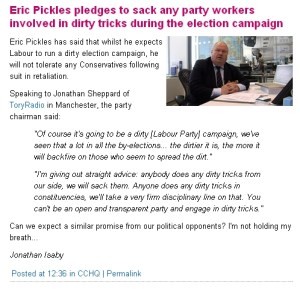
Last October, Eric Pickles, Chairman of the Conservative Party, made a very bold pledge:

However, the stricture from Eric Pickles doesn’t appear to have been picked up in Solihull. Sophie Shrubsole, Conservative Future Area Chair for Birmingham, Solihull and Coventry, excitedly marshalled her student troops after a request from Conservative Campaign Headquarters (CCHQ) to encourage students across the country to gather in Warwick and disrupt last  speech by the Prime Minister:

Paul Waugh of the Evening Standard, who broke the story, wonders on his blog if Eric Pickles will be true to his earlier comments.

More specifically, I would imagine that Pickles has at least two courses of action he should consider:

  1. An inquiry to establish which party official at CCHQ was encouraging such dirty tricks and sack them;
  2. Disciplinary action against Shrubsole as a party officer for continuing to organise this planned disruption in clear contravention of his instructions.

The sad fact is though that, despite his pledge, Pickles will do nothing and the Conservative Party will seek to ignore this first clear example of dirty tricks – or explain it away as student hijinx.

There really is nothing quite so grubby and hypocritical as a Conservative Party desperate for power at any cost.

Cameron’s Conservative Party, Con-coctions and Torydiddles: Tories dump environment despite pledges [The Fib List No. 3] #toryfail

In June 2008, David Cameron opened a speech with the following words:

“Today, I want to tackle an argument that seems to be as cyclical as the economy. The argument that when times are good, we can indulge ourselves with a bit of environmentalism – but when the economic going gets tough, the green agenda has to be dropped.

“According to this argument, protecting the environment is a luxury rather than a necessity – and it’s a luxury we just can’t afford in an economic downturn. I want this generation to be the one that bucks that trend: to be the generation that finds a way to combine economic, social and environmental progress.”

In what I imagine was a shot at critics who thought that the huskies and the cycling (with his papers in the car behind) were a stunt, he made the following  very firm statement:

“Today I want to make my position on this absolutely clear. We are not going to drop the environmental agenda in an economic downturn.”

At a press conference this morning David Cameron gave a list of ten reasons to vote for the Conservatives.

The environmental agenda did not feature at all.

The green agenda has been dropped. Completely. And, ironically, as Britain continues to teeter along the brink of recession.

Spend a moment looking at those two documents and then tell me Cameron’s long-term critics weren’t right. Cameron’s environmental credentials have been exposed as the cynical exercise in hoodwinking they always were.

This should ring alarm bells across the South East, and particularly in Basildon and Thurrock, where the threat to our green spaces and natural environment is ever-present. With DP World’s recent announcement that they will be deepening the Thames to allow the largest cargo ships in the world to dock at the proposed London Gateway port, voters should now be clear that making sure developments like this – which are important for jobs and regeneration – don’t wreck our environment is not a priority in any way for Conservatives.

Back in October last year, at the Tory conference, Cameron called for more leadership on the environment:

“And to be British is to have an instinctive love of the countryside and the natural world. The dangers of climate change are stark and very real. If we don’t act now, and act quickly, we could face disaster.

Yes, we need to change the way we live. But is that such a bad thing? The insatiable consumption and materialism of the past decade, has it made us happier or more fulfilled?

Yes, we have to put our faith in technologies. But that is not a giant leap. Just around the corner are new green technologies, unimaginable a decade ago, that can change the way we live, travel, work.

And yes, we need global co-operation. But that shouldn’t be difficult. It just takes leadership, and that’s what we need at the Copenhagen summit this December.”

By contrast, a recent survey of Tory PPCs by ConservativeIntelligence (!) revealed what looked like a shocking gulf in thinking between prospective Conservative MPs and David Cameron’s leadership team. Reducing Britain’s carbon footprint was their lowest priority. Even protecting the English countryside from over-development, something Tory councillors have been preaching for years, was way down the list of priorities.

Then, following ‘Climategate’ and the sceptics’ even more outrageous and very public manipulation of scientific evidence (i.e. flatly denying it), public opinion has shifted on global warming. The BBC recently reported a drop of 8% in the numbers believing it is taking place.

Does Cameron show the leadership he demands, attemting to lead public opinion rather than follow it? No, like his candidates, he limps on behind, dropping environmental commitments that might dent his chances.

When it comes to the environment, David Cameron has been playing us for fools for a long, long time. His environmental commitments were just the latest in a long line of rebranding exercises, designed to get votes by saying whatever people want to hear.

The 75% of people who understand global warming is taking place should stop giving him and his party the benefit of the doubt and take a long hard look at the evidence.

Cameron and the Conservatives cannot be trusted on the environment.

Add to FacebookAdd to DiggAdd to Del.icio.usAdd to StumbleuponAdd to RedditAdd to BlinklistAdd to TwitterAdd to TechnoratiAdd to Yahoo BuzzAdd to Newsvine