Three amazing artists

Some people are just amazingly talented. Here are examples of the work of three artists that took my breath away. They each use our environment in very different ways.

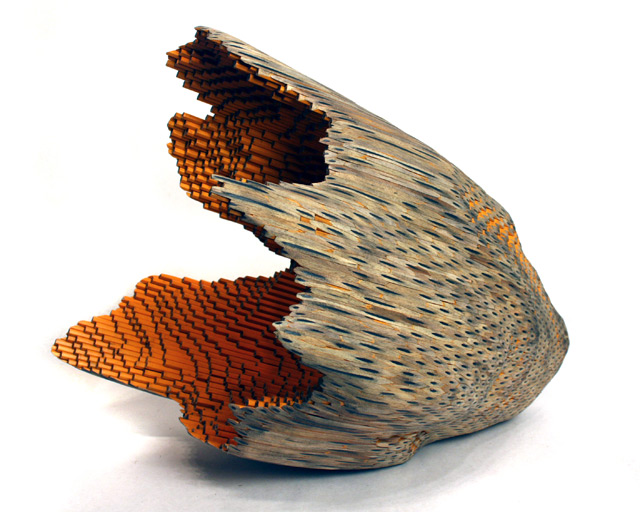
Jessica Drenk was born and grew up in Montana, developing a tremendous affinity for the natural world around her, background that has had a very deep influence on her art.  As reported by arts blog This Is Colossal:

Drenk’s most recent sculptures are a series called Implements, each of which begins with a mass of standard No. 2 pencils that have been tightly glued together. Using an electric sander she then molds the piece into a form that seems more likely to have originated in a dark cave or deep within the ocean than from a school desk. Of her work she says:

“By transforming familiar objects into nature-inspired forms and patterns, I examine how we classify the world around us. Manufactured goods appear as natural objects, something functional becomes something decorative, a simple material is made complex, and the commonplace becomes unique. In changing books into fossilized remnants of our culture, or in arranging elegantly sliced PVC pipes to suggest ripple and wave patterns, I create a connection between the man-made and the natural.”

drenk-3Haroshi is a self-taught artist from Japan. This skull, made from recycled skateboard decks, is just awesome.

haroshi-1Finally, Vadim Zaritsky is a former army office turned artist and entymologist – and uses the wings of dead butterflies, found either beside the road or thrown out from collections. In his own words on Oddity Central:

“Butterfly collectors know that some wings are considered – collectors call it trash,” Zaritsky says. “If the wings are damaged, if they have partially faded, specialists would usually put them aside. It’s a shame to throw them away but you cannot use them either. In time, the bits may become infested with pests and you have to throw everything away anyway.”

Vadim-Zaritsky-butterfly-wings-550x406

Rape: the shocking failure of our legal system – and our media

According to figures released by the Home Office, Ministry of Justice and the Office for National Statistics, more and more incidents of women being raped in England and Wales are being recorded:

2009/10

2010/11

2011/12

Rape of a female

13,902

14,589

14,767

Rape of a male

1,172

1,303

1,274

That is a total of 47,007 incidents of recorded rape over a three year period.

And the number of convictions for rape in that same period (and yes, I know there is no absolute read-across between the offences and convictions)?

1,372.

Yet these figures don’t reveal the horrific extent of rape and serious sexual offences in England and Wales: the report also shows that 57% of women told someone but not the police of a rape or serious sexual assault. 28% told no-one.

And then the questions…

There were “only” 40 non-custodial sentences for rape in 2011. Excuse me? Why were there any?

Apparently “Since 2005, there have been fewer than seven Suspended Sentences Orders (SSOs) given each year for rape of a female and none have been given for rape of a male.” What does the fact that any SSOs have been given  say about differences in perceptions between rape of a female and rape of a male?

Another shocking statistic is that, on average, it is 722 days from the moment someone is raped until the completion of the case. That is almost two years of reliving the hell of what happened in order to secure justice. Why should someone have to wait so long?

There are  so many important questions that arise from this report it is difficult to know where to start.

The figures should hit home like an iron bar hammered in your face.

They should be screamed across the  front page of every newspaper. They are utterly appalling – and reveal a shocking affront to justice that reminds us we are light years from ensuring that rape victims receive the support they need to ensure perpetrators are brought to justice.

And now, in the wake of Leveson, is the ideal time for the press to demonstrate their worth. After all, we’ve had plenty of self-indulgent hand-wringing in recent months, most notably about the important role played by our newspapers in our public life and democracy. In his evidence to Leveson, The Sun’s editor, Dominic Mohan, extolled his paper’s virtues (Para. 60):

“It distils complex important issues of the day, including politics, finance and law into concise readable copy which educates and entertains.”

So, on a day when official statistics reveal such a shocking failure of our investigative and legal processes, on an issue that clearly straddles law and politics, what was this bastion of our free press’s front page?

The_Sun_newspaper_front_page

Perhaps we would expect such crassness and double-standards from The Sun. But what were the front pages of most the other main UK papers today?

This slideshow requires JavaScript.

Only two national newspapers ran the story on their front pages: The Independent and i – the quality tabloid off-shoot of The Independent:

Metro, the newspaper given out free in major cities, also had it on its front page.

Where were all the others?

Where was The Guardian,  never usually bashful in its self-promotion as the left-wing champion of women’s rights and awareness of issues that particularly affect women? Who knows. It certainly doesn’t consider this report front page news. Even after the Savile report was released, The Independent still had this story as a second headline on its website. By contrast, it was the 17th headline on The Guardian Online – appalling.

What does this lack of interest say about a media more concerned with itself than getting to the core of issues that affect hundreds of thousands of people in the most horrendous ways?

It is a corroboration of the silence and inaction that characterises our society’s approach to rape – an approach that continues to allow rapists to escape justice. With Savile, with the horrors of Steubenville and Delhi, perhaps this might just change. Perhaps. But we shouldn’t kid ourselves that any of these are, in and of themselves, the answer.

As Deborah McIlveen, policy and services manager at Women’s Aid, told the Independent:

“Despite all that is known about rape and sexual violence, the justice system still fails to hold most rapists to account and so fails to deliver victim safety, public protection and management of perpetrator risk. These men are free to continue to rape and this is unacceptable, harmful and illegal.

“Most rape victims can identify their abuser, and many of these will be their partners or ex-partners.  This ongoing failure to secure convictions will continue to leave women and young people vulnerable and in potentially risky situations.”

And as spokeswoman for Rape Crisis England and Wales told the Independent:

“The figures are shocking but sadly not that surprising. There has been lots of publicity and measures put in place to try and increase the conviction rate around rape and sexual abuse. But it looks like it is not having as much effect as we would like.

“It is a chicken and egg situation: women do not report offences because they know they are very unlikely to get a conviction. They know they would have to put themselves through a system which is very traumatic and are likely to come out at the other end with no justice.”

If it matters to you, read the report for yourself. Ask questions.

And don’t be silent.

Remote-controlled quadcopter – I want one (please)

This has to be the ultimate gadget junky’s toy!

Flight control specialists DJI-Innovations have released a consumer toy version of their radio-controlled flight platforms – and it looks like a hell of a lot of fun.

The Phantom quadcopter is a technological mini-marvel. It can hit 6m/s vertically and 10m/s horizontally, has a range of 300m, built-in GPS for fly-home programming (i.e. if it goes out of range, it’ll fly home and land itself if the GPS signal is strong enough) and a flying time of between 10 and 15 minutes. It can also automatically land itself if the battery is low.

It also comes with a mount for the phenomenal GoPro range of video cameras. Beyond the geeky fun value, the potential for amateur film-makers wanting a different perspective, or the likes of conservationists, gardeners etc. who want to see how things appear from the air looks immense.

Tech blog gizmag has an extended review.

So if anyone is feeling generous, I’ll have one of each, please.

Bob Newhart on the origins of tobacco

“Bob” Newhart, born George Robert Newhart in Austin, Chicago in 1929, is an American actor and comedian with a fascinating and varied career. I first came across him guesting on Desperate Housewives.

In awarding him a Peabody Award for the Bob Newhart Show in 1961, the board said:

… a person whose gentle satire and wry and irreverent wit waft a breath of fresh and bracing air through the stale and stuffy electronic corridors. A merry marauder, who looks less like St. George than a choirboy, Newhart has wounded, if not slain, many of the dragons that stalk our society. In a troubled and apprehensive world, Newhart has proved once again that laughter is the best medicine.

His routines are characterised by a deadpan delivery and one of his classics is entitled “Introducing Tobacco To Civilisation”, performing a very funny riff on how we started smoking.

Sometimes humour stays fresh across the decades.

Crazy, Stupid, Gun Love: Piers Morgan’s bizarre and frightening interview with Alex Jones on gun control

I’m a Facebook follower of Upworthy, the social media site that sets out its mission: “To make meaningful stories go viral.” A particular story arrived today, clipping an interview on Monday night between Piers Morgan and Alex Jones, a pro-gun campaigner and radio host who co-organised a petition to deport Morgan from the USA (where he has a regular presenter’s slot on CNN) for offering supportive gun-control comments in the wake of Sandy Hook.

I’m not a fan of Morgan – but he exemplifies everything that is right in a calm and measured presenter. By contrast, Jones is frankly terrifying.

I hope Upworthy don’t mind – I am going to reproduce their commentary in full.

Piers Morgan decided to advocate gun control after Sandy Hook. That caused this radio host, Alex Jones, who has millions of listeners (listeners I’d prefer to never meet), to create a petition to have Piers deported.

Being the reasonable bloke he is, Piers invited Alex on his show to have a civil debate about guns. What follows is the most jaw-droppingly incoherent interview I have ever seen, in two deranged parts. The fact that this interview actually made Piers Morgan the most tolerable person on TV for 14 minutes isn’t even the craziest thing about it.

If this is what we’re up against in the reasonable gun law debate, no wonder nothing gets done. Piers should get the Medal of Honor for not requesting a medical team to come tranquilize Alex and have him committed.

Upworthy – Act I: The Dumbening

  • At :30, in a hint at what’s about to happen, Jones gets things started by changing the subject completely, and then crafting a disconnected slew of sentence fragments.
  • At 2:10-2:36, Alex threatens to burn America to the ground if he doesn’t get his way.
  • At 2:50, Alex reminds Piers (for the first of many times) that Americans once fought a war against the British. Piers responds with the kind of scathing, passive-aggressive restraint that the British have spent centuries mastering.
  • At 3:48, Alex talks about marine biology.
  • At 4:25, Alex talks about his favorite part of “Mad Max.”
  • At 6:40, Piers gives up on getting anything coherent out of him.

Act II: All Aboard The Conspiracy Train

  • From 0-0:18, Piers suggests calming things down and actually having something resembling a coherent conversation. And then Alex starts speaking again, thus anything resembling healthy discourse ceases to exist.
  • At 1:33, Alex thinks an AR-15 will protect him from the largest military in the world and accuses all American soldiers of being potential traitors. Also, HITLER.
  • At 2:35, no judgment here, I just want to transcribe what Jones just managed to say, “A study out of Hawaii killed 292 million people.” He also requests that you google “Democide”, so for balance sake, click here.
  • At 4:22, Alex quotes his favorite part of “Soylent Green” or “Dawn of the Dead.”
  • From 4:51-5:40, Piers decides to let America in on the inner workings of Alex’s brain.
  • At 5:40 … 5:40. Don’t cheat and skip ahead to this. Just be ready for it. Trust me on this one. It’s like “Masterpiece Theatre.”
  • Aaaaand at 6:27, Piers finally says what the rest of us are thinking.

Poem: On recalling a pigeon with a torn wing

We stopped and stared – young and old,
city shark and office cleaner,
the sensitive and the usually oblivious –
each hoping we might fix this small
and broken fearful bundle
hopping madly through the crowds,
its frailty and incompleteness
drawing out our wishes
for a healing or the serendipitous.

We walked on by – rich and poor,
business sort and volunteer,
the parent and the usually compassionate –
each hoping to forget the tall
but broken fearful bundle
huddled in the doorway,
his frailty and incompleteness
authored by a sad misfortune
or, uncomfortably, by chance and us.

Literally brilliant – Vikings rock

I admit to finding much of today’s children’s telly incomprehensible. My brother and sister-in-law, who have four scarily bright and funny kids, assure me that it is so much better than when we were younger.

For someone who holds a certain nostalgia for Mr Benn, Trumpton and Finger Mouse, I confess I find In The Night Garden beyond my ken, though The Gruffalo and Room On The Broom have an understated, calm charm.

However, one series that excels at sharing knowledge in a fun and mischievous way is CBBC’s Horrible Histories. It has a wickedly entertaining way of making history fun and accessible, often accompanied by tunes better than those pumped out by better-known acts.

Now, I absolutely know I am not the only one who has found myself in front of a laptop at 3am, having imbibed far too much wine and whisky, playing clips of favourite rock and metal. There is a standard format for such occasions. Both participants (there are usually two, occasionally three) open with a standard metal classic (Nightwish’s Storytime here or AC/DC’s Shoot To Thrill), before choosing more and more classic rock numbers until all semblance of sobriety is conquered by peace songs and revolutionary anthems (from the Dropkick Murphys etc).

To this exemplary canon has been added another clip which forms a part of the “must see, must hear” experience: the Horrible Histories team’s Viking song.

There are rock groups around the world that couldn’t do this – and its pastiche of Queen, symphonic metal and rock ballads is a gem.

Enjoy.

And more from the Horrible Histories crew in due course.

The games we played – childhood’s adventures

BBC History magazine had an article in its Christmas edition on the dangerous games played by children in Tudor England. With fond recollections of my own childhood games I was curious to see what mischief our ancestors got up.

True enough, some of the stories were very sad, recounting how children had met their unfortunate demise whilst playing, but the games themselves were nothing special or dangerous. Rather, youngsters then, as now, met tragedy in a pond or lake or with an item falling on top of them.

Somehow, on reflection, my own childhood games seem rather more hazardous. Weekends were an adventure playground.

There was “Stick Wars”, where four of us would split into two teams of two and roam the local woods, Coombe Wood, with its “Creepy Copse” or the “Sandy Hills” tucked away in a bushy enclave on Westley Heights and the product of centuries of toil by local badgers. (It was years before it was I realised it was “Creepy Copse” and not “Creepy Cops”, the tall pines giving me small-child nightmare images of evil tree-police ready to snatch us out of the evening gloom). There we would give ourselves a “time out” to gather suitably-sized and suitably-shaped sticks and twigs that could be flung at each other. These turned into mammoth reconnaissance efforts, donning second-hand army fatigues and wellies, buying walkie-talkies, and making clear to families and walkers up from the town and trying to enjoy a little countryside that these were our woods.

What little horrors we were.

My regular partners in games were my brother and two eldest cousins, Matt and Sarah, and we spent virtually every weekend together between the ages of six and sixteen. As the years went by, we added my sister Ellie and odd friends (odd as in random, not odd, though some were certainly quirky – eh, Bob?). It was either Matt and me or Sarah and me, never siblings together, and we could spend a goodly while deciding what mischief to get up to. Back then, 2pm to 5pm was a significant portion of a life-time and seemed to last forever.

We were lucky in that both families had extensive gardens with an adjacent field, very differently shaped, but both sporting a tremendous variety of sheds, trees, nooks, crannies, and hidey-holes.

Sticks were reserved for public spaces. For our own gardens, and depending on the season, we opted for acorns and apples, knowing that one of those catching you on the leg would sting like hell or leave a splendid, thumping bruise. We’d skulk about gathering windfalls and stashing caches of ammunition under bushes and in old coal scuttles. And then we would unleash the pain, always bemused when a glancing blow to the head reduced one of us to tears and drew down the wrath of one or other set of parents.

On one memorable occasion we were joined by Horst, a rather severe and strong German who was the brother of a friend’s friend, who rather missed the point of these games with their stealth and dexterously-flung missiles. Instead, he appeared on the brow of a hill carrying a tree trunk and yelling who-knows-what in German at the top of his voice as he charged us down. Thank goodness for Matthew and his Herculean strength, who managed to flatten him in spectacular style.

Elastic bands – the thicker variety that are rarely seen today – were strung together in threes, fours and even fives to make lethal catapults for firing gravel from the drive or grit from a felt roof. We perfected weapons with ranges of a solid two or three hundred feet, if the trajectory was suitably angled and the bands powerful enough. A careful watch was kept for parents who might not appreciate the stones peppering the lawn and dulling the blades of the Mountfield mower.

Field cricket was a potentially lethal affair. Many lazy days were spent playing cricket in “the field” under sweltering Summer suns, on a full length wicket with a makeshift backing net of fruit bush netting or chicken wire. We played with leather and willow, no fear – and no pads and gloves (except when Brian, my friend and neighbour, invested in them, tired of his bruises and in receipt of more pocket money than the rest of us). But the pitch was uneven and I liked to bowl. Having reached six foot early and being an adept strike bowler, I spent hours learning where the ball bounced best for maximum impact and avoiding the ditch on the run-up. When dusk became twilight and the light impossible for finding balls in bushes or under blackthorn we would retire scratched, exhausted and happy, ready to resume the next day.

Then, finally, there was “That Game”, so infamous we still recall it today with a wistful, evil glint in the eye, which is still spoken of in hushed terms, and which we wonder if even at our age we could perhaps play one last time. Were there any rules? Probably. I recall a violent combination of British Bulldog, the tag variants of off-ground touch and run-outs, and wrestling. It was best played in the dark, outside, torches both a boon and curse. How no-one ended up cracking open a skull on the stone wood bunker which served as a base at Matt and Sarah’s place I have no idea.

So. Sod the Tudors. Langdon Hills in twentieth century Essex is where the dangerous games were at.

We’re just lucky we survived.

Poem: An Old Committee Room Clock

An Old Committee Room Clock

Its burnished face, worn by breath and dust,

gazing on the flare and flicker of lives

casually levelled by the years.


Its tight-wound heart, clogged by grit and rust,

grinding through the flap and chatter of words

caustically traded on the days.


Its iron-hard hands, watched with hope and trust,

goading fools and wise and fat and thin so

carefully counting out the hours.

A tale of three astronauts – and Soichi Noguchi’s photographs

Once upon a time in a galaxy far, far away…

Or something like that.

It was actually 1983 and Langdon Hills, Essex – and two friends, Bob and Ben, dreamed of becoming astronauts.

They used to sneak off to the school library in Lincewood Junior School  to look at space books. They wrote to NASA. They wrote space stories and they made space project books.

Then one day reality bit, as it tends to, and the dream died. One got embroiled in politics and the other joined the army (no prizes for guessing which I didn’t do!).

However, just at the time that Ben and Bob were dreaming space, Soichi Noguchi was in his penultimate year at Chigasaki-Hokuryo High School, about to study Aeronautical Engineering at Tokyo University.  In 1996, while Ben was stepping into Parliament for the first time, Noguchi was selected to train as an astronaut.

Noguchi was later lucky enough to travel to the International Space Station. His official NASA biography  is enough to make a Ben or a Bob green with envy:

SPACE FLIGHT EXPERIENCE: STS-114 Discovery (July 26-August 9, 2005) was the Return to Flight mission during which the Shuttle docked with the International Space Station and the crew tested and evaluated new procedures for flight safety and Shuttle inspection and repair techniques.  Noguchi served as MS-1 and EV-1 and performed 3 EVAs (spacewalks) totaling 20 hours and 5 minutes.  After a 2-week, 5.8 million mile journey in space, the orbiter and its crew of seven astronauts returned to land at Edwards Air Force Base, California.

Noguchi next launched aboard a Soyuz TMA-17 spacecraft on December 21, 2009, from the Baikonur Cosmodrome in Kazakhstan, docking with the International Space Station two days later to join Expedition 22 crew.  He became the first Japanese to fly on Soyuz as left-seat Flight Engineer.  For the next 161 days, Noguchi lived and worked aboard the International Space Station as a Flight Engineer on Expedition 22/23, accomplishing Kibo full configuration assembly complete.  The Expedition 23 crew returned to a safe landing in central Kazakhstan on June 2, 2010.  In completing this long duration mission, Noguchi logged 163 days in space.

Whilst in space, Noguchi took a series of amazing pictures which he tweeted from the ISS. Below is a selection of some of my favourites.

In the mean time, neither Bob nor Ben have lost their interest in space. Bob assures Ben that he is delaying his visit to Jodrell Bank until Ben can get up there.

And both can take heart from the fact that Soichi Noguchi is at least seven years older than either of them and so there’s time yet for them to get their butts up to the ISS.

This slideshow requires JavaScript.