Artists, creativity and the election #gonick ##iagreewithnick #libdems

Along with the anger that has been unleashed by the election, as witnessed by the Rage Against the Election Facebook Group, is a huge amount of creativity from artists wanting to express their anger at other parties or their support for the Lib Dems. Here are a few of my favourites:

This slideshow requires JavaScript.

To see many, many more, take a look at the photos on the Rage Against The Election Facebook Group.

Add to FacebookAdd to DiggAdd to Del.icio.usAdd to StumbleuponAdd to RedditAdd to BlinklistAdd to TwitterAdd to TechnoratiAdd to Yahoo BuzzAdd to Newsvine

Rage Against The Election: how the web has turned this election upside down #gonick #iagreewithnick #libdems

This is an election that analysts, experts and historians will pore over for decades.

The confluence of mobile technology, media influence, information democracy on the web and voter alienation has created a serendipitous moment for the Liberal Democrats as a voice for fundamental change of a political system that is rotten to its core. From the way we pay for our politics and politicians, to the way government agencies manage information about us, to the way politics is run by two old parties who, as gigantic corporate spin operations, have lost their connection with real people and their every day concerns, people are bewildered and angry.

Paxman’s interview with Nick Clegg was telling in one particular regard: he sought to dismiss the value of £700, the average benefit of the Liberal Democrats’ income tax policy of raising the threshold to £10,000.  Even the BBC, in the person  of Jeremy Paxman, fail to understand that £700 is a colossal amount of money.

I was talking to a family friend at the weekend who, as someone who struggled to keep his small gardening business going, told me that £700 was a fortune. For BBC board member Ashley Highfield, that is less than the £773 he claimed for a single dinner on 4th February 2008 (see BBC expenses). It is difficult to imagine that such expenses are not available to their star presenters, so it is no wonder that Paxman is so out of touch with how hard it is in the real world.

But nowhere is this anti-politics more evident than on the Facebook Group Rage Against the Election. To the astonishment of new media watchers and seasoned party hacks alike, people are taking back their politics and using the democratic nature of the web to make their anger known. Elizabeth Eisenstein’s exhaustive work  The Printing Press as an Agent of Change documents the extraordinary impact of the a technical revolution on the democratisation of information. Academics and lofty historians might scoff, but their should be no doubting the impact of the likes of Facebook on the way people want to take ownership of information and use corporate tools for non-corporate purposes.

The Rage Against the Election Facebook Group is a phenomenon.

Set-up entirely independently of the Liberal Democrats, it has a single objective: to secure one million members in support of the Liberal Democrats and propel them into office.

Read that again: it has been set-up entirely independently of the Liberal Democrats. People out there, angry at their politicians, see the Liberal Democrats as a vehicle for change.

Checking in at 8.20am its membership stood at a staggering 110,847.

That is 110,847 individuals who are confident enough to attach their name to a public statement saying that they want to see the Liberal Democrats in office.

If you wonder what that means, try these figures for comparison, each checked just after 8.30am:

  • Official Conservative Facebook page 50,794
  • Official Lib Dem Facebook page 45,189
  • Official Labour Facebook page 25,658

There is nothing quite so rewarding as seeing people speaking up and refusing to be told what to think and what to believe. With 16 days until polling day, who knows how many will end up joining the Rage Against the Election?

http://www.libdem2010.com/

What is certain is that you would need to be very naive indeed to underestimate the role played by new media and internet technology in this election.

Add to FacebookAdd to DiggAdd to Del.icio.usAdd to StumbleuponAdd to RedditAdd to BlinklistAdd to TwitterAdd to TechnoratiAdd to Yahoo BuzzAdd to Newsvine

Former Sun Editor David Yelland: “Nick Clegg’s rise could lock Murdoch and the media elite out of UK politics” #gonick #iagreewithnick #libdems

For many of us involved in politics, Rupert Murdoch represents all that is wrong with the shadowy commercialisation of news. His Fox News Network happily admits its bias as this quote from Scott Norvell, Fox News’s London Bureau Chief in 2005, reminds us:

“Even we at Fox News manage to get some lefties on the air occasionally, and often let them finish their sentences before we club them to death and feed the scraps to Karl Rove and Bill O’Reilly. And those who hate us can take solace in the fact that they aren’t subsidizing Bill’s bombast; we payers of the BBC license fee don’t enjoy that peace of mind.

Fox News is, after all, a private channel and our presenters are quite open about where they stand on particular stories. That’s our appeal. People watch us because they know what they are getting. The Beeb’s institutionalized leftism would be easier to tolerate if the corporation was a little more honest about it.

Even we at Fox News manage to get some lefties on the air occasionally, and often let them finish their sentences before we club them to death and feed the scraps to Karl Rove and Bill O’Reilly. And those who hate us can take solace in the fact that they aren’t subsidizing Bill’s bombast; we payers of the BBC license fee don’t enjoy that peace of mind.

Fox News is, after all, a private channel and our presenters are quite open about where they stand on particular stories. That’s our appeal. People watch us because they know what they are getting. The Beeb’s institutionalized leftism would be easier to tolerate if the corporation was a little more honest about it.”

With that in mind, it’s incredibly  refreshing to find former Sun editor David Yelland writing thoughtfully about the implications for the media’s relationship with politics, should this current upheaval in public opinion continue:

“The fact is these papers, and others, decided months ago that Cameron was going to win. They are now invested in his victory in the most undemocratic fashion. They have gone after the prime minister in a deeply personal way and until last week they were certain he was in their sights.

I hold no brief for Nick Clegg. But now, thanks to him – an ingenue with no media links whatsoever – things look very different, because now the powerless have a voice as well as the powerful.”

If you have the time, read his article.

It poses some very important questions for those who purport to report the news, when privately their interests dictate that they seek to make it.

Add to FacebookAdd to DiggAdd to Del.icio.usAdd to StumbleuponAdd to RedditAdd to BlinklistAdd to TwitterAdd to TechnoratiAdd to Yahoo BuzzAdd to Newsvine

Great video: “I believe in fairness” #iagreewithnick #gonick #nickclegg #libdems #believeinfairness

Add to FacebookAdd to DiggAdd to Del.icio.usAdd to StumbleuponAdd to RedditAdd to BlinklistAdd to TwitterAdd to TechnoratiAdd to Yahoo BuzzAdd to Newsvine

DNA databases, mail interception, protest bans, website blocking: the shameful “wash-up” deals between Labour and the Conservatives #debill

Introduction

In its fourth term, the post-Soviet Polish Sejm saw 1,264 bills introduced.

That would tax the skills of even this draconian Labour Government’s business managers. However, we had our own little version of this un-democracy this week. And no-one should be under any illusion about the threat to our liberties and our democracy that this cosy procedural stitch-up between Labour and the Conservatives has become.

It is not something that might happen. It has happened. Laws have been passed without scrutiny that further erode our civil liberties and, were we talking about Eastern Germany under the Staatssicherheit, we would be loftily condemning the extension of police state powers.

It is called the “wash-up”.

What is “wash-up”?

Before I can explore it further, you need to understand “wash-up”, the procedural insanity that has been conducted in increasingly authoritarian fashion by successive Labour governments – and colluded in entirely by the Conservative opposition – at the fag-end of a Parliament.

Its academic presentation is entirely respectable: a government has a manifesto that it has promised to deliver and so it is important to secure the passage of as much of that as possible, even though time has run out. Therefore, the political parties are invited to “negotiate” over the content of bills, agreeing which bits to drop and which bits to pass, as there will have to be a lot of business to get the bills through Parliament in two days and not much time for votes. (Bills are not laws until they become acts and, simply put, that can’t happen until they have been voted through by both the Commons and the Lords in the same version. If you are interested, the Parliamentary Education Service has an extensive paper on how laws are made.)

The reality, though, is very different.

Labour and the Conservatives negotiate, the Liberal Democrats are notified – and no-one else is given a look-in.

There is a lot of myth and misconception around “wash-up”, which is happily perpetuated by those political parties – and government officials – who like the simplicity of an institutionalised duopoly (Labour and the  Conservatives). You hear and read a lot about “veto”, especially this time from the Conservatives, who, as Her Majesty’s Loyal Opposition, proclaim loudly when they claim to have forced concessions from Government. (They seem desperate to maintain the sense of entitlement to office that lofty allusion to convention and institution helps confer, especially with the political illiterati in the media.)

That is all bunkum.

There is no constitutional veto wielded by the Official Opposition. The only thing that actually matters are the votes to secure passage of legislation. And it is these that are informed by the earlier negotiations.

The Lords can do whatever it wants, all by simple majority. If it decides it wants to do it, it can.

Of course, it is all much easier to simply carve up decisions between the two old pals, who between them have a majority of votes…

“Cut and shut” legislation

In the Commons, where Labour had a majority, the Government should have been able to deliver its legislation, assuming its MPs had confidence in it.

In the Lords the situation is more complicated as no-one has a majority.

In the Lords the Government has two choices: play along with the confidence trick of “constitutional convention” where none really exists and accede to the Tories wishes; or have the bottle to deliver legislation by entering into discussions with all political parties and those peers on the crossbenches.

It was Labour’s decision to do grubby deals by dodgy handshakes with the Tories,  perpetuating the two-party cosiness.

Worse, they rail-roaded through a bunch of stuff they hadn’t put in any manifesto – either of them.

It is this cowardly, unprincipled wheeling and dealing with our civil liberties and fundamental British freedoms that leaves those genuinely committed to reform despairing at Labour’s lack of resolve and failure to deliver.

For a more graphic image, try looking at it like this.

Imagine the Government Chief Whip as an auctioneer of second-hand cars. Imagine the Tory Chief Whip as a second-hand car dealer at the Government Chief Whip’s auction. The laws that emerge are the product of some last minute chopping and changing between the two of them. The public then find themselves the proud recipients of however many “cut and shut” Acts of Parliament as have been haggled over. (Auto Express warns readers that a “cut and shut” is a deception with no guarantees of structural integrity, safety or handling. Readers musing on this analogy to “wash-up” can draw their own alarming conclusions.)

So how did “wash-up” 2010 work?

First of all, on Tuesday, Harriet Harman made a statement to the House of Commons setting out which bills would be considered and how much time each bill would get.

It was draconian beyond belief.

She announced that in its final two sitting days, the Commons would consider a business motion, thirteen bills and, for good measure, a motion amending the Misuse of Drugs (1971) Act. Amongst those laws being rushed through were the Digital Economy Bill, the Constitutional Reform and Governance Bill and the Crime and Security Bill. All of these are major pieces of legislation, with far-reaching implications for our lives, our communities and the way we govern Britain.

Normally, any one of these would have been subject to many, many hours of debate in the Commons. But not in “wash-up”. For example, the Finance Bill received the longest amount of time: just three hours.

When Labour were in opposition, in 1992, Margaret Beckett raised concerns that they had just four hours to discuss eleven clauses of the Finance Bill.

In 2010, Labour and the Conservatives agreed a timetable that meant that there were just three hours for a second reading and discussion of 73 clauses and 22 schedules of the Finance Bill.

Most bills received just one hour.

Absolute procedural insanity.

It is unbelievable that in 21st Century Britain we allow our lawmakers to pass laws in this way.

If you are not outraged by this travesty of democracy, you should be.

The timetable motion is worth exploring a little further because it reveals the depths of collusion between Labour and the Tories. Debating the Finance Bill, Mark Hoban, speaking for the Tories, tried to make out this was all the Government’s fault and attacked Nick Brown, the Government Chief Whip, attributing Margaret Beckett’s words from 1992 incorrectly to him.

What is remarkable and utterly bizarre about this little tirade is that hours earlier, Mark Hoban’s Conservatives had whipped Conservative MPs through the lobbies in support of this timetable!

As you can see from the division list, the only party united in opposition was the Liberal Democrats, supported by a handful of Labour rebels and Tory mavericks.

The bits that got through – and the bits that should have, but didn’t

These are some highlights of dozens of stitched-up proposals which were rushed through “wash-up” in various bills, despite Liberal Democrat opposition:

Crime and Security Act

  • Draconian DNA provisions in respect of innocent people.
  • The further criminalisation of children.

Digital Economy Act

  • Website-blocking.
  • Bandwidth-throttling and internet disconnection.

Finance Act

  • Secret interception of packages sent in the mail.

These are proposals which were dropped from various bills or business in “wash-up”, despite Liberal Democrat opposition:

Constitutional Reform and Governance Act

  • Reform of the restrictions on the right to protest in the vicinity of Parliament were dropped, maintaining the current infringement of our freedom to protest.
  • A referendum on the voting system (very weirdly the Government were voting yesterday to remove the referendum from their own bill, having announced the day before that they would have a referendum).
  • Powers for the House of Lords to expel peers convicted of criminal offences (so any peers currently facing criminal charges can breathe a sigh of relief – the day job is safe).

Wright Committee Reforms

  • Whilst there was room for thirteen bills and an order, there wasn’t room for the Standing Order changes that had already been discussed and which would have prevented fiascos such as the Digital Economy Bill.

A detailed example of abuse of “wash-up” (or “How Conservatives and Labour colluded to open your post” [packages only, of course, for now])

Back up a bit.

Yes.

You read that right.

The Conservative Party and the Labour Government conspired to change fundamentally the way our postal system works and allow Revenue and Customs to open any package they “suspect” “may” contain something it shouldn’t.

So this is “goods” and applies to “packages” in this instance. But how long before – in the interests of national security of course – the Government feel it is necessary to extend powers of intercept to some new commissioners? And it becomes applicable to written correspondence?

Impossible?

I don’t think so.

Liberal Democrat MP Evan Harris challenged the Government over it last night and the Government minister flustered and said it was all about tobacco smuggling.

Ok.

Take a look below at a note I did, marking out the changes to the Postal Services Act 2000:

There is nothing about tobacco smuggling in it. There are no restrictions in fact on content or size of package. And all the safeguards about the recipient being present or notified are removed. As Henry Porter wrote in the Guardian recently: “We must ask ourselves how many more rights are seized by government and its agencies before Britain becomes the GDR’s most obvious European imitator.”

Because it was Clause 59 of the Finance Bill, and there were only three hours for debate, it didn’t get reached for discussion. In fact, by the time MPs got on to the bit where they consider the bill in detail, line-by-line, there were only 28 minutes left to look at the whole bill.

Think about that for a moment.

28 minutes for a line-by-line examination of the bill that would usually – for the Finance Bill – take months in Committee.

This change to the law was made without a single second of proper scrutiny – and without a single vote. Worse, it was made without even the opportunity for a vote.

And that is what the Conservative Party and Labour Party wanted.

Coda

This is your democracy. This is your Parliament.

This is the system that has served the Conservative and Labour parties very nicely  over the years and that the Liberal Democrats have consistently wanted to change.

We have been consistently opposed by both of them.

So when you get angry about the website-blocking powers in the Digital Economy Act, or outraged that corrupt peers will be able to still sit in the House of Lords even after a criminal conviction, remember which two parties colluded to work this all out: the Conservative Party and the Labour Party.

Think about the Postal Services Act 2000 and the Finance Act 2010.

Don’t get angry at the failure of reformers to reform a system that they are consistently blocked from changing by the Old Pals’ act.

Instead, vote for more reformers.

Vote for more Liberal Democrats.

And take back your Parliament.

Add to FacebookAdd to DiggAdd to Del.icio.usAdd to StumbleuponAdd to RedditAdd to BlinklistAdd to TwitterAdd to TechnoratiAdd to Yahoo BuzzAdd to Newsvine

Population 51,201 and Waldo the bird is dead… It is gloriously bonkers and I am glad to be back home

“The owls are not what they seem…”

I remember it vividly.

1990 and Twin Peaks had been the subject of fevered classroom conversation for weeks. There had been teasers and trailers. Deliciously, it was airing on BBC2. Mark and I were in our final year of sixth form, enjoying a friendship that had been long in the making: a knowledge of each other in primary school refined by the ruin of other friendships in secondary school and a discovery of shared interests in gaming and cards and quirky television.

Twin Peaks, the product of the warped creative genius of David Lynch and Mark Frost, was unlike anything else that had been on television. It was the 1990s and it was the first decade I felt I could truly own, really aware of the music and film and television informing the media culture we were growing up in. It was also the last Century of a dying Millennium and somehow the dark weirdness of Twin Peaks seemed utterly appropriate. And from the slow motion opening credits, accompanied by Angelo Badalamenti’s haunting score, I knew we were hooked.

The murder of Laura Palmer – and the seductive overtures of Sherilyn Fenn’s Audrey Horne – would overshadow our final school days.

That all seems a long time ago now and in the intervening years I forgot the specific qualities that made Twin Peaks uniquely brilliant. More sadly, friendships faded and with them the remembrance of things that made them live so vividly at the time.

Then, several years back I spotted Twin Peaks on DVD.

I couldn’t resist. I wanted to know if it had stood the test of time. And I wasn’t disappointed.

Like the very best wine and the very best whisky it had improved. In an almost Lynchian way, it didn’t feel dated – perhaps because so many of the usual markers that age television of a period (technology, city fashions etc) are absent. Instead it was fresh and provocative. And, once again, Twin Peaks accompanied the transformation of a relationship – this time in a very much better direction.

Having previously watched the whole of Sex and the City back to back with Em, Twin Peaks was always going to be something of a contrast. However, we were immediately immersed in Lynch’s mischievous and murderously dark envisioning, lapping up Agent Cooper’s humorous musings, Audrey Horne’s sensuous teasings and hankering after a mug of “damn fine coffee” and a slice of cherry pie.

Lynch is one of our favourite directors.

Even at his most disturbing, there is something shockingly honest about his camera and what it sees. Wild at Heart is one of the films that sticks most in my memory, my Midnight Cowboy or  The Graduate, seeing it for the first time after I moved away from home to begin my studies in Hull. Nicolas Cage and Laura Dern give two career-defining performances in this twisted celluloid nightmare that somehow veers just the right side of kitsch, ricocheting through the violent badlands of an America that is only equalled by that of Quentin Tarantino and Oliver Stone in its capacity for brutality. IMDb has a long list of film trivia that is testament to the influences on Lynch and which he recognises in Twin Peaks through wry asides and visual tributes.

Em loved it.

And we both shared the same enormous frustration at learning that the release of Series Two had been held up by legal wranglings. I was particularly keen to get hold of it as I had – have – seen every episode except the very last. Mark never spoiled it for me and I don’t know to this day how the series resolved.

On several consecutive August excursions to Cornwall we asked the guy in Moods and Visions, in Falmouth’s George’s Arcade, if it had been released. We always left empty-handed, wondering if we would ever get to sit down with Coop again.

Then, quite by chance, walking past Basildon’s HMV just last week, I saw it.

Series Two.

Tonight we went back to Twin Peaks and picked up where we left off. It is gloriously bonkers and I am glad to be back home.

Buy it. Watch it.

Enjoy it for the uniquely brilliant piece of extended television theatre it is.

And just in case you are reading, Mark, here’s another little reminder of 1990…

Add to FacebookAdd to DiggAdd to Del.icio.usAdd to StumbleuponAdd to RedditAdd to BlinklistAdd to TwitterAdd to TechnoratiAdd to Yahoo BuzzAdd to Newsvine

Another beautiful Sunday

“All in the April evening,

April airs were abroad.”

On our way to dinner this evening, Emma and I decided to walk the hundred yards or so of unmade back lanes, arriving at Mum and Dad’s through the field beside Hillcroft.

April harbours beautiful light, a cacophony of Spring birdsong and distinct scents that each evoke fragments of memories like few other things can. The western verge of Northlands Approach had been cleared for the first time in years and the smell of damp earth bursting with fresh green life was heady. The sun had already slipped behind Coombe Woods, the clouds buffed in pink grey above the silhouette of trees. As we turned into Coombe Drive we could hear the birds in full voice before sundown, thrushes, blackbirds, robins, tits, finches and sparrows vying for air time, invisible yet at the same time more real and present in tunes than ever a band is on an MP3 player.

Walking up the field, it was great to feel the soft, damp grass under our feet, lush and spongy. Picking our way slowly to the top of the rise, by the woodshed, I stopped to take a picture.

Another perfect Sunday.

Sunset at Hillcroft

Add to FacebookAdd to DiggAdd to Del.icio.usAdd to StumbleuponAdd to RedditAdd to BlinklistAdd to TwitterAdd to TechnoratiAdd to Yahoo BuzzAdd to Newsvine

The Enchanted Palace wins Guardian plaudits… Go Ellie! #wildworks

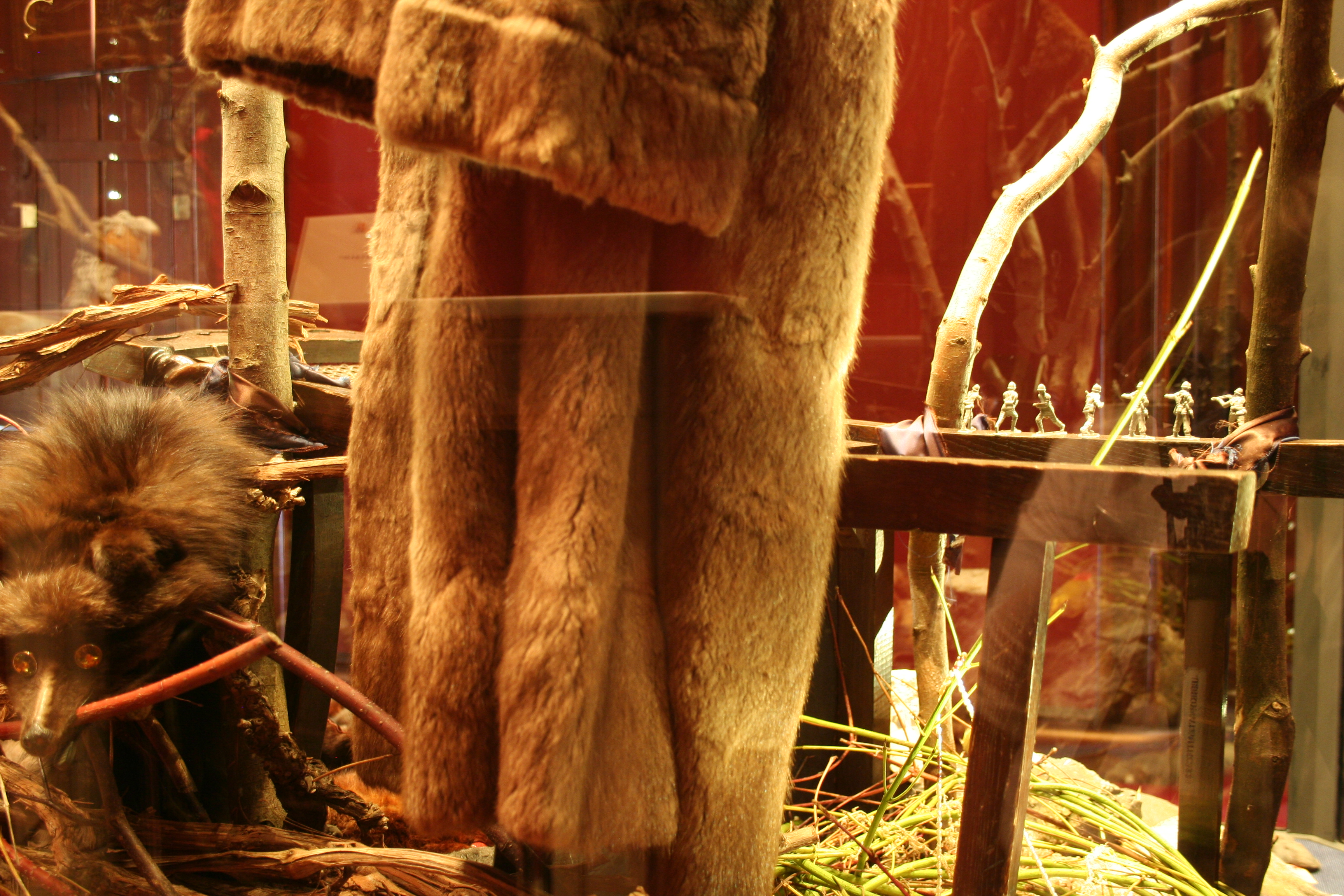
My Paloma-fabulous sister Ellie texted to let me know that The Enchanted Palace project with Wildworks that she and Myth have been working on has attracted a rave review in the Guardian. Ellie has devoted much of her effort to the creation of The Room of Royal Secrets, telling the disturbing story of Peter the Wild Boy.

Found in the forests of Hanover, near Hamelin (the town at the centre of the Pied Piper legend), Peter was brought to London by King George I, who was also Duke of Hanover. Achieving celebrity status in an era without X-Factor, Twitter and Facebook, Peter’s life inspired Daniel Dafoe to write a book about him Mere Nature Delineated: Or a Body Without a Soul with the following subtitle:

“Being observations on the young forester lately brought to Town from Germany. With suitable applications. Also, a brief dissertation upon the usefulness and necessity of fools, whether political or natural.”

However, Roger Moorehouse, in an extensive article on Peter’s life, reminds us that the notion of fame as fleeting and cruel isn’t confined to this era of d-list stars and throwaway magazines:

“Peter quickly became a celebrity. On one level, tales of his antics busied the London gazettes. Jonathan Swift, whose fictional ‘Yahoos’ Peter appeared to personify, noted sourly that “there is scarcely talk of anything else”… But Peter could not to live up to the popular interest invested in him and a fickle public quickly abandoned him in favour of the next unfortunate.”

In the peculiar way of things related to that other world of monarchs and royal households, Peter, now living an anonymous life away from the city, remained looked after. As Moorehouse writes: “His keep was paid by the Crown for nearly 60 years, through three reigns, and, when he died, a brass tablet was erected to his memory at royal expense.”

Ellie has essentially been creating a den, the sort of place Peter might have lived in and sought comfort in when retreating from a world of courtesans and pages, princes and princesses:

Writing in Friday’s Guardian, Amy Stone is well aware of the long-standing tensions between fashion and art, yet is bold in her assessment of the success of The Enchanted Palace:

“The show also (whisper it) makes for fantastic art: ghostly, ethereal and layered with subtext. These are museum pieces created for an exhibition true to the conviction that high fashion and high drama go hand in hand. Curators should take note: no more dutiful dusting down of designer archives, please. Fashion’s very essence is living, breathing and moving – something its art shows should cotton on to.”

The Guardian also wrote about The Enchanted Palace on 25 March, after the press preview, describing what visitors to the rooms will encounter and how they can interact with this immense creation of Wildworks and co.

I can’t wait to go.


Add to FacebookAdd to DiggAdd to Del.icio.usAdd to StumbleuponAdd to RedditAdd to BlinklistAdd to TwitterAdd to TechnoratiAdd to Yahoo BuzzAdd to Newsvine

“Roads Untaken”: the intersection of art and mathematics

I imagine that Leonardo Da Vinci is the person most of us would call to mind if asked to think of an individual who embraced both the abstract world of mathematics and the tangible world of artistic creation.

However, poking around on the internet I came across the work of George W. Hart, a sculptor who is also a research professor in the department of computer science at the State University of New York in Stony Brook, New York. Hart specialises in geometry, one of his publications being the online Encyclopedia of Polyhedra, in which he writes:

“Polyhedra have an enormous aesthetic appeal and the subject is fun and easy to learn on one’s own… The more you know about polyhedra, the more beauty you will see.”

He could not be more right, for Hart is also a sculptor.

The picture that prompted me to this blog piece is below. It is a stunning testament to the beauty of mathematical forms translated into sculpture. Here, he describes it in his own words:

“Here is one of my favorite sculptures: Roads Untaken.  A mosaic of three exotic hardwoods (yellowheart, paela, and padauk) with walnut “grout,” it is 17 inches in diameter, and stands 21 inches on the base.  Those are the natural colors; it is just oiled, not stained.  The ball just rests on the three struts, so it can be lifted and returned in any orientation.”

Roads Untaken, George W. Hart

For more of Hart’s hypnotic creations, take a look at the section of his website on geometric sculpture.

Beautiful.

Add to FacebookAdd to DiggAdd to Del.icio.usAdd to StumbleuponAdd to RedditAdd to BlinklistAdd to TwitterAdd to TechnoratiAdd to Yahoo BuzzAdd to Newsvine

Neglect, Surveillance, Wastefulness…

A picture is worth a thousand words

Brooke House, Camera, Light

Add to FacebookAdd to DiggAdd to Del.icio.usAdd to StumbleuponAdd to RedditAdd to BlinklistAdd to TwitterAdd to TechnoratiAdd to Yahoo BuzzAdd to Newsvine